ALAuki Labs Financial Model
Crypto/Web3 Startup Financials (Free Excel Download)
Decentralized peer-to-peer spatial positioning SDK for social AR - building the infrastructure layer to replace GPS and enable a persistent AR metaverse.



professionals from Deloitte
Used by professionals from






About this model
Auki Labs is developing a decentralised spatial-positioning SDK for shared social AR. Rather than relying on conventional GPS, its peer-to-peer infrastructure is intended to let devices agree on their place in a persistent digital-physical environment, supporting a broader spatial metaverse.
The company is still pre-launch: the underlying material describes pre-alpha software and prototypes rather than operating revenue. Its developer-facing positioning creates a B2B2C adoption problem, where SDK usefulness depends on applications, mapped spaces, and participating devices growing together. A Fehu rewards module suggests a token component to the network.
The model should therefore begin with staged adoption rather than asserted SaaS ARR. Forecast developers, integrated applications, active mapped locations, positioning requests, and network transactions. Test monetisation through SDK or enterprise services alongside token-funded incentives, while treating developer tooling, spatial data infrastructure, and protocol operations as distinct cost pools.
A turnkey financial model
Live formulas, no hardcoded values
Outputs are driven by live formulas, so the workbook updates from its assumptions instead of relying on hardcoded results.
All assumptions in one tab
Inputs are clearly marked in the Assumptions tab and separated from calculations, making it clear what to change and what to leave intact.
Statements always balancing
For integrated-statement models, the balance sheet, cash flow, and supporting schedules tie through properly.
Distinct schedules for clarity
Debt, working capital, taxes, and cash flow can get messy quickly. We group calculations in clear schedules, not across disconnected tabs.
No hidden macros or external links
There are no unexplained external workbook links or macros to undermine auditability or portability.
Changes flow through the model
Update a key driver and see the impact carry through the forecast, financing, and return outputs. We never use hardcoded numbers in formulas.
About Auki Labs
aukilabs.com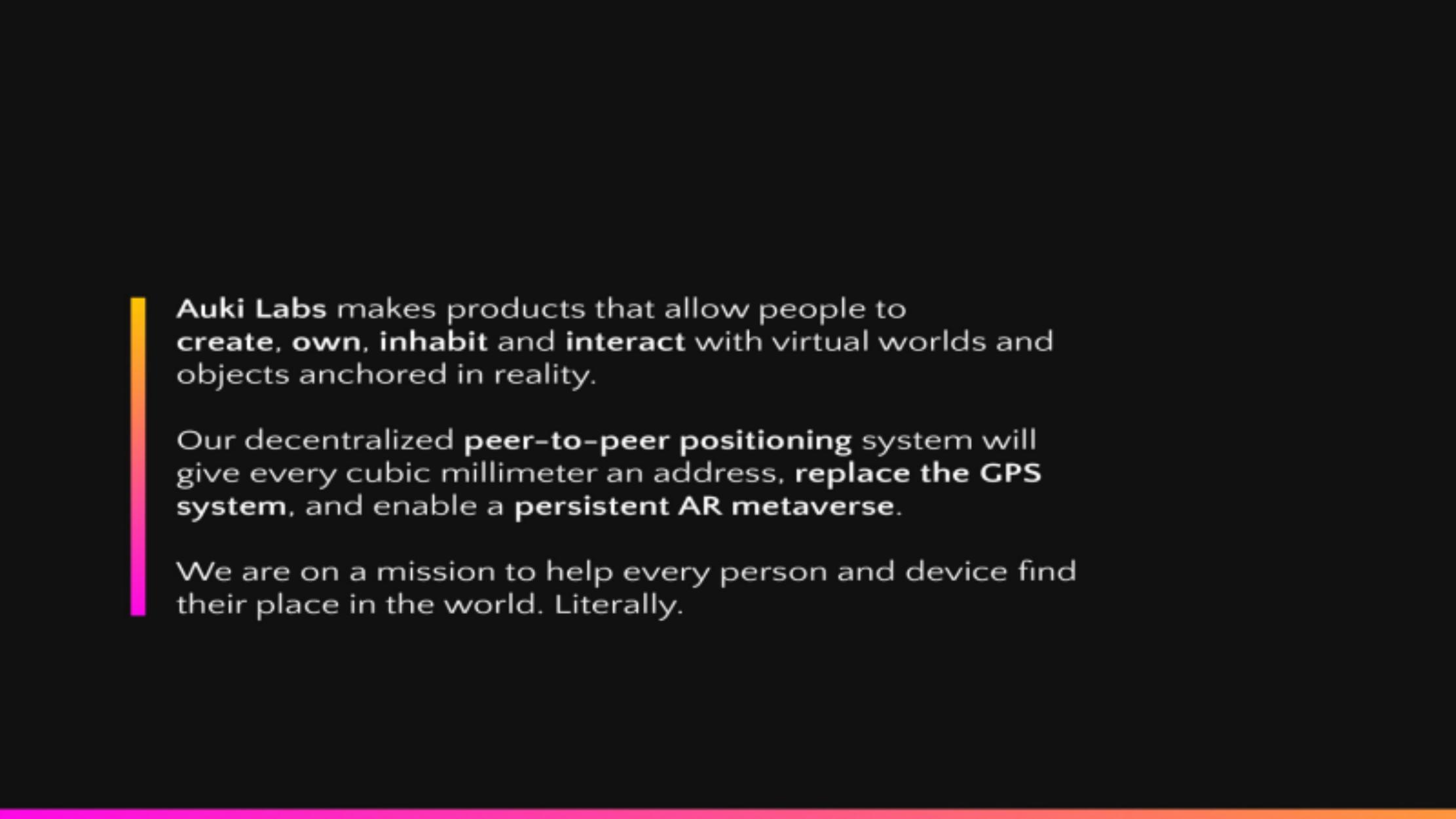
How to build a detailed financial model for Auki Labs
A complete walkthrough of the business, drivers, and assumptions behind the downloadable Auki Labs model - distilled from its pitch deck and publicly available information.
Product & value proposition
Auki Labs builds the Aukiverse SDK - a multi-module toolkit for AR developers. Core modules:
- Manna - patent-pending instant peer-to-peer calibration/positioning (replaces depth-map digital twin approach; sub-second vs 20–60 sec incumbent).
- Hagall - distributed networking engine; routes participants to most cost-efficient provider who earns tokens for hosting.
- Ur - turnkey hand and body detection / embodiment (pre-alpha).
- Odal - cross-app asset interoperability via low-latency asset cloud.
- Fehu - rewards/token module.
- Dagaz - topology.
Value prop: removes the three blockers to social AR (slow calibration, discrepant positioning, small participant limits) without requiring a centralized digital twin. Supports IoT devices (no camera required).
Market
- Handheld-era AR market: "well over $20 billion annually".
- Long-run vision: "potential trillion dollar market" for virtual rendering rights in physical spaces.
- No TAM/SAM/SOM breakdown, no CAGR, no source citation provided in deck.
Revenue model
Not explicitly stated in deck. Implied streams from SDK components:
- Developer SDK licensing / usage fees (inferred from positioning as essential AR infrastructure).
- Token economy: networking providers earn tokens (Hagall); Fehu rewards module suggests a broader token/crypto monetization layer - potentially transaction fees or token appreciation.
- Long-run: virtual rendering rights / advertising in AR spaces - described as future market opportunity, not current product.
No pricing tiers, API call pricing, rev-share, or subscription structure disclosed.
Competition / moat
Competitors named: Apple, Google, Microsoft, Snap, Niantic, Meta - all pursuing digital twin / computer vision positioning.
Moat claimed:
- Patent-pending instant calibration (Manna) - avoids need for costly, privacy-invasive digital twin.
- Decentralized P2P architecture - not dependent on centralized infrastructure.
- IoT inclusivity - works without camera, unlike vision-based competitors.
- Privacy-by-design framing vs "surveillance capitalists".
No quantified technical benchmarks (latency, accuracy specs) in deck.
Team & funding ask / use of funds
Recommended financial model
- Archetype + why: Usage-based / developer platform revenue model with a token overlay. Closest analog is an API-infrastructure platform (Twilio/Mapbox-style) - charge per SDK call or active session, layered with a crypto token economy (Hagall networking rewards). Because the company is pre-revenue and pre-product, the model should be a top-down bottom-up hybrid: market penetration → developer adoption → session volume → revenue.
- Forecast horizon & granularity: 5 years (Year 1–2 monthly, Year 3–5 annual). Pre-revenue company warrants heavy scenario-weighting on adoption timing.
- Key drivers & assumptions:
- AR developer market size: ~$20B+ current market; number of active AR developers globally
- SDK adoption rate - % of AR developers who integrate Aukiverse
- Average active apps per developer cohort
- Monthly active sessions per app
- Revenue per session / API pricing
- Token economy revenue: networking fee % retained by protocol
- CAC (developer acquisition):
- Hosting/infra COGS:
- Headcount ramp:
- Patent-pending status of Manna - no granted IP confirmed; risk factor
- Scenarios (Base / Bull / Bear - which variables flex):
- Bear: AR wearable adoption delayed; token/crypto regulatory headwinds; developer adoption 50% of base; session volume flat Y1–Y2. Reaches breakeven Y5+.
- Base: Handheld AR SDK traction Y1–Y2; wearable era begins Y3; SDK becomes infrastructure standard for 1–2% of developer market by Y5.
- Bull: Strategic partnership or acquisition by Tier-1 AR player (Apple/Meta/Snap); token launch drives viral developer adoption; 5%+ market share by Y4.
- Key flex variables: developer adoption rate, avg sessions/app, revenue/session, token monetization multiple, timing of wearable platform inflection.
- Required sheets / outputs:
- Assumptions - all drivers, clearly labeled vs
- Developer adoption model - cohort-based (new developers per month, retention curve)
- Session volume build - developers × apps × sessions
- Revenue build - session-based fees + token/networking fees
- P&L - gross margin, opex (R&D, S&M, G&A), EBITDA
- Cash flow & runway - critical given pre-revenue stage
- Headcount plan
- Scenario toggle (Bear / Base / Bull)
- KPI dashboard - developers, apps live, monthly sessions, ARR, runway months
Frequently asked
Is the Auki Labs financial model free?+
Yes. The Auki Labs model is a free Excel (.xlsx) download with live formulas. Sign up with your email and the workbook is yours to keep, review, and edit.
What's included in the model?+
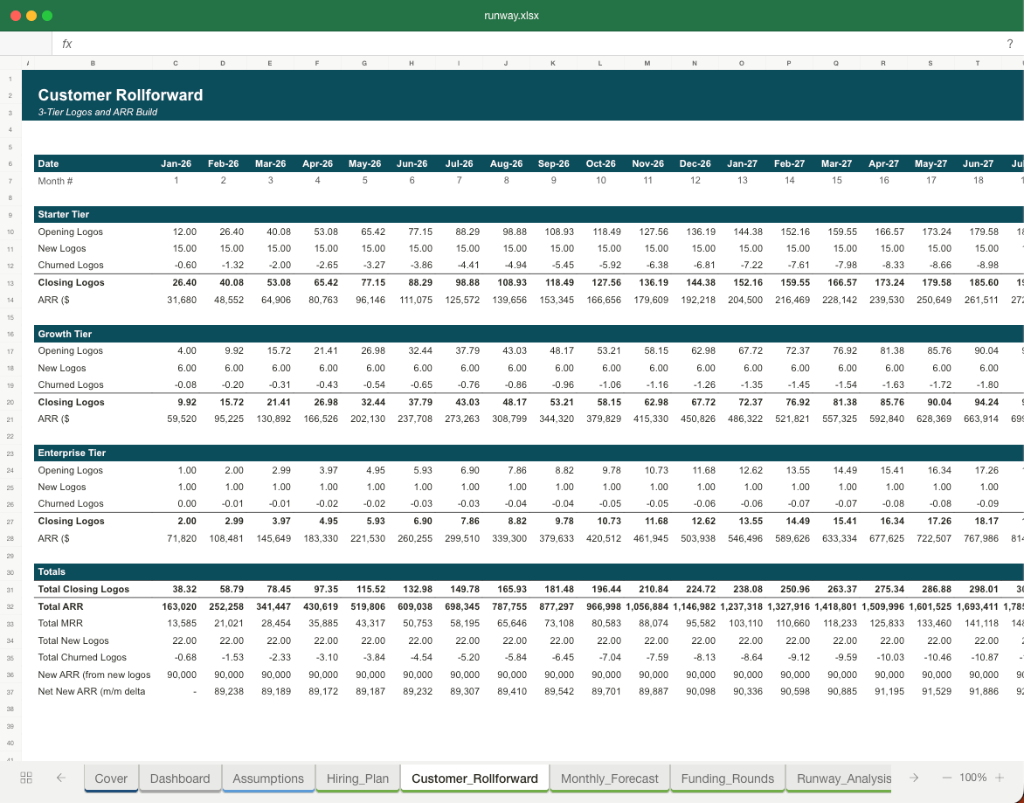
A 5-year monthly forecast with P&L, cash flow and runway, valuation (exit multiple plus a DCF cross-check), MOIC/IRR returns, and unit economics, with live formulas throughout.
How was this model built?+
It was built from Auki Labs's pitch deck and publicly available information, then structured to investment-banking standards as a fully editable Excel model.
Can I change the assumptions?+
Yes. You can change assumptions and the live formulas will recalculate in the downloadable Excel model.
Have more financial modelling questions? Contact us

Created by ex-finance professionals
Hey, I’m Alex and I created Finamodel.
Over my years in the finance industry I kept building the same models over and over again. Same structure, same assumptions, different logo. So I started building frameworks to turn them into clean, reusable templates.
Every model here is one I’d actually use for a client, and I personally vet each one before it goes up.
I’m not an expert in every industry, but I’ve built enough models to know what belongs in one. And when something is completely foreign to me, I reach out to my network for experts to work on our models with us.
Having a template library on hand cuts a first build from hours to minutes.
Need help finding your model? You’ll find me in the Finamodel app!
Other Crypto/Web3 Startup Financial Models
Browse another startup in the same category.

0x Labs
0x Labs builds open exchange infrastructure (protocol, API, consumer app) for on-chain token trading across multiple blockchains.

1inch Network
DeFi aggregation protocol that routes crypto swaps across 100+ liquidity sources to deliver best rates and lowest gas fees.

Aether
Synthetic biology platform that builds searchable protein indexes to engineer novel molecular assemblers for high-value industrial products.
Alto
Self-directed IRA platform enabling retail investors to invest in alternative assets (private equity, debt, real estate, crypto) via tax-advantaged retirement savings.
Awesome People Ventures Fund 2
Awesome People Ventures is a community-driven, decentralized early-stage Web3 VC fund raising Fund II.

Axelar
Cross-chain blockchain overlay network enabling universal transfer of assets, transactions, and state across all blockchain ecosystems.
BRD
BRD is a non-custodial crypto wallet app (consumer) and blockchain infrastructure API platform (enterprise) targeting mass-market crypto adoption.

Calaxy
Creator economy mobile app where athletes and influencers issue personal tokens and sell fan perks (shoutouts, video calls, DMs, subscriptions) directly to their communities.