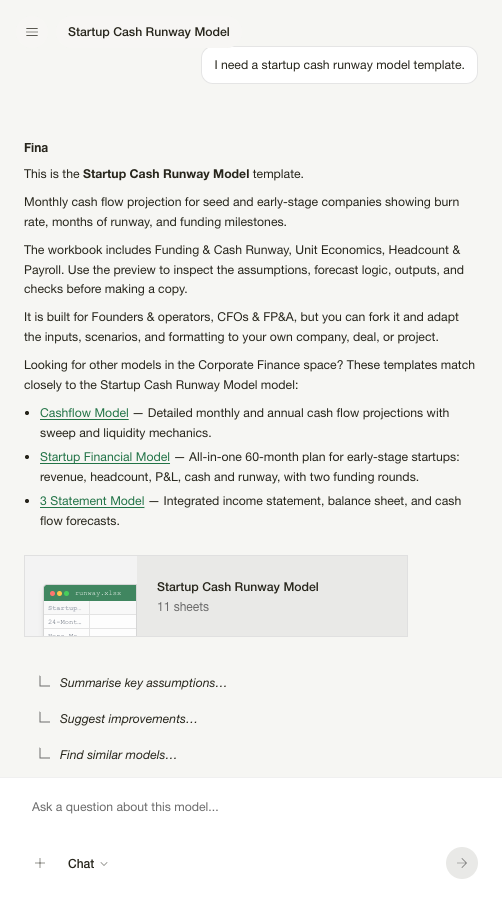
APAwesome People Ventures Fund 2 Financial Model
Crypto/Web3 Startup Financials (Free Excel Download)
Awesome People Ventures is a community-driven, decentralized early-stage Web3 VC fund raising Fund II.


professionals from Deloitte
Used by professionals from






About this model
Awesome People Ventures is raising a $20 million second fund for early-stage Web3 investments through a community-driven venture model. The GP shares economics with members who source opportunities and support portfolio companies, making participation part of its operating proposition.
Fund I was a $1.5 million vehicle and was fully deployed when the Fund II deck was prepared. The fund is US-based but its Web3 portfolio opportunity set is global. Its economics are conventional LP/GP mechanics rather than a software subscription or protocol transaction model.
Build Fund II around capital commitments, closing timing, investment pace, reserves, and management fees charged on committed or invested capital as applicable. Carry should be modelled only after portfolio exit values and distribution timing, with a separate allocation for the community’s share of GP carry. Track management-company payroll and operating costs against fee coverage and runway.
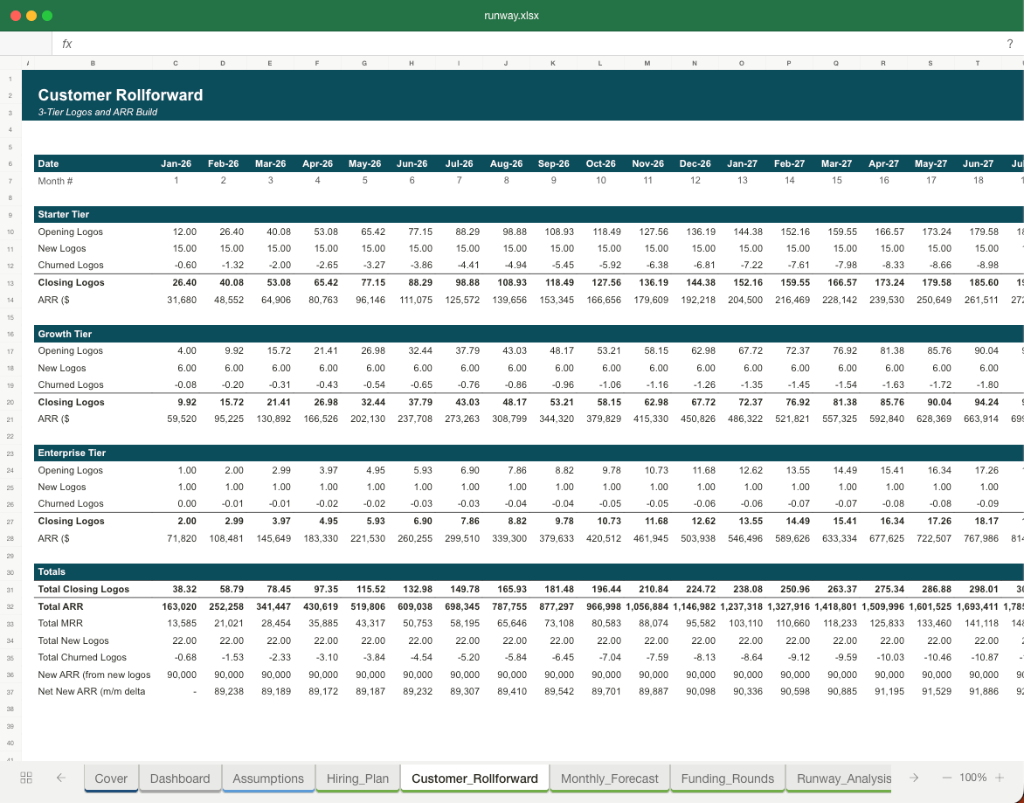
A turnkey financial model
Live formulas, no hardcoded values
Outputs are driven by live formulas, so the workbook updates from its assumptions instead of relying on hardcoded results.
All assumptions in one tab
Inputs are clearly marked in the Assumptions tab and separated from calculations, making it clear what to change and what to leave intact.
Statements always balancing
For integrated-statement models, the balance sheet, cash flow, and supporting schedules tie through properly.
Distinct schedules for clarity
Debt, working capital, taxes, and cash flow can get messy quickly. We group calculations in clear schedules, not across disconnected tabs.
No hidden macros or external links
There are no unexplained external workbook links or macros to undermine auditability or portability.
Changes flow through the model
Update a key driver and see the impact carry through the forecast, financing, and return outputs. We never use hardcoded numbers in formulas.
About Awesome People Ventures Fund 2
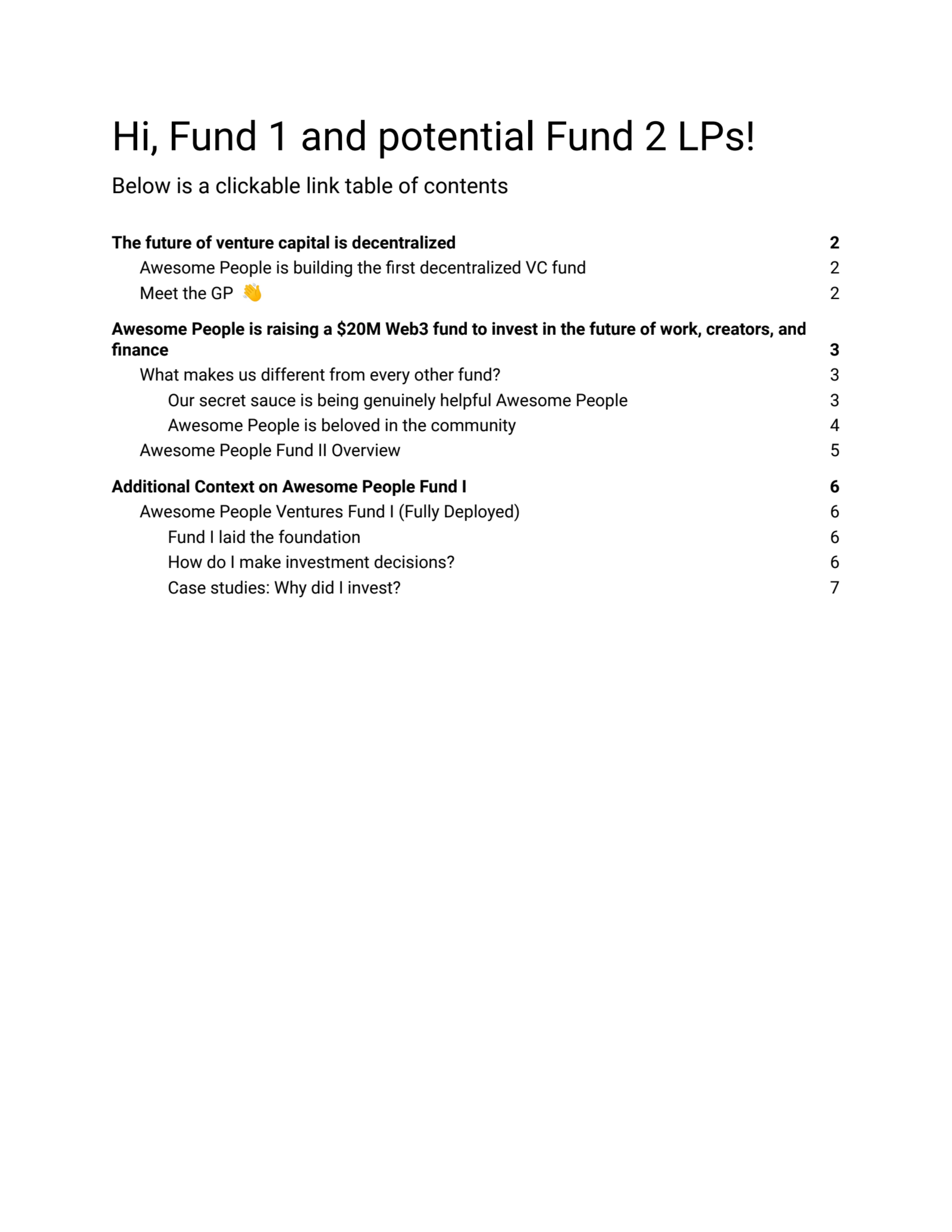
How to build a detailed financial model for Awesome People Ventures Fund 2
A complete walkthrough of the business, drivers, and assumptions behind the downloadable Awesome People Ventures Fund 2 model - distilled from its pitch deck and publicly available information.
Product & value proposition
- "Decentralized VC fund": up to 50% of GP carry shared with community contributors (deal sourcers, diligencers, portfolio supporters).
- Community DAO will own/operate fund marketing, talent sourcing, and platform functions (separate legal entity).
- Talent network generates its own revenue; referrers earn % of revenue.
- ~1,500 introductions made in the prior year; positioned as "value-add VC" supernode.
- Investment thesis: Web3 inflection points - Protocols, DAOs, DAO tooling, B2B SaaS for Web3, user-owned marketplaces, creator tools.
- Decision framework: Awesome People (founder quality) + Unique insight + Unseen inflection point.
Revenue model
Fund economics (standard LP/GP structure; specific terms not stated in deck):
- Management fee: 2% p.a. on committed capital - standard micro-VC convention; not stated in deck.
- Carry: 20% carried interest on profits above hurdle - standard; deck says up to 50% of GP carry is shared with community contributors.
- Talent network / platform: separate revenue stream from talent referrals; exact % or revenue figure not disclosed.
Traction & metrics
Fund I:
- Fund size: $1.5M
- Portfolio: 37 checks, $25–$50k each, one check per company, 0 reserves
- Co-investors: a16z, First Round, Kleiner, Floodgate, General Catalyst, Bain Capital Ventures
- Fund I IRR: redacted ("IRR = X, up X") as of April 2022; excludes SAFE markups
- Activity: ~1,500 intros made in one year
- Fund I LPs included Marc Andreessen, Chris Dixon, David Ulevitch, Lars Dalgaard, Tom Lee, Bain Capital Ventures
Fund II target:
- Fund size: $20M
- Target portfolio: ~40 companies
- Allocation: 70% first check / 30% follow-on
- Check size: $100–$500k per company
- Deployment period: ~2 years
Unit economics
- Average check size: $100–$500k; midpoint ~$300k for modeling.
- First-check capital: 70% × $20M = $14M across ~40 companies → avg first check ~$350k.
- Reserve capital: 30% × $20M = $6M for follow-ons.
- Fund I average check: ~$40k ($1.5M / 37 checks).
- CAC, LTV, payback: Not applicable / not in deck (fund model, not SaaS).
Competition / moat
- Claims to be "the first decentralized VC fund".
- Differentiators: community carry-sharing, DAO-owned operations, high-volume intro network, Floodgate mentorship (Ann Miura-Ko, Mike Maples).
Team & funding ask / use of funds
- GP: Julia Lipton - former growth/revenue operator at 3 startups (most recent acquired by One Medical pre-IPO); mentored by Ann Miura-Ko and Mike Maples at Floodgate.
- FT team: GP + Chief of Special Projects.
- Community DAO: operators, founders, angels who source/diligence/support deals.
- Funding ask: $20M Fund II (LP commitments, not equity raise).
- Use of funds: ~40 early-stage Web3 investments, up to Series A; 70/30 first-check/follow-on split.
Recommended financial model
- Archetype: VC Fund Economics Model (LP/GP waterfall). This is a fund LP pitch, not an operating company. The correct model is a fund-level P&L and return waterfall - not a 3-statement or SaaS ARR model.
- Forecast horizon & granularity: 10-year fund life (standard); annual granularity for capital deployment and exits; quarterly for management fee cashflows.
- Key drivers & assumptions:
- Fund size: $20M
- Number of portfolio companies: ~40
- First-check / follow-on split: 70% / 30%
- Average check size: $100–$500k; model midpoint ~$300k
- Deployment pace: ~2 years
- Management fee rate: 2% p.a. on committed capital
- Carry: 20%
- Hurdle rate: 8% preferred return
- Community carry share: up to 50% of GP carry redistributed
- Fund life: 10 years with optional 2-year extension
- Entry valuation / ownership: avg entry post-money $5–10M seed; target 5–10% ownership per deal
- Gross MOIC targets by scenario: Bear 1.0x–1.5x, Base 2.5x–3.5x, Bull 5x+
- Loss ratio: ~40% of portfolio at 0x (industry micro-VC base rate)
- Exit timeline: avg 5–7 years to liquidity; Web3 may be shorter via token liquidity events
- Web3-specific: token vs. equity investment mix; token lockup / vesting assumptions
- Scenarios (Base / Bull / Bear - which variables flex):
- Bear: High loss ratio (50%), low multiples on survivors (1.5–2x), no follow-on reserve deployed
- Base: 40% loss rate, 3x gross MOIC on winners, 70/30 first-check/follow-on as planned
- Bull: 25% loss rate, 7x+ MOIC on top 5 names, full follow-on reserve deployed into breakouts
- Required sheets / outputs:
- Fund Summary - fund size, fees, net investable capital, deployment schedule
- Portfolio Construction - company count, check sizes, ownership targets
- Capital Deployment - vintage year, first-check vs. follow-on by year
- Management Fee & Expense Waterfall - annual fee income, fund operating costs
- Exit / Return Waterfall - gross proceeds by company, LP preferred return, carry split (GP + community)
- LP Returns - DPI, RVPI, TVPI, net IRR by scenario
- Community Carry Model - $ carry allocated to community contributors vs. GP
Frequently asked
Is the Awesome People Ventures Fund 2 financial model free?+
Yes. The Awesome People Ventures Fund 2 model is a free Excel (.xlsx) download with live formulas. Sign up with your email and the workbook is yours to keep, review, and edit.
What's included in the model?+
A 5-year monthly forecast with P&L, cash flow and runway, valuation (exit multiple plus a DCF cross-check), MOIC/IRR returns, and unit economics, with live formulas throughout.
How was this model built?+
It was built from Awesome People Ventures Fund 2's pitch deck and publicly available information, then structured to investment-banking standards as a fully editable Excel model.
Can I change the assumptions?+
Yes. You can change assumptions and the live formulas will recalculate in the downloadable Excel model.
Have more financial modelling questions? Contact us

Created by ex-finance professionals
Hey, I’m Alex and I created Finamodel.
Over my years in the finance industry I kept building the same models over and over again. Same structure, same assumptions, different logo. So I started building frameworks to turn them into clean, reusable templates.
Every model here is one I’d actually use for a client, and I personally vet each one before it goes up.
I’m not an expert in every industry, but I’ve built enough models to know what belongs in one. And when something is completely foreign to me, I reach out to my network for experts to work on our models with us.
Having a template library on hand cuts a first build from hours to minutes.
Need help finding your model? You’ll find me in the Finamodel app!
Other Crypto/Web3 Startup Financial Models
Browse another startup in the same category.

0x Labs
0x Labs builds open exchange infrastructure (protocol, API, consumer app) for on-chain token trading across multiple blockchains.

1inch Network
DeFi aggregation protocol that routes crypto swaps across 100+ liquidity sources to deliver best rates and lowest gas fees.

Aether
Synthetic biology platform that builds searchable protein indexes to engineer novel molecular assemblers for high-value industrial products.
Alto
Self-directed IRA platform enabling retail investors to invest in alternative assets (private equity, debt, real estate, crypto) via tax-advantaged retirement savings.
Auki Labs
Decentralized peer-to-peer spatial positioning SDK for social AR - building the infrastructure layer to replace GPS and enable a persistent AR metaverse.

Axelar
Cross-chain blockchain overlay network enabling universal transfer of assets, transactions, and state across all blockchain ecosystems.
BRD
BRD is a non-custodial crypto wallet app (consumer) and blockchain infrastructure API platform (enterprise) targeting mass-market crypto adoption.

Calaxy
Creator economy mobile app where athletes and influencers issue personal tokens and sell fan perks (shoutouts, video calls, DMs, subscriptions) directly to their communities.