 Apheris Financial Model
AI/ML Startup Financials (Free Excel Download)
Privacy-preserving federated ML platform enabling enterprises to train AI on distributed data without sharing raw data.



professionals from Deloitte
Used by professionals from






About this model
Apheris provides federated machine learning that lets organisations train models on distributed data without moving raw information. Its Privacy Engine, Compute Engine, and Privacy Firewall support collaboration where GDPR, intellectual-property, or local-environment constraints prevent conventional data sharing.
The platform targets pharma, chemical, and industrial customers, with use cases spanning R&D, predictive maintenance, process optimisation, formulations, and contact tracing. The deck cites multi-year enterprise contracts, paid pilots, and a strong pharma and chemistry pipeline, while disclosing no revenue figures.
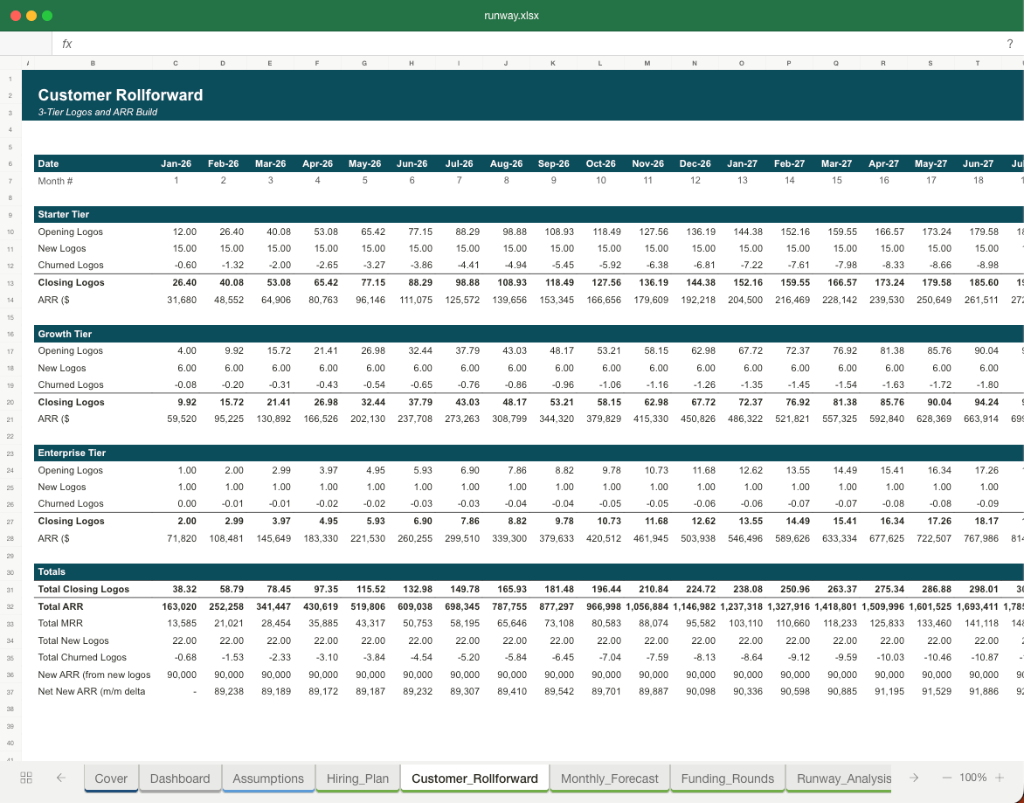
The forecast therefore begins with contract-based SaaS revenue and pilots, converting opportunities into deployed enterprise accounts. It should model implementation timing, expansion, infrastructure and privacy-engine delivery costs, the nine-to-ten-person technical team, commercial hiring, cash burn, and funding runway.
A turnkey financial model
Live formulas, no hardcoded values
Outputs are driven by live formulas, so the workbook updates from its assumptions instead of relying on hardcoded results.
All assumptions in one tab
Inputs are clearly marked in the Assumptions tab and separated from calculations, making it clear what to change and what to leave intact.
Statements always balancing
For integrated-statement models, the balance sheet, cash flow, and supporting schedules tie through properly.
Distinct schedules for clarity
Debt, working capital, taxes, and cash flow can get messy quickly. We group calculations in clear schedules, not across disconnected tabs.
No hidden macros or external links
There are no unexplained external workbook links or macros to undermine auditability or portability.
Changes flow through the model
Update a key driver and see the impact carry through the forecast, financing, and return outputs. We never use hardcoded numbers in formulas.
About Apheris
apheris.com
How to build a detailed financial model for Apheris
A complete walkthrough of the business, drivers, and assumptions behind the downloadable Apheris model - distilled from its pitch deck and publicly available information.
Product & value proposition
- Federated ML platform: trains AI models on distributed, siloed data without data ever leaving local environments.
- Core components: Privacy Engine, Compute Engine, Privacy Firewall.
- Value prop: enables cross-company (and intra-company) data collaboration under GDPR/IP constraints - "collaborate on data securely without compromising privacy".
- Target use cases: pharma R&D, industrial AI (predictive maintenance, process optimisation, formulations), COVID-19 contact tracing.
Revenue model
- Model: SaaS ("proven and profitable SaaS business model"). No pricing tiers, seat counts, or ACV figures disclosed.
- Contract type: multi-year enterprise contracts.
- Channels: direct enterprise sales; verticals are pharma, chemical, and industrial.
- Additional revenue: paid pilots (e.g., edge-based computations).
Traction & metrics
- Team: 9 FTE, 6 PhDs at time of deck; slide 9 header says "team of 10".
- Customers: "multiple year contracts with leading enterprises" closed in <1 year; target >10 enterprise customers by Q4 2021.
- Pilots: multiple paid pilots active; "very strong pharma & chemistry pipeline".
- COVID-19: core privacy technology provider for large contact tracing initiatives.
- No revenue figures, ARR, MRR, or logo names disclosed.
Competition / moat
- Moat claims: unique positioning in multiple markets; world-leading team at intersection of data privacy, cryptography, and biomedical data science.
- No direct competitor names or competitive matrix shown.
- Technical differentiation: computations execute locally - data never leaves local environment.
- Team pedigree: BCG, BCG Digital Ventures, Google, VISA, AstraZeneca, Bayer, Imperial College London, TU Munich, RWTH Aachen, Fraunhofer, CISPA.
Team & funding ask / use of funds
- Co-founders: Robin (CEO) - Medicine, Philosophy, Mathematics, expert in mathematical theories for data privacy; Michael (CTO, PhD) - Physics & CS, distributed computations, BCG & BCG DV background.
- Raising: EUR 2m Seed.
- Use of funds: hire world-class team, build out data ecosystems, build flexible core product for enterprise.
- Milestones post-raise: >10 enterprise customers by Q4 2021; Series A by Q2 2022.
Recommended financial model
- Archetype + why: Enterprise SaaS ARR model. Revenue is multi-year subscription contracts with enterprise clients. ACV-based build is appropriate - track new logos, expansions, and churn separately. Paid pilots can be modelled as a conversion funnel into full contracts.
- Forecast horizon & granularity: 3 years (2020–2022), monthly in Year 1, quarterly in Years 2–3. Aligns with the deck's own roadmap milestones (Seed → >10 customers → Series A).
- Key drivers & assumptions:
- Starting ARR: EUR 0 at model start (pre-revenue or very early; no figure in deck) - flag as open question.
- ACV per enterprise contract: EUR 80–150k/yr - typical for early-stage federated ML/data infrastructure enterprise deals; no deck figure.
- New logos per quarter: 2–3 in Year 1 ramping to 4–6 in Year 2, targeting >10 total by Q4 2021.
- Pilot-to-contract conversion rate: 40–60% - paid pilots signal intent; no deck data.
- Net revenue retention: 110–120% - multi-year contracts plus expansion potential; no deck data.
- Gross margin: 70–80% - software-heavy delivery with some professional services; no deck data.
- Headcount: 9–10 FTE at raise; scale to ~20 FTE by end of Year 1 (engineering + sales ramp).
- Avg. fully-loaded cost per FTE: EUR 90k/yr (Germany; senior technical team).
- Seed proceeds: EUR 2m.
- Burn rate / runway: ~EUR 150–180k/mo post-hire-up; ~12–14 months runway from EUR 2m raise.
- Series A timing: Q2 2022; amount EUR 6–10m based on typical Series A for stage/sector.
- Scenarios (Base / Bull / Bear - which variables flex):
- Base: 2–3 new logos/quarter, 50% pilot conversion, 110% NRR, headcount per plan.
- Bull: faster enterprise closings (4+ logos/quarter), 70% pilot conversion, 120% NRR, earlier Series A.
- Bear: long sales cycles (1–2 logos/quarter), 30% pilot conversion, 100% NRR, extended runway needed or bridge required.
- Required sheets / outputs:
- ARR bridge (new ARR, expansion, churn, net new ARR)
- P&L (revenue, COGS, gross profit, OpEx by function, EBITDA)
- Headcount plan (by department: engineering, sales, ops)
- Cash flow & runway (monthly burn, ending cash, months to zero)
- Milestones tracker (>10 customers Q4 2021, Series A Q2 2022)
- Scenarios toggle (Base / Bull / Bear)
Frequently asked
Is the Apheris financial model free?+
Yes. The Apheris model is a free Excel (.xlsx) download with live formulas. Sign up with your email and the workbook is yours to keep, review, and edit.
What's included in the model?+
A 5-year monthly forecast with P&L, cash flow and runway, valuation (exit multiple plus a DCF cross-check), MOIC/IRR returns, and unit economics, with live formulas throughout.
How was this model built?+
It was built from Apheris's pitch deck and publicly available information, then structured to investment-banking standards as a fully editable Excel model.
Can I change the assumptions?+
Yes. You can change assumptions and the live formulas will recalculate in the downloadable Excel model.
Have more financial modelling questions? Contact us

Created by ex-finance professionals
Hey, I’m Alex and I created Finamodel.
Over my years in the finance industry I kept building the same models over and over again. Same structure, same assumptions, different logo. So I started building frameworks to turn them into clean, reusable templates.
Every model here is one I’d actually use for a client, and I personally vet each one before it goes up.
I’m not an expert in every industry, but I’ve built enough models to know what belongs in one. And when something is completely foreign to me, I reach out to my network for experts to work on our models with us.
Having a template library on hand cuts a first build from hours to minutes.
Need help finding your model? You’ll find me in the Finamodel app!
Other AI/ML Startup Financial Models
Browse another startup in the same category.

AI Rudder
AI Rudder provides multi-lingual conversational AI for B2C customer engagement - automating outbound and inbound voice/chat interactions at scale.

Aisera
AI Service Experience platform that automates IT, HR, and customer service workflows via conversational AI and automation.

Amberscript
AI + human hybrid transcription and subtitling platform targeting B2B customers in Europe

Arcane
AI copilot for marketing teams that automates data analysis, reporting, and repeatable tasks via a chat interface and scheduled workflows.

Artisan
AI-powered "digital workers" (branded Artisans) that autonomously perform role-specific tasks - starting with outbound sales - and are delivered as SaaS subscriptions.

Artisan Series A
AI-native B2B SaaS platform consolidating the enterprise software stack with human-like "Artisan" AI employees that automate role-specific workflows

Bigblue
Tech-enabled e-commerce fulfillment platform for European D2C brands - "Amazon-standard" delivery without Amazon.

BlueOcean
AI/ML-powered always-on brand tracking platform replacing traditional survey-based market research