 Artisan Financial Model
AI/ML Startup Financials (Free Excel Download)
AI-powered "digital workers" (branded Artisans) that autonomously perform role-specific tasks - starting with outbound sales - and are delivered as SaaS subscriptions.



professionals from Deloitte
Used by professionals from






About this model
Artisan builds AI 'digital workers' that take role-specific actions across connected applications. Its first product, Ava, automates outbound sales: prospecting, email outreach, reply handling, LinkedIn activity, and self-onboarding through a short chat conversation.
The company sells a subscription for each deployed Artisan, treating the agent more like a colleague than a text-generation tool. The roadmap includes additional role-specific agents and an App Store for third-party agents, where Artisan expects to take a 30% commission.
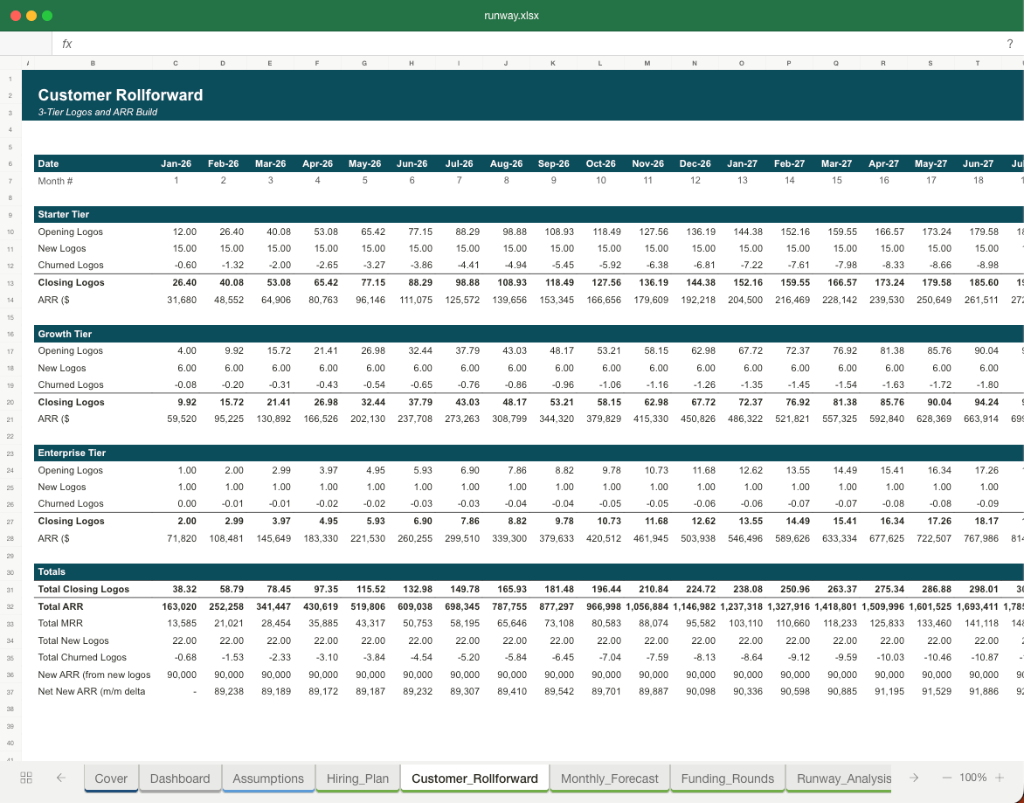
The model begins with direct subscription revenue: customer adds, Artisans per account, pricing, churn, and LLM and hosting costs. From the planned marketplace launch, it layers agent GMV and the commission rate, alongside team build-out, gross margin, cash burn, and pre-seed runway.
A turnkey financial model
Live formulas, no hardcoded values
Outputs are driven by live formulas, so the workbook updates from its assumptions instead of relying on hardcoded results.
All assumptions in one tab
Inputs are clearly marked in the Assumptions tab and separated from calculations, making it clear what to change and what to leave intact.
Statements always balancing
For integrated-statement models, the balance sheet, cash flow, and supporting schedules tie through properly.
Distinct schedules for clarity
Debt, working capital, taxes, and cash flow can get messy quickly. We group calculations in clear schedules, not across disconnected tabs.
No hidden macros or external links
There are no unexplained external workbook links or macros to undermine auditability or portability.
Changes flow through the model
Update a key driver and see the impact carry through the forecast, financing, and return outputs. We never use hardcoded numbers in formulas.
About Artisan
artisan.co
How to build a detailed financial model for Artisan
A complete walkthrough of the business, drivers, and assumptions behind the downloadable Artisan model - distilled from its pitch deck and publicly available information.
Product & value proposition
- GenAI chatbot trained for a specific job role, integrated with 100s of apps, giving it the ability to take autonomous actions (not just generate text).
- Each Artisan has a unique persona (face, name, memory), Slack/Teams integration so it feels like a colleague, and a role-specific dashboard.
- Agents self-improve via user feedback and systemwide model updates.
- Supports video-call-based interaction with sentiment/facial analysis.
- First product: Ava, the Sales Rep Artisan - outbound email at scale, autonomous reply handling, LinkedIn outreach, self-onboards in 5–10 min chat.
- Long-term vision: replace entire SaaS stacks per vertical (Leadfeeder, HubSpot, Salesloft, Chili Piper, Calendly cited as displacement targets); become an "App Store for AI Agents" with 30% commission on third-party agent subscriptions.
Market
- TAM framing: "Labor is the biggest market in the world" - AI agents operate in roles costing US companies >$10 trillion annually.
- Segment breakdowns (US annual labor cost):
- B2B sales representatives: $154bn
- Marketing managers: $21bn
- Copywriters: $7bn
- No SAM/SOM or addressable-revenue percentages provided.
- No market growth rate in deck.
Revenue model
- Primary: SaaS subscription per Artisan deployed (pricing not disclosed in deck).
- Future: 30% commission on agent subscriptions sold through the "Artisan App Store" marketplace.
- Implied per-seat model - customers "hire" an Artisan like an employee.
- No pricing tiers, contract lengths, or ARPU disclosed.
Traction & metrics
- Product in private beta as of the deck date; Ava available starting November.
- No revenue, ARR, customer count, or growth figures in deck.
- Cost comparison claimed (not operating traction): $250 Artisan cost vs $7,000 human cost per 1,000 prospects contacted; 30 seconds vs 2 hours to send 100 emails.
- Demo dashboard shows sample metrics (Spam Score 5%, Emails Sent 570, Meeting Link Clicks 14, Response Rate 65%) - these appear to be illustrative UI mockup numbers, not verified traction.
Unit economics
- No CAC, LTV, or payback period in deck.
- Implied COGS advantage: $250 per 1,000 prospects (Artisan) vs $7,000 (human) - a 28× cost reduction framing.
- Gross margin not stated; underlying cost is LLM API + infrastructure.
Competition / moat
- Competitors cited: ChatGPT, Adept, UiPath.
- Artisan claims differentiation on: role-specific agents, action-taking (not text-only), Slack/Teams integration, call functionality, self-improvement, user molding.
- Moat levers stated:
- Switching cost: deployed agents mold to company ways of working.
- Data flywheel: usage generates proprietary training data for full automation.
- Lock-in: agents built on platform cannot be transferred elsewhere.
- Viral loop: built-in virality (mechanism not specified).
- Privacy: private LLM option planned to reduce enterprise concerns.
Team & funding ask / use of funds
- Team: not detailed in deck (slide 18 mentions "assembling an extraordinarily talented team").
- Ask: Pre-Seed $2–4M.
- Pre-Seed use of funds:
- Build founding team
- Release 3 Artisans
- Refine product roadmap
- Have Ava automate most of the sales cycle
- Launch "Artisan App Store" closed beta
- Series A / B amounts TBC.
Recommended financial model
- Archetype + why: SaaS ARR / per-seat subscription model. Revenue is purely subscription-driven at this stage (marketplace is roadmap). Closest comparable: outbound sales tooling SaaS (e.g., Salesloft, Apollo) with an eventual platform/marketplace layer. A two-phase model makes sense: (1) direct Artisan subscriptions for 0–24 months; (2) marketplace GMV + take-rate layered in at month 18+.
- Forecast horizon & granularity: 5-year annual model with monthly build for Year 1–2 (pre-revenue / early revenue). Pre-Seed phase is the operating concern; model should support Series A narrative.
- Key drivers & assumptions:
| Driver | Value | Source |
|---|---|---|
| Launch date (Ava GA) | Nov 2023 | - |
| Pricing - monthly subscription per seat | - | $500–$1,500/mo per Artisan seat; mid-point $1,000 for base case; benchmark Apollo.io ($99) → Salesloft ($125+) but Artisan claims full-cycle automation justifying premium |
| Sales motion | Outbound + PLG | consistent with product positioning |
| New customers / month (Y1) | 5–15 in early months | private beta starting; ramp from Nov 2023 |
| Avg seats per customer | 1–3 | small/mid-market initial ICP; single Artisan pilot then expand |
| Monthly churn rate | 2–3% | early SaaS benchmark; deck claims 0% human churn as selling point but real churn will exist |
| Gross margin | 70% | AI SaaS; LLM API costs at scale compress below 30% COGS |
| Headcount - pre-seed period | 5–10 FTEs | use-of-funds says "build founding team"; $2–4M raise at ~$150k fully-loaded → 13–26 person-years |
| Marketplace go-live | H2 2024 | - |
| Marketplace take rate | 30% | - |
| Second Artisan release | March 2024 | - |
| Third Artisan release | May 2024 | - |
| LLM transition to custom model | Jan 2024 | - |
- Scenarios (Base / Bull / Bear - which variables flex):
- Base: $1,000/mo per seat, 10 new customers/month by end of Y1, 2% monthly churn, 70% gross margin, marketplace contributing <5% of revenue in Y2.
- Bull: $1,500/mo pricing validated, 25 new customers/month by end of Y1, 1% churn, marketplace take-rate revenue adds 15% by Y2, successful custom LLM cuts COGS to 15%.
- Bear: Pricing pressure to $500/mo (competition from ChatGPT plugins etc.), 5 customers/month Y1, 4% churn, marketplace delayed to 2025, gross margin 55% due to LLM costs.
- Required sheets / outputs:
- Assumptions - all drivers, colour-coded inputs
- Revenue build - seats × ARPU × (1 − churn), ARR waterfall, new/expansion/churned MRR
- P&L - Revenue, COGS (LLM + hosting), Gross Profit, OpEx (R&D, S&M, G&A), EBITDA
- Headcount plan - FTE by function, fully-loaded cost
- Cash & runway - burn rate, months of runway on $2–4M raise
- Marketplace module (Year 2+) - GMV, take-rate revenue
- KPI dashboard - ARR, MRR, customers, churn rate, LTV/CAC (estimated), gross margin
- Scenario toggle - single dropdown to switch Base/Bull/Bear
Frequently asked
Is the Artisan financial model free?+
Yes. The Artisan model is a free Excel (.xlsx) download with live formulas. Sign up with your email and the workbook is yours to keep, review, and edit.
What's included in the model?+
A 5-year monthly forecast with P&L, cash flow and runway, valuation (exit multiple plus a DCF cross-check), MOIC/IRR returns, and unit economics, with live formulas throughout.
How was this model built?+
It was built from Artisan's pitch deck and publicly available information, then structured to investment-banking standards as a fully editable Excel model.
Can I change the assumptions?+
Yes. You can change assumptions and the live formulas will recalculate in the downloadable Excel model.
Have more financial modelling questions? Contact us

Created by ex-finance professionals
Hey, I’m Alex and I created Finamodel.
Over my years in the finance industry I kept building the same models over and over again. Same structure, same assumptions, different logo. So I started building frameworks to turn them into clean, reusable templates.
Every model here is one I’d actually use for a client, and I personally vet each one before it goes up.
I’m not an expert in every industry, but I’ve built enough models to know what belongs in one. And when something is completely foreign to me, I reach out to my network for experts to work on our models with us.
Having a template library on hand cuts a first build from hours to minutes.
Need help finding your model? You’ll find me in the Finamodel app!
Other AI/ML Startup Financial Models
Browse another startup in the same category.

AI Rudder
AI Rudder provides multi-lingual conversational AI for B2C customer engagement - automating outbound and inbound voice/chat interactions at scale.

Aisera
AI Service Experience platform that automates IT, HR, and customer service workflows via conversational AI and automation.

Amberscript
AI + human hybrid transcription and subtitling platform targeting B2B customers in Europe

Apheris
Privacy-preserving federated ML platform enabling enterprises to train AI on distributed data without sharing raw data.

Arcane
AI copilot for marketing teams that automates data analysis, reporting, and repeatable tasks via a chat interface and scheduled workflows.

Artisan Series A
AI-native B2B SaaS platform consolidating the enterprise software stack with human-like "Artisan" AI employees that automate role-specific workflows

Bigblue
Tech-enabled e-commerce fulfillment platform for European D2C brands - "Amazon-standard" delivery without Amazon.

BlueOcean
AI/ML-powered always-on brand tracking platform replacing traditional survey-based market research