 Artisan Series A Financial Model
AI/ML Startup Financials (Free Excel Download)
AI-native B2B SaaS platform consolidating the enterprise software stack with human-like "Artisan" AI employees that automate role-specific workflows



professionals from Deloitte
Used by professionals from






About this model
Artisan Sales is an AI-native B2B platform centered on Ava, an AI business-development representative. Ava finds and researches prospects, draws on a 300-million-plus B2B lead database and enrichment sources, personalises outreach, and runs email and LinkedIn campaigns in autopilot mode.
The company is positioned to consolidate fragmented sales tools, then add AI employees for customer success, HR, marketing, and operations. Its go-to-market combines SEO-led inbound demand, where it ranks for AI BDR terms, with outbound sales to SMB and mid-market companies.
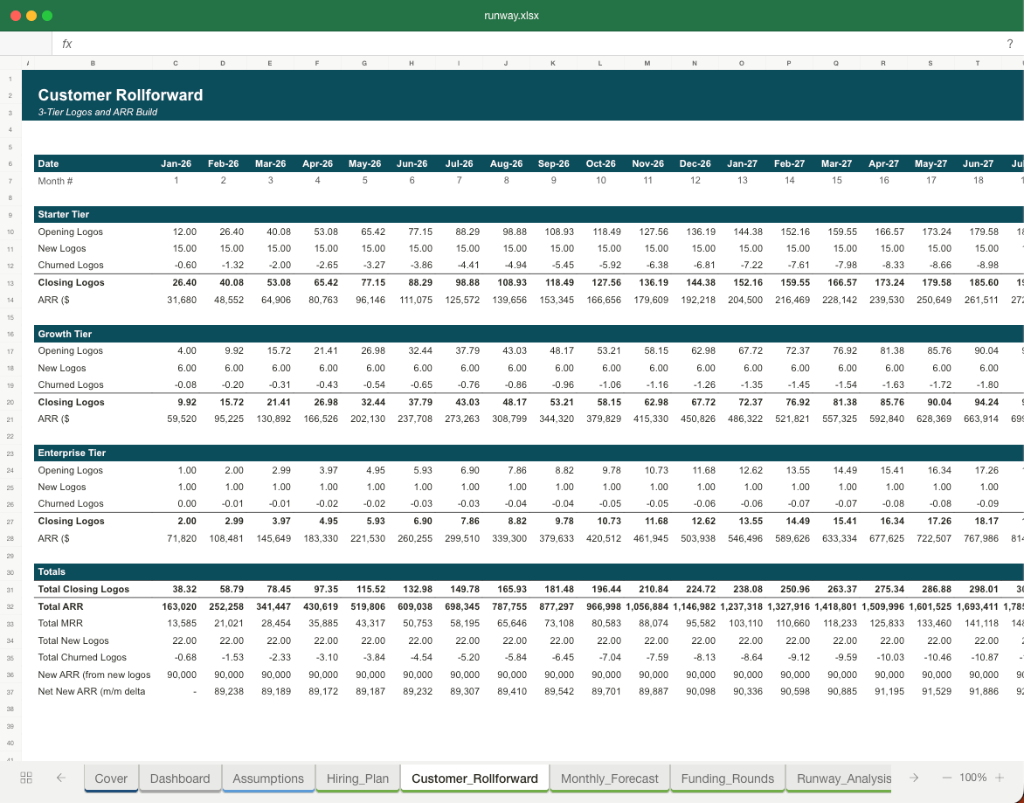
The Series A model uses an ARR waterfall by AI-employee seat: new logos, expansion into seats and new Artisan roles, and churn. It tests ACV, NRR, inference cost and gross margin, then connects sales efficiency, functional headcount, cash runway, and labour-savings ROI.
A turnkey financial model
Live formulas, no hardcoded values
Outputs are driven by live formulas, so the workbook updates from its assumptions instead of relying on hardcoded results.
All assumptions in one tab
Inputs are clearly marked in the Assumptions tab and separated from calculations, making it clear what to change and what to leave intact.
Statements always balancing
For integrated-statement models, the balance sheet, cash flow, and supporting schedules tie through properly.
Distinct schedules for clarity
Debt, working capital, taxes, and cash flow can get messy quickly. We group calculations in clear schedules, not across disconnected tabs.
No hidden macros or external links
There are no unexplained external workbook links or macros to undermine auditability or portability.
Changes flow through the model
Update a key driver and see the impact carry through the forecast, financing, and return outputs. We never use hardcoded numbers in formulas.
About Artisan Series A
artisan.co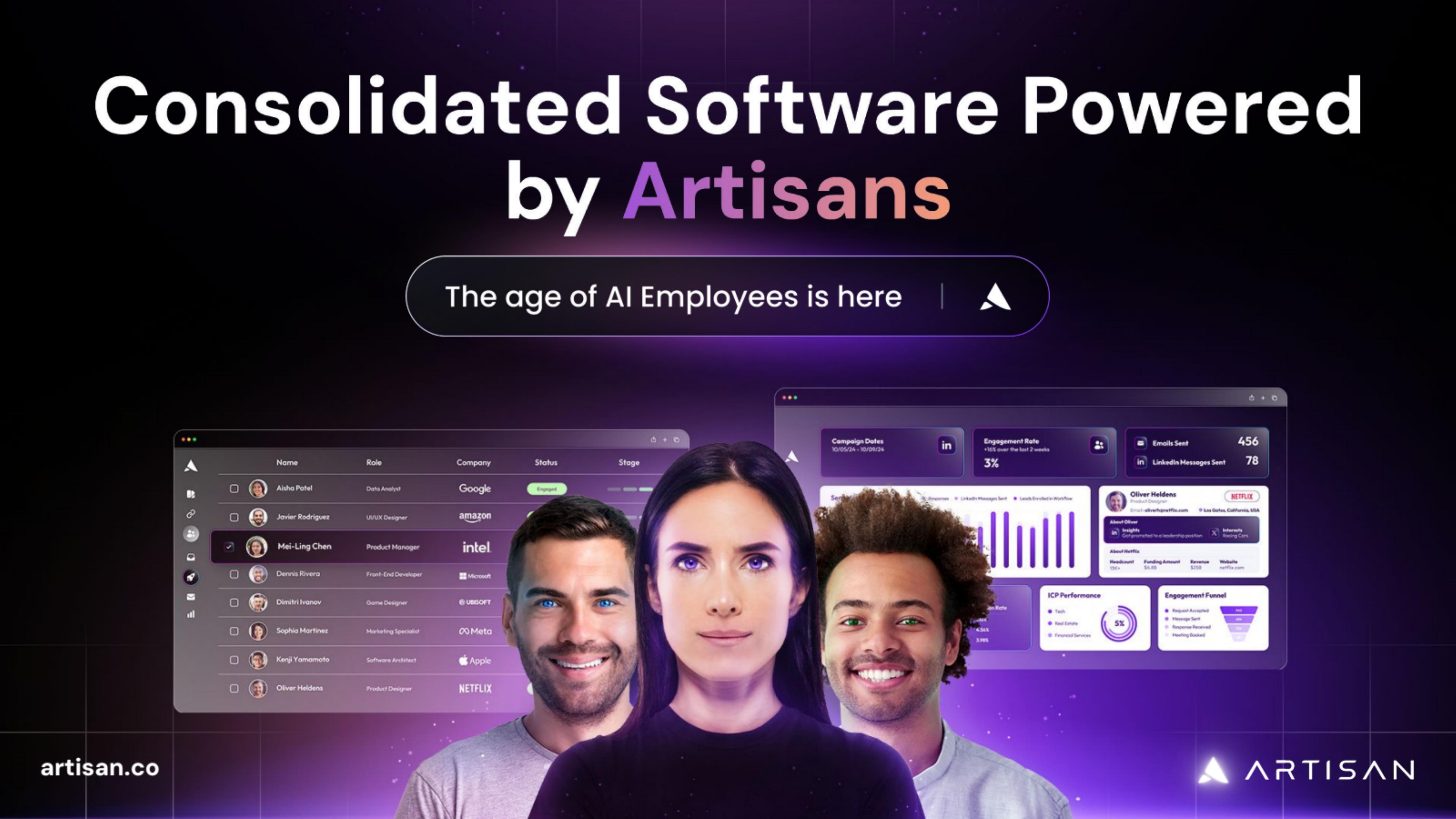
How to build a detailed financial model for Artisan Series A
A complete walkthrough of the business, drivers, and assumptions behind the downloadable Artisan Series A model - distilled from its pitch deck and publicly available information.
Product & value proposition
- Core thesis: Replace fragmented point-solution software stacks with consolidated, AI-first software managed by "Artisans" - AI employees trained to automate specific roles
- First product: Ava, AI BDR (Business Development Representative) - automates outbound lead generation end-to-end: find → research → draft → outreach
- Ava capabilities: 300M+ B2B leads database, dozens of data enrichment sources, personalization waterfall, email + LinkedIn outreach, autopilot mode, multi-agent architecture
- Self-improving: Ava trains on aggregated, anonymized interaction metrics over time; no PII used
- Product: Artisan Sales - consolidated sales ecosystem replacing tools like email warmup, bounce testing, intent data, 3rd-party enrichment, outbound CRM, AI sales playbooks
- Roadmap: Artisan AI employees to extend across Customer Success, HR & Recruitment, Marketing, Operations - taking actions (scheduling, account reassignment, hiring) via natural-language prompts
Market
- Total Annual Labor Costs across target verticals: $790B
- B2B Sales: $90–100B
- Customer Success: $100–120B
- HR & Recruitment: $130–150B
- Marketing: $180–200B
- Operations: $200–220B
- Total Annual Software Costs across target verticals: $52B
- Customer Success: $1–2B
- Operations: $2–4B
- Marketing: $6–8B
- B2B Sales: $12–15B
- HR & Recruitment: $19–23B
Revenue model
- Revenue model type: B2B SaaS subscription (inferred from product description and competitive positioning; no explicit pricing tiers shown)
- Channels: Inbound (SEO-dominant; #1 Google ranking for "AI BDR") + outbound
- Unit of sale: AI employee seat or platform license
- GTM: Direct sales to SMB/mid-market B2B companies needing outbound sales automation
Traction & metrics
- Product demo metrics visible on cover/dashboard (slide 1, 3): Campaign dates 10/05/24–10/09/24; Engagement Rate 3%; Emails Sent 456; LinkedIn Messages Sent 78 - these appear to be illustrative UI demos, not company-level KPIs
- Google search rankings: AI BDR #1, AI SDR #2, AI Sales Agent #3, AI Sales Rep #3
- Press: Named by TechCrunch as one of the "best-known AI SDR startups" alongside Regie.ai, AiSDR, and 11X.ai
- Customer testimonial: Karlo Buik, Growth Lead at SumUp
- No revenue, ARR, customer count, MoM/YoY growth, or churn figures disclosed
Competition / moat
- Competitors: unnamed 4 B2B-only players shown in comparison table; TechCrunch names Regie.ai, AiSDR, 11X.ai
- Ava differentiation vs. competitors:
- Data types: B2B + E-commerce + Local Business vs. B2B only
- AI Employee Interaction: Chat-capable (others: None or Chat for one)
- Data Enrichment: News, LinkedIn Posts, X Posts, Web Scraping (broadest set)
- Advanced Features: Coaching + Personalization Waterfall + Web Visitor Tracking + Target Audiences (most comprehensive)
- Moat narrative: SEO dominance (#1 "AI BDR"), consolidated platform lock-in (replacing multiple tools), self-improving AI flywheel
Team & funding ask / use of funds
- Jaspar Carmichael-Jack - Co-Founder & CEO: serial entrepreneur; founded on-demand services startup + 15-person GTM agency
- Sam Stallings - Co-Founder & CPO: 9 years engineering, 4 years product; engineering at 2 YC companies; product + engineering at IBM; led eng + product at a consumer app startup
Recommended financial model
- Archetype + why: B2B SaaS ARR model with seat/AI-employee expansion layer. Artisan is a recurring-subscription business with a land-and-expand motion (start with Ava for sales, expand to CS, HR, Marketing, Ops). Standard SaaS ARR waterfall (new ARR, expansion ARR, churn ARR, net revenue retention) best captures the business. A secondary labor-displacement efficiency layer can be added to model ROI per Artisan seat (labor cost saved vs. software cost).
- Forecast horizon & granularity: 5-year annual model (Year 1 monthly for cash management); Series A cohort visibility expected out to Year 3–5.
- Key drivers & assumptions:
- Starting ARR: $1–3M; typical Series A AI SaaS with early traction but no figure disclosed - flag as highest-priority data gap
- ACV (Annual Contract Value per customer): $15,000–$30,000 per year for Ava seat(s); benchmarked against comparable AI SDR tools (AiSDR, 11X.ai public pricing); no deck figure
- New logo growth (customers added per year): 30–80% YoY growth in Year 1–3, decelerating as market matures; typical early-stage SaaS growth trajectory
- Seats per customer (expansion): 1.0 seats at land, growing to 1.5–2.0 as additional Artisan verticals launch
- Gross margin: 65–75%; AI inference cost (LLM API) is meaningful at early scale, improving with volume; typical AI SaaS gross margin range
- Net Revenue Retention (NRR): 110–120%; expansion into new Artisan verticals is the primary expansion lever
- Churn rate (gross): 8–12% annually; SMB-weighted customer base tends toward higher churn
- CAC: $5,000–$10,000 per customer; SEO-dominant inbound channel should compress CAC vs. pure outbound; no deck figure
- CAC payback period: 6–18 months depending on ACV and sales motion
- Headcount: Series A typically 20–50 employees; no headcount disclosed
- R&D / S&M / G&A split: 30% / 40% / 15% of revenue in Year 1–2, improving toward profitability by Year 4–5
- Scenarios (Base / Bull / Bear - which variables flex):
- Base: ACV $20K, 100% new logo growth Y1 decelerating to 40% Y3, NRR 115%, gross margin 70%
- Bull: ACV $30K (mid-market penetration), NRR 125% (fast cross-sell of new Artisans), gross margin 75%
- Bear: ACV $12K (price competition from well-funded rivals), churn 15%, NRR 95%, gross margin 60% (LLM cost pressure)
- Required sheets / outputs:
- Assumptions - all inputs in one place; all three scenarios
- ARR Waterfall - new ARR, expansion ARR, churned ARR → ending ARR and customer count
- P&L (Income Statement) - revenue, COGS, gross profit, S&M, R&D, G&A, EBITDA
- Headcount Plan - by department, tied to revenue milestones
- Cash Flow & Runway - burn rate, months of runway on Series A proceeds (amount TBD)
- Unit Economics - CAC, LTV, LTV/CAC, payback period by cohort
- Market Penetration - TAM $52B software cost; implied penetration at Base/Bull/Bear exit
- Dashboard - KPIs: ARR, customers, NRR, gross margin, burn, runway
Frequently asked
Is the Artisan Series A financial model free?+
Yes. The Artisan Series A model is a free Excel (.xlsx) download with live formulas. Sign up with your email and the workbook is yours to keep, review, and edit.
What's included in the model?+
A 5-year monthly forecast with P&L, cash flow and runway, valuation (exit multiple plus a DCF cross-check), MOIC/IRR returns, and unit economics, with live formulas throughout.
How was this model built?+
It was built from Artisan Series A's pitch deck and publicly available information, then structured to investment-banking standards as a fully editable Excel model.
Can I change the assumptions?+
Yes. You can change assumptions and the live formulas will recalculate in the downloadable Excel model.
Have more financial modelling questions? Contact us

Created by ex-finance professionals
Hey, I’m Alex and I created Finamodel.
Over my years in the finance industry I kept building the same models over and over again. Same structure, same assumptions, different logo. So I started building frameworks to turn them into clean, reusable templates.
Every model here is one I’d actually use for a client, and I personally vet each one before it goes up.
I’m not an expert in every industry, but I’ve built enough models to know what belongs in one. And when something is completely foreign to me, I reach out to my network for experts to work on our models with us.
Having a template library on hand cuts a first build from hours to minutes.
Need help finding your model? You’ll find me in the Finamodel app!
Other AI/ML Startup Financial Models
Browse another startup in the same category.

AI Rudder
AI Rudder provides multi-lingual conversational AI for B2C customer engagement - automating outbound and inbound voice/chat interactions at scale.

Aisera
AI Service Experience platform that automates IT, HR, and customer service workflows via conversational AI and automation.

Amberscript
AI + human hybrid transcription and subtitling platform targeting B2B customers in Europe

Apheris
Privacy-preserving federated ML platform enabling enterprises to train AI on distributed data without sharing raw data.

Arcane
AI copilot for marketing teams that automates data analysis, reporting, and repeatable tasks via a chat interface and scheduled workflows.

Artisan
AI-powered "digital workers" (branded Artisans) that autonomously perform role-specific tasks - starting with outbound sales - and are delivered as SaaS subscriptions.

Bigblue
Tech-enabled e-commerce fulfillment platform for European D2C brands - "Amazon-standard" delivery without Amazon.

BlueOcean
AI/ML-powered always-on brand tracking platform replacing traditional survey-based market research