 Audience Town Financial Model
Marketplace Startup Financials (Free Excel Download)
Vertical data and advertising platform targeting home movers across the entire home journey - pre-move through post-move.



professionals from Deloitte
Used by professionals from






About this model
Audience Town is a vertical advertising platform built around the US home-moving journey, from pre-move research through settling in. It combines audience data, campaign tools, media buying, attribution, and analytics in a self-serve system for advertisers serving movers.
The company sells to enterprises, realtors, retailers, and home-service brands, with customers including Toll Brothers and Lennar. Its deck reported 200% revenue growth in 2020 and 212% in 2021, while a $6 million seed raise was intended to expand the self-serve product, data infrastructure, and marketplace.
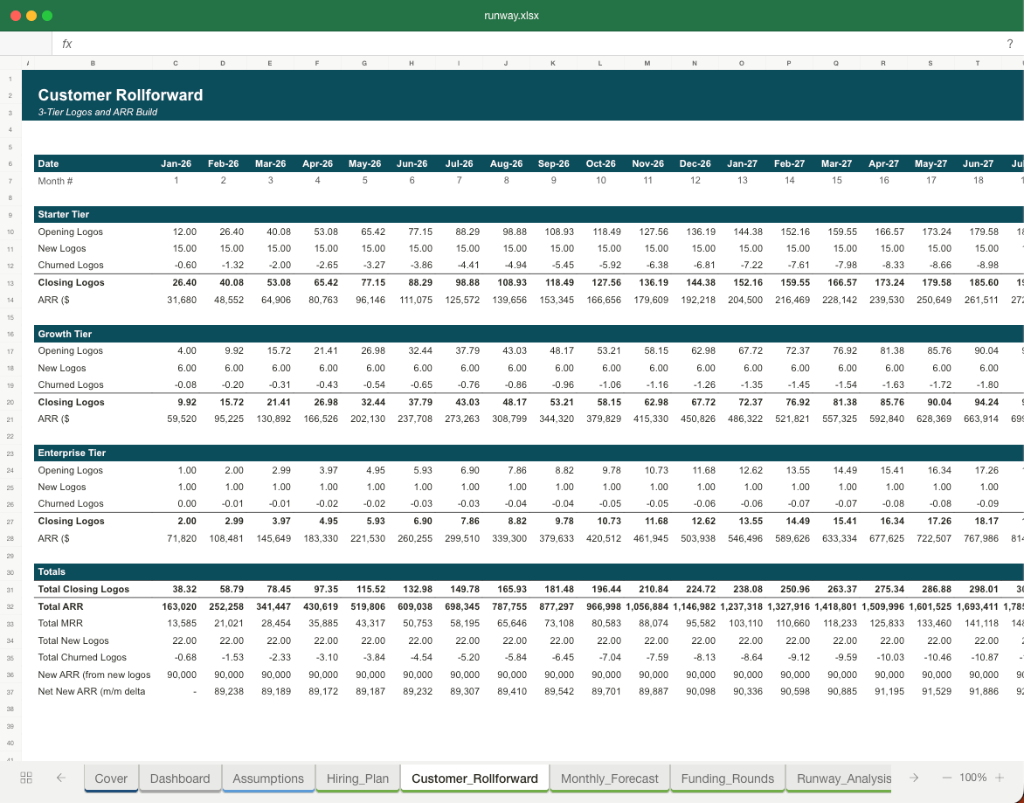
The financial model separates recurring platform MRR from media revenue earned on client advertising spend. Customer additions, ARPU, churn, campaign spend, and media take rate feed a blended revenue build; data acquisition, sales, engineering, and marketing then determine gross margin, burn, and runway.
A turnkey financial model
Live formulas, no hardcoded values
Outputs are driven by live formulas, so the workbook updates from its assumptions instead of relying on hardcoded results.
All assumptions in one tab
Inputs are clearly marked in the Assumptions tab and separated from calculations, making it clear what to change and what to leave intact.
Statements always balancing
For integrated-statement models, the balance sheet, cash flow, and supporting schedules tie through properly.
Distinct schedules for clarity
Debt, working capital, taxes, and cash flow can get messy quickly. We group calculations in clear schedules, not across disconnected tabs.
No hidden macros or external links
There are no unexplained external workbook links or macros to undermine auditability or portability.
Changes flow through the model
Update a key driver and see the impact carry through the forecast, financing, and return outputs. We never use hardcoded numbers in formulas.
About Audience Town
audiencetown.com
How to build a detailed financial model for Audience Town
A complete walkthrough of the business, drivers, and assumptions behind the downloadable Audience Town model - distilled from its pitch deck and publicly available information.
Product & value proposition
Audience Town consolidates 14 traditionally separate marketing functions (DSP, identity, creative builder, media, data management, consumer data, attribution, search, analytics, social, ad agency, data science/tech, service) into a single self-serve platform. It targets the 40 million annual US home movers across the full home journey (pre-move → in-market → close → confirmed → post-move → settled home) using proprietary mover-intent data and an ML engine.
Revenue claim: 5x ROI for advertisers.
Customers span enterprises, realtors, SMBs, home furnishings, CPG, and retail. Named clients include Toll Brothers, Lennar, HomeLight, Invitation Homes, Serhant, Guaranteed Rate, Sunrun, 1-800-PACK-RAT, Plymouth Rock, and others.
Payment model: subscription / MRR.
Market
- TAM: $1T (global online advertising)
- SAM: $95B
- SOM: $1B
- AdTech public market caps grew from $5B (2017) to $160B (2021)
- PropTech record funding: $4.5B in Q1 2021
- 40 million home movers targeted annually
- 83% of searchers have looked for homes with no intention of buying
- Average B2C business loses 20% of customers per year to moving
AdTech comps cited: TripleLift ($1.4B PE M&A, 2021), Viant (IPO, $1.7B market cap, 2021), The Trade Desk (IPO, $27B market cap, 2021), PubMatic (IPO, $1.7B market cap, 2021).
PropTech comps cited: Opcity ($210M exit to News Corp, 2018), Homesnap ($250M exit to CoStar, 2020), Porch (IPO, $1.7B market cap, 2020), Top of Mind ($250M exit to Black Knight, 2021).
Revenue model
Two-layer model:
- Subscription / MRR - platform access fee for self-serve ads UI, data management, and analytics. Specific price points not disclosed.
- Media / ad spend - managed or self-serve ad campaigns across all formats and channels (DSP, search, social, display). Revenue likely taken as a margin on media or as CPM/CPC fees. Specific take-rate not disclosed.
Channels: direct sales (enterprise/realtor) and self-serve (SMBs). Self-service platform launched in 2021.
No ARPU, contract size, or pricing tiers disclosed in the deck.
Traction & metrics
- 200% YoY revenue growth in 2020
- 212% YoY revenue growth in 2021
- First client: 2018
- Pre-seed round completed: 2019
- Self-service platform launched: 2021
- Named client logos spanning real estate, home services, insurance, energy, and moving categories
No absolute revenue figures, ARR, MRR, customer count, or retention rates disclosed.
Competition / moat
Competitive framing: existing marketing vendors (Meta, Zillow, Google, RealPage, Porch) each cover only a narrow slice of the mover journey and require fragmented stacks. Audience Town's moat claims:
- Proprietary home-journey intent data spanning the full pre-/post-move window
- Consolidated platform (14 functions in one) reduces vendor fragmentation
- ML engine for audience targeting and data management
- First-mover positioning in home-mover vertical adtech
No formal competitive matrix or defensibility metrics in the deck.
Team & funding ask / use of funds
- Raising: up to $6M (Seed)
- Use of funds:
- Hire engineering and marketing leadership
- Accelerate self-serve ads UI, data infrastructure, and marketplace architecture
- Acquire unique data to accelerate offering
- Founded: 2016 (idea stage)
- Team composition not disclosed in this deck (no team slide).
Recommended financial model
Archetype + why: AdTech SaaS + Media Marketplace hybrid. Revenue splits across (a) subscription MRR from platform access and (b) media revenue (take-rate or gross media margin on ad spend). Given the self-serve launch and MRR language, the primary model archetype is a SaaS ARR / MRR build with a media revenue layer. This is standard for vertical AdTech platforms that monetize both software access and managed/self-serve media.
Forecast horizon & granularity:
- 5-year annual model (2022–2026) with monthly detail for Year 1 (matching the fundraise close).
- Monthly for the first 12 months to track MRR ramp and ad spend; annual thereafter.
Key drivers & assumptions:
*Revenue - Subscription / MRR:*
- Starting MRR: $50K/month (2022 base); rationale: implied by ~200%+ growth trajectory from a small base starting ~2018–2019, no actuals given.
- New logos per month: 3–5 SMB/self-serve + 1 enterprise; rationale: self-serve platform just launched, early ramp expected.
- Monthly subscription ARPU - SMB: $1,000–$3,000/month; enterprise: $5,000–$15,000/month. Rationale: typical AdTech SaaS for mid-market.
- Monthly churn rate: 2–3% (SMB), 1% (enterprise). Rationale: AdTech vertical benchmarks; deck claims retention benefit from mover-data stickiness.
*Revenue - Media / Ad Spend:*
- Media revenue as % of subscription revenue: 1.5–2.5x. Rationale: managed media revenue typically exceeds subscription revenue in early-stage AdTech platforms.
- Net take-rate on media: 20–30% of gross ad spend. Rationale: programmatic AdTech industry standard.
- Ad spend per client per month: $5,000–$50,000 range. Rationale: no deck data; based on named client profiles (homebuilders, insurance, CPG).
*Growth:*
- YoY revenue growth: 200% ('20), 212% ('21). Applied as a decelerating curve: 150% in 2022, 80% in 2023, 50% in 2024, 30% in 2025, 20% in 2026. Rationale: growth compression typical post-Series A buildout; SOM of $1B implies room but sales motion will mature.
*Costs:*
- Gross margin: 55–65% blended (software ~80%, media net ~30%). Rationale: typical for SaaS+media mix.
- Headcount: 2022 plan focused on engineering and marketing leadership hires. Starting headcount: ~10–15 FTEs; ramp to ~30 by end-2022 with $6M raise.
- S&M as % of revenue: 40–50% in early years, declining to 25% by Year 5. Rationale: customer acquisition investment during self-serve launch.
- R&D as % of revenue: 25–35% Year 1, declining to 15% by Year 5. Rationale: platform and data infrastructure build-out.
- G&A: 15% of revenue, declining to 8% by Year 5.
*Data acquisition:*
- One-time / recurring data acquisition capex: explicitly called out in use of funds.: $500K–$1M Year 1, $200K–$500K recurring. Rationale: proprietary mover-data moat is a core strategic asset.
*Raise:*
- Seed raise: up to $6M. Model starting cash: $6M + existing cash.
- Runway target: 18–24 months to Series A. Rationale: standard seed burn horizon.
Scenarios (Base / Bull / Bear - which variables flex):
- Base: 150% YoY 2022, churn 2.5% SMB, take-rate 22%, 30 FTEs by year-end 2022.
- Bull: 200%+ sustained into 2022 (self-serve flywheel kicks in early), churn 1.5%, enterprise mix higher, data monetization adds a third revenue stream.
- Bear: Growth compresses to 80% in 2022 (macro/rate sensitivity hits real estate ad budgets), churn 4%, media take-rate compresses to 15% under competitive pressure, extends burn rate requiring bridge.
Required sheets / outputs:
- Assumptions dashboard (all drivers in one place)
- MRR / ARR build (cohort-based: SMB self-serve + enterprise; new/expansion/churned)
- Media revenue build (clients × spend/client × take-rate)
- P&L (IS): Revenue, COGS, Gross Profit, OpEx by category, EBITDA, Net Income
- Headcount plan (department × role × start month × salary)
- Cash flow & runway (monthly, 24 months)
- Scenario toggle (Base / Bull / Bear switchable)
- Cap table (pre/post Seed; include pre-seed dilution)
Frequently asked
Is the Audience Town financial model free?+
Yes. The Audience Town model is a free Excel (.xlsx) download with live formulas. Sign up with your email and the workbook is yours to keep, review, and edit.
What's included in the model?+
A 5-year monthly forecast with P&L, cash flow and runway, valuation (exit multiple plus a DCF cross-check), MOIC/IRR returns, and unit economics, with live formulas throughout.
How was this model built?+
It was built from Audience Town's pitch deck and publicly available information, then structured to investment-banking standards as a fully editable Excel model.
Can I change the assumptions?+
Yes. You can change assumptions and the live formulas will recalculate in the downloadable Excel model.
Have more financial modelling questions? Contact us

Created by ex-finance professionals
Hey, I’m Alex and I created Finamodel.
Over my years in the finance industry I kept building the same models over and over again. Same structure, same assumptions, different logo. So I started building frameworks to turn them into clean, reusable templates.
Every model here is one I’d actually use for a client, and I personally vet each one before it goes up.
I’m not an expert in every industry, but I’ve built enough models to know what belongs in one. And when something is completely foreign to me, I reach out to my network for experts to work on our models with us.
Having a template library on hand cuts a first build from hours to minutes.
Need help finding your model? You’ll find me in the Finamodel app!
Other Marketplace Startup Financial Models
Browse another startup in the same category.

Acquco
Amazon brand aggregator - acquires third-party Amazon seller businesses at attractive multiples, then scales them via proprietary growth playbooks and technology.
Arive
Premium q-commerce app delivering lifestyle and branded products in under 30 minutes across German cities.

AudioMob
Non-intrusive in-game audio ad platform bridging music/brand advertisers to mobile game publishers.

Authoritive
Two-way messaging platform that turns creator expertise into scalable, push-delivered learning experiences via SMS/WhatsApp.

Avo
Building amenity and office perk platform delivering same-day grocery/pantry/goods to residential and commercial tenants via a white-label marketplace.
beehiiv
Newsletter platform for creators to build, grow, and monetize email audiences - SaaS subscription + native ad network revenue.
Borzo
Global same-day logistics marketplace connecting B2B merchants with crowdsourced couriers for last-mile delivery

BoxedUp
Marketplace for delivered equipment rentals targeting content creators, connecting them with local rental shops and peer renters.