 Avo Financial Model
Marketplace Startup Financials (Free Excel Download)
Building amenity and office perk platform delivering same-day grocery/pantry/goods to residential and commercial tenants via a white-label marketplace.



professionals from Deloitte
Used by professionals from






About this model
Avo is a white-label marketplace and amenity platform for residential and office buildings. It delivers groceries, pantry goods, gifting, and events to tenants and employees through partnerships with property managers and corporate customers.
The company reported more than 1,000% revenue growth from 2020 to 2021 and serves thousands of buildings. Its commercial model is a hybrid: building partners can pay for the platform, while Avo also earns a commission on orders placed through each building marketplace.
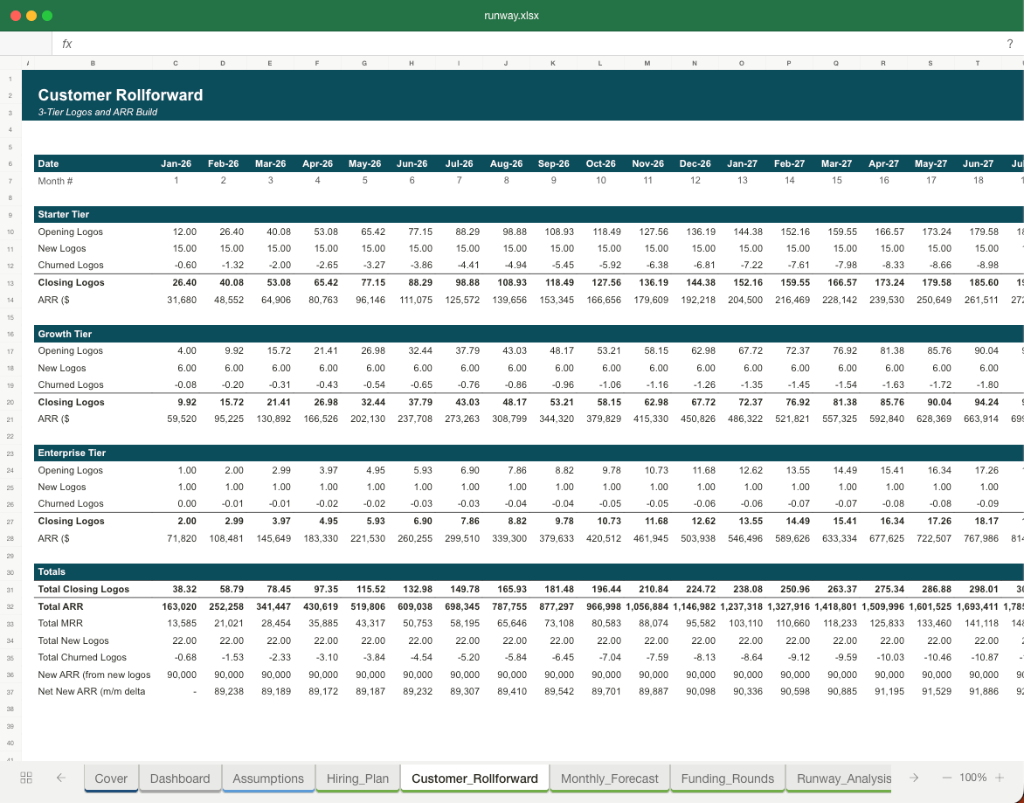
The model treats each contracted building as the unit of growth. Buildings, resident or employee penetration, order frequency, and average order value produce GMV; platform fees and take rate convert that into revenue. It then tests contribution margin after delivery, merchant, customer-acquisition, and building-partnership costs.
A turnkey financial model
Live formulas, no hardcoded values
Outputs are driven by live formulas, so the workbook updates from its assumptions instead of relying on hardcoded results.
All assumptions in one tab
Inputs are clearly marked in the Assumptions tab and separated from calculations, making it clear what to change and what to leave intact.
Statements always balancing
For integrated-statement models, the balance sheet, cash flow, and supporting schedules tie through properly.
Distinct schedules for clarity
Debt, working capital, taxes, and cash flow can get messy quickly. We group calculations in clear schedules, not across disconnected tabs.
No hidden macros or external links
There are no unexplained external workbook links or macros to undermine auditability or portability.
Changes flow through the model
Update a key driver and see the impact carry through the forecast, financing, and return outputs. We never use hardcoded numbers in formulas.
About Avo
avo.app
How to build a detailed financial model for Avo
A complete walkthrough of the business, drivers, and assumptions behind the downloadable Avo model - distilled from its pitch deck and publicly available information.
Product & value proposition
Three service lines:
- Personal Shopper - custom-branded online marketplace for residents/employees; same-day delivery, order by 11 AM Mon–Fri.
- Virtual Pantry - pantry staples through to office/janitorial supplies.
- Tenant Gifting / Events - on-site and virtual engagement events facilitated by Avo (e.g. pumpkin carving class).
Value props to building partners: attract/retain residents and employees; boost at-home/in-office experience; monthly activity engagement reporting.
Market
- Geographic scope: NYC; deck implies large national/global expansion opportunity ("millions more to go").
- Building count: "Thousands of commercial and residential buildings" currently served - no precise number given.
Revenue model
Not explicitly stated in deck. Inferred structure:
- B2B SaaS / platform fee to building operators for white-label marketplace access; rationale: product is framed as a "building amenity perk" and partners are the buyer (property managers, corporates like KPMG, Extell, FirstService).
- Take-rate / commission on GMV from orders placed through the marketplace; rationale: e-commerce platform model standard for on-demand delivery aggregators.
- Possible event/gifting fees for tenant events; rationale: third product line (Gifting/Events) implies separate pricing.
- No pricing tiers, contract lengths, or take-rate percentages disclosed.
Traction & metrics
- Revenue growth: 1000%+ from 2020 to 2021. No absolute revenue figures disclosed; Y-axis has no labels.
- Buildings served: "Thousands" of commercial and residential buildings. No precise count.
- Named partners/clients: Extell / One Manhattan Square (residential); KPMG Tel Aviv Office (corporate); FirstService Realty NYC / Galaxy Towers; House39 (residential).
- No GMV, order volume, AOV, user count, or retention rate disclosed.
Competition / moat
- White-label branded storefronts per building (switching cost for property managers).
- Exclusive partnership language used by Extell ("exclusive partnership with Avo").
- Engagement reporting as a retention tool for building operators.
Team & funding ask / use of funds
- Contact: jp@avonow.com.
Recommended financial model
- Archetype + why: B2B2C marketplace GMV model with a building-as-the-unit driver. Avo's economics flow through two layers - (1) building contracts (B2B SaaS/fee or commission guarantee) and (2) per-order GMV with a take-rate. The right archetype is a marketplace GMV + platform fee hybrid: buildings contracted × active resident/employee penetration rate × orders per active user per month × AOV = GMV; apply take-rate to get net revenue. This mirrors DoorDash/Instacart operator models adapted for proptech B2B2C.
- Forecast horizon & granularity: 3 years (2022–2024), quarterly for Year 1, annual thereafter. Deck shows data through Q3 2021, so Year 1 starts 2022.
- Key drivers & assumptions:
- Buildings under contract (starting count): ~50–200 buildings based on "thousands" hyperbole vs. typical early-stage NYC footprint; needs clarification - open question.
- New buildings added per quarter: 10–25/quarter; rationale: NYC PropTech comps at Series A/B stage.
- Residents/employees per building: 200 residential units or 500 employees per commercial building; rationale: NYC mid-rise averages.
- Penetration rate (active users / total eligible): 15–30%; rationale: amenity app adoption benchmarks.
- Orders per active user per month: 2–4; rationale: weekly grocery/pantry cadence minus friction.
- Average order value (AOV): $45–$75; rationale: NYC grocery basket for same-day delivery (Instacart NYC comps).
- Take-rate on GMV: 20–30%; rationale: on-demand delivery platform norms.
- Platform fee per building per month: $500–$2,000; rationale: SaaS amenity platform pricing (ButterflyMX, Amenify comps).
- COGS (fulfillment, last-mile, picker labor): 40–55% of net revenue; rationale: on-demand grocery economics pre-scale.
- Gross margin: 45–60% at scale; rationale: marketplace software + services blend.
- Revenue growth 2020→2021: 1000%+ - use as anchor to back-solve implied 2021 revenue base.
- Churn (building-level): 10–15% annually; rationale: B2B SaaS PropTech norms; testimonials suggest sticky.
- Scenarios (Base / Bull / Bear - which variables flex):
- Base: 15% building penetration, 3 orders/user/month, $55 AOV, 25% take-rate, 20 new buildings/quarter.
- Bull: 25% penetration, 4 orders/user/month, $65 AOV, exclusive-partner pricing premium, 30 new buildings/quarter (NYC + expansion city).
- Bear: 10% penetration, 1.5 orders/user/month, $45 AOV, 10 new buildings/quarter, elevated fulfillment costs.
- Required sheets / outputs:
- Assumptions dashboard (all drivers in one place, color-coded inputs).
- Building cohort build (buildings added by quarter, churn, net active).
- GMV bridge (buildings × penetration × orders × AOV).
- Revenue P&L (take-rate revenue + platform fees, COGS, gross profit, OpEx, EBITDA).
- Headcount & OpEx schedule (ops/delivery, tech, sales/partnerships, G&A).
- Cash flow & runway (pre-raise).
- Scenario toggle (Base / Bull / Bear on one page).
Frequently asked
Is the Avo financial model free?+
Yes. The Avo model is a free Excel (.xlsx) download with live formulas. Sign up with your email and the workbook is yours to keep, review, and edit.
What's included in the model?+
A 5-year monthly forecast with P&L, cash flow and runway, valuation (exit multiple plus a DCF cross-check), MOIC/IRR returns, and unit economics, with live formulas throughout.
How was this model built?+
It was built from Avo's pitch deck and publicly available information, then structured to investment-banking standards as a fully editable Excel model.
Can I change the assumptions?+
Yes. You can change assumptions and the live formulas will recalculate in the downloadable Excel model.
Have more financial modelling questions? Contact us

Created by ex-finance professionals
Hey, I’m Alex and I created Finamodel.
Over my years in the finance industry I kept building the same models over and over again. Same structure, same assumptions, different logo. So I started building frameworks to turn them into clean, reusable templates.
Every model here is one I’d actually use for a client, and I personally vet each one before it goes up.
I’m not an expert in every industry, but I’ve built enough models to know what belongs in one. And when something is completely foreign to me, I reach out to my network for experts to work on our models with us.
Having a template library on hand cuts a first build from hours to minutes.
Need help finding your model? You’ll find me in the Finamodel app!
Other Marketplace Startup Financial Models
Browse another startup in the same category.

Acquco
Amazon brand aggregator - acquires third-party Amazon seller businesses at attractive multiples, then scales them via proprietary growth playbooks and technology.
Arive
Premium q-commerce app delivering lifestyle and branded products in under 30 minutes across German cities.

Audience Town
Vertical data and advertising platform targeting home movers across the entire home journey - pre-move through post-move.

AudioMob
Non-intrusive in-game audio ad platform bridging music/brand advertisers to mobile game publishers.

Authoritive
Two-way messaging platform that turns creator expertise into scalable, push-delivered learning experiences via SMS/WhatsApp.
beehiiv
Newsletter platform for creators to build, grow, and monetize email audiences - SaaS subscription + native ad network revenue.
Borzo
Global same-day logistics marketplace connecting B2B merchants with crowdsourced couriers for last-mile delivery

BoxedUp
Marketplace for delivered equipment rentals targeting content creators, connecting them with local rental shops and peer renters.