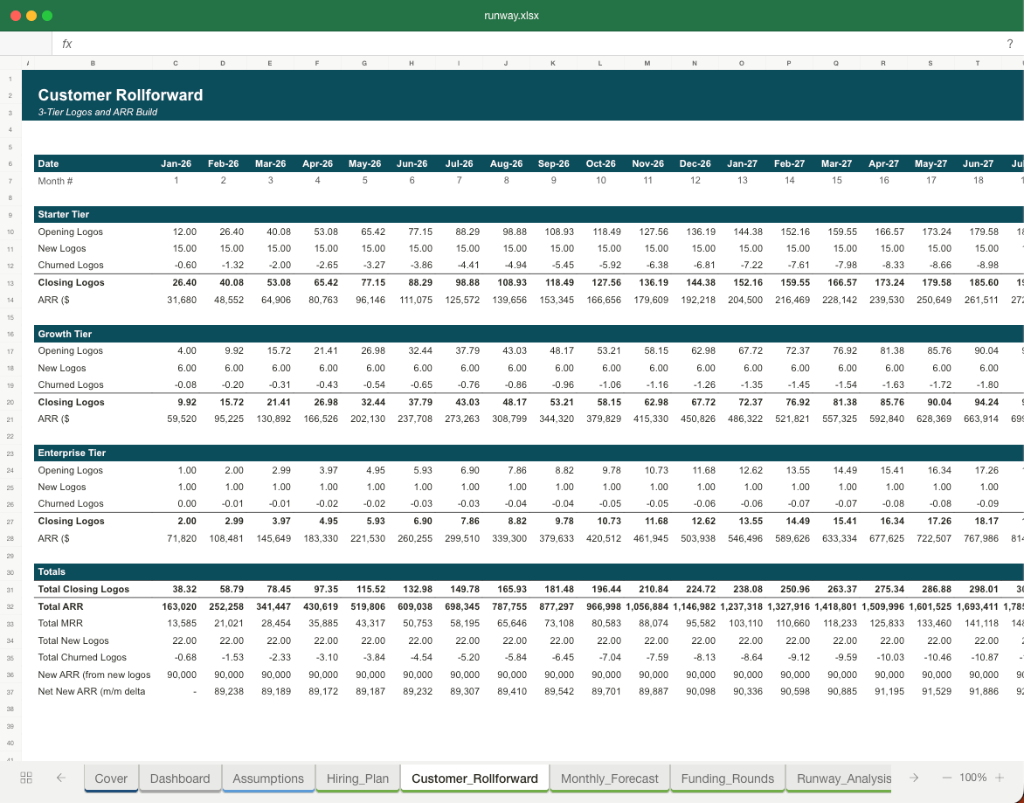
 Authoritive Financial Model
Marketplace Startup Financials (Free Excel Download)
Two-way messaging platform that turns creator expertise into scalable, push-delivered learning experiences via SMS/WhatsApp.



professionals from Deloitte
Used by professionals from






About this model
Authoritive helps creators turn their expertise into push-delivered learning experiences through SMS and WhatsApp. The product is designed to make courses more conversational and scalable, with creator tools that can move toward self-service management.
Its commercial proposition is tied to creator success rather than traditional enterprise seats. The research supports a revenue-share or platform-fee model on creator course sales, with a potential subscription layer for the software; pricing and take rates were not disclosed in the deck.
The financial model therefore starts with creator supply, learner conversion, course pricing, and repeat purchases to build marketplace GMV. A take rate turns that GMV into platform revenue, while any creator subscription is modeled separately. Creator activation, marketing efficiency, retention, and cash burn are the key operating sensitivities.
A turnkey financial model
Live formulas, no hardcoded values
Outputs are driven by live formulas, so the workbook updates from its assumptions instead of relying on hardcoded results.
All assumptions in one tab
Inputs are clearly marked in the Assumptions tab and separated from calculations, making it clear what to change and what to leave intact.
Statements always balancing
For integrated-statement models, the balance sheet, cash flow, and supporting schedules tie through properly.
Distinct schedules for clarity
Debt, working capital, taxes, and cash flow can get messy quickly. We group calculations in clear schedules, not across disconnected tabs.
No hidden macros or external links
There are no unexplained external workbook links or macros to undermine auditability or portability.
Changes flow through the model
Update a key driver and see the impact carry through the forecast, financing, and return outputs. We never use hardcoded numbers in formulas.
About Authoritive
authoritive.co
How to build a detailed financial model for Authoritive
A complete walkthrough of the business, drivers, and assumptions behind the downloadable Authoritive model - distilled from its pitch deck and publicly available information.
Product & value proposition
Two-way messaging platform (SMS + WhatsApp) that allows creators to push rich-media learning content (audio, text, images, gamification) directly to learners' phones in daily cohort format.
Key differentiators stated:
- Content is pushed to learners (no login friction)
- Two-way: learners respond/acknowledge, enabling accountability loops
- Cohort learning with individual personalisation via NLP
- Network-agnostic (SMS and WhatsApp)
- Planned self-service course management + analytics (not yet live at time of deck)
The illustrative product shown ("Outer Order Inner Calm", "Happiness Project", "Relationship Challenge") suggests 30-day challenge-style courses as the initial format.
Market
Qualitative framing: positions at intersection of Creator Economy, messaging, owned-audience, and education - competing proxy set includes Zoom, Substack, Community, Udemy.
Revenue model
Not explicitly stated in deck. Inferred from context:
- Revenue share or platform fee on creator course sales, consistent with B2B2C creator-economy platforms (analogous to Substack's ~10% take rate or Kajabi's subscription fee model). Rationale: deck emphasises "Revenue Growth because we scale with creators", implying Authoritive's revenue is tied to creator revenue.
- Possible SaaS subscription tier for creator access to platform tools, given "planned conversion of course management tools to self-service".
- No pricing, take rate, or ARPU figures disclosed.
Competition / moat
Competitive positioning framed as a Venn diagram at convergence of four elements: Two-Way Communication, Owned Audience, Messaging, Education. Named incumbents: Zoom (live instruction), Substack (owned audience / newsletters), Community (messaging), Udemy (education marketplace).
Stated moats:
- Proprietary AI-driven two-way delivery platform
- NLP + personalisation + gamification layer
- Creators bring their own audiences - Authoritive does not pay for learner acquisition
- Platform agnostic (SMS + WhatsApp) - meets learners where they are
Team & funding ask / use of funds
Team (8 people named):
- Christy Fletcher - Co-Founder / Co-CEO
- Jacob Lewis - Co-Founder / Co-CEO / President
- Gene Cohen - Co-Founder / CTO
- Eric Ries - Board / Investor (author of "The Lean Startup")
- Andre Plaut - VP, Product
- Dionysis Revisios - VP, Engineering
- Rachel Meier - VP, Operations
- Paul Bae - VP, Marketing
Recommended financial model
- Archetype + why: Creator-economy marketplace / SaaS revenue-share model. Authoritive earns a take rate on Gross Merchandise Value (GMV = creator course sales to end learners). Secondary revenue stream may be a creator platform subscription. This is analogous to a B2B2C marketplace with a creator supply side and learner demand side. A 3-statement model with GMV waterfall is appropriate.
- Forecast horizon & granularity: 3 years (2021–2024), monthly for Year 1, quarterly for Years 2–3. Monthly granularity required in Year 1 because the business is pre-revenue and cash burn cadence matters.
- Key drivers & assumptions:
*Supply side (Creators):*
- Number of active creators on platform at period start
- New creators added per month
- Creator churn rate
*Demand side (Learners per creator):*
- Average learners per creator cohort
- Average course price (creator-set)
- Cohorts per creator per year
*Revenue:*
- Authoritive take rate
- Optional: creator SaaS subscription fee
*Costs:*
- SMS/WhatsApp API costs per message per learner
- Messages per learner per course
- Headcount: 8 named employees at deck date; engineering, product, marketing, ops
- Infrastructure / hosting
- Scenarios (Base / Bull / Bear - which variables flex):
- Base: Steady creator ramp (5/month Y1), 100 learners/cohort, $50 avg price, 15% take rate
- Bull: Faster creator onboarding post self-serve launch (20/month Y2+), 200 learners/cohort, viral word-of-mouth among creator communities
- Bear: Slow creator adoption, SMS costs erode margin, WhatsApp policy restrictions on bulk messaging limit scale
- Required sheets / outputs:
- Assumptions dashboard (all drivers in one place)
- Creator supply model (cohort by cohort, ramp + churn)
- GMV model (learners × price × cohorts)
- Revenue model (GMV × take rate + optional SaaS)
- COGS (messaging API costs)
- OpEx (headcount, infrastructure, G&A)
- P&L summary
- Cash flow / runway
- Scenario toggle (Base / Bull / Bear)
Frequently asked
Is the Authoritive financial model free?+
Yes. The Authoritive model is a free Excel (.xlsx) download with live formulas. Sign up with your email and the workbook is yours to keep, review, and edit.
What's included in the model?+
A 5-year monthly forecast with P&L, cash flow and runway, valuation (exit multiple plus a DCF cross-check), MOIC/IRR returns, and unit economics, with live formulas throughout.
How was this model built?+
It was built from Authoritive's pitch deck and publicly available information, then structured to investment-banking standards as a fully editable Excel model.
Can I change the assumptions?+
Yes. You can change assumptions and the live formulas will recalculate in the downloadable Excel model.
Have more financial modelling questions? Contact us

Created by ex-finance professionals
Hey, I’m Alex and I created Finamodel.
Over my years in the finance industry I kept building the same models over and over again. Same structure, same assumptions, different logo. So I started building frameworks to turn them into clean, reusable templates.
Every model here is one I’d actually use for a client, and I personally vet each one before it goes up.
I’m not an expert in every industry, but I’ve built enough models to know what belongs in one. And when something is completely foreign to me, I reach out to my network for experts to work on our models with us.
Having a template library on hand cuts a first build from hours to minutes.
Need help finding your model? You’ll find me in the Finamodel app!
Other Marketplace Startup Financial Models
Browse another startup in the same category.

Acquco
Amazon brand aggregator - acquires third-party Amazon seller businesses at attractive multiples, then scales them via proprietary growth playbooks and technology.
Arive
Premium q-commerce app delivering lifestyle and branded products in under 30 minutes across German cities.

Audience Town
Vertical data and advertising platform targeting home movers across the entire home journey - pre-move through post-move.

AudioMob
Non-intrusive in-game audio ad platform bridging music/brand advertisers to mobile game publishers.

Avo
Building amenity and office perk platform delivering same-day grocery/pantry/goods to residential and commercial tenants via a white-label marketplace.
beehiiv
Newsletter platform for creators to build, grow, and monetize email audiences - SaaS subscription + native ad network revenue.
Borzo
Global same-day logistics marketplace connecting B2B merchants with crowdsourced couriers for last-mile delivery

BoxedUp
Marketplace for delivered equipment rentals targeting content creators, connecting them with local rental shops and peer renters.