 Briq Financial Model
PropTech Startup Financials (Free Excel Download)
SaaS platform that automates money workflow management (budgeting, forecasting, cash flow, WIP) for construction companies.



professionals from Deloitte
Used by professionals from






About this model
Briq automates construction money workflows including budgets, forecasts, cash flow, and work in progress. Its software gives construction companies a connected financial-operating layer for project economics rather than relying on disconnected spreadsheets and manual reporting.
The company uses a multi-component SaaS pricing structure: platform fees, modules, and per-user charges. Construction customers have enterprise-style sales cycles, while modules create a credible land-and-expand path after an initial implementation.
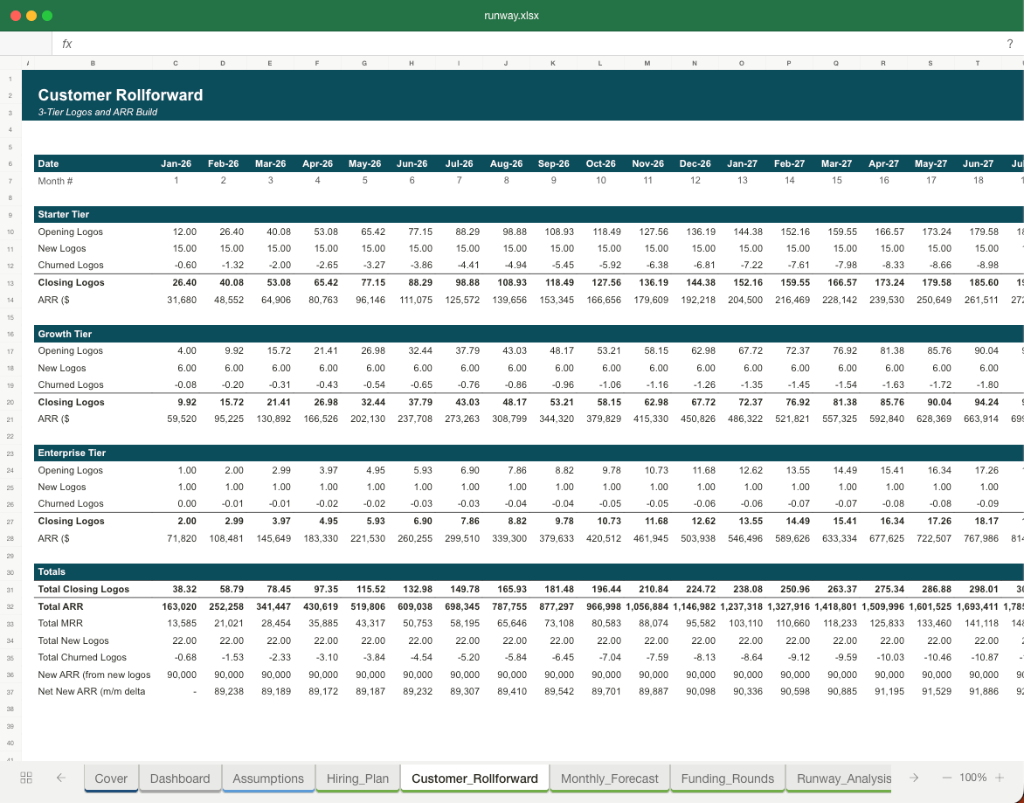
The model builds ARR from contractor additions, projects, platform fees, module adoption, users, expansion, and churn. Implementation, customer success, sales capacity, gross margin, and operating costs show how net retention and the construction sales cycle affect cash runway.
A turnkey financial model
Live formulas, no hardcoded values
Outputs are driven by live formulas, so the workbook updates from its assumptions instead of relying on hardcoded results.
All assumptions in one tab
Inputs are clearly marked in the Assumptions tab and separated from calculations, making it clear what to change and what to leave intact.
Statements always balancing
For integrated-statement models, the balance sheet, cash flow, and supporting schedules tie through properly.
Distinct schedules for clarity
Debt, working capital, taxes, and cash flow can get messy quickly. We group calculations in clear schedules, not across disconnected tabs.
No hidden macros or external links
There are no unexplained external workbook links or macros to undermine auditability or portability.
Changes flow through the model
Update a key driver and see the impact carry through the forecast, financing, and return outputs. We never use hardcoded numbers in formulas.
About Briq
briq.ai
How to build a detailed financial model for Briq
A complete walkthrough of the business, drivers, and assumptions behind the downloadable Briq model - distilled from its pitch deck and publicly available information.
Product & value proposition
- Financial operating system for construction companies - integrates CRM, accounting, and project management data into one platform.
- Six modules: Revenue Forecasting, Project Forecasting, Cash Flow Modelling & Forecasting, Corporate Budgeting & Forecasting, Revenue Recognition/WIP, Resource Planning (Equipment, Labor, Materials).
- Replaces spreadsheets and ill-fitting ERPs; positions as the "system of record" for money workflow automation.
- Key customer outcomes vs. pre-briq baseline:
- Average work/resource costs: 4 weeks/month → 2 weeks/month
- Time on one project workflow: 2–3 weeks/month → 1 hour/month
- Margin of error: 40% (industry avg) → 5%
Market
- TAM: $10T+ construction industry market.
- Stated ambition: own 80% of money workflow automation within the construction industry within 10 years.
Revenue model
- Platform fee (base subscription) + per-module add-on fees + per-user seat pricing.
- Six purchasable modules (listed in §2 above).
- Direct sales implied (enterprise/mid-market construction firms); no channel partner detail in deck.
- No specific price points ($/seat, $/module, platform fee $) disclosed.
Traction & metrics
- Customer testimonials from: Cafco Construction Management (CFO), WestCor Companies (CFO), Choate Construction (Finance). - qualitative social proof only.
- Bassem Hamdy (CEO) previously at CMIC and Procore - implied domain credibility.
Competition / moat
- Claims "new category with no direct competitors."
- Adjacent players:
- Autodesk: owns Design Workflow.
- Procore: owns Document Workflow.
- briq: claims to own Money Workflow - differentiated niche.
- Current alternatives: home-grown Excel models and antiquated in-house/ERP systems not designed for construction.
- Moat drivers implied: deep construction-specific data integrations, workflow automation reducing switching costs, and proprietary predictive modelling.
Team & funding ask / use of funds
- CEO & Co-Founder: Bassem Hamdy (br.iq).
- Prior roles: CMIC, Procore (construction tech background).
- No other team members named.
Recommended financial model
- Archetype + why: SaaS ARR model with module-based expansion revenue. Briq's pricing structure (platform fee + per-module + per-seat) is a classic multi-component SaaS model. The construction vertical and long sales cycles suggest enterprise-style cohort tracking with strong focus on net revenue retention (NRR) and expansion ARR from module upsell.
- Forecast horizon & granularity: 5 years (2021–2025), monthly for Year 1–2, quarterly for Year 3–5. Monthly granularity needed to track cohort-level ACV expansion.
- Key drivers & assumptions:
| Driver | Value |
|---|---|
| Starting customer count | Unknown |
| New logo adds per year | 15–30 new logos/yr in early years, scaling with sales headcount |
| Average Contract Value (ACV) - platform fee only | $30K–$80K/yr; no pricing disclosed |
| Module attach rate | 1.5 modules avg at land, growing to 3+ over 3 years |
| Per-module incremental ACV | $10K–$20K per module per year |
| Per-seat pricing | secondary revenue component; model as a fixed uplift % on ACV |
| Gross margin | 70–75% |
| Net Revenue Retention (NRR) | 110–120% |
| Annual churn (logo) | 5–10% |
| Sales cycle | 3–6 months |
| S&M as % of revenue | 50–60% in early years, declining to 30% at scale |
| R&D as % of revenue | 20–25% |
| G&A as % of revenue | 10–15% |
| Construction market TAM | $10T+ total industry |
- Scenarios (Base / Bull / Bear - which variables flex):
- Bear: Slow logo adds (10/yr), low ACV ($30K), low module attach (1.5x), high churn (10%), NRR 105%.
- Base: Moderate logo adds (20/yr), mid ACV ($50K), module attach growing to 2.5x, churn 7%, NRR 115%.
- Bull: Fast logo adds (35/yr), high ACV ($70K), module attach 3x+, churn 5%, NRR 125%, driven by large GC / national accounts.
- Required sheets / outputs:
- Assumptions dashboard (all toggleable drivers)
- ARR bridge (new ARR, expansion ARR, churn ARR, net new ARR)
- Cohort P&L (ACV by vintage, module attach over time)
- Revenue schedule (MRR/ARR by module)
- Income Statement (IS) - GAAP revenue, gross profit, OpEx, EBITDA, net income
- Cash Flow statement (operating burn / path to profitability)
- Headcount model (AE quota capacity drives logo adds; CS headcount drives retention)
- Scenario summary (Bear / Base / Bull vs. key KPIs)
- Valuation sensitivity (ARR multiple × NTM ARR)
Frequently asked
Is the Briq financial model free?+
Yes. The Briq model is a free Excel (.xlsx) download with live formulas. Sign up with your email and the workbook is yours to keep, review, and edit.
What's included in the model?+
A 5-year monthly forecast with P&L, cash flow and runway, valuation (exit multiple plus a DCF cross-check), MOIC/IRR returns, and unit economics, with live formulas throughout.
How was this model built?+
It was built from Briq's pitch deck and publicly available information, then structured to investment-banking standards as a fully editable Excel model.
Can I change the assumptions?+
Yes. You can change assumptions and the live formulas will recalculate in the downloadable Excel model.
Have more financial modelling questions? Contact us

Created by ex-finance professionals
Hey, I’m Alex and I created Finamodel.
Over my years in the finance industry I kept building the same models over and over again. Same structure, same assumptions, different logo. So I started building frameworks to turn them into clean, reusable templates.
Every model here is one I’d actually use for a client, and I personally vet each one before it goes up.
I’m not an expert in every industry, but I’ve built enough models to know what belongs in one. And when something is completely foreign to me, I reach out to my network for experts to work on our models with us.
Having a template library on hand cuts a first build from hours to minutes.
Need help finding your model? You’ll find me in the Finamodel app!
Other PropTech Startup Financial Models
Browse another startup in the same category.

Agora
Agora automates operations for real estate investment firms - investment accounting, fundraising, CRM, investor reporting, portal, and data room in one platform.

Canary Technologies
B2B SaaS platform providing guest management and digital operations software to hotels

Geodesic.Life
Sustainable prefabricated geodesic dome houses for rural development, sold as a design + prefab kit + consultancy bundle to real estate partners.

Huboo
Full-stack, software-driven e-commerce fulfilment network built on a micro-warehousing model, targeting SME merchants across UK and Europe.

Immo
Tech-enabled iBuyer that acquires single-unit/single-family residential properties directly from homeowners, renovates and rents them under the IMMO Homes brand, and aggregates the portfolios into institutional investment products.

Kasa Living
Tech-enabled hospitality operator that manages furnished apartments and hotel units on behalf of property owners, capturing a share of room revenue without owning real estate.
Latch (Door.com)
Latch is an enterprise proptech company selling LatchOS, a full-building smart-access and SaaS operating system for multifamily residential buildings, going public via SPAC merger with TS Innovation Acquisitions Corp. (TSIA).

Minut
IoT sensor + SaaS platform that acts as a "co-host" for short-term rental (STR) properties - monitoring noise, occupancy, safety, and guest experience.