 Canary Technologies Financial Model
PropTech Startup Financials (Free Excel Download)
B2B SaaS platform providing guest management and digital operations software to hotels



professionals from Deloitte
Used by professionals from






About this model
Canary Technologies provides guest-management and digital-operations SaaS for hotels. Its platform digitises workflows across the guest journey, helping operators manage property operations and improve the guest experience through a dedicated hospitality software layer.
The company sells vertical SaaS on a per-property or hotel basis and operates globally, with offices across North America, Europe, Asia, and more than 70 countries served. Its Series A completed in 2021, with the deck positioned as a later growth-stage opportunity.
The model builds ARR from hotels, rooms or properties, subscription value, modules, expansion, and churn. Implementation, support delivery, sales capacity, customer success, gross margin, and international operating costs determine the scale and runway of the hospitality platform.
A turnkey financial model
Live formulas, no hardcoded values
Outputs are driven by live formulas, so the workbook updates from its assumptions instead of relying on hardcoded results.
All assumptions in one tab
Inputs are clearly marked in the Assumptions tab and separated from calculations, making it clear what to change and what to leave intact.
Statements always balancing
For integrated-statement models, the balance sheet, cash flow, and supporting schedules tie through properly.
Distinct schedules for clarity
Debt, working capital, taxes, and cash flow can get messy quickly. We group calculations in clear schedules, not across disconnected tabs.
No hidden macros or external links
There are no unexplained external workbook links or macros to undermine auditability or portability.
Changes flow through the model
Update a key driver and see the impact carry through the forecast, financing, and return outputs. We never use hardcoded numbers in formulas.
About Canary Technologies
canarytechnologies.com
How to build a detailed financial model for Canary Technologies
A complete walkthrough of the business, drivers, and assumptions behind the downloadable Canary Technologies model - distilled from its pitch deck and publicly available information.
Product & value proposition
Two product lines sold to hotels:
Guest Management System (GMS) - mobile web-based, no app download required:
- Contactless check-in / checkout
- In-stay messaging
- Upsells (room upgrades, amenities)
- Digital tipping
Digital Authorizations & Contracts (first product, launched ~2017):
- Replaces paper credit card authorization forms
- Reduces chargebacks and fraud by 90%+
- Saves 3 hours/week per front-desk
Key differentiators: PCI compliant, web-based (no app install), 60-second guest check-in, 24/7 support, integrates with existing PMS (e.g. OPERA), 75 NPS.
Market
- Hotel industry topline revenue: $600B
- Hotel industry IT spend: $36B
- Hotel industry software spend: $23B - this is the effective TAM
- Analog: Veeva (life sciences vertical SaaS) built on $28B software TAM from $500B industry revenue - presented as proof-of-concept for vertical SaaS scale
- No explicit SAM/SOM breakdown or growth CAGR given in deck
Revenue model
- SaaS subscription model; metric tracked is Contracted ARR (CARR)
- ACV per deal: redacted/blurred in deck
- Average sales cycle: redacted/blurred
- Per-property/per-hotel licensing implied by unit economics structure
- Product expansion: upsell existing hotel customers from Digital Auths into GMS (multi-product land-and-expand)
- Case study: Coeur d'Alene Resort generates $10k/month in new upsell revenue through Canary GMS - indicates revenue-sharing or value-based upsell component may exist, though primary model appears flat SaaS
Traction & metrics
- 20,000+ hoteliers using Canary worldwide
- 5M+ guest reservations processed through the platform
- 70+ countries; present in all 50 US states
- 75 NPS
- Dream Hollywood case study: 20%+ increase in guest satisfaction
- Coeur d'Alene Resort: $10k/month average new upsell revenue
- ARR / CARR trajectory: strong J-curve growth shown on two separate chart slides (slides 9 and 11); GMS launch inflected growth upward - axis values are blurred/redacted in both images, no dollar amounts readable
- Timeline bar chart (slide 18): ARR bars 2017–2022 show consistent step-up each year; 2021 (Series A) and 2022 (Scale) bars are tallest - exact values blurred
- Forward projection chart (slide 19): "We are here" annotation points to 2022 bar; 2023 and 2024 projected bars are materially larger - exact values blurred
Unit economics
- ACV per deal: blurred
- Average sales cycle: blurred
- Upsell revenue per property: $10k/month at Coeur d'Alene (~338 keys) as one data point
Competition / moat
- Existing hotel tech solutions described as "antiquated (many 30–45 years old)" - incumbent PMS vendors are moat by inertia, not by quality
- No direct competitor grid in deck
- Moat levers cited:
- Deep PMS integrations (OPERA and others) make switching painful
- Web-based architecture (no app) drives high guest adoption vs. app-based alternatives
- Network effects implied: 5M+ reservations as proof of platform reliability
- Awards: HotelTechAwards Best Cyber Security & Fraud Prevention 2021 and 2022
- 75 NPS as retention/expansion signal
- Competitive positioning framed as Veeva-for-hotels analogy
Team & funding ask / use of funds
Founders:
- Harman Singh Narula - Global Strategy at Starwood Hotels & Resorts; Bain & Co.; Cornell Hotel School; Wharton MBA
- Satjot "SJ" Sawhney - VP Product at Stayful (hospitality tech); Senior Technical PM at Vevo; Columbia BS
Prior funding:
- YC alumnus (2018)
- Series A: F-Prime Capital (2021)
Recommended financial model
Archetype + why: Multi-product vertical SaaS ARR model. Canary sells recurring subscriptions to hotels; growth comes from (a) new hotel logos and (b) multi-product expansion (Digital Auths → GMS → future modules). This maps directly to a land-and-expand SaaS model with property-count as the primary unit. Analogy to Veeva further supports SaaS ARR framing.
Forecast horizon & granularity:
- 5-year annual model (2022–2027), monthly in Year 1 for cash-flow purposes
- Key period: 2022 actual anchor → 2023–2024 shown as "projected" in deck → extend to 2027
Key drivers & assumptions:
*Customer / logo growth:*
- Starting hotel customers: ~500–1,000 paying properties (20k hoteliers likely includes freemium/trial users; paid base is a subset - open question); tag as gap
- Net new hotel logos per year: 30–50% YoY based on J-curve trajectory on slides 9/11
- Churn rate: 5–10% annual gross logo churn; hospitality SaaS historically sticky post-integration
*Revenue per customer:*
- ACV per deal: $5,000–$15,000/year per property (blurred in deck; consistent with SMB/mid-market hotel SaaS comps); model as a driver to sensitize
- Average keys per property: 150–250 keys (mix of boutique and enterprise)
- Product mix: Digital Auths vs. GMS modules - GMS at higher ACV; model separate tiers
- Upsell revenue share: not modeled as separate line unless confirmed; flag as open question
*Cost structure:*
- R&D as % revenue: 25–35% (early-scale SaaS)
- S&M as % revenue: 30–40% (enterprise hotel sales; moderate sales cycle)
- G&A as % revenue: 10–15%
- Gross margin: 65–75% (SaaS with some support cost given 24/7 emphasis)
*Growth levers:*
- GTM expansion (new geographies, new hotel segments)
- New product modules (iceberg framework)
- Enterprise brand expansion (up-sell into existing enterprise accounts)
Scenarios (Base / Bull / Bear - which variables flex):
- Base: 35% YoY logo growth, $8k ACV, 7% churn, 70% gross margin
- Bull: 50% YoY logo growth, $12k ACV (GMS adoption lifts ACV), 5% churn - reflects successful enterprise expansion
- Bear: 20% YoY logo growth, $6k ACV, 12% churn - macro headwinds (travel slowdown), slower GMS adoption
Required sheets / outputs:
- Assumptions dashboard (all toggleable drivers)
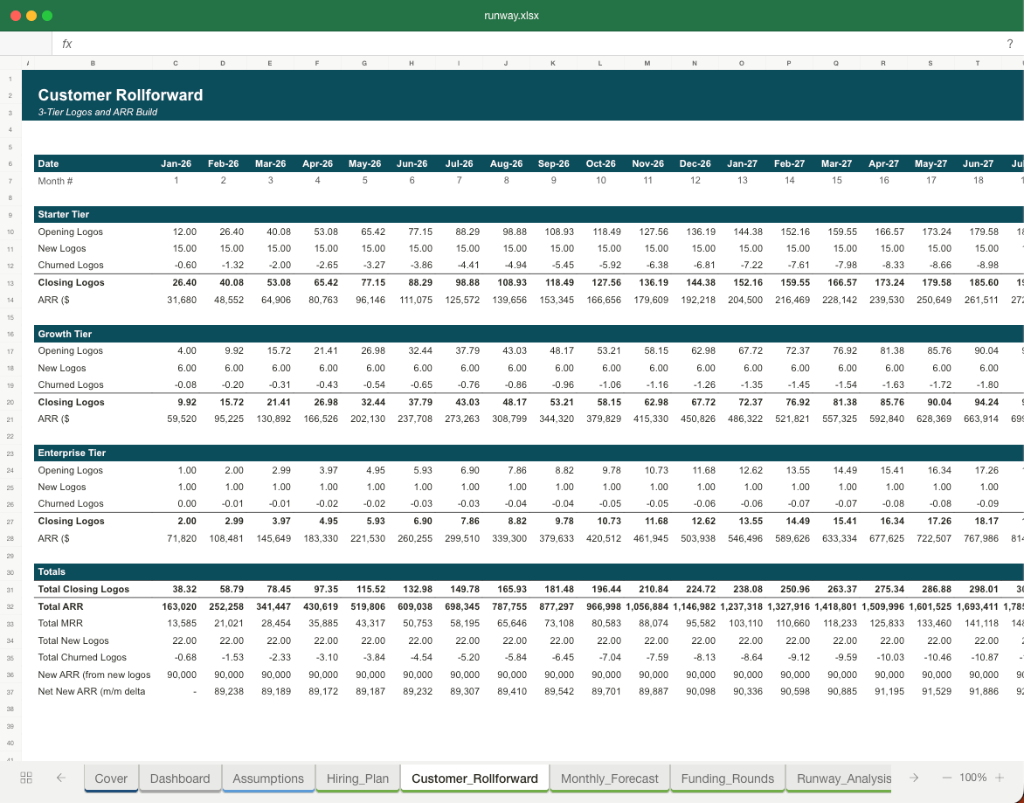
- Logo / ARR bridge (new logos, expansion ARR, churn, net ARR)
- Revenue build (Digital Auths ARR + GMS ARR by cohort)
- P&L (revenue → gross profit → EBITDA)
- Headcount plan (CS, Sales, Eng, G&A)
- Cash / runway (given no disclosed burn rate - model from opex assumptions)
- Scenario toggle (Base / Bull / Bear)
- KPI summary (CARR, logo count, ACV, NRR, gross margin)
Frequently asked
Is the Canary Technologies financial model free?+
Yes. The Canary Technologies model is a free Excel (.xlsx) download with live formulas. Sign up with your email and the workbook is yours to keep, review, and edit.
What's included in the model?+
A 5-year monthly forecast with P&L, cash flow and runway, valuation (exit multiple plus a DCF cross-check), MOIC/IRR returns, and unit economics, with live formulas throughout.
How was this model built?+
It was built from Canary Technologies's pitch deck and publicly available information, then structured to investment-banking standards as a fully editable Excel model.
Can I change the assumptions?+
Yes. You can change assumptions and the live formulas will recalculate in the downloadable Excel model.
Have more financial modelling questions? Contact us

Created by ex-finance professionals
Hey, I’m Alex and I created Finamodel.
Over my years in the finance industry I kept building the same models over and over again. Same structure, same assumptions, different logo. So I started building frameworks to turn them into clean, reusable templates.
Every model here is one I’d actually use for a client, and I personally vet each one before it goes up.
I’m not an expert in every industry, but I’ve built enough models to know what belongs in one. And when something is completely foreign to me, I reach out to my network for experts to work on our models with us.
Having a template library on hand cuts a first build from hours to minutes.
Need help finding your model? You’ll find me in the Finamodel app!
Other PropTech Startup Financial Models
Browse another startup in the same category.

Agora
Agora automates operations for real estate investment firms - investment accounting, fundraising, CRM, investor reporting, portal, and data room in one platform.

Briq
SaaS platform that automates money workflow management (budgeting, forecasting, cash flow, WIP) for construction companies.

Geodesic.Life
Sustainable prefabricated geodesic dome houses for rural development, sold as a design + prefab kit + consultancy bundle to real estate partners.

Huboo
Full-stack, software-driven e-commerce fulfilment network built on a micro-warehousing model, targeting SME merchants across UK and Europe.

Immo
Tech-enabled iBuyer that acquires single-unit/single-family residential properties directly from homeowners, renovates and rents them under the IMMO Homes brand, and aggregates the portfolios into institutional investment products.

Kasa Living
Tech-enabled hospitality operator that manages furnished apartments and hotel units on behalf of property owners, capturing a share of room revenue without owning real estate.
Latch (Door.com)
Latch is an enterprise proptech company selling LatchOS, a full-building smart-access and SaaS operating system for multifamily residential buildings, going public via SPAC merger with TS Innovation Acquisitions Corp. (TSIA).

Minut
IoT sensor + SaaS platform that acts as a "co-host" for short-term rental (STR) properties - monitoring noise, occupancy, safety, and guest experience.