 Cambridge GaN Devices Financial Model
Hardware/Deep-tech Startup Financials (Free Excel Download)
Fabless semiconductor startup commercialising self-protected GaN power transistors (HiGaN) that replace silicon and standard GaN with higher efficiency and no external protection circuitry.



professionals from Deloitte
Used by professionals from






About this model
Cambridge GaN Devices commercialises self-protected gallium-nitride power transistors for more efficient power electronics. Its fabless HiGaN products are designed to replace silicon and standard GaN components without requiring external protection circuitry, potentially simplifying customer designs and improving efficiency.
The important commercial milestone is a design win: customers must qualify the component and then incorporate it into products that ship at scale. Revenue therefore arrives after a potentially long engineering and validation cycle, while manufacturing depends on wafer supply, packaging, testing, and concentrated customer or channel relationships.
Model qualified design wins, time to production, unit shipments, ASP, wafer and packaging cost, test yield, and customer concentration. Include applications engineering, R&D, foundry commitments, sales, and inventory costs. Win rate, qualification timing, shipment ramp, pricing, gross margin, supply yield, and repeat designs should determine scenarios.
A turnkey financial model
Live formulas, no hardcoded values
Outputs are driven by live formulas, so the workbook updates from its assumptions instead of relying on hardcoded results.
All assumptions in one tab
Inputs are clearly marked in the Assumptions tab and separated from calculations, making it clear what to change and what to leave intact.
Statements always balancing
For integrated-statement models, the balance sheet, cash flow, and supporting schedules tie through properly.
Distinct schedules for clarity
Debt, working capital, taxes, and cash flow can get messy quickly. We group calculations in clear schedules, not across disconnected tabs.
No hidden macros or external links
There are no unexplained external workbook links or macros to undermine auditability or portability.
Changes flow through the model
Update a key driver and see the impact carry through the forecast, financing, and return outputs. We never use hardcoded numbers in formulas.
About Cambridge GaN Devices
camgandevices.com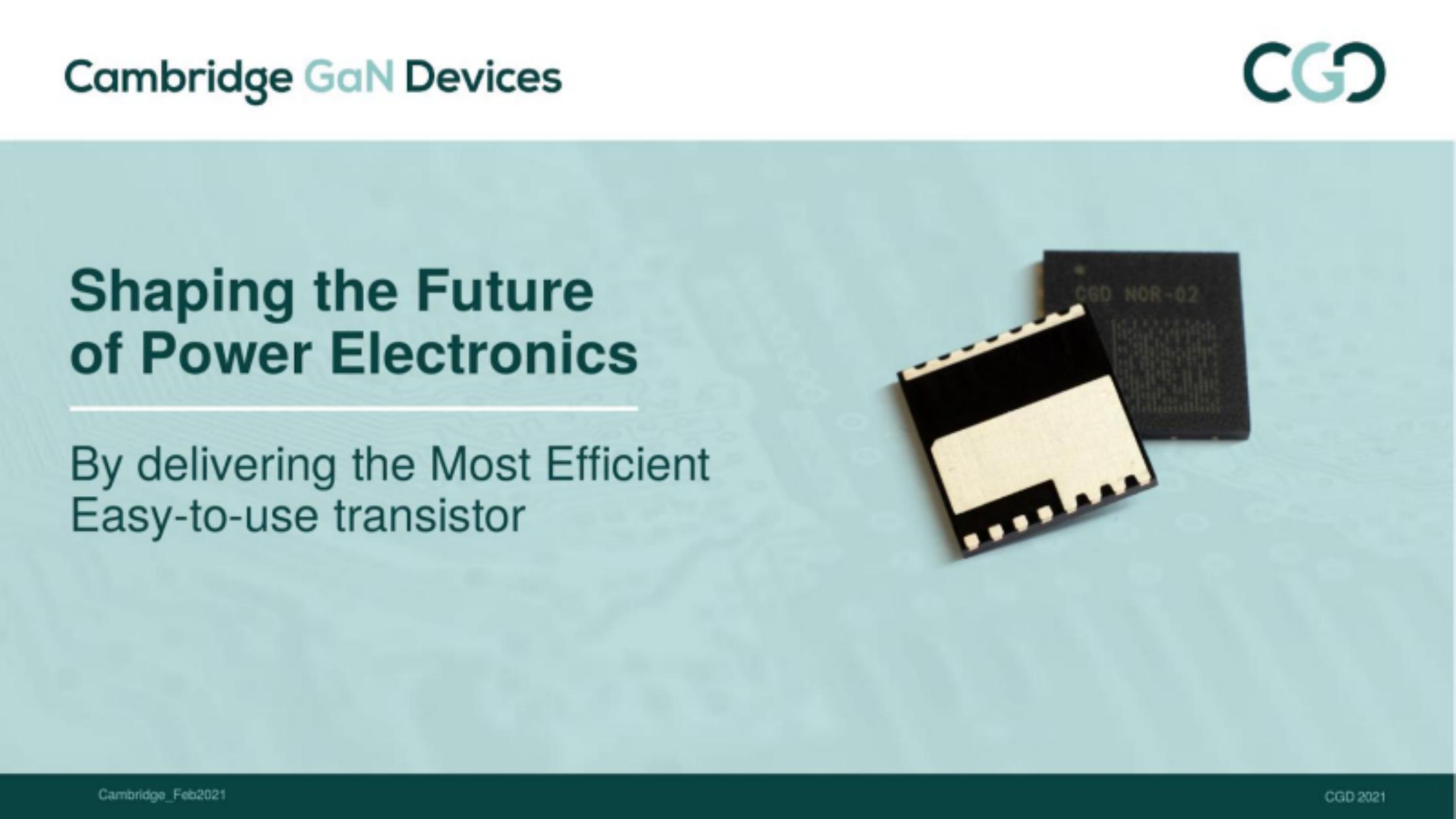
How to build a detailed financial model for Cambridge GaN Devices
A complete walkthrough of the business, drivers, and assumptions behind the downloadable Cambridge GaN Devices model - distilled from its pitch deck and publicly available information.
Product & value proposition
- Product: CGD NOR-02 GaN transistor (visible on cover slide) - a chip with integrated on-chip IC ("HiGaN intelligence") that removes external protection/gate-driver components needed by standard GaN devices.
- Key claims: up to 99% efficiency; switching frequency up to 100× faster than silicon; no additional gate driver, safety, or reliability components required.
- Differentiator vs. standard GaN: standard GaN requires extra external components that degrade efficiency and increase BOM cost; CGD integrates all protection on-chip.
- Markets served: consumer power supplies/chargers, industrial LED drivers, data centre power supplies (OPEX reduction ≥10%, CAPEX reduction up to 10%), automotive on-board chargers and DC-DC converters (50% smaller OBCs).
Market
- TAM: Power semiconductor market = $45 billion.
- SAM (GaN devices sub-market): Predicted to reach over $1 billion by 2026.
- Chart read (slide 7 image): GaN power device market ~$0.05B in 2017, growing to ~$0.2B by 2020, ~$0.6B by 2022, ~$1.1B by 2025, ~$1.75B by 2028. Segments: PSU Computing/Datacenters (largest, dark blue), PSU Consumer/Chargers (mid blue), PSU Other/Lighting (grey), EV/HEV (orange), Other (light blue).
- Implied CAGR (2017–2026, GaN sub-market): ~$0.05B → >$1B over ~9 years ≈ ~40% CAGR.
Revenue model
- Fabless model: CGD designs chips; outsourced fab/packaging supply chain "in place" as of 2019.
- Revenue stream: Component sales (transistors) to OEM/ODM customers - price per unit × volume shipped. No SaaS, licensing, or subscription layer described in deck.
- Channels: Direct B2B engagement ("Customers' engagement" noted 2020, "1st Design-In" noted 2021).
Traction & metrics
- 2016: Founded; 20+ years team GaN experience; 1st prize Cambridge Enterprise competition.
- 2017: First Innovate UK (iUK) project awarded (lead-partner).
- 2018: Second iUK project awarded.
- 2019: BEIS project awarded (green technologies); $2.5M seed fund raised; +4 patent applications; full supply chain in place.
- 2020: $12M European (GaNext/Penta EUREKA) project awarded (lead-partner, 13 partners, 3 countries); customers' engagement commenced; +7 patent applications; engineering samples delivered.
- 2021 (current at time of deck): 1st Design-In achieved; raising $9.5M Series A; IP portfolio = 26 patent applications.
Competition / moat
- Competitors (implied): Standard GaN players (Infineon, NXP, Vishay, On Semi - all cited as team's prior employers implying familiarity with competitive landscape); silicon incumbents (low frequency, lower efficiency).
- Moat: 26 patent applications covering HiGaN integrated protection technology; Cambridge University affiliation and brand; team with direct insider knowledge of competitor products; CTO (Prof. Udrea) with 150+ patent applications and two prior fabless exits (CamSemi → Power Integration; Cambridge CCS → AMS).
- Competitive positioning chart (slide 5): CGD claims highest efficiency (~99%) at highest frequency (1 MHz+), versus standard GaN (high efficiency, hard to use) and silicon (easy to use, lower efficiency/frequency).
Team & funding ask / use of funds
- Dr. Giorgia Longobardi - Founder & CEO; 11 years GaN power device experience; NXP, Infineon, Vishay; led GaN team at Cambridge Engineering Dept.; 12 patent applications.
- Prof. Florin Udrea - Founder & CTO; Cambridge Professor; 150+ patents; prior exits: CamSemi (to Power Integration), Cambridge CCS (to AMS), Camutronix.
- Zahid Ansari - VP Operations; ex-CamSemi VP Operations; scaled to 500,000 ICs/day, 1B+ ICs total.
- Andrea Bricconi - VP Business Development; 20+ years power semiconductors; ex-International Rectifier, Vishay; co-started GaN program at Infineon.
- Funding ask: $9.5M Series A.
- Prior funding: $2.5M seed (2019) + substantial non-dilutive public grants (iUK ×2, BEIS, $12M EU GaNext lead).
- Use of funds: Not explicitly stated. Implied: commercialisation phase - market entry, scaling from engineering samples to volume production.
Recommended financial model
- Archetype + why: Fabless semiconductor revenue P&L + cash burn model. CGD is pre-revenue, selling discrete components (transistors) to OEMs at per-unit ASPs with volume ramp. This is not SaaS, not marketplace, not DTC. The right structure is: unit volume ramp × ASP → revenue; COGS via outsourced fab (wafer cost + packaging + test); gross margin expansion as volumes scale; R&D + SG&A opex; burn rate and runway vs. Series A proceed. No balance sheet complexity needed yet; a 3-statement model is premature pre-revenue - a P&L + cash model suffices.
- Forecast horizon & granularity: 5 years (2021–2025), quarterly for years 1–2, annual for years 3–5. Rationale: first commercial revenues likely 2022 (design-in → production ramp takes 12–18 months); Series A runway and next funding gate are the near-term critical outputs.
- Key drivers & assumptions:
| Driver | Value / Source |
|---|---|
| First revenue year | 2022 |
| Year 1 unit shipments | ~50k–200k units; early ramp with 1–2 anchor customers |
| ASP per unit | $3–$8; GaN transistors in consumer/industrial class; no deck data |
| ASP erosion | ~5–10% per year as competition intensifies |
| Unit volume CAGR (yrs 1–4) | ~100–150% (fabless semi ramp profile); design-wins cascade |
| Gross margin (at scale) | 45–55%; fabless semi benchmark (no fab capex; outsourced wafer/pkg/test costs) |
| Gross margin year 1 | 25–35%; low volumes, high per-unit fab cost |
| R&D opex | $3–4M/year; team salaries + IP maintenance + tape-out costs; partially offset by grant income |
| SG&A opex | $1.5–2.5M/year; small commercial team (CEO/VP BizDev + hires) |
| Grant income (non-dilutive) | ~$1–2M/year ongoing; CGD has strong track record but amounts unconfirmed post-Series A |
| Series A proceeds | $9.5M |
| Seed remaining | partially spent by 2021; treat as near-zero by close of Series A |
| Headcount | 15–25 FTEs by 2022, scaling to 40–60 by 2025 |
| GaN market growth rate | ~40% CAGR through 2026 |
| CGD market share (2025) | 0.5–2% of GaN sub-market; conservative given early entrant status |
| Target segments priority | Data centres → consumer chargers → automotive OBC |
- Scenarios (Base / Bull / Bear):
- Base: First volume revenues in Q2 2022; 2 design-wins by end 2022; gross margin reaches 45% by 2024; Series A funds 24–30 months of runway; Series B needed ~2023.
- Bull: Design-win acceleration (Infineon/Signify GaNext partners convert to customers); automotive OBC design-in by 2023; gross margin 50%+ earlier due to competitive ASP holding.
- Bear: Design-in → production ramp delayed 6–12 months (customer qualification delays are common in semi); single design-win stalls; Series A runway shrinks to 18 months; bridge round required.
- Flex variables: time-to-revenue, design-win count, ASP, gross margin ramp pace, grant income continuity.
- Required sheets / outputs:
- Assumptions dashboard (all drivers in one place, tagged /)
- Revenue build (units × ASP by segment: consumer, industrial/data centre, automotive)
- COGS build (wafer cost + packaging + test per unit; scale curve)
- P&L (revenue → gross profit → EBITDA → net loss)
- Cash flow / burn (operating cash + grant receipts + Series A proceeds; monthly/quarterly runway)
- Headcount & opex schedule
- Scenario toggle (Base / Bull / Bear on key assumptions)
- KPI summary (units shipped, ASP, gross margin %, cash runway in months)
Frequently asked
Is the Cambridge GaN Devices financial model free?+
Yes. The Cambridge GaN Devices model is a free Excel (.xlsx) download with live formulas. Sign up with your email and the workbook is yours to keep, review, and edit.
What's included in the model?+
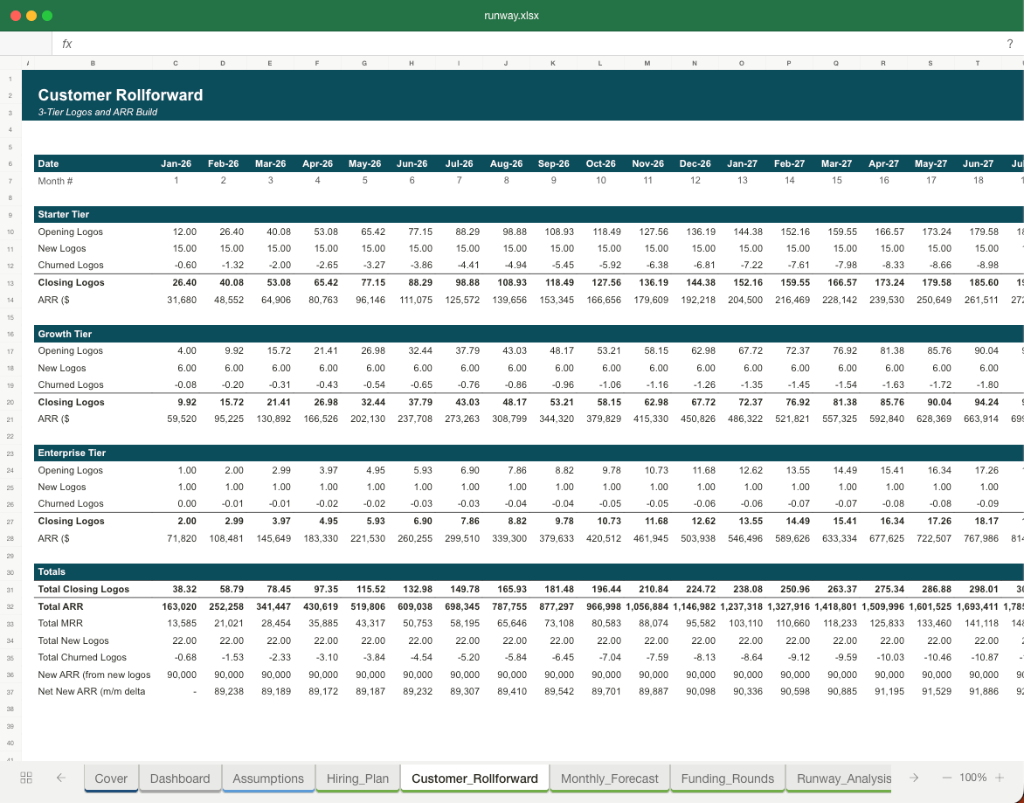
A 5-year monthly forecast with P&L, cash flow and runway, valuation (exit multiple plus a DCF cross-check), MOIC/IRR returns, and unit economics, with live formulas throughout.
How was this model built?+
It was built from Cambridge GaN Devices's pitch deck and publicly available information, then structured to investment-banking standards as a fully editable Excel model.
Can I change the assumptions?+
Yes. You can change assumptions and the live formulas will recalculate in the downloadable Excel model.
Have more financial modelling questions? Contact us

Created by ex-finance professionals
Hey, I’m Alex and I created Finamodel.
Over my years in the finance industry I kept building the same models over and over again. Same structure, same assumptions, different logo. So I started building frameworks to turn them into clean, reusable templates.
Every model here is one I’d actually use for a client, and I personally vet each one before it goes up.
I’m not an expert in every industry, but I’ve built enough models to know what belongs in one. And when something is completely foreign to me, I reach out to my network for experts to work on our models with us.
Having a template library on hand cuts a first build from hours to minutes.
Need help finding your model? You’ll find me in the Finamodel app!
Other Hardware/Deep-tech Startup Financial Models
Browse another startup in the same category.

ANYbotics
ANYbotics builds and sells autonomous legged inspection robots (ANYmal) for industrial facilities, targeting oil & gas, chemicals, power, offshore, mining, and manufacturing sectors.
Awake Security
Awake Security - AI-driven Network Detection & Response (NDR) platform for the hybrid cloud, positioning as the "intent detection" layer of the SOC visibility triad.

Beem
AR communications platform that overlays full-body "hologram" video of a person into the recipient's physical space via smartphone or web.

Blue White Robotics
Autonomous robotics platform converting existing farm equipment to self-driving tractors for permanent-crop growers, sold as Robots-as-a-Service.

Canix
Cannabis-focused ERP (inventory tracking, compliance automation, sales management, yield forecasting) sold as SaaS to cannabis cultivators, manufacturers, and distributors.
Chobani
Chobani is the US market leader in Greek yogurt; TPG invested $671M in April 2014 for a 35% stake via a structured second lien + equity deal
Cipher Skin
Wearable sensor mesh platform that collects dense multi-modal data from human bodies and industrial objects to predict structural and functional failure before it occurs.

Citylitics
B2B SaaS intelligence platform that aggregates and curates public-sector infrastructure procurement data for private-sector vendors, suppliers, and consultants.