CSCipher Skin Financial Model
Hardware/Deep-tech Startup Financials (Free Excel Download)
Wearable sensor mesh platform that collects dense multi-modal data from human bodies and industrial objects to predict structural and functional failure before it occurs.



professionals from Deloitte
Used by professionals from






About this model
Cipher Skin builds wearable sensor mesh that captures dense data from people and industrial objects. The platform is intended to detect structural or functional deterioration before failure occurs, creating applications that combine physical sensing hardware with software interpretation of continuous data streams.
The commercial model can blend sensor deployments with recurring software access and data usage. Enterprise adoption will depend on proving that dense sensing improves maintenance, safety, or performance decisions enough to justify installation and integration into existing operational workflows, often through long validation and procurement cycles.
Model sensor deployments, units per customer, hardware ASP, software subscriptions, data usage, and expansion by use case. Deduct sensor manufacturing, installation, connectivity, cloud processing, analytics, field support, and enterprise sales costs. Pilot conversion, deployment scale, hardware margin, data usage, sales-cycle length, and renewal should drive scenarios.
A turnkey financial model
Live formulas, no hardcoded values
Outputs are driven by live formulas, so the workbook updates from its assumptions instead of relying on hardcoded results.
All assumptions in one tab
Inputs are clearly marked in the Assumptions tab and separated from calculations, making it clear what to change and what to leave intact.
Statements always balancing
For integrated-statement models, the balance sheet, cash flow, and supporting schedules tie through properly.
Distinct schedules for clarity
Debt, working capital, taxes, and cash flow can get messy quickly. We group calculations in clear schedules, not across disconnected tabs.
No hidden macros or external links
There are no unexplained external workbook links or macros to undermine auditability or portability.
Changes flow through the model
Update a key driver and see the impact carry through the forecast, financing, and return outputs. We never use hardcoded numbers in formulas.
About Cipher Skin
cipherskin.com
How to build a detailed financial model for Cipher Skin
A complete walkthrough of the business, drivers, and assumptions behind the downloadable Cipher Skin model - distilled from its pitch deck and publicly available information.
Product & value proposition
Three-layer stack:
- Cipher Mesh - flexible sensor mesh that wraps cylinders and flat surfaces; measures movement, strain, temperature, moisture, vibration, biometrics simultaneously across the full object.
- Digital Mirror™ - iOS/iPad app that renders real-time 3D visualization of the monitored object from the mesh data stream; displays biometrics dashboard (heart rate, blood pressure, O2 saturation, HRV, VO2, EKG, respiration rate/depth, lactic threshold).
- Cipher Cloud - cloud data aggregation via API; builds longitudinal dataset enabling predictive analytics and failure prediction.
Go-to-market model: customer-sponsored co-development → 90-day pilot (product package purchase) → multi-year data subscription conversion.
Current products (shipped): Pipe Sleeve, Knee BioSleeve, Arm BioSleeve, BioHelmet. Upcoming products: BioLegs (leggings), BioShirt (tee-shirt). Product roadmap tied to "cylinders monitored": Sleeve (1 cylinder, 12 mo) → Leggings (2 cylinders, 24 mo) → Tee-Shirt (3 cylinders, 36 mo).
IP: 9 granted US patents, 18+ patents pending.
Market
- Combined TAM across sample applications: >$700 billion by ~2023–2026.
- Life sciences (majority): $650 billion by 2024.
- Remote monitoring: $27 billion by 2023.
- Oil & gas monitoring: $9 billion by 2026.
- Market sizing methodology: Third-party market figures cited without sources; used to frame opportunity, not bottoms-up. Figures aggregate very different markets (life sciences is broadly defined).
Revenue model
Two-part model implied by the co-development process slide:
- Hardware / product package sale - upfront purchase of Cipher Skin product package (device + Digital Mirror app + initial cloud access). No price points disclosed.
- Multi-year data subscription - recurring contract for Cipher Cloud data aggregation, access to anonymized database, and predictive analytics insights. No pricing tiers, ASP, or contract lengths disclosed.
Channels: Direct enterprise sales (pilots with early partner customers); trade shows mentioned for marketing. Consumer vs. enterprise: Primary go-to-market is enterprise/institutional (athletic teams, industrial operators, healthcare providers), not direct-to-consumer.
Traction & metrics
- Seed raised: $1.35M
- Employees: 20
- Patents: 9 granted US patents, 18+ pending
- Products shipped: Pipe Sleeve, Knee BioSleeve, Arm BioSleeve, BioHelmet
Competition / moat
- Moat claims (from product/vision slides): 9 granted patents + 18+ pending; proprietary "Cipher Mesh" sensor architecture capturing simultaneous multi-modal data pinned to a common timeline across the full object (vs. isolated point sensors); unique longitudinal dataset accumulating in Cipher Cloud.
Team & funding ask / use of funds
Founders:
- Phillip Bogdanovich (CEO) - former USMC Recon Corpsman, former Tactical Medical Chief (Dept. of State), Harvard Business School; two prior tech startups taken to several million dollars in revenue.
- Dr. Shaka Bahadu (Co-founder) - Weill Cornell MD, Stanford GSB MBA; healthcare ops / clinical informaticist; experience at two Y Combinator digital health startups pre- and post-Series A.
Key hires: CSO (Ph.D. biosignals), Head of Engineering (PhD computer science, wearable tech), VP Marketing, mechanical engineers (sports + biomedical), electrical engineer (ex-Lockheed Martin).
Round: Series A (size not stated).
Use of funds (categories, no dollar amounts):
- Engineering & Legal: software dev (full stack, back-end, mobile iOS, data science, QA), pilot manufacturing, materials/equipment, university research, sponsorships, patent filing, FCC licensing.
- Sales & Marketing: sales reps, customer success, product marketing, trade shows.
- Operations: COGS for operating/supporting pilots, office operations.
Note: Deck references a "Detailed Proforma" as a separate document - actual Series A ask size and proforma financials are not in this deck.
Recommended financial model
Archetype + why: Hardware + SaaS subscription (two-part IoT revenue model). The business sells a physical sensor product upfront (one-time hardware revenue) then converts customers to recurring multi-year data subscriptions (recurring SaaS-style revenue). The appropriate model is a hardware + recurring revenue 3-statement model with separate hardware P&L and subscription ARR build, similar to a med-device / industrial IoT company. Not a pure SaaS model because hardware COGS and inventory are material. Not a marketplace. Not M&A/SPAC.
Forecast horizon & granularity:
- 5-year annual model (Year 1–5), monthly in Year 1 to reflect pilot conversion dynamics.
- Year 1 = sleeve commercialization ramp; Year 2 = leggings added; Year 3 = tee-shirt added. Align to roadmap milestones.
Key drivers & assumptions:
*Revenue - Hardware*
- Units sold per product line per year: start 50–200 units/year in Y1 (pilot-stage enterprise, not consumer scale); scale 2–3x annually as commercialization completes.
- ASP hardware per unit: $1,500–$5,000 depending on product (BioSleeve vs. Pipe Sleeve); enterprise hardware pricing typical for medical-grade wearables. No deck data.
- Product lines active: Sleeve Y1, Leggings Y2, Tee-Shirt Y3.
*Revenue - Subscription*
- Pilot-to-subscription conversion rate: 60–70%; 90-day pilot window.
- Annual subscription ASP per customer: $10,000–$50,000/year (enterprise contract for cloud data + analytics); no pricing in deck.
- Contract length: 2–3 years (deck says "multi-year"); model as 3-year.
- Churn rate: 10–15%/year annual logo churn; early-stage enterprise benchmark.
- Subscription lag: 90 days post hardware sale before subscription starts.
*COGS*
- Hardware COGS: 50–60% of hardware ASP at pilot volumes; expect improvement to 35–45% at scale; typical for custom IoT hardware.
- Subscription COGS (hosting, support): 15–20% of subscription revenue.
*Opex*
- Headcount: grow from 20 employees today to ~40 by end Y1, ~65 by Y2, ~90 by Y3 per roadmap investment.
- Engineering & Legal spend: ~50% of Opex in Y1 (software-heavy build-out).
- Sales & Marketing: ~25–30% of Opex; ramps with commercialization.
- Operations: ~15–20% of Opex.
*Balance sheet / cash*
- Series A raised: $5–$10M (not stated in deck; typical range for an IoT/wearable startup at this stage with $1.35M seed already raised).
- Runway target: 18–24 months post-raise.
- Inventory: will need working capital model for hardware builds; 60–90 days inventory on hand.
Scenarios (Base / Bull / Bear):
- Flex variables: pilot-to-subscription conversion rate, hardware ASP, subscription ASP, sales cycle length, headcount ramp, Series A size.
- Bear: Conversion rate 40%, low ASP, slower product launches (Leggings delayed to Y3).
- Base: Conversion rate 65%, mid ASP, roadmap on schedule.
- Bull: Conversion rate 80%, premium ASP, industrial (pipe) channel takes off alongside bio, faster hiring.
Required sheets / outputs:
- Assumptions dashboard (all drivers in one place, toggle scenarios)
- Revenue build - Hardware: units × ASP by product line
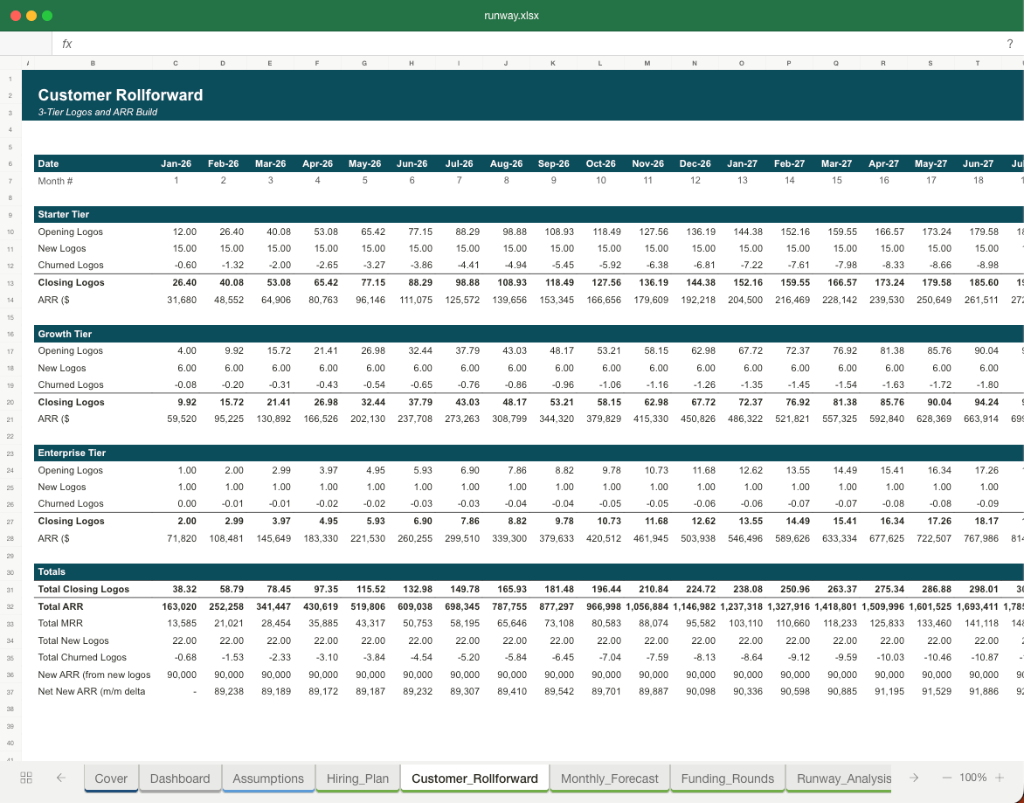
- Revenue build - Subscription: cohort waterfall (new customers, conversions, churned, total active)
- Income Statement (monthly Y1, annual Y1–Y5): hardware revenue, subscription revenue, hardware COGS, subscription COGS, gross profit, Opex by category, EBITDA, D&A, EBIT, interest, taxes, net income
- Balance Sheet (annual): cash, inventory, PP&E, deferred revenue, equity
- Cash Flow Statement (annual): OCF, capex, financing (Series A)
- Headcount schedule by department
- Unit economics summary: hardware gross margin %, subscription gross margin %, blended gross margin %, LTV/CAC (once CAC assumptions added), payback period
- Runway / cash waterfall chart
Frequently asked
Is the Cipher Skin financial model free?+
Yes. The Cipher Skin model is a free Excel (.xlsx) download with live formulas. Sign up with your email and the workbook is yours to keep, review, and edit.
What's included in the model?+
A 5-year monthly forecast with P&L, cash flow and runway, valuation (exit multiple plus a DCF cross-check), MOIC/IRR returns, and unit economics, with live formulas throughout.
How was this model built?+
It was built from Cipher Skin's pitch deck and publicly available information, then structured to investment-banking standards as a fully editable Excel model.
Can I change the assumptions?+
Yes. You can change assumptions and the live formulas will recalculate in the downloadable Excel model.
Have more financial modelling questions? Contact us

Created by ex-finance professionals
Hey, I’m Alex and I created Finamodel.
Over my years in the finance industry I kept building the same models over and over again. Same structure, same assumptions, different logo. So I started building frameworks to turn them into clean, reusable templates.
Every model here is one I’d actually use for a client, and I personally vet each one before it goes up.
I’m not an expert in every industry, but I’ve built enough models to know what belongs in one. And when something is completely foreign to me, I reach out to my network for experts to work on our models with us.
Having a template library on hand cuts a first build from hours to minutes.
Need help finding your model? You’ll find me in the Finamodel app!
Other Hardware/Deep-tech Startup Financial Models
Browse another startup in the same category.

ANYbotics
ANYbotics builds and sells autonomous legged inspection robots (ANYmal) for industrial facilities, targeting oil & gas, chemicals, power, offshore, mining, and manufacturing sectors.
Awake Security
Awake Security - AI-driven Network Detection & Response (NDR) platform for the hybrid cloud, positioning as the "intent detection" layer of the SOC visibility triad.

Beem
AR communications platform that overlays full-body "hologram" video of a person into the recipient's physical space via smartphone or web.

Blue White Robotics
Autonomous robotics platform converting existing farm equipment to self-driving tractors for permanent-crop growers, sold as Robots-as-a-Service.

Cambridge GaN Devices
Fabless semiconductor startup commercialising self-protected GaN power transistors (HiGaN) that replace silicon and standard GaN with higher efficiency and no external protection circuitry.

Canix
Cannabis-focused ERP (inventory tracking, compliance automation, sales management, yield forecasting) sold as SaaS to cannabis cultivators, manufacturers, and distributors.
Chobani
Chobani is the US market leader in Greek yogurt; TPG invested $671M in April 2014 for a 35% stake via a structured second lien + equity deal

Citylitics
B2B SaaS intelligence platform that aggregates and curates public-sector infrastructure procurement data for private-sector vendors, suppliers, and consultants.