COConnectly Financial Model
Enterprise/Security Startup Financials (Free Excel Download)
AI-powered cloud platform for message-based marketing, enabling businesses to convert 2-way WhatsApp/SMS conversations into revenue.



professionals from Deloitte
Used by professionals from






About this model
Connectly helps businesses turn two-way WhatsApp and SMS conversations into marketing and commerce activity. Its cloud platform applies AI to message-based customer engagement, giving businesses a way to automate campaigns and conversations in channels customers already use.
The commercial model blends subscription software with messaging usage. That makes the business more nuanced than a pure seat-based SaaS product: subscription ARR supports the platform, while message volume carries pass-through costs and a separate margin profile.
The model builds those two revenue streams separately, forecasting accounts and subscription tiers alongside messages sent, price per message, and carrier costs. Expansion, retention, gross margin, sales costs, and a payments take-rate toggle show how product adoption converts into revenue and cash flow.
A turnkey financial model
Live formulas, no hardcoded values
Outputs are driven by live formulas, so the workbook updates from its assumptions instead of relying on hardcoded results.
All assumptions in one tab
Inputs are clearly marked in the Assumptions tab and separated from calculations, making it clear what to change and what to leave intact.
Statements always balancing
For integrated-statement models, the balance sheet, cash flow, and supporting schedules tie through properly.
Distinct schedules for clarity
Debt, working capital, taxes, and cash flow can get messy quickly. We group calculations in clear schedules, not across disconnected tabs.
No hidden macros or external links
There are no unexplained external workbook links or macros to undermine auditability or portability.
Changes flow through the model
Update a key driver and see the impact carry through the forecast, financing, and return outputs. We never use hardcoded numbers in formulas.
About Connectly
connectly.com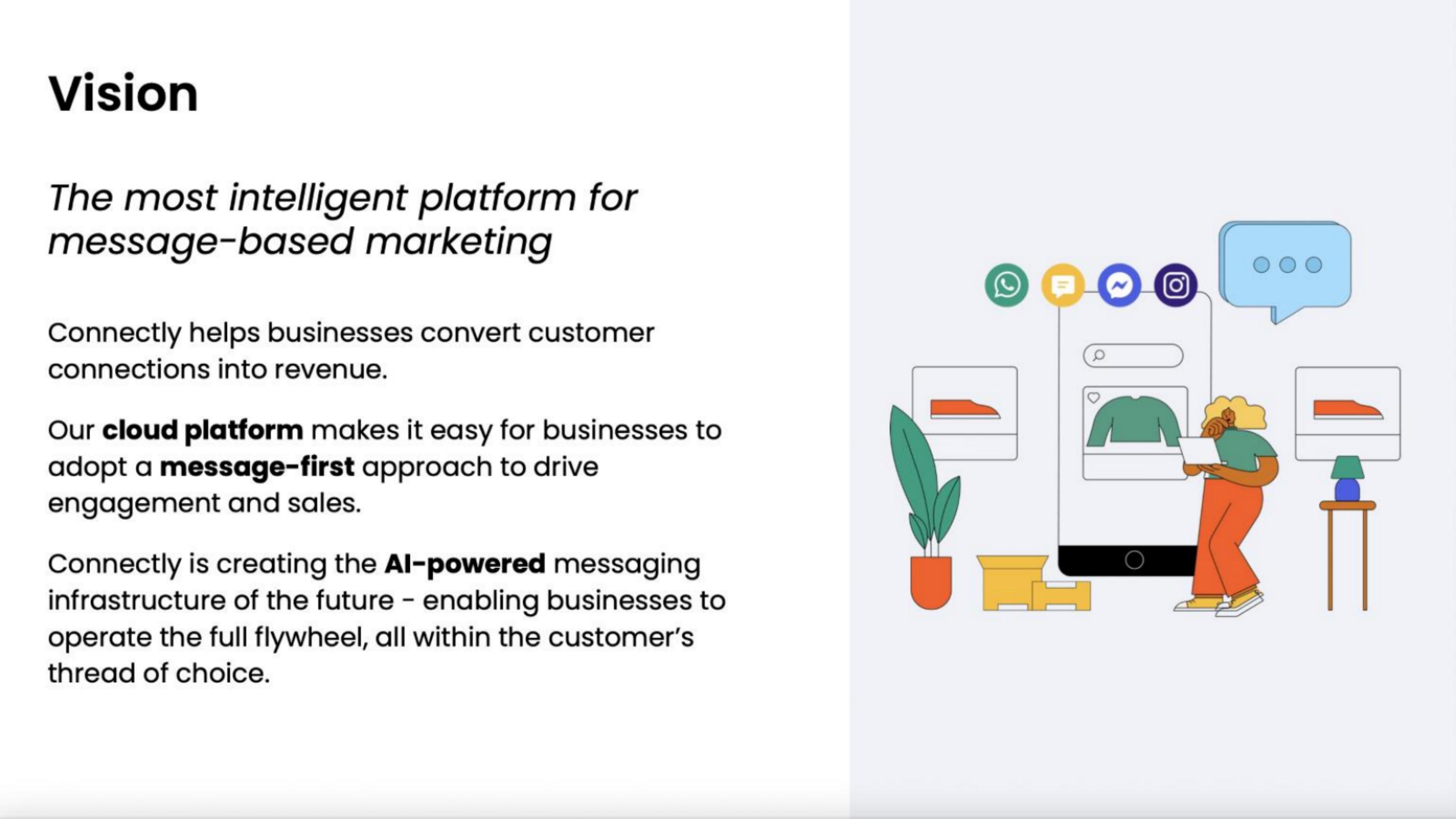
How to build a detailed financial model for Connectly
A complete walkthrough of the business, drivers, and assumptions behind the downloadable Connectly model - distilled from its pitch deck and publicly available information.
Product & value proposition
- Cloud platform enabling businesses to run two-way, AI-personalized messaging across WhatsApp, SMS, and other channels.
- Core modules: Unified Inbox, insight-driven dashboard, CRM integrations, campaign/broadcast automation, website widget, in-message payments.
- WhatsApp Business Solution Provider (BSP) - direct API access, no-code campaign builders, 2-way communication at scale.
- AI layer: message prioritization, tagging, routing, personalized recommendations, sales/agent assistant, conversational analytics.
- Full-funnel: lead gen → transactions → retargeting, all within the customer's preferred thread.
Market
- CPaaS TAM: ~$72B; source: Goldman Sachs Software Report, December 2021.
- CPaaS TAM growth: 30%+ per year, 2022–2025.
- Chart (sl.6) shows Communication Platforms (CPaaS) TAM ~$70B (blue bar), Cloud TAM 2020 ~$2B (red), Cloud TAM 2025 ~$17B (yellow) - rough reads off bar chart axes (0–100 scale).
- Adjacent categories in same chart: UCaaS (~$95B TAM), CCaaS (~$25B TAM), CEM (~$15B), Project Mgmt (~$35B), DaaS (~$20B).
- Consumer pull stats: 2.5B+ WhatsApp monthly active users; >80% of people perceive businesses positively if they can message them; 9/10 people want to communicate with businesses via messaging; 95% of texts opened within 3 min.
Revenue model
Three revenue streams:
- Subscription (platform license): Monthly license fee for marketing & automation + notification tools. Tiered by segment.
- Message pass-through margin: Cost per message (WhatsApp, SMS) charged to customers at a ~5–20% margin over carrier/Meta cost.
- Payments in thread: Take-rate (% of transaction value) on in-message payment transactions.
Expected average ACVs:
- SMB DIY: $2K – $20K per year.
- Enterprise: $30K – $200K+ per year.
Traction & metrics
- Customers: ~60.
- Top markets: Brazil, India, US, Indonesia.
- Verticals: eCommerce, Fintech, Travel, Healthcare.
- Use cases: Marketing, OTP (one-time passwords).
- No ARR, MRR, or revenue figures disclosed in deck.
Case study - Treinta (sl.12):
- 10x better performance than other channels.
- >80% read rates.
- >60% CTR.
Case study - ISA Lab (sl.13):
- 60% customer response rate.
- Average 5 campaigns sent per day.
- ~2K messages sent per week.
Unit economics
- Message margin: ~5–20% over wholesale cost.
- Subscription pricing range implies mid-market ACV of ~$11K (SMB midpoint) to ~$115K (Enterprise midpoint).
Competition / moat
Moat claims:
- WhatsApp BSP status (direct API access) - structural barrier; most competitors lack it.
- No-code campaign builders vs. developer-only alternatives.
- 2-way AI understanding of conversation context vs. outbound-only incumbents.
- Built-in CRM integration and conversational analytics.
Competitive gap vs. existing solutions:
- Incumbent tools focus on outbound automation, lack personalization, no direct API access, poor integrations, unable to prioritize inbound messages.
Team & funding ask / use of funds
Team:
- Stefanos Loukakos - Co-founder & CEO.
- Yandong Liu - Co-founder & CTO.
- Joscha Koepke - Head of Product.
- Vincent Lan Shi - Head of Design.
- Isabelle Brenton - Head of Marketing.
- Juliana Schlesinger Felippe - Head of Sales, LATAM.
- Engineering team: ~8 engineers (AI/ML, frontend, backend, full-stack).
Recommended financial model
- Archetype + why: B2B SaaS + CPaaS usage-based hybrid. The business has two distinct P&L layers that must be modelled separately: (a) a subscription ARR engine (seat/tier-based license) and (b) a message-volume margin engine (gross-margin pass-through on WhatsApp/SMS volume). A third nascent stream - payments take-rate - is too early for a dedicated module but should be a toggle. This is closest to a "SaaS + usage" combo model, similar to Twilio or Intercom.
- Forecast horizon & granularity: 3 years monthly (months 1–36), then annual summary for years 4–5. Monthly granularity needed because both new customer adds and message volume ramp are irregular and early-stage.
- Key drivers & assumptions:
*Customer / ARR drivers:*
- Starting customers: 60
- New logo adds per month: 5–10/month, ramping with sales headcount; no deck data on growth rate
- SMB vs. Enterprise mix: 70% SMB / 30% Enterprise initially, shifting to 50/50 by Year 3 as GTM matures
- SMB ACV: $11K midpoint
- Enterprise ACV: $115K midpoint
- Annual logo churn: 10% SMB / 5% Enterprise - early-stage SaaS benchmarks; no retention data in deck
- Net Revenue Retention: 110–120% - usage-based component drives expansion; no deck data
*Message volume drivers:*
- Messages per customer per month: 5,000 avg for SMB / 50,000 avg for Enterprise; based on ISA Lab case (~2K/week = ~8K/month for small healthcare customer)
- Message volume growth per customer per month: 5% MoM as customers expand campaigns
- Wholesale cost per message (WhatsApp): $0.005–$0.008 (Meta published BSP pricing range); not in deck
- Margin on messages: ~5–20%; model at 12% midpoint
*Payments stream:*
- Take-rate on in-thread transactions: 1–2% of GMV; toggle off by default until Year 2
- GMV per transacting customer: low volume in early periods; not in deck
*Cost drivers:*
- Gross margin on subscription: 70–75% - typical SaaS infra + support cost; no data in deck
- Gross margin on messaging: 5–20% pass-through; use 12%
- Blended gross margin: 55–65%, improving as subscription grows faster than messaging
- S&M as % of revenue: 40–50% early (customer 60 signal indicates sales-led, not PLG)
- R&D as % of revenue: 30–35%; engineering team is ~8 people
- G&A: 15–20% of revenue
- Scenarios (Base / Bull / Bear - which variables flex):
- Base: 7 new logos/month, SMB/Enterprise 70/30 mix, 12% message margin, 10%/5% churn.
- Bull: 12 new logos/month, faster shift to Enterprise (50/50 by Year 2), 15% message margin, 5%/2% churn, payments take-rate live Year 1.
- Bear: 4 new logos/month, stays SMB-heavy (80/20), 8% message margin (pricing pressure), 15%/8% churn, payments take-rate delayed to Year 3.
- Required sheets / outputs:
- Assumptions - all drivers centralized with scenario toggle (Base/Bull/Bear).
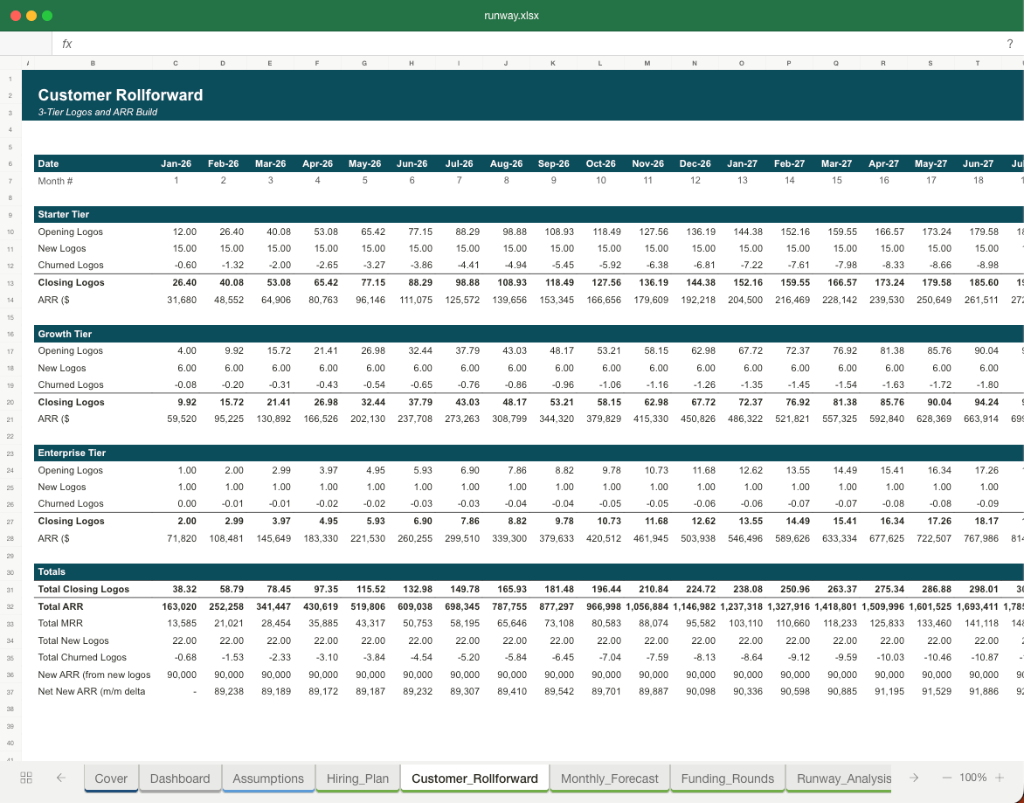
- Customer Cohort Model - monthly logo adds, churn, and net active customers by segment (SMB / Enterprise).
- ARR Bridge - new ARR, expansion ARR, churned ARR, net new ARR, ending ARR.
- Message Revenue - volume × per-message revenue × margin; separate from subscription P&L.
- Income Statement (P&L) - subscription revenue + messaging revenue + payments revenue; COGS split by stream; gross profit; OpEx (S&M, R&D, G&A); EBITDA; net income.
- Headcount Plan - sales, engineering, product, G&A; feeds S&M and R&D cost lines.
- Cash Flow / Runway - operating cash flow, capex, ending cash; critical given no funding ask is disclosed but this is clearly pre-profitability.
- KPI Dashboard - ARR, MRR, customer count, NRR, blended gross margin, burn rate, months of runway.
Frequently asked
Is the Connectly financial model free?+
Yes. The Connectly model is a free Excel (.xlsx) download with live formulas. Sign up with your email and the workbook is yours to keep, review, and edit.
What's included in the model?+
A 5-year monthly forecast with P&L, cash flow and runway, valuation (exit multiple plus a DCF cross-check), MOIC/IRR returns, and unit economics, with live formulas throughout.
How was this model built?+
It was built from Connectly's pitch deck and publicly available information, then structured to investment-banking standards as a fully editable Excel model.
Can I change the assumptions?+
Yes. You can change assumptions and the live formulas will recalculate in the downloadable Excel model.
Have more financial modelling questions? Contact us

Created by ex-finance professionals
Hey, I’m Alex and I created Finamodel.
Over my years in the finance industry I kept building the same models over and over again. Same structure, same assumptions, different logo. So I started building frameworks to turn them into clean, reusable templates.
Every model here is one I’d actually use for a client, and I personally vet each one before it goes up.
I’m not an expert in every industry, but I’ve built enough models to know what belongs in one. And when something is completely foreign to me, I reach out to my network for experts to work on our models with us.
Having a template library on hand cuts a first build from hours to minutes.
Need help finding your model? You’ll find me in the Finamodel app!
Other Enterprise/Security Startup Financial Models
Browse another startup in the same category.
AgBiome
AgBiome is a microbial-platform agtech company that discovers, develops, and commercialises biological crop protection products (and licences the platform across adjacent markets).

Alation
Enterprise data intelligence platform - data catalog, governance, and metadata management for large organisations.

Archer SPAC
Archera
Cloud resource automation platform that continuously optimizes AWS commitment purchases, de-risks overcommitment, and automates FinOps workflows.

Ardoq
Cloud-native Enterprise Architecture (EA) SaaS platform that helps large enterprises navigate digital transformation through automated data collection, graph-based architecture modelling, and change impact analysis.

Ascend
Ascend.io is an enterprise big data automation platform ("Enterprise Intelligence Platform") that abstracts away the complexity of big data engineering so non-experts can build and run data pipelines.

Athennian
Cloud-based legal entity management system (EMS) uniting entity data with workflow and document automation.

Auditboard
Cloud-based integrated risk management platform connecting audit, risk, compliance, and ESG teams across the enterprise.