 Craft.io Financial Model
Enterprise/Security Startup Financials (Free Excel Download)
SaaS product management platform that serves as a unified system-of-record for digital product teams.



professionals from Deloitte
Used by professionals from






About this model
Craft.io is a product-management platform that acts as a system of record for digital product teams. It brings feedback, feature definition, prioritisation, capacity planning, roadmap visualisation, and execution into a connected workflow.
The company serves both enterprise and mid-market software organisations, with a higher-touch proof-of-concept and onboarding path for larger accounts alongside a more transactional self-serve path for smaller customers. Its positioning is centred on reducing disconnected tools and alignment gaps.
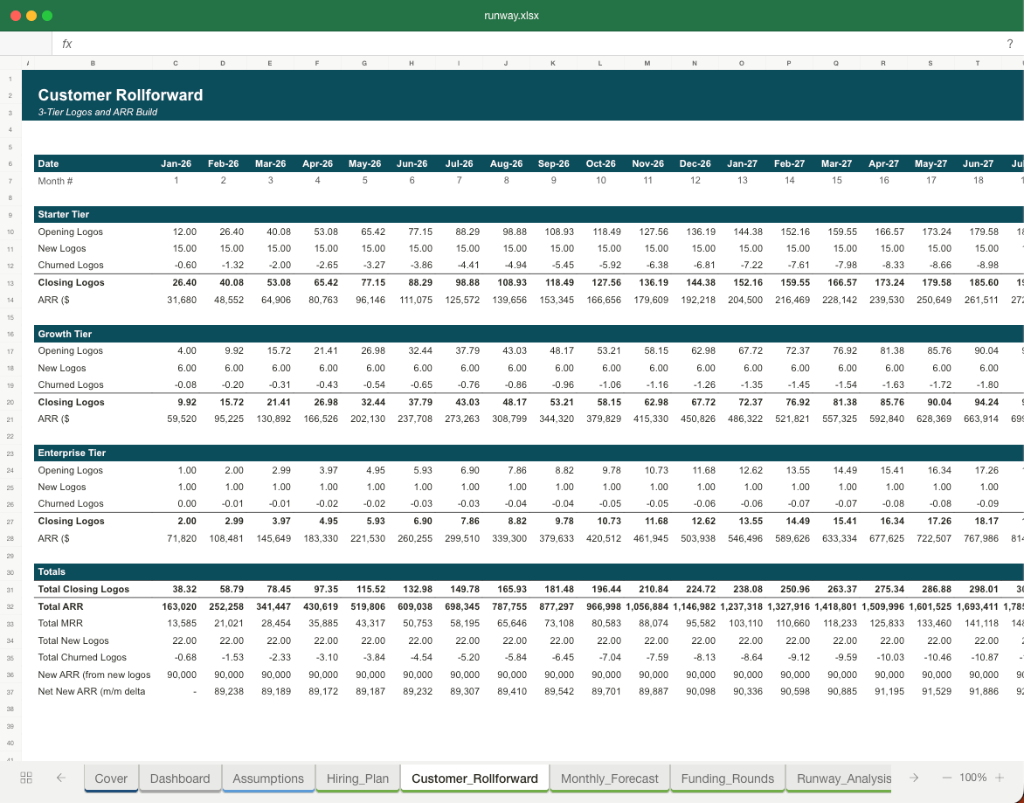
The model builds ARR from new enterprise and self-serve customers, team-based pricing, expansion, and churn. Separate funnel assumptions reflect the two sales motions, while implementation support, gross margin, marketing, sales hiring, and operating expenses determine the runway.
A turnkey financial model
Live formulas, no hardcoded values
Outputs are driven by live formulas, so the workbook updates from its assumptions instead of relying on hardcoded results.
All assumptions in one tab
Inputs are clearly marked in the Assumptions tab and separated from calculations, making it clear what to change and what to leave intact.
Statements always balancing
For integrated-statement models, the balance sheet, cash flow, and supporting schedules tie through properly.
Distinct schedules for clarity
Debt, working capital, taxes, and cash flow can get messy quickly. We group calculations in clear schedules, not across disconnected tabs.
No hidden macros or external links
There are no unexplained external workbook links or macros to undermine auditability or portability.
Changes flow through the model
Update a key driver and see the impact carry through the forecast, financing, and return outputs. We never use hardcoded numbers in formulas.
About Craft.io
craft.io
How to build a detailed financial model for Craft.io
A complete walkthrough of the business, drivers, and assumptions behind the downloadable Craft.io model - distilled from its pitch deck and publicly available information.
Product & value proposition
- End-to-end product management platform for the "entire team" spanning vision, strategy, roadmap, prioritisation, capacity planning, roadmap visualisation, and execution.
- Positioned as a "system-of-record" for product - a single source of truth integrated into existing engineering/delivery processes.
- Six core workflow modules: Feedback → Feature Definition → Prioritisation → Capacity Planning → Roadmap Visualisation → Execution, plus third-party integrations.
- Addresses three pain points: disconnected tools creating duplicative work; knowledge-dissemination gaps; mistrust between business and technology units.
Market
- TAM chart shown across three horizons (2021 → 2023 → 2025) with three expanding layers, but all dollar values are redacted as "$xxB" - no numeric TAM disclosed.
- Three-tier market framing:
- 2021 horizon: tools for product managers in large organisations (workflow / skeleton layer).
- 2023 horizon: product data / customer understanding layer.
- 2025 horizon: enterprise product data integration layer (full organisational scope).
- Third-party growth signals cited:
- "By 2023, over 75% of product managers will leverage product management and roadmapping tools."
- Digital adoption index (McKinsey): 20 → 20 → 36 → 58 (June 2017, May 2018, Dec 2019, July 2020), described as 3 years ahead of the 2017–2019 adoption rate.
- 60% of customer interactions are now digital (McKinsey).
- "80% of IT organizations will experience radical restructuring to embrace the product management operating model."
Revenue model
- SaaS subscription platform. Specific pricing tiers, ARPU, or seat-based vs. usage-based structure not disclosed in deck.
- GTM channels: paid + organic inbound (50/50 split targeting MQLs) → email/in-app SQL conversion; opportunistic outbound via outsourced SDR and events.
- Segmented sales: large-value customers → light/full POC with CS involvement; small-value customers → transactional self-serve sales path.
- High-touch onboarding for enterprise (e.g. Kimberly-Clark, Fannie Mae referenced as named enterprise logos).
Competition / moat
- Not explicitly shown as a competitor slide; however, the deck frames Craft.io as differentiated from "suboptimal project management tools" (implied: Jira, Asana, Monday, Aha!, ProductBoard).
- Moat framing: product-management-specific depth (vs. generic project management), integration layer, and enterprise knowledge-dissemination capability.
Team & funding ask / use of funds
- Co-Founder, CEO: Elad Simon - prior roles: Google (Head of SMB Marketing, EMEA), Taboola (VP SMB and Media Ops).
- Co-Founder, CPO & CTO: Roni Ben-Aharon - prior roles: Wix (Head of Wix Insights), Booking.com (ML Product Manager).
- Advisors: Amir Shevat (CPO, Reshuffle / ex-Google), Asaf Gover (VP Product, Taboola), Roi Carmel (CEO, Spotlight.ai / ex-HP).
Recommended financial model
- Archetype + why: SaaS ARR model. Craft.io sells a B2B subscription platform to enterprise and mid-market teams; the natural unit of value is ARR built from new bookings, expansion, and churn. A seat-based or team-based driver structure fits the stated segmentation (large enterprise vs. self-serve SMB). A lightweight 3-statement wrapper is worth including to show cash burn and runway.
- Forecast horizon & granularity: 3 years (2021–2023 monthly for years 1–2, then annual for year 3), matching the company's own TAM phasing. Monthly granularity needed to model sales ramp and cash burn for fundraising purposes.
- Key drivers & assumptions:
| Driver | Value |
|---|---|
| Starting ARR | Unknown |
| New logo adds per month (enterprise) | 2–4 per month |
| New logo adds per month (SMB/self-serve) | 10–20 per month |
| Enterprise ACV | $30–60k |
| SMB ACV | $5–15k |
| Net Revenue Retention | 110–120% |
| Gross logo churn (annual) | 10–15% |
| Gross margin | 70–75% |
| S&M % of revenue | 50–60% |
| R&D % of revenue | 25–35% |
| G&A % of revenue | 10–15% |
| Payback period | 18–24 months |
| Paid/organic inbound split | 50/50 |
- Scenarios (Base / Bull / Bear - which variables flex):
- Base: 3 enterprise logos/month, 12 SMB/month, NRR 115%, churn 12%.
- Bull: 5 enterprise logos/month, 20 SMB/month, NRR 125%, churn 8% (faster product-led expansion in large orgs).
- Bear: 1 enterprise logo/month, 5 SMB/month, NRR 105%, churn 18% (market slower to adopt dedicated tooling, enterprise sales cycles extend).
- Required sheets / outputs:
- Assumptions - all drivers in one place, colour-coded, no hardcodes in formula cells.
- ARR Bridge - monthly waterfall: opening ARR, new bookings, expansion, churn, closing ARR.
- Income Statement - revenue, COGS, gross profit, S&M, R&D, G&A, EBITDA, net income.
- Cash Flow - operating CF, capex, financing (funding rounds), ending cash / runway.
- Balance Sheet - simplified (cash, deferred revenue, equity).
- KPI Summary - ARR, logo count (enterprise / SMB), NRR, CAC, LTV, LTV:CAC, gross margin, burn, runway.
- Scenario toggle - Base / Bull / Bear selector feeding all outputs.
Frequently asked
Is the Craft.io financial model free?+
Yes. The Craft.io model is a free Excel (.xlsx) download with live formulas. Sign up with your email and the workbook is yours to keep, review, and edit.
What's included in the model?+
A 5-year monthly forecast with P&L, cash flow and runway, valuation (exit multiple plus a DCF cross-check), MOIC/IRR returns, and unit economics, with live formulas throughout.
How was this model built?+
It was built from Craft.io's pitch deck and publicly available information, then structured to investment-banking standards as a fully editable Excel model.
Can I change the assumptions?+
Yes. You can change assumptions and the live formulas will recalculate in the downloadable Excel model.
Have more financial modelling questions? Contact us

Created by ex-finance professionals
Hey, I’m Alex and I created Finamodel.
Over my years in the finance industry I kept building the same models over and over again. Same structure, same assumptions, different logo. So I started building frameworks to turn them into clean, reusable templates.
Every model here is one I’d actually use for a client, and I personally vet each one before it goes up.
I’m not an expert in every industry, but I’ve built enough models to know what belongs in one. And when something is completely foreign to me, I reach out to my network for experts to work on our models with us.
Having a template library on hand cuts a first build from hours to minutes.
Need help finding your model? You’ll find me in the Finamodel app!
Other Enterprise/Security Startup Financial Models
Browse another startup in the same category.
AgBiome
AgBiome is a microbial-platform agtech company that discovers, develops, and commercialises biological crop protection products (and licences the platform across adjacent markets).

Alation
Enterprise data intelligence platform - data catalog, governance, and metadata management for large organisations.

Archer SPAC
Archera
Cloud resource automation platform that continuously optimizes AWS commitment purchases, de-risks overcommitment, and automates FinOps workflows.

Ardoq
Cloud-native Enterprise Architecture (EA) SaaS platform that helps large enterprises navigate digital transformation through automated data collection, graph-based architecture modelling, and change impact analysis.

Ascend
Ascend.io is an enterprise big data automation platform ("Enterprise Intelligence Platform") that abstracts away the complexity of big data engineering so non-experts can build and run data pipelines.

Athennian
Cloud-based legal entity management system (EMS) uniting entity data with workflow and document automation.

Auditboard
Cloud-based integrated risk management platform connecting audit, risk, compliance, and ESG teams across the enterprise.