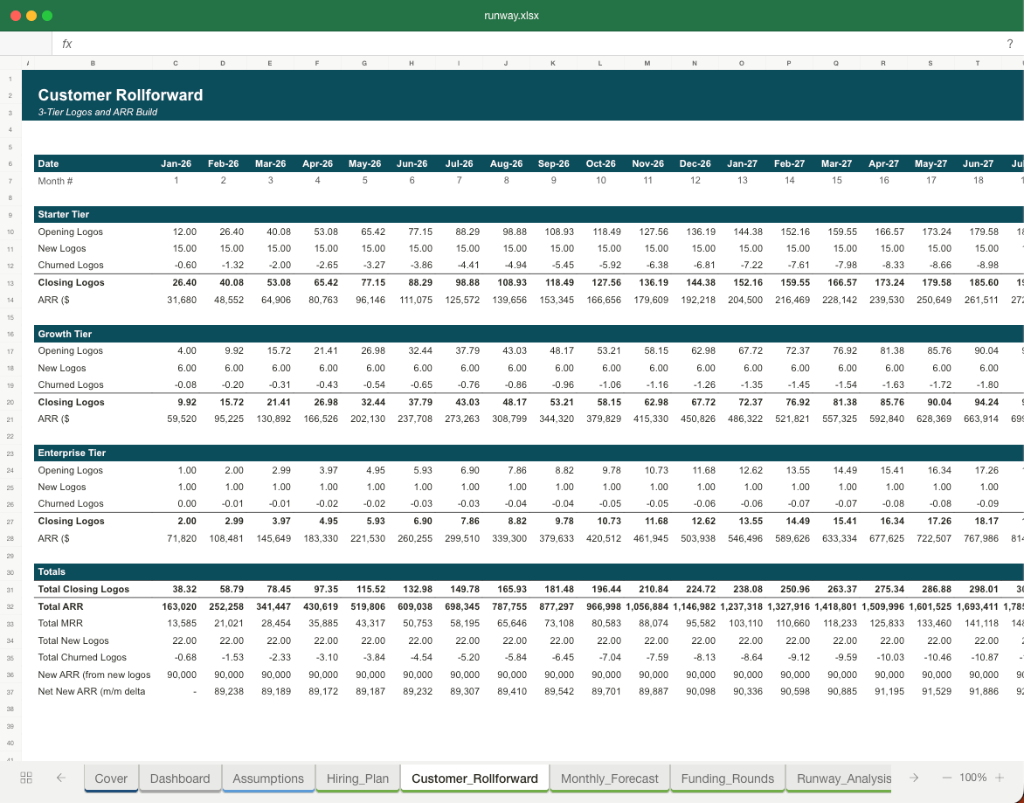
 GraphCMS Financial Model
Dev Tools Startup Financials (Free Excel Download)
GraphQL-native headless CMS with Content Federation - a unified API layer that joins data across multiple enterprise backend services.



professionals from Deloitte
Used by professionals from






About this model
GraphCMS is a GraphQL-native headless CMS that lets enterprises manage content and federate data from multiple backend systems through one API. It combines editor workflows with a managed, secured GraphQL layer for teams building composable digital experiences.
The product is a B2B SaaS platform, with the expected developer-led path from a free entry tier to growth and enterprise plans. Its technical value is strongest where content and commerce or other external data sources must be joined without custom integration work.
The model is a SaaS ARR build. Developer signups, project activation, paid conversion, team seats, API usage, enterprise contracts, expansion, and churn determine revenue. Cloud infrastructure, support, sales assistance, integration depth, and net retention drive the forecast.
A turnkey financial model
Live formulas, no hardcoded values
Outputs are driven by live formulas, so the workbook updates from its assumptions instead of relying on hardcoded results.
All assumptions in one tab
Inputs are clearly marked in the Assumptions tab and separated from calculations, making it clear what to change and what to leave intact.
Statements always balancing
For integrated-statement models, the balance sheet, cash flow, and supporting schedules tie through properly.
Distinct schedules for clarity
Debt, working capital, taxes, and cash flow can get messy quickly. We group calculations in clear schedules, not across disconnected tabs.
No hidden macros or external links
There are no unexplained external workbook links or macros to undermine auditability or portability.
Changes flow through the model
Update a key driver and see the impact carry through the forecast, financing, and return outputs. We never use hardcoded numbers in formulas.
About GraphCMS
graphcms.com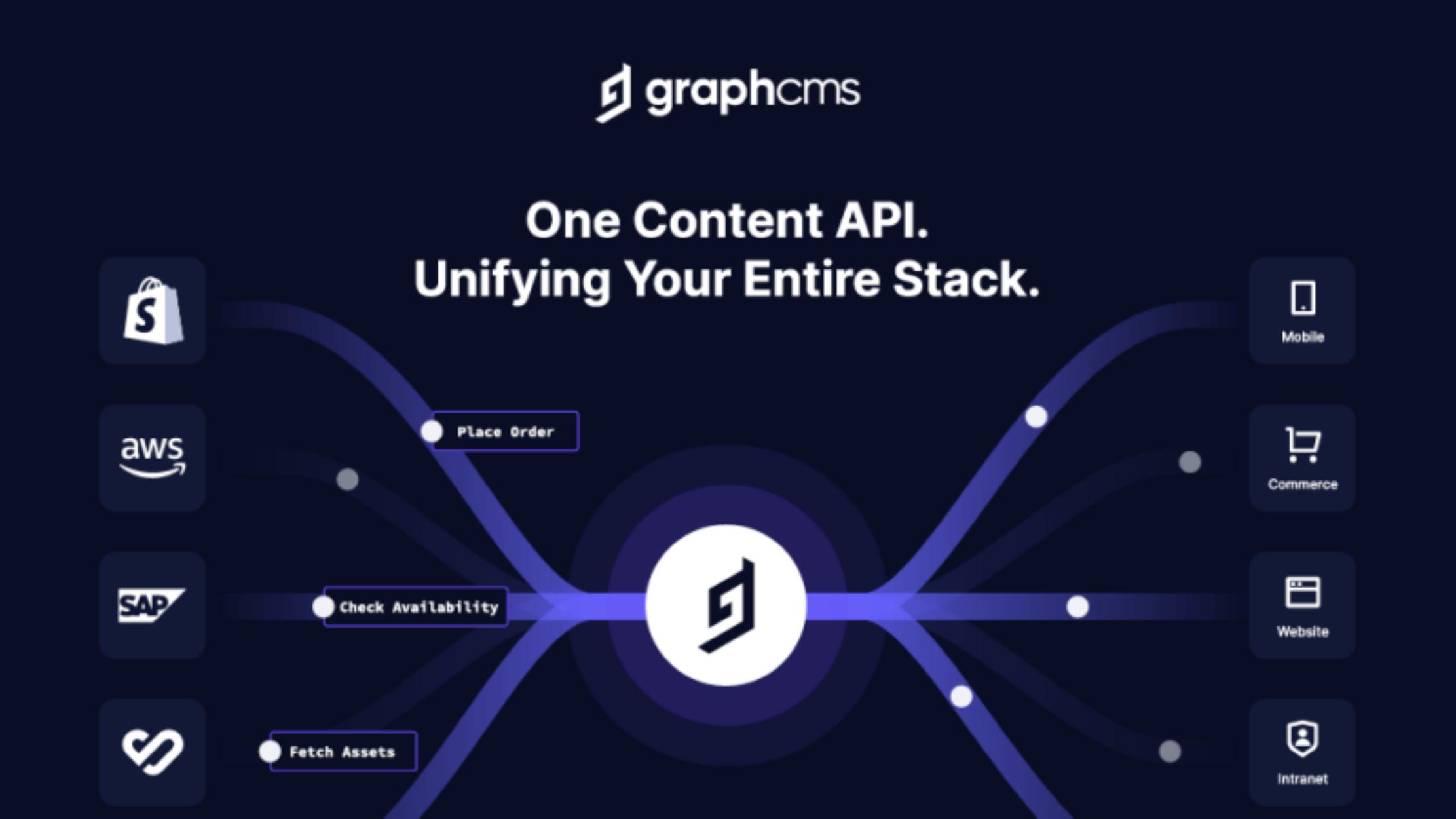
How to build a detailed financial model for GraphCMS
A complete walkthrough of the business, drivers, and assumptions behind the downloadable GraphCMS model - distilled from its pitch deck and publicly available information.
Product & value proposition
GraphCMS is the first GraphQL-native headless CMS offering Content Federation - the ability to join and expose data from multiple backend services (Shopify, AWS, any API) through a single managed, secured GraphQL endpoint.
Three product pillars:
- GraphQL Native - first and leading GraphQL headless CMS.
- Powerful Editors - content management UI with collaboration, localization, publishing workflows.
- Content Federation - seamless data joining across multiple services; eliminates custom middleware.
Target users: software architects and content editors inside enterprise dev teams.
Market
All figures from slide 6 image:
| Market | Size / Year |
|---|---|
| Global CMS Market | $58B in 2021 → $100B+ by 2026 |
| API Management Market | $12B by 2026 |
| Headless CMS Market | $3B by 2026 |
No SAM or SOM segmentation provided. No source citations for market figures shown in deck.
Competition / moat
Competitive positioning from 2×2 matrix:
- Axes: Y = Headless Content Services vs. Data Services; X = Frontend Agnostic Only vs. Frontend + Backend Agnostic.
- Competitors in top-left quad (Headless Content Services / Frontend Agnostic Only): Contentful, Contentstack, Kontent, Sanity, Strapi.
- Competitors in bottom-right quad (Data Services / Frontend + Backend Agnostic): Apollo, Hasura.
- Competitors in bottom-left quad (Data Services / Frontend Agnostic Only): Firebase, Supabase.
- GraphCMS positioning: top-right quad - only player combining Headless Content Services with Frontend + Backend Agnostic architecture. Claims high entry barrier due to demanding architectural challenges.
Stated moats: GraphQL-native (first-mover claim), Content Federation (novel approach, no direct competitor shown), unified managed API, backend agnosticism.
Team & funding ask / use of funds
Team:
- CEO & Co-Founder: Michael Lukaszczyk - M.Sc Computer Science; 19 years web development, SaaS product focus.
- CTO & Co-Founder: Daniel Winter - M.Sc Computer Science; decade of scalable cloud architecture experience.
- CCO: Christopher Kühn - M.Sc Business Administration; 5 years B2B enterprise SaaS commercial scaling; part of a €300M exit.
Recommended financial model
- Archetype + why: SaaS ARR model. GraphCMS is clearly a B2B SaaS API platform; all product and market framing is subscription-infrastructure. Standard headless CMS monetization is tiered SaaS (free developer tier → growth plan → enterprise). Recommend ARR-driven 3-statement with MRR build-up.
- Forecast horizon & granularity: 3 years monthly (M1–M36) rolling into annual summary. Monthly needed to model land-and-expand cadence and cohort churn.
- Key drivers & assumptions:
| Driver | Value |
|---|---|
| Headless CMS TAM (SAM proxy) | $3B by 2026 |
- Scenarios (Base / Bull / Bear - which variables flex):
- Bear: Logo churn 3%, slow enterprise adoption, ARPU stays low (~$500); no upsell.
- Base: Churn 2%, healthy PLG + outbound mix, ARPU $1,200; modest federation upsell.
- Bull: Churn 1%, federation resonates in enterprise, ARPU $2,500+, strong NRR >120%.
- Required sheets / outputs:
- Assumptions - all drivers in one place, clearly tagged.
- MRR Build - new MRR, expansion MRR, churn MRR, net new MRR by month.
- P&L (Income Statement) - revenue, COGS, gross profit, OpEx (S&M, R&D, G&A), EBITDA.
- Headcount Plan - by function, tied to hiring plan.
- Cash & Runway - burn rate, runway vs. raise scenarios.
- KPI Summary - ARR, MRR, logo count, ARPU, NRR, gross margin, CAC payback.
- Scenario Toggle - Bear / Base / Bull switchable from assumptions sheet.
Frequently asked
Is the GraphCMS financial model free?+
Yes. The GraphCMS model is a free Excel (.xlsx) download with live formulas. Sign up with your email and the workbook is yours to keep, review, and edit.
What's included in the model?+
A 5-year monthly forecast with P&L, cash flow and runway, valuation (exit multiple plus a DCF cross-check), MOIC/IRR returns, and unit economics, with live formulas throughout.
How was this model built?+
It was built from GraphCMS's pitch deck and publicly available information, then structured to investment-banking standards as a fully editable Excel model.
Can I change the assumptions?+
Yes. You can change assumptions and the live formulas will recalculate in the downloadable Excel model.
Have more financial modelling questions? Contact us

Created by ex-finance professionals
Hey, I’m Alex and I created Finamodel.
Over my years in the finance industry I kept building the same models over and over again. Same structure, same assumptions, different logo. So I started building frameworks to turn them into clean, reusable templates.
Every model here is one I’d actually use for a client, and I personally vet each one before it goes up.
I’m not an expert in every industry, but I’ve built enough models to know what belongs in one. And when something is completely foreign to me, I reach out to my network for experts to work on our models with us.
Having a template library on hand cuts a first build from hours to minutes.
Need help finding your model? You’ll find me in the Finamodel app!
Other Dev Tools Startup Financial Models
Browse another startup in the same category.

8base
Low-code/no-code platform providing backend and frontend development tools for building digital products, internal apps, and SaaS.
Ably
Enterprise realtime messaging infrastructure (pub/sub) delivered as a cloud-native platform, enabling developers to build scalable live experiences without managing complex realtime infrastructure.

Amplitude
Mobile analytics SaaS platform giving app developers real-time behavioral analytics, funnel/retention analysis, and raw data warehouse access at scale.
Anima
Automated design-to-code platform - designers export production-ready code from their design tools with one click.

Apollo
Apollo builds and sells an enterprise "data graph" platform (powered by GraphQL) that sits as a unified API layer between frontend apps and backend microservices.
BrowserStack
Cloud-based cross-browser and mobile app testing platform used by 50,000+ customers across 135 countries.
CodeSandbox
Cloud-native collaborative web IDE that lets entire product teams (not just developers) code, review, and iterate together in the browser.
CommandBar
SaaS SDK that embeds a search-based command bar into web apps, improving UX, onboarding, and retention for B2B software companies.