Iterable Financial Model
Enterprise/Security Startup Financials (Free Excel Download)
Cross-channel marketing automation platform for B2C enterprise companies



professionals from Deloitte
Used by professionals from






About this model
Iterable is a cross-channel marketing-automation platform for consumer-facing enterprise companies. It brings email, SMS, push notifications, in-app messages, and direct mail into a shared system for designing and measuring customer engagement.
The company sells recurring MarTech software to B2C brands that need to coordinate personalised communications across channels. Account value can grow with marketing teams, channels deployed, message volume, and the depth of the platform's role in a customer's retention and growth programmes.
The model uses enterprise ARR with account additions, ACV, channel adoption, expansion, and churn as its core drivers. A separate usage sensitivity can capture message-volume economics where appropriate, while delivery costs, sales capacity, customer success, gross margin, and operating expenses determine cash flow.
A turnkey financial model
Live formulas, no hardcoded values
Outputs are driven by live formulas, so the workbook updates from its assumptions instead of relying on hardcoded results.
All assumptions in one tab
Inputs are clearly marked in the Assumptions tab and separated from calculations, making it clear what to change and what to leave intact.
Statements always balancing
For integrated-statement models, the balance sheet, cash flow, and supporting schedules tie through properly.
Distinct schedules for clarity
Debt, working capital, taxes, and cash flow can get messy quickly. We group calculations in clear schedules, not across disconnected tabs.
No hidden macros or external links
There are no unexplained external workbook links or macros to undermine auditability or portability.
Changes flow through the model
Update a key driver and see the impact carry through the forecast, financing, and return outputs. We never use hardcoded numbers in formulas.
About Iterable
iterable.com
How to build a detailed financial model for Iterable
A complete walkthrough of the business, drivers, and assumptions behind the downloadable Iterable model - distilled from its pitch deck and publicly available information.
Product & value proposition
- Platform for all customer engagement data and execution
- Powers, orchestrates, and automates cross-channel communications (email, mobile push, SMS, in-app, web push, social, direct mail)
- Data-first approach: co-located data and execution engines, flexible data architecture, AI-ready infrastructure
- Visual, no-code workflow builder; real-time individualized journeys
- Primary buyer: CMO, CRM Division, Lifecycle Marketers - B2C enterprise
- Scale stats: 2B+ user profiles ingested, 1B+ daily events processed
Market
- TAM: Marketing Automation Software market projected to reach $32.6B in spend by 2024
- Positioning note: Deck frames Iterable as addressing under-penetrated demand - only 12% of companies leverage integrated customer data for multichannel marketing execution
Revenue model
- SaaS subscription; pricing model / tiers not disclosed in deck
- Sold to enterprise B2C companies; sales-led (SVP of Sales on leadership team)
- Channels: direct sales + partner ecosystem (agencies, system integrators, e-commerce platforms)
Traction & metrics
- Customers: 450+
- Employees: 250+
- Total raised: $140M
- Platform scale: 2B+ user profiles, 1B+ daily events
- Offices: 4 (SF, NY, Denver, London)
- Founded: 2013
- Logo diversity: 28+ named enterprise customers across 7 verticals (e-commerce, entertainment, food & beverage, health & wellness, marketplaces, retail, subscription services)
Competition / moat
- Moat claimed: data-first architecture with co-located data + execution engines; AI-architected; no-code interface reducing implementation friction
- Pain points addressed vs. incumbents: siloed channel execution, heavy implementation burden, poor data activation, limited A/B testing
- Competitors not named; implied incumbents are legacy MAPs (Marketo, Salesforce Marketing Cloud, etc.) - inferred from team backgrounds (Marketo listed as prior employer)
- Partner ecosystem of 60+ technology partners across analytics, data management, e-commerce, mobile, personalization, email services
Team & funding ask / use of funds
- Co-founders: Justin Zhu (CEO), Andrew Boni
- Key executives: Jeff Samuels (COO), Will Johnson (CFO), Matt Marshall (SVP Sales), Tasha Reasor (VP Marketing), Krishna Reddy (VP Customer Success), Harold Giménez (VP Technology), Sara Riedl (VP People Ops), Dan Brayton (Head BizOps), Dave Schwartz (Head BD & Partnerships), Tristan Tao (Sr. Director Solutions)
- Prior employers represented: Twitter, Google, Cisco, Marketo, Heroku, SAP SuccessFactors, Workday, OpenDNS
- Total raised to date: $140M
Recommended financial model
- Archetype + why: SaaS ARR model - Iterable is a subscription platform sold to enterprise B2C companies; revenue is recurring contract-based, making ARR/MRR the natural organizing metric. A 3-statement build is appropriate given the $140M raised and 250+ employee base (meaningful cost structure to model).
- Forecast horizon & granularity: 3 years (annual) with Year 1 monthly; 450+ customer base warrants cohort-level ARR waterfall (new ARR, expansion, churn, net new ARR).
- Key drivers & assumptions:
- Starting customer count: 450
- New logo adds per year: ~150–200/yr, based on sales-led GTM with 60+ partner ecosystem and 250+ headcount implying sizable sales org
- Average ACV: $80K–$150K/yr - enterprise B2C with 2B+ user profile scale suggests mid-market to enterprise contracts; comparable to Klaviyo/Braze public benchmarks
- Net Revenue Retention (NRR): 115–125% - cross-channel expansion and data volume growth drive natural upsell; typical for usage-adjacent MAPs
- Gross churn rate: 8–12% annually - enterprise MAPs tend to be sticky once integrated
- Gross margin: 65–75% - SaaS platform with infrastructure costs (email/SMS delivery volume at 1B+ daily events implies non-trivial COGS)
- Headcount: 250+; S&M-heavy given sales-led GTM
- R&D as % of revenue: 25–30% - active platform development (AI, mobile, data architecture)
- S&M as % of revenue: 35–45% - sales-led enterprise motion; partner-assisted but direct sales dominant
- G&A as % of revenue: 10–15%
- Revenue growth rate: 40–60% YoY - $140M raised, 450+ customers, 250+ employees suggest high-growth stage; Braze/Klaviyo comparable cohort
- Scenarios (Base / Bull / Bear - which variables flex):
- Base: NRR 120%, new logos 175/yr, ACV $100K, gross margin 70%
- Bull: NRR 130%, new logos 220/yr, ACV $120K (upsell to additional channels), margin expansion to 75%
- Bear: NRR 108%, new logos 120/yr, ACV $85K (competitive pressure from Braze/Klaviyo), churn 14%
- Required sheets / outputs:
- ARR Waterfall (new, expansion, churned, net new ARR by cohort)
- P&L (Revenue, COGS, Gross Profit, S&M, R&D, G&A, EBITDA)
- Headcount plan (by department, driving S&M and R&D costs)
- Cash & runway (given active growth-stage spend)
- SaaS metrics dashboard (NRR, GRR, CAC payback, LTV/CAC, magic number)
- Scenario toggle (Base / Bull / Bear)
Frequently asked
Is the Iterable financial model free?+
Yes. The Iterable model is a free Excel (.xlsx) download with live formulas. Sign up with your email and the workbook is yours to keep, review, and edit.
What's included in the model?+
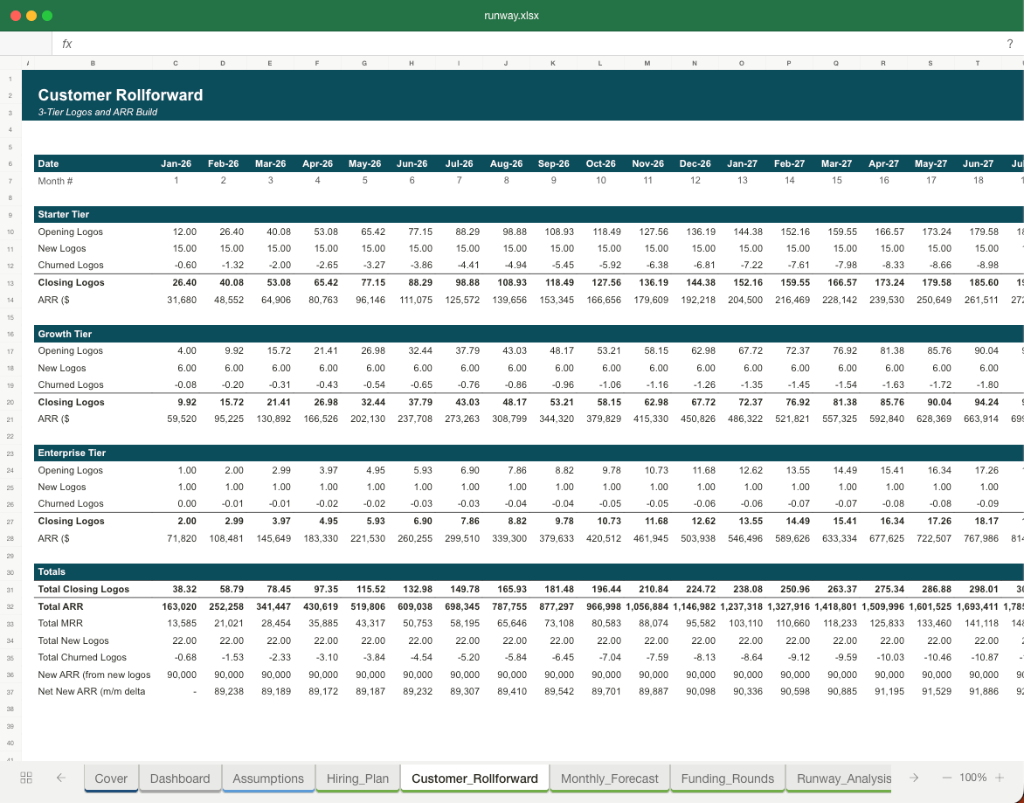
A 5-year monthly forecast with P&L, cash flow and runway, valuation (exit multiple plus a DCF cross-check), MOIC/IRR returns, and unit economics, with live formulas throughout.
How was this model built?+
It was built from Iterable's pitch deck and publicly available information, then structured to investment-banking standards as a fully editable Excel model.
Can I change the assumptions?+
Yes. You can change assumptions and the live formulas will recalculate in the downloadable Excel model.
Have more financial modelling questions? Contact us

Created by ex-finance professionals
Hey, I’m Alex and I created Finamodel.
Over my years in the finance industry I kept building the same models over and over again. Same structure, same assumptions, different logo. So I started building frameworks to turn them into clean, reusable templates.
Every model here is one I’d actually use for a client, and I personally vet each one before it goes up.
I’m not an expert in every industry, but I’ve built enough models to know what belongs in one. And when something is completely foreign to me, I reach out to my network for experts to work on our models with us.
Having a template library on hand cuts a first build from hours to minutes.
Need help finding your model? You’ll find me in the Finamodel app!
Other Enterprise/Security Startup Financial Models
Browse another startup in the same category.
AgBiome
AgBiome is a microbial-platform agtech company that discovers, develops, and commercialises biological crop protection products (and licences the platform across adjacent markets).

Alation
Enterprise data intelligence platform - data catalog, governance, and metadata management for large organisations.

Archer SPAC
Archera
Cloud resource automation platform that continuously optimizes AWS commitment purchases, de-risks overcommitment, and automates FinOps workflows.

Ardoq
Cloud-native Enterprise Architecture (EA) SaaS platform that helps large enterprises navigate digital transformation through automated data collection, graph-based architecture modelling, and change impact analysis.

Ascend
Ascend.io is an enterprise big data automation platform ("Enterprise Intelligence Platform") that abstracts away the complexity of big data engineering so non-experts can build and run data pipelines.

Athennian
Cloud-based legal entity management system (EMS) uniting entity data with workflow and document automation.

Auditboard
Cloud-based integrated risk management platform connecting audit, risk, compliance, and ESG teams across the enterprise.