 Juro Financial Model
Enterprise/Security Startup Financials (Free Excel Download)
All-in-one browser-native contract automation platform for legal teams



professionals from Deloitte
Used by professionals from






About this model
Juro is a browser-native contract-automation platform for legal teams. It brings contract creation, collaboration, approval, and management into a single workflow, reducing the friction of documents moving between legal, commercial, and operational stakeholders.
The company is a subscription business with a pronounced land-and-expand motion. Its materials show net dollar retention above 100% and a cohort pattern in which existing customers add value over time, making expansion and contraction important alongside new logo growth.
The model follows an ARR waterfall that separates new bookings, expansion, contraction, churn, and ending ARR. It connects these cohorts to ACV, sales capacity, retention, gross margin, product and customer-success costs, and headcount-driven operating expenses.
A turnkey financial model
Live formulas, no hardcoded values
Outputs are driven by live formulas, so the workbook updates from its assumptions instead of relying on hardcoded results.
All assumptions in one tab
Inputs are clearly marked in the Assumptions tab and separated from calculations, making it clear what to change and what to leave intact.
Statements always balancing
For integrated-statement models, the balance sheet, cash flow, and supporting schedules tie through properly.
Distinct schedules for clarity
Debt, working capital, taxes, and cash flow can get messy quickly. We group calculations in clear schedules, not across disconnected tabs.
No hidden macros or external links
There are no unexplained external workbook links or macros to undermine auditability or portability.
Changes flow through the model
Update a key driver and see the impact carry through the forecast, financing, and return outputs. We never use hardcoded numbers in formulas.
About Juro
juro.com
How to build a detailed financial model for Juro
A complete walkthrough of the business, drivers, and assumptions behind the downloadable Juro model - distilled from its pitch deck and publicly available information.
Product & value proposition
Browser-native contract platform replacing MS Word + 4 other point tools (create, negotiate, sign, store, track). Built on a structured data model rather than files. Three core modules:
- Self-serve automation - initiate contracts from integrated tools
- Collaborative workflow - multiplayer edits, approvals
- Data-rich repository - real-time query of contract data
Key differentiator: structured data model vs. file-based incumbents; enables downstream analytics and workflow integrations.
Revenue model
- Subscription ARR; pricing structure not disclosed in deck
- Land-and-expand: initial seat/usage footprint expands as customers add more contracts
- GTM: primarily inbound-led (organic inbound 45.0% of 2021 SQLs, paid inbound 16.6%, outbound 38.4%)
- Customers span SaaS, FinTech, Retail, Healthcare, Marketplace and 10+ other verticals
- Typical customers: Luno, Cazoo, QuantumScape, Deliveroo, Personio, The RealReal, Trustpilot
Traction & metrics
- ARR: "$XXm+" - exact figure redacted in deck
- Net ARR growth y/y: 3x
- 12-month net dollar retention: "1xx%" - exact figure redacted (confirmed >100%)
- Contracts added in 12 months: 250k+
- Growth in contracts added m/m: 26.5%
- Gross $ARR quarterly churn (most recent quarters): trending down; 1.1% Q1 2021 → 0.6% Q2 2021 (net churn shown as negative/expansion in chart)
- Net $ARR quarterly churn: positive expansion (net negative churn); chart labels show 5.0%, 5.5%, 10.6% - these appear to be net quarterly expansion rates at the bottom of the area chart
- ARR added / net cash burn: 1:1
- Gross sales efficiency: 0.9
- NPS (customer): 72
- Community group members: 550+
- Headcount: ~25 (Oct 2020) growing to ~50 (Sep 2021)
- Employee NPS: 94; Glassdoor 5.0 stars, 100% recommend, 100% CEO approval
- ARR cohort chart (slide 11) shows compounding expansion across Q2 2020 – Q3 2021 cohorts; individual customer expansion case studies redacted ($XXXk ARR, XX%–XXX% growth)
Unit economics
- Gross sales efficiency: 0.9 (implies ~$0.90 of new ARR per $1 of S&M spend)
- ARR added / net cash burn: 1:1 (implies burn multiple of ~1x - highly capital efficient)
- Net dollar retention: >100% (1xx%) - LTV theoretically unbounded given expansion
Competition / moat
Positioning: sole occupant of "all-in-one + suitable for legal" quadrant; competitors are blurred in the quadrant chart:
- Upper-left quadrant (all-in-one, not optimized for legal): 2 blurred logos - likely general workflow/CRM players
- Lower-left quadrant (files-based, not optimized for legal): 3 blurred logos - likely DocSign, Adobe Sign type e-signature tools
- Lower-right quadrant (files-based, suitable for legal): 1 blurred logo - likely a legacy CLM or Word plug-in
Stated moat: structured data model (not files) creates switching costs and downstream data lock-in; community of 550+ champions; NPS 72. Vision is to own the "system of record" layer for all contracts across teams, similar to DocuSign's ownership of e-signature.
Team & funding ask / use of funds
Team:
- Richard Mabey - Co-founder, CEO; background at Freshfields (Magic Circle law firm), LegalZoom
- Pavel Kovalevich - Co-founder, CPO; background at Accenture IT, IdeaPort
- ~50 total headcount as of Sep 2021
Funding history:
- 2016 - $750k seed: Seedcamp, Paul Forster (Indeed), Michael Pennington (Gumtree), +6 angels
- 2018 - $2m: Point Nine Capital, Seedcamp, Taavet Hinrikus (Wise), various angel follow-on
- 2020 - $5.25m (oversubscribed): Union Square Ventures, Point Nine Capital, Seedcamp
- Total raised to date: ~$8m
Recommended financial model
- Archetype + why: SaaS ARR model with cohort-based expansion. Juro is a pure subscription business with a pronounced land-and-expand dynamic (net NDR >100%, cohort stacking visible). The model should track new ARR, expansion ARR, contraction, and churn separately - exactly the waterfall shown in slide 6. A 3-statement is not warranted at this stage; ARR bridge + unit economics + headcount-driven opex is the right structure.
- Forecast horizon & granularity: Monthly for Year 1–2, quarterly for Year 3–5. Given the deck is ~Q3 2021, a 5-year model (2022–2026) makes sense for a Series B investment decision.
- Key drivers & assumptions:
| Driver | Value / Tag |
|---|---|
| ARR base (start of model) | Redacted in deck - "$XXm+"; ~$3–5m ARR based on 3x y/y growth from a plausible seed-stage base, 50-person team, and $8m total raised with 1:1 burn multiple. Confirm with company. |
| New ARR growth (new logo) | ~80–100% y/y new business ARR in Year 1, decelerating to ~50% by Year 3, ~30% by Year 5 |
| Net dollar retention (NDR) | >100% confirmed; "1xx%"; 115–125% for modelling (mid-point of 100–130% range) |
| Gross $ARR quarterly churn rate | Trending to ~0.6% per quarter; stabilises at 0.5–0.8% quarterly (~2–3% annualised gross churn) |
| Gross margin | 70–75% - typical for early B2B SaaS with some implementation/support cost; not disclosed |
| S&M as % of revenue | 40–50% at current scale, declining as inbound scales; gross sales efficiency 0.9 implies ~$1.11 S&M spend per $1 new ARR added |
| R&D as % of revenue | 30–35% - product-led company, likely engineering-heavy |
| G&A as % of revenue | 15–20% |
| Headcount growth | ~25 → ~50 in 12 months; continues at ~50–70% y/y in Year 1–2, then normalises |
| Average contract value (ACV) | $20–50k - SMB-to-mid-market legal teams; no pricing shown in deck |
| Sales cycle | 1–3 months (inbound-led, tech-savvy buyers) |
| GTM mix | Organic 45% / Outbound 38% / Paid 17%; inbound share grows as brand scales |
- Scenarios (Base / Bull / Bear - which variables flex):
- Base: NDR 115%, new ARR growth 80% Year 1 declining linearly, gross churn 0.7% quarterly
- Bull: NDR 125%, new ARR growth 100%+ Year 1, churn 0.5% quarterly - inbound flywheel accelerates
- Bear: NDR 105%, new ARR growth 50% Year 1, churn 1.5% quarterly - market softens, expansion slows
- Required sheets / outputs:
- Assumptions - all drivers in one tab
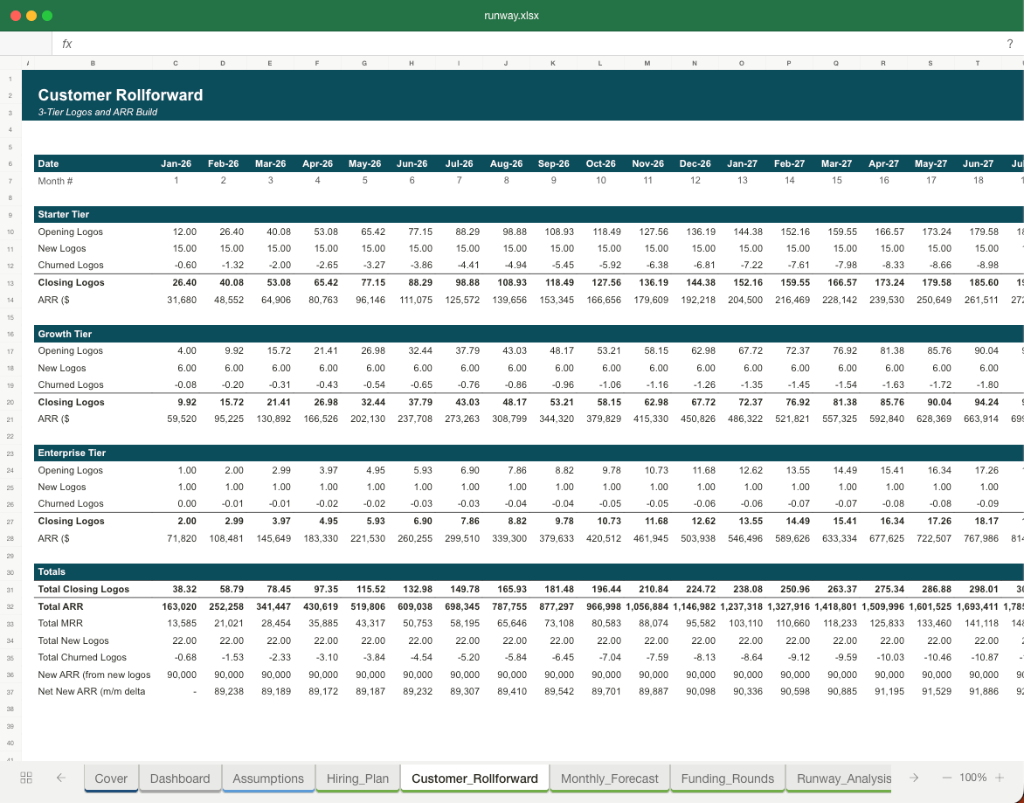
- ARR Bridge - monthly waterfall: beginning ARR + new business + expansion − contraction − churn = ending ARR
- Cohort Model - quarterly cohort table showing expansion over time (mirrors slide 11 chart)
- P&L - Revenue → Gross Profit → S&M / R&D / G&A → EBITDA → Net burn
- Headcount Plan - by department; drives opex
- Cash / Runway - cash balance, monthly burn, runway given raise amount
- KPI Dashboard - ARR, MRR, NDR, gross churn, ARR added/burn, sales efficiency
- Scenarios - toggle or separate columns for Base / Bull / Bear
Frequently asked
Is the Juro financial model free?+
Yes. The Juro model is a free Excel (.xlsx) download with live formulas. Sign up with your email and the workbook is yours to keep, review, and edit.
What's included in the model?+
A 5-year monthly forecast with P&L, cash flow and runway, valuation (exit multiple plus a DCF cross-check), MOIC/IRR returns, and unit economics, with live formulas throughout.
How was this model built?+
It was built from Juro's pitch deck and publicly available information, then structured to investment-banking standards as a fully editable Excel model.
Can I change the assumptions?+
Yes. You can change assumptions and the live formulas will recalculate in the downloadable Excel model.
Have more financial modelling questions? Contact us

Created by ex-finance professionals
Hey, I’m Alex and I created Finamodel.
Over my years in the finance industry I kept building the same models over and over again. Same structure, same assumptions, different logo. So I started building frameworks to turn them into clean, reusable templates.
Every model here is one I’d actually use for a client, and I personally vet each one before it goes up.
I’m not an expert in every industry, but I’ve built enough models to know what belongs in one. And when something is completely foreign to me, I reach out to my network for experts to work on our models with us.
Having a template library on hand cuts a first build from hours to minutes.
Need help finding your model? You’ll find me in the Finamodel app!
Other Enterprise/Security Startup Financial Models
Browse another startup in the same category.
AgBiome
AgBiome is a microbial-platform agtech company that discovers, develops, and commercialises biological crop protection products (and licences the platform across adjacent markets).

Alation
Enterprise data intelligence platform - data catalog, governance, and metadata management for large organisations.

Archer SPAC
Archera
Cloud resource automation platform that continuously optimizes AWS commitment purchases, de-risks overcommitment, and automates FinOps workflows.

Ardoq
Cloud-native Enterprise Architecture (EA) SaaS platform that helps large enterprises navigate digital transformation through automated data collection, graph-based architecture modelling, and change impact analysis.

Ascend
Ascend.io is an enterprise big data automation platform ("Enterprise Intelligence Platform") that abstracts away the complexity of big data engineering so non-experts can build and run data pipelines.

Athennian
Cloud-based legal entity management system (EMS) uniting entity data with workflow and document automation.

Auditboard
Cloud-based integrated risk management platform connecting audit, risk, compliance, and ESG teams across the enterprise.