Jus Mundi Financial Model
Enterprise/Security Startup Financials (Free Excel Download)
AI-powered search engine for international law and arbitration case law, sold on subscription to law firms, governments, and universities.



professionals from Deloitte
Used by professionals from






About this model
Jus Mundi is an AI-powered research platform for international law and arbitration. Its multilingual search engine indexes awards, treaties, and case law, adding analytics, conflict checks, and alerts for law firms, governments, and universities.
The company sells annual subscriptions with one- to five-year contracts. Its early materials reported ARR growing from around €100,000 to €500,000 in 12 months, zero churn across 21 renewed clients, and 191% net revenue retention from expansion within the initial customer base.
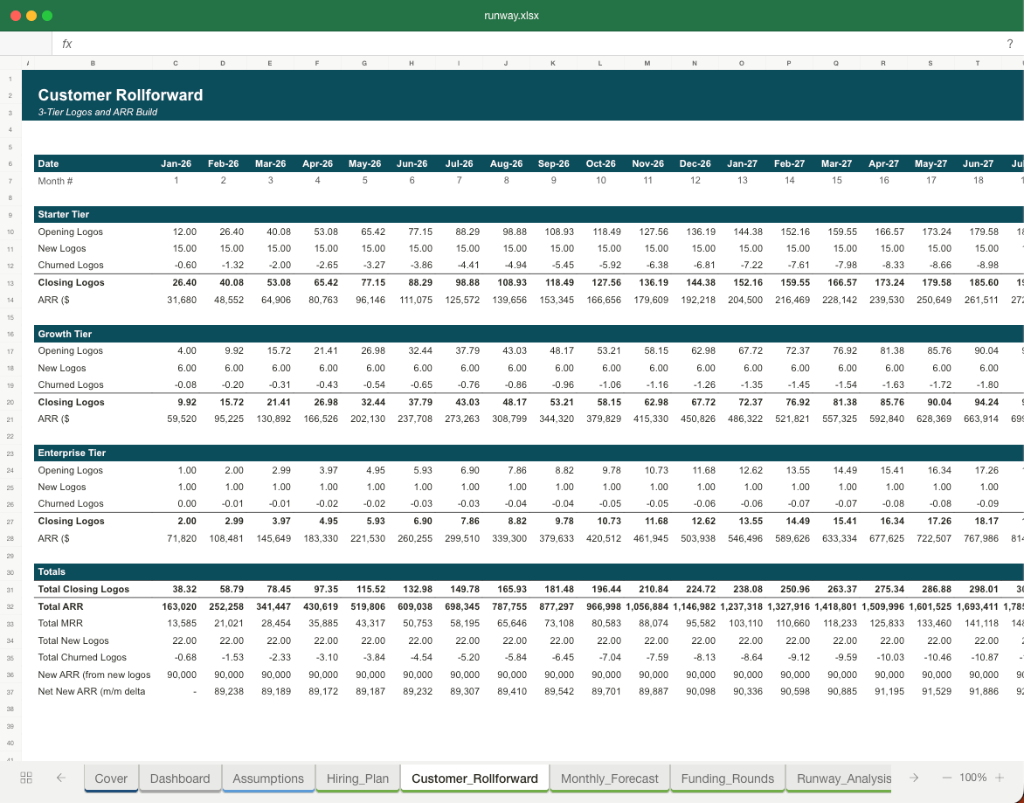
The model is a subscription ARR waterfall built from new logos, blended ACV, expansion, contraction, and churn. It reflects annual upfront billing and very high software gross margin, then uses customer-segment mix, sales efficiency, and retention scenarios to test the path from the early base toward scale.
A turnkey financial model
Live formulas, no hardcoded values
Outputs are driven by live formulas, so the workbook updates from its assumptions instead of relying on hardcoded results.
All assumptions in one tab
Inputs are clearly marked in the Assumptions tab and separated from calculations, making it clear what to change and what to leave intact.
Statements always balancing
For integrated-statement models, the balance sheet, cash flow, and supporting schedules tie through properly.
Distinct schedules for clarity
Debt, working capital, taxes, and cash flow can get messy quickly. We group calculations in clear schedules, not across disconnected tabs.
No hidden macros or external links
There are no unexplained external workbook links or macros to undermine auditability or portability.
Changes flow through the model
Update a key driver and see the impact carry through the forecast, financing, and return outputs. We never use hardcoded numbers in formulas.
About Jus Mundi
jusmundi.com
How to build a detailed financial model for Jus Mundi
A complete walkthrough of the business, drivers, and assumptions behind the downloadable Jus Mundi model - distilled from its pitch deck and publicly available information.
Product & value proposition
- Multilingual legal search engine indexing international arbitration awards, treaties, and case law
- Three core feature pillars: multilingual search + dedicated filters; analytics & conflict check; personalized alerts & monitoring
- Differentiated data pipeline: proprietary collection → enrichment → smart search → user-centric UX ("secret sauce")
- Saves clients up to 30% in search time vs. prior workflow
- Disrupts legacy legal publishers (digitalized books, 40-year-old multi-billion dollar industry) and general search engines not fit for legal research
Market
- TAM: €21B global legal research market, 5% growth/year
- ~1/3 US national research; ~1/3 non-US national research (UK €1B, Germany €500M, France €500M); ~1/3 international research
- SAM: ~€7B international legal research market, 10% growth/year
- Key verticals within SAM: Arbitration €600M, IP €450M, Competition €450M, Construction €360M, Data €360M, Labour €330M, Tax €330M, Transport €330M, Environment €260M, Energy €260M, Private €200M, Telecom €180M, Mining €150M, Trade €150M, Sports €65M
Revenue model
- Annual subscription (B2B): 1- to 5-year contracts
- ACV range: €1,500 (entry) to €XXXX (upper end redacted) - floor is stated, ceiling is obscured
- Upfront payment component for capital efficiency
- Customer segments: law firms (primary), governments, universities
- No mention of freemium, usage-based, or per-seat pricing; all indications point to annual flat-fee or tiered seat-license
Traction & metrics
- ARR grew from ~€100K to €500K in 12 months; ARR at Jan 2021 = €500,000
- YoY ARR growth: 400%+
- Product launched 2019; chart starts Dec 2019 at ~€50K ARR, reaching €500K by Jan 2021
- Total funding to date: €1M
- Churn: 0% (21 clients renewed)
- Net Revenue Retention: 191% (upsell from 2019 cohort)
- WAU (weekly active users/rate): 36%
- Client mix: 50 law firms, 5 governments, 13 universities
- Geography: 40% of clients in Americas, 30% Europe; 80% outside EU
- Named clients: Freshfields, DLA Piper, Dentons, MOFA Japan, Harvard University, Panthéon-Sorbonne
Unit economics
- Payback period: 8 months
- Gross margin: 99.9% - consistent with SaaS software-only delivery
- CAC: €XXX (redacted in deck)
- ACV: €XXX (redacted in deck for the specific figure used in the bar chart)
- CLV: €XXXK (redacted) - formula disclosed as ACV × NRR × 5% churn hypothesis
- ACV floor stated as €1,500; exact CAC and ACV used in payback calc obscured
Competition / moat
- Legacy legal publishers: Westlaw/LexisNexis-type players (revenues redacted in deck but large: $3.4B / $1.6B / €945M referenced for three competitors)
- General search engines (Google, Yandex, Baidu) - not purpose-built for legal
- Moat: proprietary multilingual data collection + enrichment pipeline ("secret sauce"); Head of Sales is ex-LexisNexis France; Head of Partnerships ex-ICC
- International focus (vs. national-only incumbents) is core differentiation
Team & funding ask / use of funds
- CEO: Jean-Rémi de Maistre - ex lawyer at ICJ
- CFO: Valentin Brondel - ex Carrefour
- CTO: Thomas Latterner - ex Capgemini
- COO: Aurélien Duval - ex ALTEN
- Head of Sales: Lauraine de Thiersant - ex LexisNexis France (Head of Sales)
- Head of Legal: Marie-Hélène Ludwig - ex Dentons
- Head of Marketing: Sneha Ashtikar - ex lawyer, ex Leaders League US BD
- Head of Partnerships: Andrew Willcocks - ex lawyer, ex ICC
- Advisors: Stefan Tietze (ex-Director Auto1 Group), Patrick Bertrand (ex-CEO CEGID)
- Round: Series A; raise size not stated in deck
- Use of funds: not explicitly broken down; implied direction: expand to corporates, accelerate law firm + government growth, add verticals (Trade, Sports in 2021; more in 2022–2025)
- 5-year ARR target: €80M
Recommended financial model
- Archetype + why: B2B SaaS ARR model. Revenue is 100% subscription, billed annually with multi-year contracts. The core P&L is driven by new logo adds, upsell/expansion (191% NRR is the dominant growth engine at this stage), and near-zero churn. A pure ARR waterfall model is the right frame.
- Forecast horizon & granularity: 5 years (2021–2025), matching the stated ARR target; monthly granularity in years 1–2, quarterly in years 3–5. Starting ARR = €500K (Jan 2021).
- Key drivers & assumptions:
| Driver | Value | Source |
|---|---|---|
| Starting ARR (Jan 2021) | €500,000 | - |
| ARR growth rate - Year 1 | 400%+ YoY as base; model conservatively at 300% | ; haircut for execution risk |
| ARR growth rate - Years 2–5 | Step down: 150% → 100% → 80% → 60% | typical SaaS S-curve deceleration toward €80M target |
| Target ARR (Year 5) | €80M | - |
| Gross margin | 99.9% | - |
| Logo churn | 0% historically; model at 5% annually | ; prudent assumption per deck's own CLV footnote |
| Net Revenue Retention | 191% current; model at 150% base / 120% bear | ; normalization as base expands |
| ACV (entry tier) | €1,500 | - |
| Average ACV (blended) | ~€5,000–€10,000 given law firm + gov mix and 191% NRR; confirm when CAC/ACV unredacted data available | |
| CAC | Redacted; ~€2,000–€4,000 implied by 8-month payback on ACV; sensitivity test required | |
| Payback period | 8 months | - |
| Contract length | 1–5 years | - |
| Customer segments | Law firms (~65%), Governments (~20%), Universities (~15%) | from ratio of 50/5/13 clients |
| Geographic mix | 40% Americas, 30% EU, 30% RoW | - |
| Upfront payment % | Not quantified; 50% upfront for multi-year deals (capital efficiency claim) |
- Scenarios (Base / Bull / Bear - which variables flex):
- Base: 300% YoY ARR growth in 2021, decelerating to ~60% by 2025; NRR 150%; logo churn 5%; reaches ~€80M ARR
- Bull: 400% YoY in 2021, NRR sustained at 175%, churn stays near 0%; reaches €80M by 2024
- Bear: 150% YoY growth; NRR normalizes to 120%; churn rises to 10%; reaches €30–40M ARR by 2025
- Primary flex variables: new logo growth rate, NRR, blended ACV (as verticals expand), CAC as paid channels scale
- Required sheets / outputs:
- Assumptions - all drivers, toggled by scenario
- ARR Waterfall - opening ARR + new logo ARR + expansion ARR − churned ARR = closing ARR (monthly Y1–Y2, quarterly Y3–Y5)
- Revenue & P&L - ARR to recognized revenue (annual contracts → straight-line), gross profit (near 100% margin), S&M spend, R&D, G&A, EBITDA
- Unit Economics - CAC, LTV, payback, LTV/CAC ratio by segment
- Customer Cohort Table - annual cohort retention + expansion (NRR waterfall)
- Headcount Plan - hires by function, tied to revenue milestones
- Cash Flow & Runway - deferred revenue from upfront payments, burn, implied Series A size to reach next milestone
- Scenario Summary - Base / Bull / Bear side-by-side on ARR, revenue, EBITDA, cash
Frequently asked
Is the Jus Mundi financial model free?+
Yes. The Jus Mundi model is a free Excel (.xlsx) download with live formulas. Sign up with your email and the workbook is yours to keep, review, and edit.
What's included in the model?+
A 5-year monthly forecast with P&L, cash flow and runway, valuation (exit multiple plus a DCF cross-check), MOIC/IRR returns, and unit economics, with live formulas throughout.
How was this model built?+
It was built from Jus Mundi's pitch deck and publicly available information, then structured to investment-banking standards as a fully editable Excel model.
Can I change the assumptions?+
Yes. You can change assumptions and the live formulas will recalculate in the downloadable Excel model.
Have more financial modelling questions? Contact us

Created by ex-finance professionals
Hey, I’m Alex and I created Finamodel.
Over my years in the finance industry I kept building the same models over and over again. Same structure, same assumptions, different logo. So I started building frameworks to turn them into clean, reusable templates.
Every model here is one I’d actually use for a client, and I personally vet each one before it goes up.
I’m not an expert in every industry, but I’ve built enough models to know what belongs in one. And when something is completely foreign to me, I reach out to my network for experts to work on our models with us.
Having a template library on hand cuts a first build from hours to minutes.
Need help finding your model? You’ll find me in the Finamodel app!
Other Enterprise/Security Startup Financial Models
Browse another startup in the same category.
AgBiome
AgBiome is a microbial-platform agtech company that discovers, develops, and commercialises biological crop protection products (and licences the platform across adjacent markets).

Alation
Enterprise data intelligence platform - data catalog, governance, and metadata management for large organisations.

Archer SPAC
Archera
Cloud resource automation platform that continuously optimizes AWS commitment purchases, de-risks overcommitment, and automates FinOps workflows.

Ardoq
Cloud-native Enterprise Architecture (EA) SaaS platform that helps large enterprises navigate digital transformation through automated data collection, graph-based architecture modelling, and change impact analysis.

Ascend
Ascend.io is an enterprise big data automation platform ("Enterprise Intelligence Platform") that abstracts away the complexity of big data engineering so non-experts can build and run data pipelines.

Athennian
Cloud-based legal entity management system (EMS) uniting entity data with workflow and document automation.

Auditboard
Cloud-based integrated risk management platform connecting audit, risk, compliance, and ESG teams across the enterprise.