KAKarmaCheck Financial Model
Enterprise/Security Startup Financials (Free Excel Download)
API-first background screening platform with SaaS subscription packaging, built for hyper-growth and high-velocity hiring companies.



professionals from Deloitte
Used by professionals from






About this model
KarmaCheck is an API-first background-screening platform for high-growth, high-velocity hiring companies. It packages screening in SaaS subscriptions while giving employers a faster, programmatic alternative to legacy background-check workflows.
The business combines recurring software subscriptions with pay-as-you-go checks, and serves both self-serve and enterprise buyers. Its reported 179% net revenue retention makes expansion and transactional usage important alongside initial subscription sales.
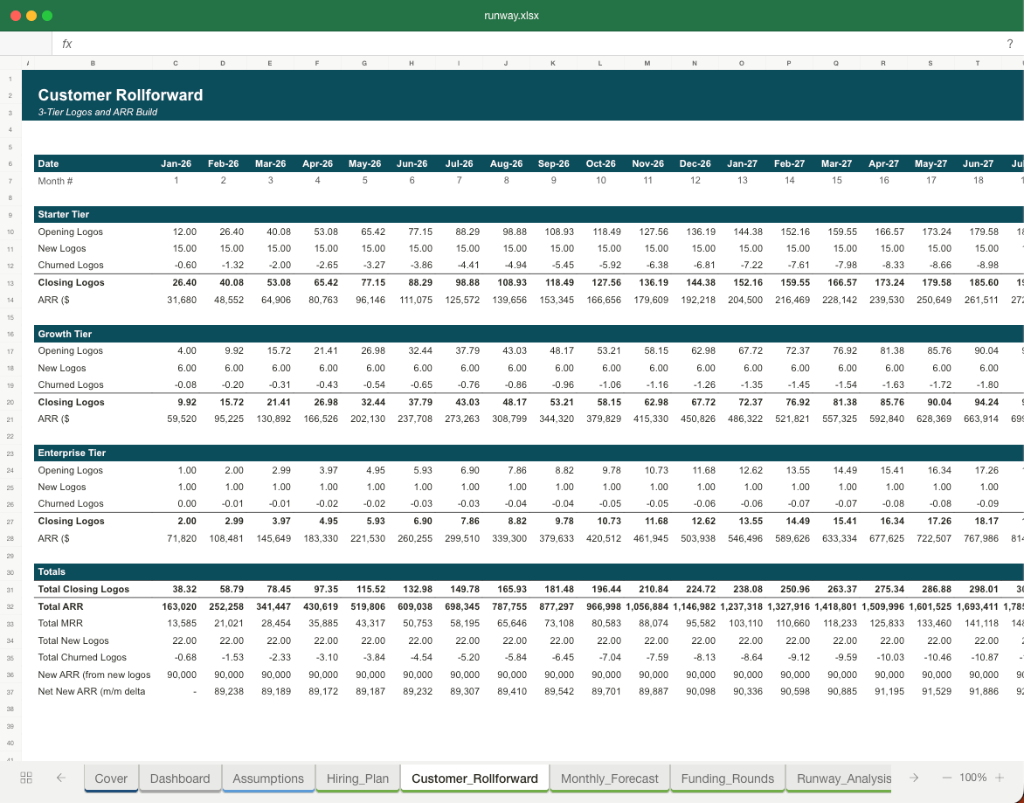
The model separates subscription MRR from per-check revenue. It tracks new accounts, conversion, checks per customer, subscription upgrades, retention, delivery costs, gross margin, and sales efficiency to show the cash and unit economics of the dual-stream model.
A turnkey financial model
Live formulas, no hardcoded values
Outputs are driven by live formulas, so the workbook updates from its assumptions instead of relying on hardcoded results.
All assumptions in one tab
Inputs are clearly marked in the Assumptions tab and separated from calculations, making it clear what to change and what to leave intact.
Statements always balancing
For integrated-statement models, the balance sheet, cash flow, and supporting schedules tie through properly.
Distinct schedules for clarity
Debt, working capital, taxes, and cash flow can get messy quickly. We group calculations in clear schedules, not across disconnected tabs.
No hidden macros or external links
There are no unexplained external workbook links or macros to undermine auditability or portability.
Changes flow through the model
Update a key driver and see the impact carry through the forecast, financing, and return outputs. We never use hardcoded numbers in formulas.
About KarmaCheck
karmacheck.co
How to build a detailed financial model for KarmaCheck
A complete walkthrough of the business, drivers, and assumptions behind the downloadable KarmaCheck model - distilled from its pitch deck and publicly available information.
Product & value proposition
- Background screening platform targeting hyper-growth companies and high-velocity hiring.
- "Best-in-class" tech stack vs. legacy incumbents - positions on speed (fast-to-instant checks), mobile-first UX, and candidate transparency.
- Single API covers: criminal/occupational health screenings (OHS), Identity Verification (IDV), Motor Vehicle Records (MVR), licenses, credit checks, social media checks, and self-pay.
- Industry-first subscription packaging (all competitors are pay-as-you-go).
- Self-serve onboarding with instant account provisioning (vs. several days for competitors).
Market
- Background Screenings TAM: $13B (long-term); current market spend: $6B; 56M checks/year.
- $7B whitespace attributed to new products, services, and international.
- Long-term CAGR: 6%.
- Consumer Identity Access Management (CIAM) adjacent TAM: $23B; current spend: $7B; CAGR 14.9% until 2025.
- Gig economy gross volume: $297B (2020) → $455B (2023); 14.4% CAGR.
- 25–30% of US workforce are contingent workers.
- SAM and SOM not broken out in deck.
Revenue model
- Primary: SaaS subscriptions - recurring packages of background checks; unused checks from subscriptions retain healthy margins.
- Secondary: Pay-as-you-go - per-check transactional; serves as upsell pipeline into subscriptions.
- Pricing strategy: 20%+ cheaper than incumbents from existing automations; 40–50% cheaper in self-serve funnel.
- Go-to-market: three pillars - SaaS subscriptions, aggressive pricing, self-serve funnel.
- Self-serve funnel targets SMB/mid-market; enterprise acquired via sales motion (3-month sales cycle).
- "Data Re-Use" strategy: customer data accumulation creates compounding cost advantage over time.
Traction & metrics
- Annual run rate: $2M.
- Run rate trajectory (from chart): ~$0 at Q2 2020 → ~$50K at Q3 2020 → ~$550K at Q4 2020 → ~$800K at Q1 2021 → ~$1.2M at Q2 2021 (chart y-axis max = $1.2M, but headline states $2M ARR - likely reflects post-Q2 momentum or annualized MRR).
- Net revenue retention: 179%.
- Screenings completed: 125K+.
- Customers: 100+.
- Sales cycle: 3 months.
- Revenue growth rate not stated explicitly; implied very high given near-zero start Q2 2020 → $2M ARR by mid-2021.
Unit economics
- CAC: $113 (self-serve funnel).
- LTV: $563.
- LTV:CAC ratio: 5.6x.
- Gross margins: 65%.
- Payback to profits: 14–16 months based on CAC.
- Note: The $113 CAC and $563 LTV appear to be self-serve segment figures. Enterprise/subscription segment economics not separately disclosed. The 5.6x LTV:CAC shown on slide 13 may blend segments.
Competition / moat
Competitors identified: | Company | Stage | Valuation | Revenue | Revenue Model | | -- | -- | -- | -- | -- | | Vetty | Seed | $20M | - | Pay-as-you-go | | Checkr | Pre-IPO (Accel) | $4.6B | $220M (est.) | Pay-as-you-go | | Certn | Series A+ | $115M | $8M | Pay-as-you-go | | Truework | Series B (Sequoia) | $150M (est.) | $3M (est.) | Pay-as-you-go | | HireRight | Privately-owned | $2.65B (est.) | $482.5M | Pay-as-you-go | | First Advantage | Public | $2.96B | $530.4M | Pay-as-you-go | | Sterling | PE-owned / Pre-IPO (Goldman) | $7.7B (est.) | $1.4B | Pay-as-you-go |
- Moat claims: industry-first subscription model; data re-use flywheel; instant provisioning; single-API breadth; 179% NRR (expansion revenue from existing customers).
- All named competitors operate pay-as-you-go only.
Team & funding ask / use of funds
- Eric Ly - CEO & Co-Founder; LinkedIn Co-Founder.
- Mark Lieberwitz - CPO & Co-Founder; ex-Meltwater, 15-year product lead.
- Shaunak Mali - VP Special Projects & Co-Founder; original architect at Checkr, worked on Uber relationship.
- Tim Flanders - VP Engineering, Founding Team; ex-Chordiant, 25+ years enterprise software.
- Bo Mohazzabi - Head of Sales & Customer Success; ex-Amplitude, 12+ years SaaS/growth.
- Prior funding: Not explicitly stated; "Seed" stage implied relative to competitors listed.
Recommended financial model
- Archetype + why: SaaS ARR model with dual-stream revenue (subscription MRR + transactional PAYG). The 179% NRR, LTV/CAC framing, subscription focus, and self-serve + enterprise motion all point to a classic SaaS ARR build. PAYG checks are a secondary transactional line that feeds the subscription upsell pipeline.
- Forecast horizon & granularity: 3 years (2021–2024); monthly for Year 1, quarterly for Years 2–3.
- Key drivers & assumptions:
- ARR starting point: $2M.
- Customer count: 100+ at deck date; split into self-serve (SMB) and enterprise segments.
- Self-serve CAC: $113.
- Enterprise sales cycle: 3 months.
- LTV: $563 (self-serve); enterprise LTV higher.
- LTV:CAC ratio: 5.6x.
- Gross margin: 65%.
- Net revenue retention: 179% - drives expansion MRR from existing customers; key upside lever.
- New logo adds per month (self-serve):.
- New logo adds per month (enterprise):.
- PAYG revenue mix:.
- Average subscription ACV:.
- CAC payback period: 14–16 months.
- S&M spend as % of revenue:.
- Headcount growth:.
- Gross check cost / data re-use savings: 20%+ from automations currently; assumed to improve as data re-use scales.
- Scenarios (Base / Bull / Bear - which variables flex):
- Base: NRR stays ~150% (some churn at lower end), self-serve CAC stable at $113, 65% gross margin.
- Bull: NRR maintains 179%, gross margin improves to 70%+ via data re-use, self-serve funnel scales >40–50% cheaper per.
- Bear: NRR compresses to 120% (competitive pressure from Checkr/others), enterprise sales cycle lengthens, gross margin stays flat at 65%.
- Required sheets / outputs:
- Assumptions - all drivers in one place.
- Revenue - MRR bridge: new logos × ACV + NRR expansion + churn; split self-serve vs. enterprise; PAYG transactional line.
- Unit Economics - CAC, LTV, payback by segment; cohort expansion table (179% NRR).
- P&L - Revenue, COGS (gross margin), S&M (growth loop spend), R&D, G&A, EBITDA.
- Headcount - by department, feeding into opex.
- Cash / Runway - given no funding ask disclosed, model cash burn vs. ARR growth to show when self-funded.
- KPI Summary - ARR, NRR, LTV:CAC, gross margin, CAC payback, customer count.
Frequently asked
Is the KarmaCheck financial model free?+
Yes. The KarmaCheck model is a free Excel (.xlsx) download with live formulas. Sign up with your email and the workbook is yours to keep, review, and edit.
What's included in the model?+
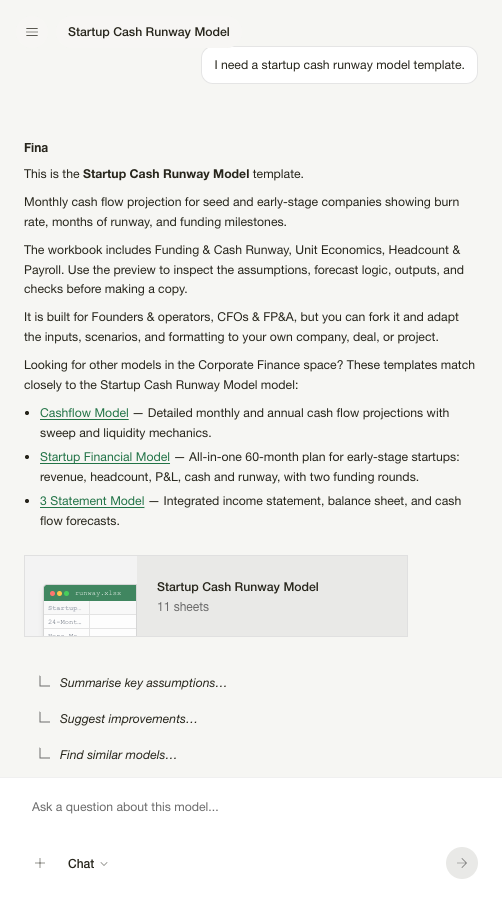
A 5-year monthly forecast with P&L, cash flow and runway, valuation (exit multiple plus a DCF cross-check), MOIC/IRR returns, and unit economics, with live formulas throughout.
How was this model built?+
It was built from KarmaCheck's pitch deck and publicly available information, then structured to investment-banking standards as a fully editable Excel model.
Can I change the assumptions?+
Yes. You can change assumptions and the live formulas will recalculate in the downloadable Excel model.
Have more financial modelling questions? Contact us

Created by ex-finance professionals
Hey, I’m Alex and I created Finamodel.
Over my years in the finance industry I kept building the same models over and over again. Same structure, same assumptions, different logo. So I started building frameworks to turn them into clean, reusable templates.
Every model here is one I’d actually use for a client, and I personally vet each one before it goes up.
I’m not an expert in every industry, but I’ve built enough models to know what belongs in one. And when something is completely foreign to me, I reach out to my network for experts to work on our models with us.
Having a template library on hand cuts a first build from hours to minutes.
Need help finding your model? You’ll find me in the Finamodel app!
Other Enterprise/Security Startup Financial Models
Browse another startup in the same category.
AgBiome
AgBiome is a microbial-platform agtech company that discovers, develops, and commercialises biological crop protection products (and licences the platform across adjacent markets).

Alation
Enterprise data intelligence platform - data catalog, governance, and metadata management for large organisations.

Archer SPAC
Archera
Cloud resource automation platform that continuously optimizes AWS commitment purchases, de-risks overcommitment, and automates FinOps workflows.

Ardoq
Cloud-native Enterprise Architecture (EA) SaaS platform that helps large enterprises navigate digital transformation through automated data collection, graph-based architecture modelling, and change impact analysis.

Ascend
Ascend.io is an enterprise big data automation platform ("Enterprise Intelligence Platform") that abstracts away the complexity of big data engineering so non-experts can build and run data pipelines.

Athennian
Cloud-based legal entity management system (EMS) uniting entity data with workflow and document automation.

Auditboard
Cloud-based integrated risk management platform connecting audit, risk, compliance, and ESG teams across the enterprise.