 Klue Financial Model
Enterprise/Security Startup Financials (Free Excel Download)
AI-driven Competitive Enablement Platform that collects, curates, and distributes competitor intelligence to enterprise sales and product teams.



professionals from Deloitte
Used by professionals from






About this model
Klue is an AI-driven competitive-enablement platform for sales and product teams. It collects, curates, and distributes competitor intelligence so customer-facing teams can make better decisions in active deals and product conversations.
The company sells subscription software to mid-market and enterprise customers through an inside-sales motion. Its cohort data shows net revenue retention above 100%, making the land-and-expand playbook - not only new-logo acquisition - the principal growth engine.
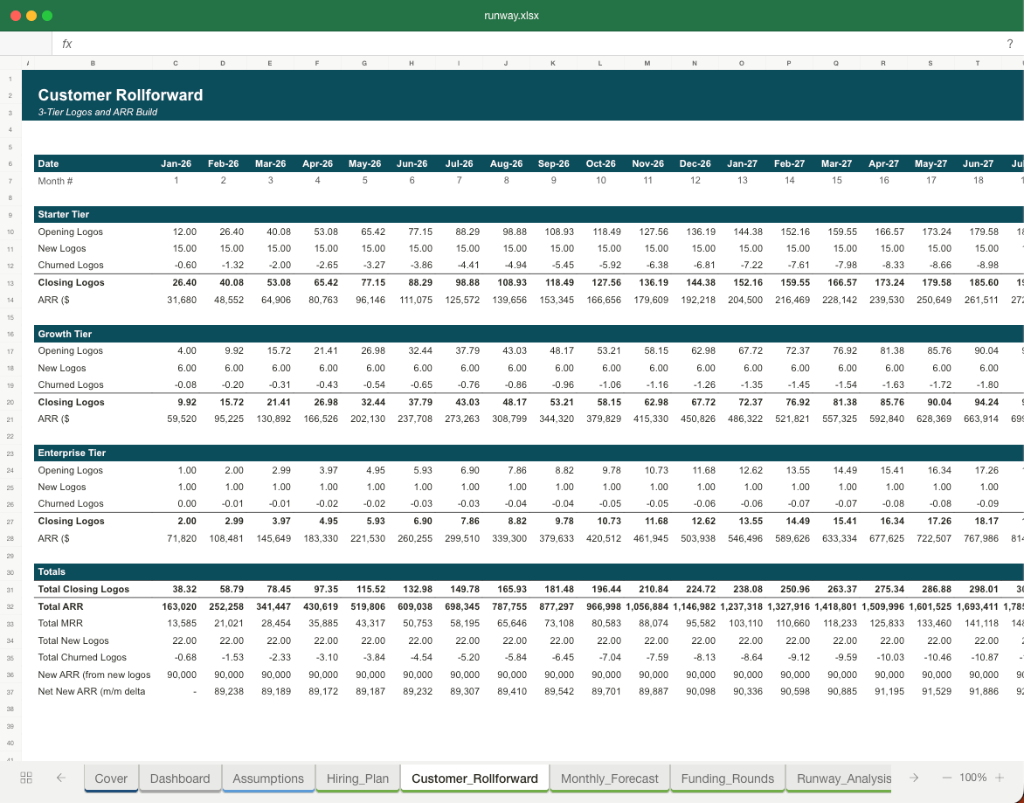
The model builds ARR by cohort, separating new-logo bookings, expansion, churn, and ending ARR. ACV, inside-sales capacity, conversion, retention, customer success, gross margin, and operating expense assumptions show how competitive intelligence translates into scalable SaaS economics.
A turnkey financial model
Live formulas, no hardcoded values
Outputs are driven by live formulas, so the workbook updates from its assumptions instead of relying on hardcoded results.
All assumptions in one tab
Inputs are clearly marked in the Assumptions tab and separated from calculations, making it clear what to change and what to leave intact.
Statements always balancing
For integrated-statement models, the balance sheet, cash flow, and supporting schedules tie through properly.
Distinct schedules for clarity
Debt, working capital, taxes, and cash flow can get messy quickly. We group calculations in clear schedules, not across disconnected tabs.
No hidden macros or external links
There are no unexplained external workbook links or macros to undermine auditability or portability.
Changes flow through the model
Update a key driver and see the impact carry through the forecast, financing, and return outputs. We never use hardcoded numbers in formulas.
About Klue
klue.com
How to build a detailed financial model for Klue
A complete walkthrough of the business, drivers, and assumptions behind the downloadable Klue model - distilled from its pitch deck and publicly available information.
Product & value proposition
- Three-step platform: Collect (external web: 3M+ signals/day - news, reviews, jobs, videos, webpage changes; plus internal sources: email, Slack, Salesforce, Chrome extension) → Curate (ML + human analysts) → Consume (battlecards, insight cards, embeddable in Salesforce, Zendesk, email/Slack digests, sales enablement tools).
- Primary buyers: Product Marketers (efficiency - 8x competitor coverage with same headcount) and Sales / Sales Enablement teams (effectiveness - 16% competitive win rate improvement QoQ).
- Category coined "Competitive Enablement" = intersection of Competitive Intelligence and Revenue Enablement.
- Analyst recognition: Gartner Cool Vendor in Sales & Channel Enablement; Forrester Strong Performer in Market & Competitive Intelligence.
Market
- TAM (Addressable Market): $38B - 5M businesses with 50+ employees, worldwide.
- SAM (Serviceable Market): $10B - 1.5M businesses with 50+ employees, NA & Europe.
- SOM (Obtainable Market): $3.4B - 150k businesses with 100+ employees, US & Canada only.
- Adjacent markets cited: $28B Business Intelligence, $43B Enterprise Content Management, $12B Learning Management, $47B Market Intelligence.
- Macro tailwinds: Competition increasing (150 martech companies in 2011 → 7,000 in 2019); digital universe growing 10x by 2025 (153 zettabytes); 52% of Fortune 500 since 2000 gone bankrupt/acquired/ceased; 72% of companies vulnerable to disruption within 3 years.
Revenue model
- Annual Contract Value (ACV) subscription model; ARR-based.
- Deal sizes redacted in deck ($XXk–$XXXXk range, growing year-over-year across 2018–2020).
- Expansion model: land with one line of business, expand to multiple LOBs + partners (slide 15 shows a named $XXXb tech company growing from $Xk/mo with 1 LOB to $XXk/mo with 6 LOBs + Partners over X years - exact figures redacted).
- 100% inside sales; no pilot programs.
- Channels: direct, with integrations into Salesforce, Zendesk, Slack, Highspot, and other sales enablement tools as distribution levers.
Traction & metrics
- "100's of companies using Klue today"; named customers include Shopify, Red Hat, Cisco, SurveyMonkey, Nike, Dell, K2.
- GTM line chart (slide 14) shows three series over ~12 months:
- Top series (green, users or seats): 234 → 313 → 347 → 542 → 691 → 845 → 936 → 1,095
- Middle series (red, likely clients or accounts): 110 → 143 → 185 → 195 → 278 → 383 → 447 → 589
- Bottom series (purple, likely something narrower - possibly paying clients): 42 → 48 → 52 → 65 → 86 → 113 → 142 → 168
- Revenue: consistent upward bar chart across ~12 quarters; no axis labels or absolute values disclosed.
- ACV increasing over 2018–2020; milestones and deal size figures redacted.
- Cohort retention heatmap (slide 18): all cohorts grow beyond 100% (net revenue expansion). Oldest visible cohort reaches 1,091% by period 12–14. One anomaly cohort starts at 89% (SMB mix, limited CEO involvement). Majority of cohorts show NRR well above 200–300% over 10+ periods.
- NPS: 68 (vs. software industry low 28, average 41, high 55).
- Product-market fit survey: 51% "very disappointed" if they lost Klue (threshold = 40%; Slack in 2015 = 51%).
- 8x competitor coverage improvement for product marketers.
- 16% competitive win rate improvement QoQ for sales teams.
Unit economics
- CAC payback: 9 months (fully gross-margin burdened).
- BVP Efficiency Score (Net New ARR / Burn): 4.3x - in the "BEST > 1.5x" tier.
- Sales Efficiency "Magic Number" (New ARR / prior quarter S&M spend): 2.4x - well above "Strong Efficiency" threshold of >1.0x; highest bar in their own chart at ~3.1x, most recent at ~2.3x.
- 85% of deals closed with minimal CEO involvement, indicating repeatable sales motion.
- Cohort NRR: strongly net-positive across all cohorts (see §5 above) - implies high LTV relative to CAC.
- Gross margin: referenced as basis for CAC payback ("fully GM burdened") but exact GM% not disclosed.
- Cash on hand: $Xm (redacted).
- Monthly burn: $XXk (redacted).
- Total funding raised to date: $4M (Angel + Seed, USD).
Competition / moat
- Self-described as one of "two companies creating the category" - Klue (enterprise, AI-driven, ARR > Spend, lower than avg churn) vs. unnamed SMB-oriented competitor (search-and-save lookup tool, services/analyst-driven, Spend >>> ARR, higher than avg churn).
- Analogises itself to category creators in adjacent sales tech: Sales Enablement (Highspot $200M raised, Seismic $165M raised), Sales Engagement (Salesloft $145M, Outreach $240M), Conversational Intelligence (Gong.io $133M, Chorus.ai $55M).
- Moat sources stated: ML/AI curation at scale (3M+ signals/day), internal + external data flywheel, deep integration into sales workflow (Salesforce, Slack, enablement tools), proprietary battlecard/insight format, strong NPS and retention indicating switching costs.
Team & funding ask / use of funds
- CEO Jason Smith: 5x founder; former President at VisionCritical (SaaS startup to $50M ARR); co-founded 100-person web applications company acquired by TELUS (NYSE: TU).
- CTO Sarathy Naicker: developed PureMessage anti-spam product (used by 100M+ people); former Chief Technologist at Sophos; co-wrote Perl.
- Team: 40+ people, average 10+ years experience; pedigree from Hootsuite, VisionCritical, Salesforce, Ipsos, TELUS across Sales, Product, Engineering, Customer Success.
- Raise: US$10M Series A.
- Use of funds (stated in deck):
- Expand across verticals, geographies, and departments.
- Deepen AI and product workflow.
- Opportunistic moves in downturn.
Recommended financial model
- Archetype + why: SaaS ARR model with cohort-based NRR expansion. Klue is a subscription B2B SaaS business with strong net revenue retention (demonstrated NRR well above 100% across all cohorts), ACV-based deals, inside sales motion, and a land-and-expand playbook. The model must separate new logo ARR from expansion ARR, as cohort expansion is the dominant growth engine.
- Forecast horizon & granularity: Monthly for Year 1–2; quarterly for Year 3–5. 5-year total horizon is appropriate for a Series A.
- Key drivers & assumptions:
| Driver | Value / Source |
|---|---|
| Beginning client count (most recent) | ~168 (bottom series, slide 14, likely paying clients) |
| New logos per month | Implied by client series growth; ~15–20/month at most recent pace |
| Net Revenue Retention (NRR) | >200% for established cohorts; model at 130% blended (conservatively, reflecting SMB cohort drag and early-cohort dilution) |
| Gross margin | 70–75% |
| CAC payback (fully burdened) | 9 months |
| Sales Efficiency Magic Number | 2.4x |
| BVP Efficiency Score | 4.3x |
| S&M as % of revenue | Derived from magic number: if Net New ARR = 2.4x prior quarter S&M, then S&M% ≈ ARR growth rate / 2.4 |
| Headcount growth | Scale from ~40 today; hire predominantly in Engineering/ML and Sales |
| Churn (gross logo) | Low; stated "lower than average churn" for enterprise tier |
| Series A proceeds | $10M USD |
| Geographic expansion | US & Canada Year 1–2; NA & Europe Year 3+ |
- Scenarios (Base / Bull / Bear - which variables flex):
- Base: New logo additions at current pace (~18/mo), blended NRR 130%, ACV grows modestly YoY as enterprise mix increases.
- Bull: NRR sustains 150%+, ACV climbs faster (larger enterprise deals), geographic expansion accelerates in Year 2.
- Bear: NRR reverts toward 110% (SMB-heavy mix), new logo growth slows (longer sales cycles post-downturn), burn increases with AI/ML investment.
- Flex variables: NRR, new logo count, average ACV, S&M efficiency (magic number).
- Required sheets / outputs:
- Assumptions - all drivers, tagged or.
- ARR Bridge - monthly: Beginning ARR + New Logo ARR + Expansion ARR − Contraction − Churned ARR = Ending ARR.
- Cohort Model - annual cohorts, each with its own NRR expansion schedule (can simplify to a blended NRR multiplier after Year 1).
- Income Statement - Revenue (ARR recognised monthly), COGS (hosting, CS), Gross Profit, S&M, R&D, G&A, EBITDA.
- Headcount Plan - by function, linked to opex.
- Cash Flow & Runway - monthly burn, cash on hand, runway from $10M raise.
- KPI Dashboard - ARR, MRR, Clients, Users, NRR, CAC payback, Magic Number, BVP Score, Gross Margin %.
- Scenario toggle - Base / Bull / Bear switchable via single cell.
Frequently asked
Is the Klue financial model free?+
Yes. The Klue model is a free Excel (.xlsx) download with live formulas. Sign up with your email and the workbook is yours to keep, review, and edit.
What's included in the model?+
A 5-year monthly forecast with P&L, cash flow and runway, valuation (exit multiple plus a DCF cross-check), MOIC/IRR returns, and unit economics, with live formulas throughout.
How was this model built?+
It was built from Klue's pitch deck and publicly available information, then structured to investment-banking standards as a fully editable Excel model.
Can I change the assumptions?+
Yes. You can change assumptions and the live formulas will recalculate in the downloadable Excel model.
Have more financial modelling questions? Contact us

Created by ex-finance professionals
Hey, I’m Alex and I created Finamodel.
Over my years in the finance industry I kept building the same models over and over again. Same structure, same assumptions, different logo. So I started building frameworks to turn them into clean, reusable templates.
Every model here is one I’d actually use for a client, and I personally vet each one before it goes up.
I’m not an expert in every industry, but I’ve built enough models to know what belongs in one. And when something is completely foreign to me, I reach out to my network for experts to work on our models with us.
Having a template library on hand cuts a first build from hours to minutes.
Need help finding your model? You’ll find me in the Finamodel app!
Other Enterprise/Security Startup Financial Models
Browse another startup in the same category.
AgBiome
AgBiome is a microbial-platform agtech company that discovers, develops, and commercialises biological crop protection products (and licences the platform across adjacent markets).

Alation
Enterprise data intelligence platform - data catalog, governance, and metadata management for large organisations.

Archer SPAC
Archera
Cloud resource automation platform that continuously optimizes AWS commitment purchases, de-risks overcommitment, and automates FinOps workflows.

Ardoq
Cloud-native Enterprise Architecture (EA) SaaS platform that helps large enterprises navigate digital transformation through automated data collection, graph-based architecture modelling, and change impact analysis.

Ascend
Ascend.io is an enterprise big data automation platform ("Enterprise Intelligence Platform") that abstracts away the complexity of big data engineering so non-experts can build and run data pipelines.

Athennian
Cloud-based legal entity management system (EMS) uniting entity data with workflow and document automation.

Auditboard
Cloud-based integrated risk management platform connecting audit, risk, compliance, and ESG teams across the enterprise.