 Komodor Financial Model
Dev Tools Startup Financials (Free Excel Download)
Kubernetes-native change-intelligence platform that correlates cross-system events to accelerate incident troubleshooting and reduce MTTR.



professionals from Deloitte
Used by professionals from






About this model
Komodor is a Kubernetes-native change-intelligence platform that connects events across infrastructure and developer tools to speed incident investigation. It gives engineering teams a unified timeline of changes, services, metrics, and past incidents rather than requiring manual context switching.
The product targets Kubernetes-using companies with 50–500 developers and enters through a quick installation before expanding across services and teams. Early customers included Intel, Varonis, Outreach, monday.com, Yotpo, and other technology companies.
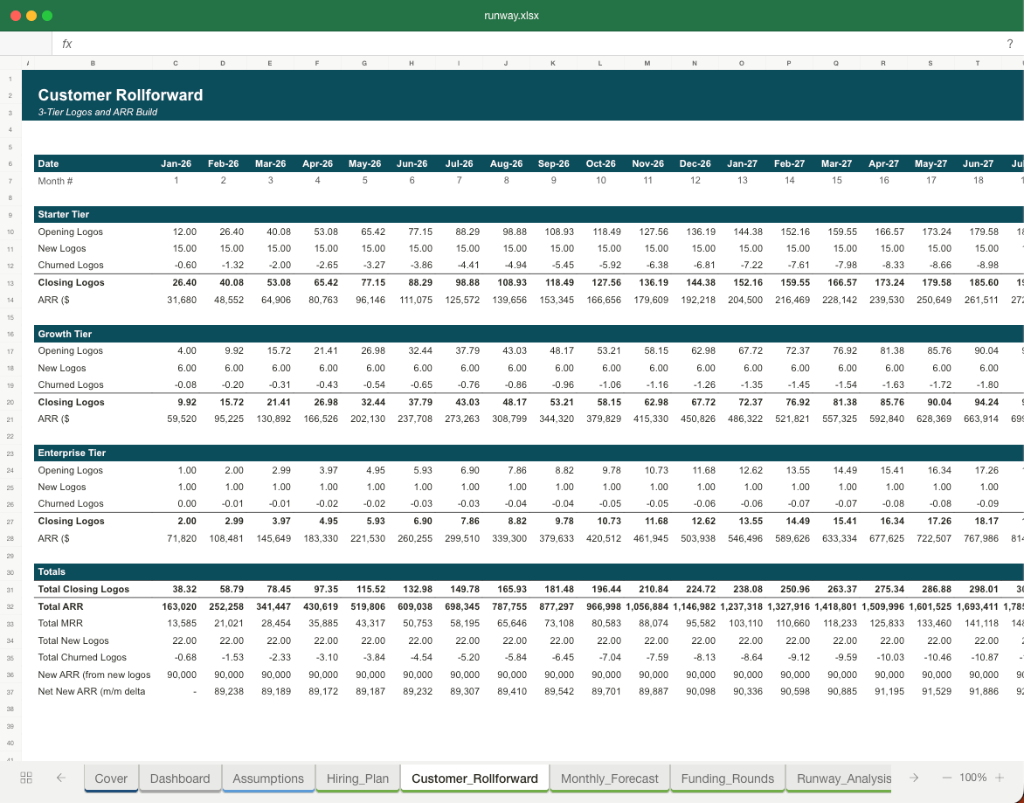
The model is a B2B SaaS ARR forecast priced by users, clusters, or services. New logos, initial deployment, technical adoption, expansion, annual contract value, and churn build revenue. Product-led conversion, enterprise sales, infrastructure integrations, support, and net retention determine the scale path.
A turnkey financial model
Live formulas, no hardcoded values
Outputs are driven by live formulas, so the workbook updates from its assumptions instead of relying on hardcoded results.
All assumptions in one tab
Inputs are clearly marked in the Assumptions tab and separated from calculations, making it clear what to change and what to leave intact.
Statements always balancing
For integrated-statement models, the balance sheet, cash flow, and supporting schedules tie through properly.
Distinct schedules for clarity
Debt, working capital, taxes, and cash flow can get messy quickly. We group calculations in clear schedules, not across disconnected tabs.
No hidden macros or external links
There are no unexplained external workbook links or macros to undermine auditability or portability.
Changes flow through the model
Update a key driver and see the impact carry through the forecast, financing, and return outputs. We never use hardcoded numbers in formulas.
About Komodor
komodor.io
How to build a detailed financial model for Komodor
A complete walkthrough of the business, drivers, and assumptions behind the downloadable Komodor model - distilled from its pitch deck and publicly available information.
Product & value proposition
Komodor tracks changes across tools and teams (GitHub, AWS, PostgreSQL, Auth0, Datadog, Slack, PagerDuty, Sentry, Kubernetes, Jaeger, Consul, Kiali), understands their ripple effects across services, and surfaces a unified activity timeline per service so engineers can identify root cause without switching tools.
Three functional pillars:
- Understand - changes, events, services, metrics, past incidents (stated as absorbing ~80% of troubleshooting resources).
- Manage - team collaboration, runbooks, alert-level actions.
- Prevent - policy/rules from past incidents, auto-remediation / self-healing.
Key claims: 85% of incidents traceable to system changes; current tooling creates blind spots (unaudited changes), fragmented data (hundreds of tools), and butterfly effects in distributed systems.
Revenue model
Not explicitly stated in deck. Inferred from ICP and product:
- SaaS subscription, likely per-seat (per DevOps/SRE/developer user) or per-cluster/per-service, billed annually. Rationale: standard model for Kubernetes tooling comps (Datadog, PagerDuty, etc.).
- Self-serve / PLG motion with enterprise land-and-expand, given "five-minute installation" positioning and ICP of 50–500 developers.
- Sales-assisted for VP/Director of R&D buyers (budget holders).
- Channel: direct / product-led; integrations (PagerDuty, Datadog, Slack) serve as distribution hooks.
Traction & metrics
- Named early customers (logo cloud, January 2021): Intel, Varonis, Outreach, monday.com, Yotpo, Aqua Security, logz.io, Splitit, Rookout, TuneIn.
- Qualitative testimonials from Varonis (Cloud Ops), Splitit (Software Architect), Aqua (R&D DevOps).
- One client running 200+ Kubernetes microservices (product demo context).
- No revenue, ARR, MRR, customer count, growth rate, or NRR figures disclosed.
Competition / moat
Competitive landscape - Komodor claims superiority vs.:
- APM (e.g., Datadog, New Relic) - alerts only, no cross-system event correlation.
- Log Management Platforms - alerts only.
- Incident Resolution Platforms (e.g., PagerDuty) - no preventive analysis.
- SRE Platforms - no system-wide events collection.
- AIOps Platforms (IT & NOC) - different buyer, IT/NOC-centric.
Moat claims: service-centric topology graph ("Komodor's brain") mapping 200+ microservice dependency chains; cross-system event ingestion breadth; change-to-alert correlation as a proprietary data asset.
Team & funding ask / use of funds
Founders:
- Ben Ofiri - Co-founder & CEO (background: Google).
- Itiel Shwartz - Co-founder & CTO (background: eBay, Forter, Rookout).
Investors:
- VCs: Gigi Weiss (GP, NFX), Eyal Niv (GP, Pitango).
- Angels: Danny Grander (Co-founder & CSO, Snyk), Tomer Levy (Co-founder & CEO, Logz.io), Amir Jerbi (Co-founder & CTO, Aqua Security), Michael Stoppelman (Former SVP Engineering, Yelp), Erez Ofer (GP, 83North), Eric Reiner (Founding & Managing Partner, New Venture Capital Firm).
Recommended financial model
- Archetype + why: SaaS ARR model with seat/cluster-based expansion. Komodor is a pure B2B SaaS targeting a defined ICP (50–500 devs, Kubernetes-required), selling to a technical buyer with a product-led entry and enterprise expansion motion. ARR build + NRR waterfall is the correct archetype.
- Forecast horizon & granularity: 3 years (Y1–Y3), monthly granularity for Y1, quarterly for Y2–Y3.
- Key drivers & assumptions:
- New logos per month: starting at 3–5/month in Y1 ramping to 10–15 by Y3; rationale: early stage, ~10 named logos at seed.
- ACV per customer: $15k–$40k/year; rationale: mid-market DevOps SaaS comps (comparable to early Datadog/PagerDuty mid-market ACV); no deck data.
- ICP company size: 200–2,000 employees, 50–500 developers.
- Pricing unit: per seat (DevOps/SRE) or per cluster; assume ~$150–300/seat/month or flat cluster fee.
- Gross churn: 5–8% annual; rationale: DevOps tooling that embeds into on-call workflow has high switching cost but early-stage retention is uncertain.
- Net Revenue Retention (NRR): 110–120%; rationale: expansion via seat count / service count growth as companies scale; PLG motion typical for this category.
- Sales cycle: 30–60 days for initial land (self-serve/PLG), 60–120 days for enterprise expansion.
- Gross margin: 70–75%; rationale: cloud-hosted SaaS with Kubernetes agent infrastructure costs; no hardware.
- Headcount: primarily R&D and sales in Y1; sales ramp from Y2. No team size disclosed.
- CAC: $5k–$15k blended (PLG land lowers initial CAC; enterprise expansion requires CSM + AE).
- CAC payback: 12–18 months.
- Scenarios (Base / Bull / Bear - which variables flex):
- Bull: faster logo adds (15+/month by Y2), ACV upside ($50k+), NRR 130%+, US enterprise penetration accelerates.
- Base: 8–10 new logos/month by Y2, ACV $25k, NRR 115%, moderate churn.
- Bear: slow enterprise sales cycle, PLG limited to SMB, ACV $12k, churn 12%, NRR sub-100% until product matures.
- Key flex variables: new logo velocity, ACV, NRR, and gross margin (infrastructure cost at scale).
- Required sheets / outputs:
- Assumptions dashboard (all drivers editable).
- ARR waterfall (new ARR, expansion ARR, churn ARR, net new ARR, ending ARR by period).
- P&L (revenue, COGS, gross profit, S&M, R&D, G&A, EBITDA).
- Headcount plan (by department, linked to opex).
- Cash / runway (burn rate, runway given assumed raise).
- Cohort table (logo count by vintage, ACV by cohort, NRR by cohort year).
- Scenario toggle (Base / Bull / Bear).
Frequently asked
Is the Komodor financial model free?+
Yes. The Komodor model is a free Excel (.xlsx) download with live formulas. Sign up with your email and the workbook is yours to keep, review, and edit.
What's included in the model?+
A 5-year monthly forecast with P&L, cash flow and runway, valuation (exit multiple plus a DCF cross-check), MOIC/IRR returns, and unit economics, with live formulas throughout.
How was this model built?+
It was built from Komodor's pitch deck and publicly available information, then structured to investment-banking standards as a fully editable Excel model.
Can I change the assumptions?+
Yes. You can change assumptions and the live formulas will recalculate in the downloadable Excel model.
Have more financial modelling questions? Contact us

Created by ex-finance professionals
Hey, I’m Alex and I created Finamodel.
Over my years in the finance industry I kept building the same models over and over again. Same structure, same assumptions, different logo. So I started building frameworks to turn them into clean, reusable templates.
Every model here is one I’d actually use for a client, and I personally vet each one before it goes up.
I’m not an expert in every industry, but I’ve built enough models to know what belongs in one. And when something is completely foreign to me, I reach out to my network for experts to work on our models with us.
Having a template library on hand cuts a first build from hours to minutes.
Need help finding your model? You’ll find me in the Finamodel app!
Other Dev Tools Startup Financial Models
Browse another startup in the same category.

8base
Low-code/no-code platform providing backend and frontend development tools for building digital products, internal apps, and SaaS.
Ably
Enterprise realtime messaging infrastructure (pub/sub) delivered as a cloud-native platform, enabling developers to build scalable live experiences without managing complex realtime infrastructure.

Amplitude
Mobile analytics SaaS platform giving app developers real-time behavioral analytics, funnel/retention analysis, and raw data warehouse access at scale.
Anima
Automated design-to-code platform - designers export production-ready code from their design tools with one click.

Apollo
Apollo builds and sells an enterprise "data graph" platform (powered by GraphQL) that sits as a unified API layer between frontend apps and backend microservices.
BrowserStack
Cloud-based cross-browser and mobile app testing platform used by 50,000+ customers across 135 countries.
CodeSandbox
Cloud-native collaborative web IDE that lets entire product teams (not just developers) code, review, and iterate together in the browser.
CommandBar
SaaS SDK that embeds a search-based command bar into web apps, improving UX, onboarding, and retention for B2B software companies.