LSLago Series A Financial Model
Dev Tools Startup Financials (Free Excel Download)
Open-source billing and metering infrastructure for B2B software companies, sold via an open-core SaaS model.



professionals from Deloitte
Used by professionals from






About this model
Lago turns event streams into billable data for finance and engineering teams, covering metering, pricing, invoicing, payments, and analytics at up to 100,000 events per second. It supports subscriptions, usage, graduated, percentage, weighted, prorated, and prepaid-credit pricing through a business UI and REST or gRPC APIs.
Its open-core model offers free self-hosted software plus paid Self-hosted Premium and Cloud Premium subscriptions. Engineers can inspect the codebase or self-host before buying, and Lago grew through inbound developer communities without a dedicated sales team. Mistral AI replaced Stripe Billing and Swan.io displaced Chargebee.
Lago had 4,800-plus GitHub stars, 1,000-plus Slack members, and Product Hunt Product of the Month status, with recurring revenue growing in beta. The model should forecast OSS adoption, premium conversion, cloud versus self-hosted ARR, annual minimums, sales hiring, expansion, churn, infrastructure cost, and retention.
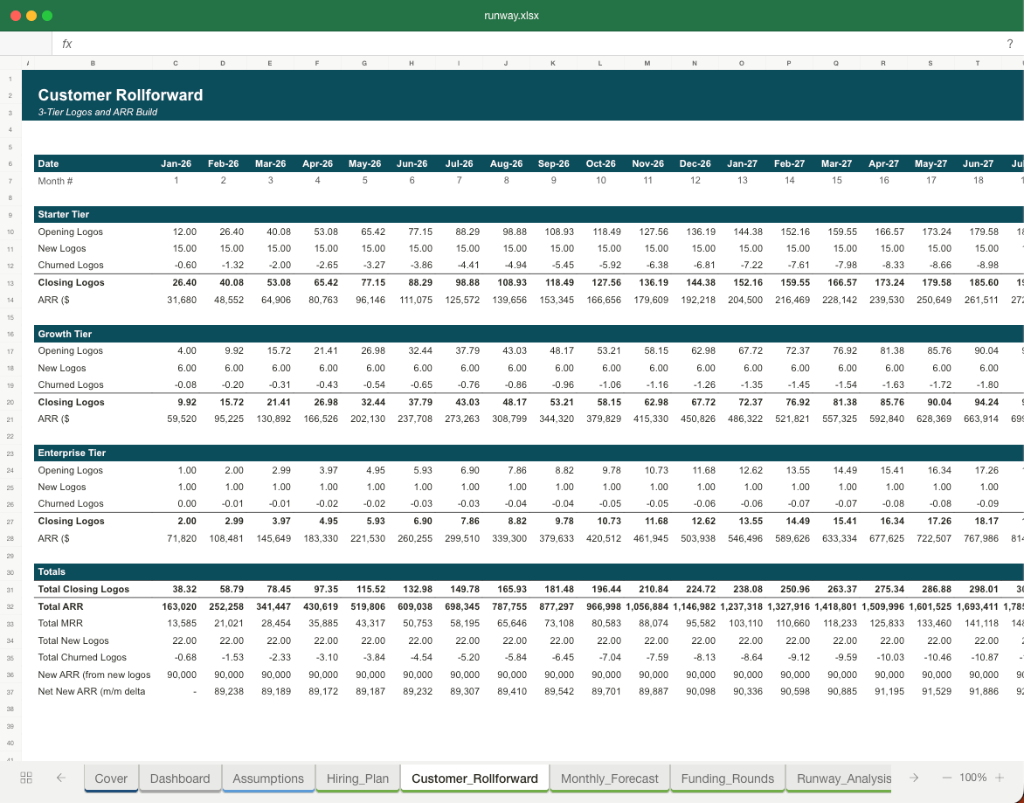
A turnkey financial model
Live formulas, no hardcoded values
Outputs are driven by live formulas, so the workbook updates from its assumptions instead of relying on hardcoded results.
All assumptions in one tab
Inputs are clearly marked in the Assumptions tab and separated from calculations, making it clear what to change and what to leave intact.
Statements always balancing
For integrated-statement models, the balance sheet, cash flow, and supporting schedules tie through properly.
Distinct schedules for clarity
Debt, working capital, taxes, and cash flow can get messy quickly. We group calculations in clear schedules, not across disconnected tabs.
No hidden macros or external links
There are no unexplained external workbook links or macros to undermine auditability or portability.
Changes flow through the model
Update a key driver and see the impact carry through the forecast, financing, and return outputs. We never use hardcoded numbers in formulas.
About Lago Series A
https: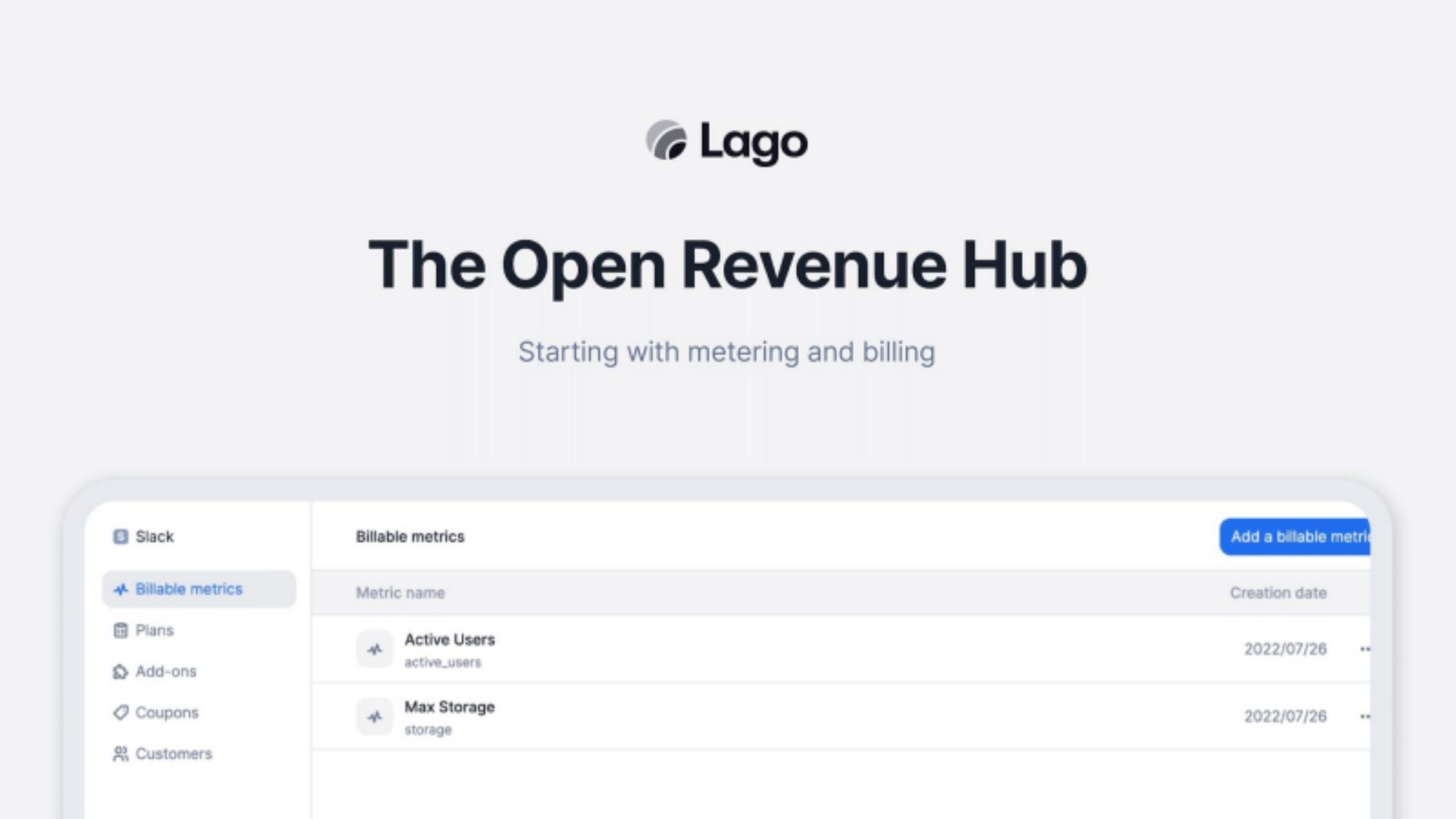
How to build a detailed financial model for Lago Series A
A complete walkthrough of the business, drivers, and assumptions behind the downloadable Lago Series A model - distilled from its pitch deck and publicly available information.
Product & value proposition
- Lago processes raw event streams (up to 100K events/sec) into billable data - metering, pricing, invoicing, payments, and analytics
- Two surfaces: intuitive UI for finance/business users; REST + gRPC API for engineers
- Supports diverse pricing models: subscription, usage-based, graduated, percentage, weighted aggregation, prorated, prepaid credits
- Open-source codebase on GitHub (getlago/lago); engineers can self-inspect and self-host before buying
- Positioned as "The Open Revenue Hub" - starting with metering and billing, expanding to full revenue stack
Revenue model
- Open-core model: three tiers:
- Lago Open Source - self-hosted, free (community edition)
- Lago Self-hosted Premium - self-hosted + premium features, paying
- Lago Cloud Premium - hosted (cloud) + premium features, paying
- Deck deliberately redacts the ACV floor: "ACV = $XX K / year of minimum spend (only software, no service)"
- 100% inbound lead generation; no sales or marketing team at time of deck
- GTM transition planned: hiring SDR/BDR, AEs, Solution Engineers, Business Ops, Content, SEO, Product Marketing in EU and NYC
- No usage-based / transaction-fee revenue model described; pure software subscription
Traction & metrics
- 4,800+ GitHub stars
- GitHub star growth: ~0 in July 2022 → ~4k by October 2023 (approximately 16 months)
- Slack community: 1,000+ members
- Product Hunt: #1 Product of the Month
- Loved by 1,200+ Product Managers
- Recurring revenue chart shows exponential growth from November 2022 to October 2023; no absolute revenue values visible on y-axis
- EU = 31% of revenue; US = 27% of revenue
- ACV = $XX K/year minimum spend (value redacted in deck)
- Product still in Beta; no dedicated sales or marketing team
- HackerNews posts: "Billing systems are a nightmare for engineers" (777 points, 359 comments); "Why doesn't Stripe use Stripe Billing?" (336 points); "Stripe's real pricing: a primer" (417 points); "Open Source does not win by being cheaper" (425 points)
- Named customers / wins: Mistral AI (displaced Stripe Billing), Swan.io (displaced Chargebee)
- Team: 10 FTEs, fully founder-led GTM
Unit economics
- CAC: 100% inbound, no paid acquisition, effectively $0 outbound CAC at time of deck
- ACV minimum: $XX K/year (exact value redacted)
Competition / moat
- Direct competitors named: Stripe Billing (won against at Mistral AI), Chargebee (won against at Swan.io)
- Broader competitive framing: home-grown billing systems and legacy incumbents
- Moat sources identified in deck:
- Open-source trust / developer inspection - shortens sales cycle
- Extensibility - competes against home-grown builds by being more customisable
- Connectivity / land-and-expand - integrates with existing back-office and finance stacks
- Community flywheel - HN content, GitHub stars, Slack community drive inbound
- Team moat: built Qonto's billing system (Qonto = European B2B neobank, $100M+ ARR, 150K+ customers, $5B valuation Series D)
Team & funding ask / use of funds
- Team: 10 FTEs; 8 were early Qonto employees
- CEO: Anh-Tho; rest of team is product/engineering
- YC S21; pivoted to billing in 2022
- Existing investors: SignalFire, Lee Fixel's Addition, Y Combinator (US); New Wave (EU)
- Angels: Hugging Face CEO, MongoDB 1st GTM hire, OpenAI Head of DevRel
- "Haven't touched a cent from the latest raise; N years of runway at current burn" - exact runway and raise size are redacted
- Use of funds: Implied by GTM slide - hiring sales (SDR/BDR, AEs, SEs, BizOps) and marketing (content, SEO, product marketing, community) in EU and NYC
Recommended financial model
- Archetype + why: Open-core SaaS ARR model. Revenue is pure software subscription with ACV-based contracts; open-core funnel (OSS installs → cloud/self-hosted premium conversions) is the defining mechanic. Standard SaaS ARR waterfall applies with an OSS-to-paid conversion layer on top.
- Forecast horizon & granularity: 3 years (Year 1–3), monthly granularity for Year 1, quarterly for Years 2–3. Rationale: early-stage with exponential revenue curve visible but no absolute revenue base disclosed; monthly detail needed to model the GTM hiring ramp.
- Key drivers & assumptions:
| Driver | Value / Rationale |
|---|---|
| Starting ARR (Month 0) | $0.5M–$1M; consistent with Beta-stage, redacted ACV, exponential curve starting near zero in late 2022 |
| ACV per customer (minimum) | $XX K/year - exact value redacted; model should parameterise as a variable (suggest $20K–$60K range) |
| OSS installs / new leads per month | Grows with GitHub star velocity; ~300 stars/month at deck date implies ~50–80 qualified inbound leads/month |
| OSS → paid conversion rate | 2–5%; standard open-core benchmark for developer-infra tools |
| Average sales cycle | 1–3 months; inbound-led, no outbound friction, product already tested by engineers |
| Net Revenue Retention (NRR) | 110–130%; usage-based metering enables expansion as customers grow event volumes |
| Gross Revenue Retention (GRR) | 85–90%; infrastructure switching cost is high once integrated |
| Gross margin | 75–85%; cloud-hosted product has infrastructure cost; self-hosted premium has near-zero COGS |
| Headcount ramp | 10 FTEs today; Series A proceeds fund sales + marketing hires in EU and NYC [slide 19] |
| Revenue mix: EU vs US | EU 31%, US 27% at deck date; model currency split accordingly |
| Blended ACV growth over time | Increases as GTM matures and enterprise deals close; start at minimum, grow toward $50K–$150K range |
| Self-hosted premium vs cloud mix | ~50/50 split initially; cloud share grows as Lago Cloud matures |
- Scenarios (Base / Bull / Bear - which variables flex):
- Base: OSS→paid conversion 3%, NRR 115%, ACV grows modestly, headcount hired on plan
- Bull: Conversion 5%, NRR 130% (strong usage-based expansion), faster enterprise ACV ramp, US market accelerates
- Bear: Conversion 1.5%, NRR 105%, ACV stays at floor, GTM hiring delayed or under-performs
- Required sheets / outputs:
- Assumptions - all drivers as named inputs; ACV range, conversion rate, NRR, headcount plan
- OSS Funnel - GitHub star growth → inbound leads → trials → paid conversions
- ARR Waterfall - new ARR, expansion ARR, churned ARR, net new ARR, ending ARR (monthly)
- P&L - revenue, COGS (infrastructure), gross profit, S&M, R&D, G&A, EBITDA
- Headcount Plan - by function (Eng, Sales, Marketing, BizOps, G&A), timing, fully-loaded cost
- Cash & Runway - opening cash, monthly burn, runway months (parameterise raise amount)
- Cohort / NRR - customer cohorts, expansion and churn rates, LTV build
- Dashboard / KPIs - ARR, MRR, customers, ACV, NRR, CAC payback, runway
Frequently asked
Is the Lago Series A financial model free?+
Yes. The Lago Series A model is a free Excel (.xlsx) download with live formulas. Sign up with your email and the workbook is yours to keep, review, and edit.
What's included in the model?+
A 5-year monthly forecast with P&L, cash flow and runway, valuation (exit multiple plus a DCF cross-check), MOIC/IRR returns, and unit economics, with live formulas throughout.
How was this model built?+
It was built from Lago Series A's pitch deck and publicly available information, then structured to investment-banking standards as a fully editable Excel model.
Can I change the assumptions?+
Yes. You can change assumptions and the live formulas will recalculate in the downloadable Excel model.
Have more financial modelling questions? Contact us

Created by ex-finance professionals
Hey, I’m Alex and I created Finamodel.
Over my years in the finance industry I kept building the same models over and over again. Same structure, same assumptions, different logo. So I started building frameworks to turn them into clean, reusable templates.
Every model here is one I’d actually use for a client, and I personally vet each one before it goes up.
I’m not an expert in every industry, but I’ve built enough models to know what belongs in one. And when something is completely foreign to me, I reach out to my network for experts to work on our models with us.
Having a template library on hand cuts a first build from hours to minutes.
Need help finding your model? You’ll find me in the Finamodel app!
Other Dev Tools Startup Financial Models
Browse another startup in the same category.

8base
Low-code/no-code platform providing backend and frontend development tools for building digital products, internal apps, and SaaS.
Ably
Enterprise realtime messaging infrastructure (pub/sub) delivered as a cloud-native platform, enabling developers to build scalable live experiences without managing complex realtime infrastructure.

Amplitude
Mobile analytics SaaS platform giving app developers real-time behavioral analytics, funnel/retention analysis, and raw data warehouse access at scale.
Anima
Automated design-to-code platform - designers export production-ready code from their design tools with one click.

Apollo
Apollo builds and sells an enterprise "data graph" platform (powered by GraphQL) that sits as a unified API layer between frontend apps and backend microservices.
BrowserStack
Cloud-based cross-browser and mobile app testing platform used by 50,000+ customers across 135 countries.
CodeSandbox
Cloud-native collaborative web IDE that lets entire product teams (not just developers) code, review, and iterate together in the browser.
CommandBar
SaaS SDK that embeds a search-based command bar into web apps, improving UX, onboarding, and retention for B2B software companies.