 Macrometa Financial Model
Dev Tools Startup Financials (Free Excel Download)
Serverless global data cloud (edge + multi-cloud) that lets enterprise developers build real-time, distributed apps with <50ms latency at 1/10th the cost of hyperscalers.



professionals from Deloitte





About this model
Macrometa’s Global Data Network is a serverless multi-cloud edge platform combining database, streams, functions, pipelines, and search behind one API. It supports global stateful applications with sub-50ms latency and AWS-compatible DynamoDB and Kinesis protocols, reducing migration friction for web, mobile, IoT, analytics, and security workloads.
The enterprise model is ARR- and usage-led, sold directly and through cloud or CDN partners. Verizon and Cox Communications each represented deals above $250,000, while VMware, Intuit, and Awake Security were design partners. The deck does not disclose tiering or consumption rates.
Macrometa grew from zero to $1.5 million ARR in nine months during 2020 and targeted more than threefold growth in 2021. It had conducted over 500 customer and partner interviews. The model should forecast enterprise ACV, partner pipeline, usage, infrastructure cost, sales cycles, expansion, churn, and cash.
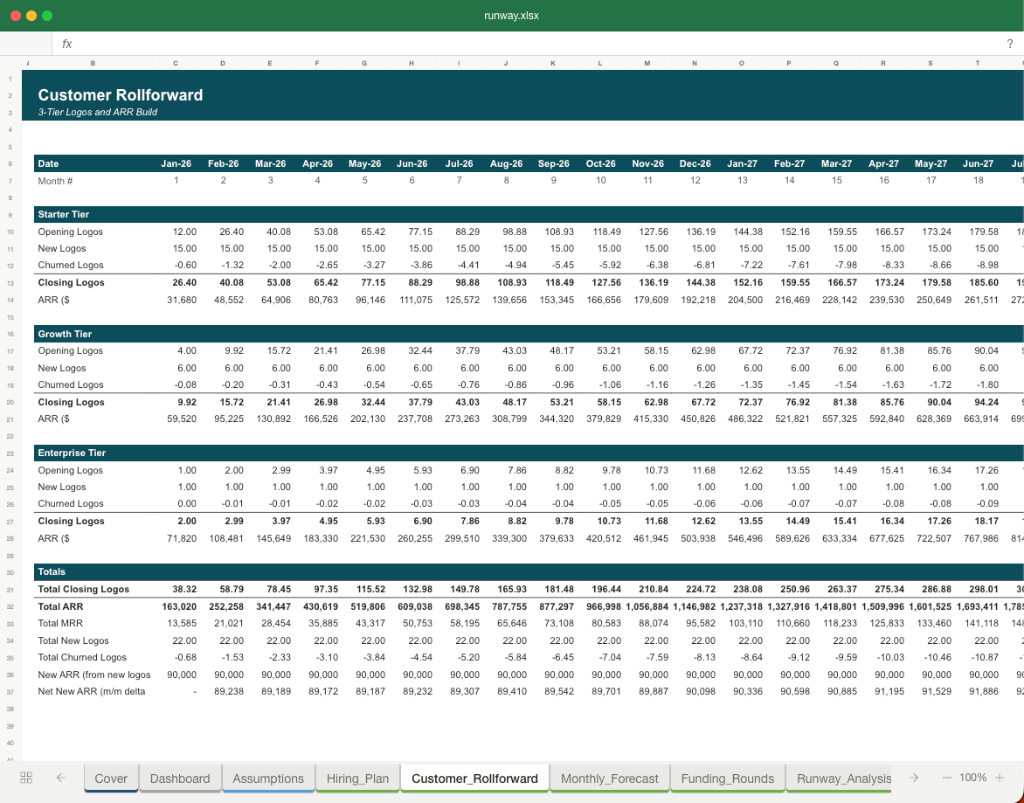
A turnkey financial model
Live formulas, no hardcoded values
Outputs are driven by live formulas, so the workbook updates from its assumptions instead of relying on hardcoded results.
All assumptions in one tab
Inputs are clearly marked in the Assumptions tab and separated from calculations, making it clear what to change and what to leave intact.
Statements always balancing
For integrated-statement models, the balance sheet, cash flow, and supporting schedules tie through properly.
Distinct schedules for clarity
Debt, working capital, taxes, and cash flow can get messy quickly. We group calculations in clear schedules, not across disconnected tabs.
No hidden macros or external links
There are no unexplained external workbook links or macros to undermine auditability or portability.
Changes flow through the model
Update a key driver and see the impact carry through the forecast, financing, and return outputs. We never use hardcoded numbers in formulas.
About Macrometa
macrometa.com
How to build a detailed financial model for Macrometa
A complete walkthrough of the business, drivers, and assumptions behind the downloadable Macrometa model - distilled from its pitch deck and publicly available information.
Product & value proposition
- Macrometa Global Data Network (GDN): serverless, multi-cloud platform with edge DB, streams, functions, pipeline, and search - all behind a single API
- Serves stateful apps worldwide at <50ms RTT latency
- AWS-compatible API/SDK (DynamoDB & Kinesis proxy protocols) - low friction migration
- Replaces a dozen+ cloud data services (Firebase/Firestore, pub/sub, DataFlow, Cloud Functions, etc.) in one platform
- Key value claims: 25x faster data ingest vs GCP; 70% cost reduction; 50–100x better performance for web/mobile; sub-second analytics at 80% less cost than public cloud
- Use cases: Web & mobile acceleration, real-time analytics, in-region data processing (regulatory compliance), 5G/IoT/edge apps, cybersecurity threat propagation
- Deeply integrated with CDN and cloud platforms from Day 1
Revenue model
- Model: ARR-based enterprise SaaS/usage - referenced consistently as ARR metric
- ACV: High ACV enterprise deals; >$250K per deal confirmed at Verizon & Cox Communications in 2020; slide 6 references "$ X Million" ACV wins (exact value redacted)
- Channels: (1) Direct founder-led enterprise sales, (2) cloud channel / CDN partner distribution built in from Day 1
- No pricing tiers, per-seat, or consumption unit rates disclosed in deck
Traction & metrics
- ARR trajectory: $0 → $1.5M ARR in 9 months (2020); deck slide 3 shows "$Y.ZM" (redacted in the April investor deck version)
- 2021 target: >3x YoY ARR growth
- Long-range target: $100M ARR by 2024; earlier version of deck says 2025
- 2020 beat plan by 50% ("we did $XX.5M ARR and beat plan by 50%")
- Customers: anonymized; segments include Leading SaaS/web-scale/e-commerce, IoT/data analytics, F100 enterprise; named design partners include VMware, Intuit, Awake Security; Verizon & Cox Communications as 2020 wins
- Pipeline: "exploding customer demand" with qualified 2021 pipeline across all three segments
- 500+ customer & partner interviews conducted
Unit economics
- ACV >$250K confirmed for enterprise wins
- "$ X Million" ACV mentioned for F100 wins (exact redacted)
- Cost advantage claim: platform operates at 1/10th the cost of cloud - implies strong margin structure but no GM % disclosed
Competition / moat
- No explicit competitive landscape slide
- Implicit competition: AWS (DynamoDB, Kinesis, Lambda), GCP (Firebase, Firestore, DataFlow, Cloud Functions), Cloudflare Workers, Fastly
- Moats cited: (1) 150+ edge PoP global network built out, (2) AWS-compatible API reduces switching cost, (3) founder-market fit - 20+ years each in data infra, 7 prior data infra startups, >$500M lifetime revenue sold by team, (4) cloud channel distribution designed in from Day 1, (5) product-channel fit via CDN & cloud platform integrations
Team & funding ask / use of funds
Team:
- Chetan Venkatesh, CEO & Co-founder - 3 prior data infra startups, ex-CEO Atlantis Computing, 14 patents, sold $50M+ into enterprise
- Durga Gokina, CTO & Co-founder - ex-Chief Architect Atlantis Computing, early Opsware/Nutanix, 3 patents
- David Cumberworth, SVP WW Sales - ex-SVP Sales Atlantis Computing
- Justin Johnson, Product & Marketing - ex-VP Stackpath & keen.io
- Go Urano, Finance - ex-Audit Practice Head, Deloitte
- Board independents: Jon Gelsey (CEO Auth0, Xnor.ai), Rob Fry (CTO Armorblox, ex-Chief Architect Netflix)
Funding:
- Pre-seed: $800K
- Seed Plus: $7M, August 2020, led by DNX (Q Motiwala)
- Convertible note: $XXM from Pelion in Oct 2020 (no cap, standard discount, no liq pref, no board seat)
- Series A: $20M, April 2021, led by Pelion Ventures + DNX, BGV, Shasta, Fusion Fund & others
- Total raised: ~$30M across 3 rounds in 15 months
Use of funds: Not explicitly stated in deck.
Recommended financial model
- Archetype + why: Enterprise SaaS ARR model with usage-based overlay. Revenue is ARR-driven with high-ACV enterprise deals (>$250K confirmed); growth is land-and-expand via channel partners. Standard SaaS ARR build (new ARR + expansion ARR − churn) is the right spine. Secondary usage/consumption layer can be added as data is available.
- Forecast horizon & granularity: Monthly for Year 1–2 (Apr 2021–Dec 2022), quarterly for Year 3–4 (2023–2024). Target anchor: $100M ARR by end of 2024. 4-year model (2021–2024).
- Key drivers & assumptions:
- Starting ARR (April 2021): ~$4.5M, 3x growth target implies ~$4–5M by mid-2021; use $4.5M as Series A close baseline]
- ARR growth rate 2021: >3x YoY → ~300% on 2020 base = ~$4.5–6M by year-end 2021; use 3.0x
- ARR growth rate 2022–2024: ~2.0x, 1.8x, 1.5x YoY - deceleration curve consistent with $100M ARR by 2024 target; requires ~$6M → $12M → $22M → $100M trajectory (note: $100M by 2024 is aggressive - implies ~3x CAGR from 2021, feasible only with channel acceleration)
- Average ACV: $250K–$500K; blended with smaller customers assumed lower]
- New logos per quarter: 5–15 scaling to 30–50 by 2023, driven by channel GTM
- Net Revenue Retention (NRR): 120–130% - consistent with infrastructure/developer platforms with usage growth
- Gross margin: 65–75% - edge infrastructure has real COGS (PoP costs, bandwidth); benchmarked against Cloudflare (~75–77%), Fastly (~55–60%); use 70% as base
- Headcount: scale S&M and Eng aggressively post-Series A; S&M as % of revenue ~50–60% in 2021 declining to ~35% by 2024
- Channel revenue contribution: begins contributing meaningfully in 2022; grows to ~30–40% of new ARR by 2024
- Churn rate: 5–8% gross annual logo churn - enterprise infra tends to be sticky once embedded
- Scenarios (Base / Bull / Bear - which variables flex):
- Base: 3x 2021, 2x 2022, 1.8x 2023, 1.5x 2024 → ~$90–100M ARR by 2024
- Bull: Channel partnerships accelerate in 2022; NRR 140%+; 3x sustained through 2022 → $120–150M ARR by 2024
- Bear: Channel slow to ramp; enterprise sales cycle longer than planned; 2x then 1.5x then 1.3x → $40–50M ARR by 2024
- Flex variables: channel ARR contribution %, NRR, new logo ramp, ACV mix (enterprise vs. SMB developer)
- Required sheets / outputs:
- ARR Waterfall (new, expansion, churn, net new ARR by quarter)
- P&L - Revenue, COGS, Gross Profit, S&M, R&D, G&A, EBITDA, Net Income
- Headcount plan by function
- Cash & runway (burn rate post-Series A $20M raise, extend to Series B trigger)
- Key SaaS metrics dashboard: ARR, MRR, NRR, LTV/CAC (when data available), CAC payback
- Scenario toggle (Base / Bull / Bear)
Frequently asked
Is the Macrometa financial model free?+
Yes. The Macrometa model is a free Excel (.xlsx) download with live formulas. Sign up with your email and the workbook is yours to keep, review, and edit.
What's included in the model?+
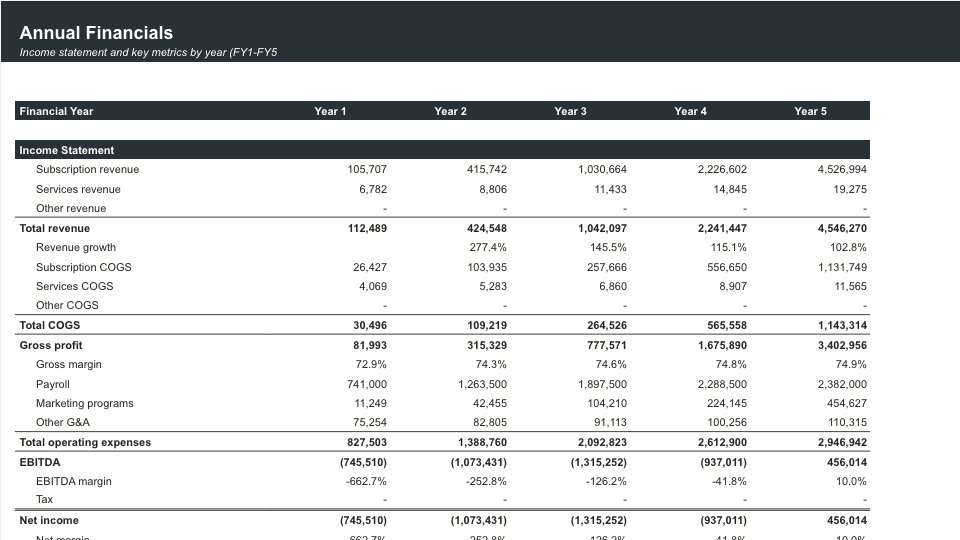
A 5-year monthly forecast with P&L, cash flow and runway, valuation (exit multiple plus a DCF cross-check), MOIC/IRR returns, and unit economics, with live formulas throughout.
How was this model built?+
It was built from Macrometa's pitch deck and publicly available information, then structured to investment-banking standards as a fully editable Excel model.
Can I change the assumptions?+
Yes. You can change assumptions and the live formulas will recalculate in the downloadable Excel model.
Have more financial modelling questions? Contact us

Created by ex-finance professionals
Hey, I’m Alex and I created Finamodel.
Over my years in the finance industry I kept building the same models over and over again. Same structure, same assumptions, different logo. So I started building frameworks to turn them into clean, reusable templates.
Every model here is one I’d actually use for a client, and I personally vet each one before it goes up.
I’m not an expert in every industry, but I’ve built enough models to know what belongs in one. And when something is completely foreign to me, I reach out to my network for experts to work on our models with us.
Having a template library on hand cuts a first build from hours to minutes.
Other Dev Tools Startup Financial Models
Browse another startup in the same category.

8base
Low-code/no-code platform providing backend and frontend development tools for building digital products, internal apps, and SaaS.
Ably
Enterprise realtime messaging infrastructure (pub/sub) delivered as a cloud-native platform, enabling developers to build scalable live experiences without managing complex realtime infrastructure.

Amplitude
Mobile analytics SaaS platform giving app developers real-time behavioral analytics, funnel/retention analysis, and raw data warehouse access at scale.
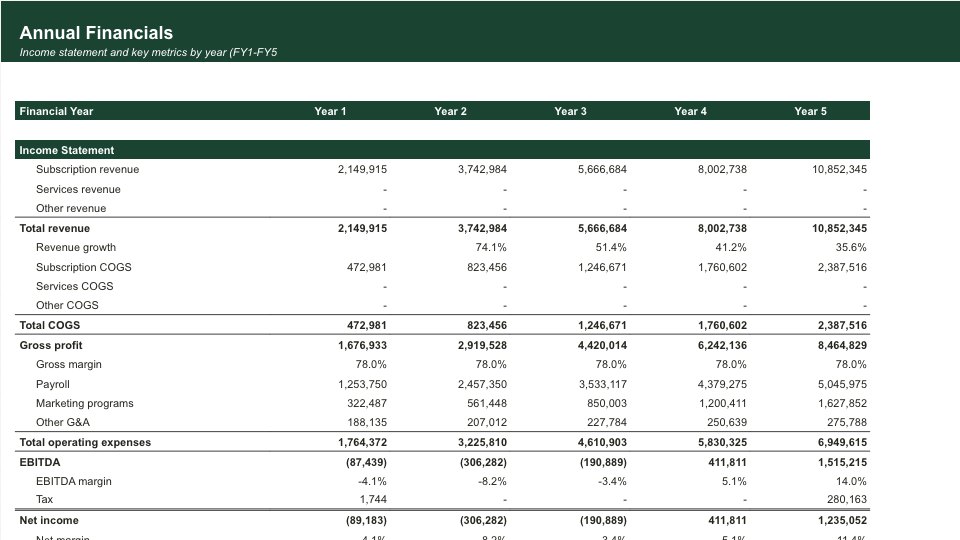
Anima
Automated design-to-code platform - designers export production-ready code from their design tools with one click.
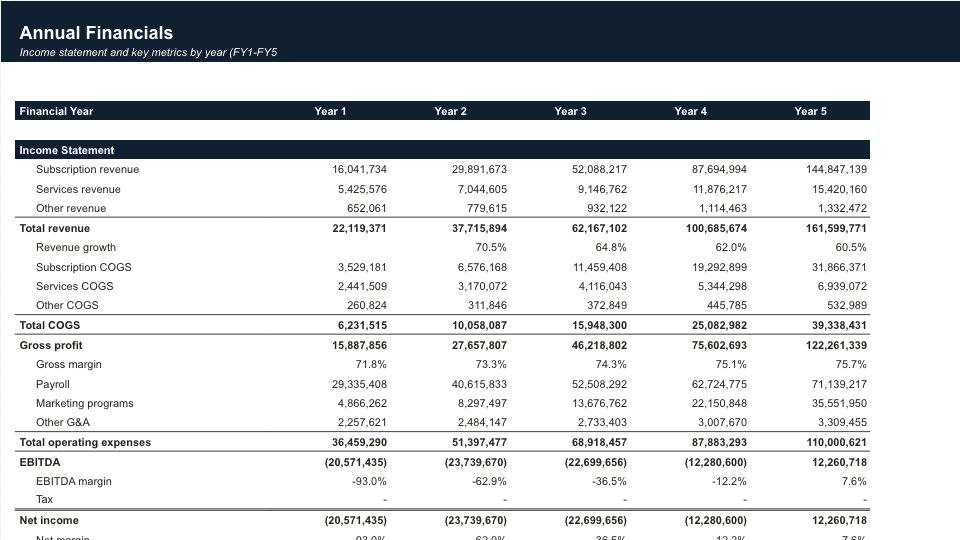

Apollo
Apollo builds and sells an enterprise "data graph" platform (powered by GraphQL) that sits as a unified API layer between frontend apps and backend microservices.
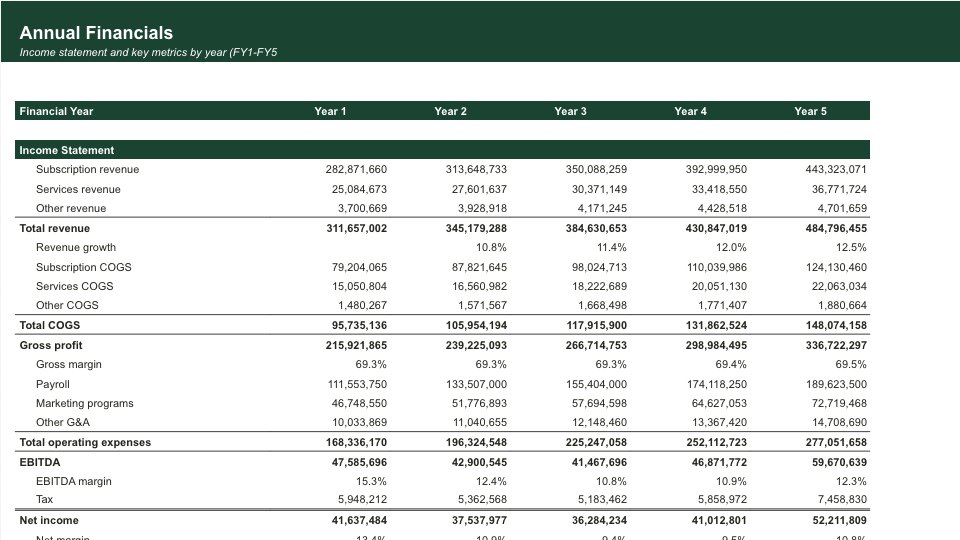
BrowserStack
Cloud-based cross-browser and mobile app testing platform used by 50,000+ customers across 135 countries.
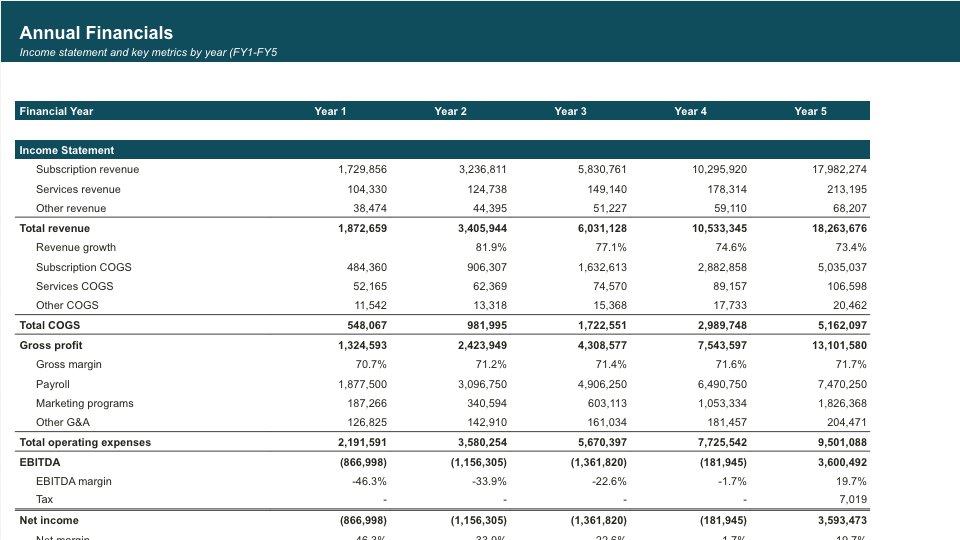
CodeSandbox
Cloud-native collaborative web IDE that lets entire product teams (not just developers) code, review, and iterate together in the browser.
CommandBar
SaaS SDK that embeds a search-based command bar into web apps, improving UX, onboarding, and retention for B2B software companies.