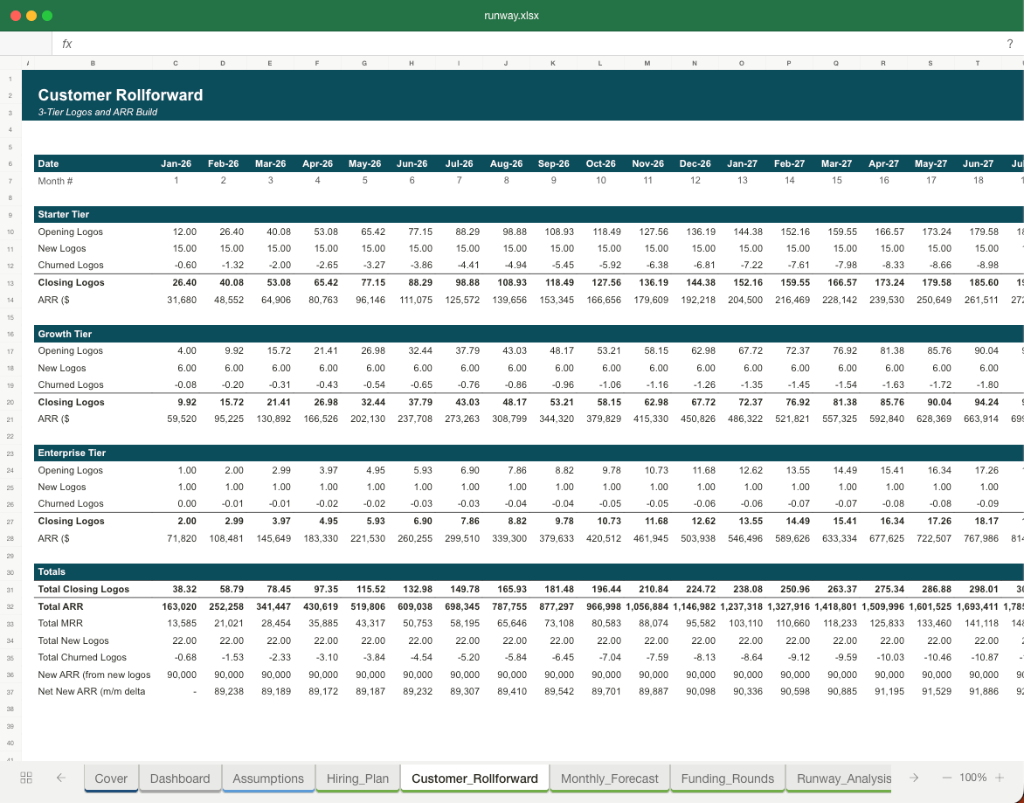
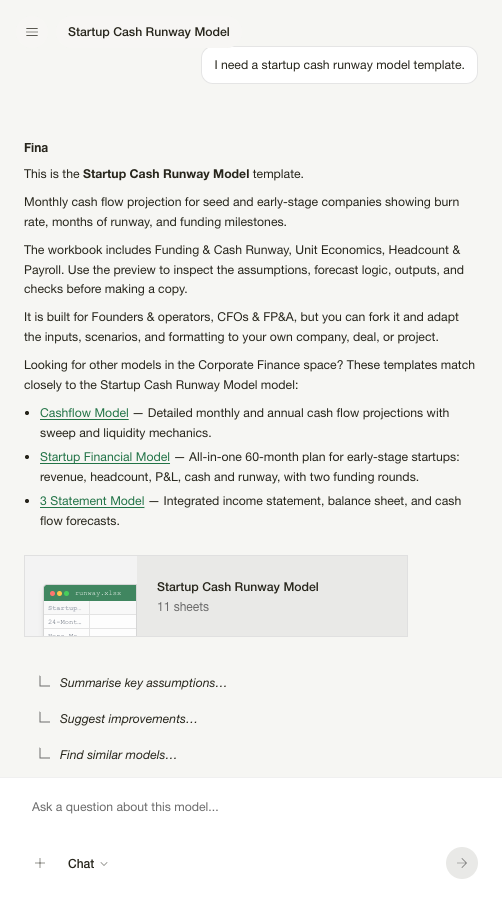
 MessageBird Financial Model
Dev Tools Startup Financials (Free Excel Download)
Cloud communications API platform (CPaaS) providing SMS, Voice, and data routing infrastructure to enterprises globally.



professionals from Deloitte
Used by professionals from






About this model
MessageBird provides messaging, voice, video, and data APIs backed by its own points of presence, direct carrier connections, and routing intelligence. Its routing engine optimises quality, speed, and price, supporting Google two-factor authentication, Uber driver acquisition, and DoorDash delivery notifications.
The business is usage-based CPaaS: customers pay for messages and calls routed through the network, while carrier termination costs are the principal cost of goods sold. The company appears to combine self-serve signup with enterprise sales, but the deck provides no price per message or subscription component.
MessageBird was bootstrapped, profitable, and running at $75 million of revenue. Net revenue expansion ranged roughly from 125% to 175% between 2016 and 2017, with DoorDash, Google, and Uber named customers. The model should build customers, message and call volume, price, carrier cost, retention, and margin.
A turnkey financial model
Live formulas, no hardcoded values
Outputs are driven by live formulas, so the workbook updates from its assumptions instead of relying on hardcoded results.
All assumptions in one tab
Inputs are clearly marked in the Assumptions tab and separated from calculations, making it clear what to change and what to leave intact.
Statements always balancing
For integrated-statement models, the balance sheet, cash flow, and supporting schedules tie through properly.
Distinct schedules for clarity
Debt, working capital, taxes, and cash flow can get messy quickly. We group calculations in clear schedules, not across disconnected tabs.
No hidden macros or external links
There are no unexplained external workbook links or macros to undermine auditability or portability.
Changes flow through the model
Update a key driver and see the impact carry through the forecast, financing, and return outputs. We never use hardcoded numbers in formulas.
About MessageBird
messagebird.com
How to build a detailed financial model for MessageBird
A complete walkthrough of the business, drivers, and assumptions behind the downloadable MessageBird model - distilled from its pitch deck and publicly available information.
Product & value proposition
- APIs for Telecommunication covering three product lines: Messaging (SMS), Voice, and Video/Data.
- Core differentiator is proprietary intelligent routing engine ("Trifecta of Routing") - optimises across Quality, Speed, and Price simultaneously.
- Infrastructure layer: own Points of Presence (POPs), SS7/SMPP/VPN direct carrier connections, number lookup and routing lookup services. Flow illustrated via "a day in the life of an Uber message" with 7 routing paths to Indonesian carriers.
- Bootstrapped to profitability without external capital.
Market
2020 market size estimates (bubble chart, slide 7):
- Mobile Telecom TAM: $1T
- VoIP: $130B
- MVNO: $75B
- Messaging (addressable for MessageBird's current core): $34.3B
No SAM or SOM breakdown provided. No growth rate cited for any segment.
Revenue model
- Usage-based API pricing: customers pay per message/call routed through the platform.
- No per-seat or subscription component mentioned.
- Channels: self-serve (implied by sign-up cohort chart going back to 2007) + enterprise sales (Uber, DoorDash, Google named as customers).
- Use cases cited: 2FA (Google), Driver Acquisition (Uber), Delivery notifications (DoorDash).
- Gross margin not stated; as a routing/CPaaS business, carrier termination costs are the primary COGS.
Traction & metrics
- Run rate revenue: $75M USD at time of deck.
- Bootstrapped and profitable.
- Revenue Year over Year (slide 9): curve is flat/slow 2011–2014, acceleration from 2015, sharp inflection in 2016, with two upside-case dashed projections for 2017E; no Y-axis dollar labels on chart - exact annual figures not readable.
- Net Revenue Expansion Rate (slide 10): quarterly data 2016-Q1 through 2017-Q1; range ~125%–175%; Q1-2016 ≈125%, Q3-2016 ≈155%, Q4-2016 ≈143%, Q1-2017 ≈173%. All above 100% = strong negative churn / expansion.
- Revenue by Sign-Up Cohort - SMS Revenue (slide 11): stacked area 2014–2016; cohorts back to 2007; largest bands are 2011 (red) and 2016 (orange, top band) suggesting both strong legacy retention and rapid new cohort ramp. No Y-axis dollar values readable.
- Customers: DoorDash, Google, Uber named; no total customer count given.
Unit economics
- Net Revenue Expansion Rate: ~125%–175% range (2016–2017Q1). - implies negative net churn; existing customers grow faster than any churn.
Competition / moat
- Competitive moat framed as the "Trifecta of Routing" - proprietary routing engine simultaneously optimising Quality, Speed, and Price.
- Own infrastructure (POPs, direct SS7 carrier connections) is the structural barrier - replicating direct carrier relationships is capital- and time-intensive.
- Twilio is the obvious implied competitor (not named in deck).
- No direct competitor logos or analysis slide present.
Team & funding ask / use of funds
- Team slide not present; team branding referred to internally as "birds" ("global team of birds").
- No funding amount or valuation stated.
- Use of funds (expansion plan slide 12):
- Dedicated SDR, AE, CSM sales teams
- 3x sales headcount across US, APAC, Europe
- M&A opportunities
- Investment in low-level infrastructure
- Brand awareness and reach
Recommended financial model
- Archetype + why: Usage-based CPaaS revenue model with cohort-driven expansion. MessageBird is a volume-based API business where revenue = messages/calls × price per unit, with strong net revenue retention (>100%) making a cohort NRR model the right spine. Supports a lightweight 3-statement P&L overlay given they are profitable.
- Forecast horizon & granularity: 3 years (2017–2019), monthly for Year 1, quarterly for Years 2–3. Deck is ~2017 vintage so anchor to the $75M run rate baseline.
- Key drivers & assumptions:
- Starting ARR / run rate revenue: $75M
- New cohort revenue ramp: model new sign-up cohorts growing at 50–80% YoY based on visible cohort acceleration in slide 11
- Net Revenue Expansion Rate on existing cohorts: ~150% annualised (midpoint of 125%–175% quarterly range)
- Gross margin: ~30–40%; CPaaS businesses carry significant carrier termination COGS; Twilio comparable ~50–55% gross margin used as ceiling; MessageBird's own routing infrastructure may improve margin vs. pure resellers
- Headcount growth: 3x sales headcount; current sales team ~30–50 people → grows to 90–150 over 2 years
- OpEx / S&M as % of revenue: ~25–35% post-fundraise, typical for CPaaS growth phase
- Infrastructure capex: material but not quantified; treat as % of revenue ~5–8% for CapEx
- Churn: implied near-zero given NRR >100%; model gross churn at ~5–10% annually
- Pricing per message/call: blended ~$0.004–$0.006/SMS (industry standard range); voice higher
- Message volume implied: $75M run rate ÷ ~$0.005 blended = ~15B messages/year
- New product revenue (Voice, Video, Data): 10–15% of total revenue today, growing faster than SMS
- M&A: flagged as a use of funds; model as a separate line / sensitivity rather than baking in
- Scenarios (Base / Bull / Bear - which variables flex):
- Base: NRR stays ~150%, new cohort growth +60% YoY, GM ~35%
- Bull: NRR expands to 175% (2017-Q1 trajectory), new cohort growth +80%, successful M&A adds 1–2 product lines
- Bear: NRR compresses to 120% (competition, pricing pressure), new cohort growth +30%, carrier cost pressure holds GM at 28%
- Required sheets / outputs:
- Assumptions dashboard (all drivers in one place)
- Cohort model - annual sign-up cohorts, per-cohort revenue with NRR expansion applied
- Revenue build - SMS, Voice, Other by quarter
- P&L - gross profit, S&M, R&D, G&A, EBITDA
- Headcount plan (by function: Engineering, Sales/SDR/AE/CSM, Ops, G&A)
- Cash flow / runway (company is self-funded; model should show cash generation, not just P&L)
- Scenario toggle (Base / Bull / Bear)
- KPI summary: NRR, message volume, revenue per cohort, gross margin
Frequently asked
Is the MessageBird financial model free?+
Yes. The MessageBird model is a free Excel (.xlsx) download with live formulas. Sign up with your email and the workbook is yours to keep, review, and edit.
What's included in the model?+
A 5-year monthly forecast with P&L, cash flow and runway, valuation (exit multiple plus a DCF cross-check), MOIC/IRR returns, and unit economics, with live formulas throughout.
How was this model built?+
It was built from MessageBird's pitch deck and publicly available information, then structured to investment-banking standards as a fully editable Excel model.
Can I change the assumptions?+
Yes. You can change assumptions and the live formulas will recalculate in the downloadable Excel model.
Have more financial modelling questions? Contact us

Created by ex-finance professionals
Hey, I’m Alex and I created Finamodel.
Over my years in the finance industry I kept building the same models over and over again. Same structure, same assumptions, different logo. So I started building frameworks to turn them into clean, reusable templates.
Every model here is one I’d actually use for a client, and I personally vet each one before it goes up.
I’m not an expert in every industry, but I’ve built enough models to know what belongs in one. And when something is completely foreign to me, I reach out to my network for experts to work on our models with us.
Having a template library on hand cuts a first build from hours to minutes.
Need help finding your model? You’ll find me in the Finamodel app!
Other Dev Tools Startup Financial Models
Browse another startup in the same category.

8base
Low-code/no-code platform providing backend and frontend development tools for building digital products, internal apps, and SaaS.
Ably
Enterprise realtime messaging infrastructure (pub/sub) delivered as a cloud-native platform, enabling developers to build scalable live experiences without managing complex realtime infrastructure.

Amplitude
Mobile analytics SaaS platform giving app developers real-time behavioral analytics, funnel/retention analysis, and raw data warehouse access at scale.
Anima
Automated design-to-code platform - designers export production-ready code from their design tools with one click.

Apollo
Apollo builds and sells an enterprise "data graph" platform (powered by GraphQL) that sits as a unified API layer between frontend apps and backend microservices.
BrowserStack
Cloud-based cross-browser and mobile app testing platform used by 50,000+ customers across 135 countries.
CodeSandbox
Cloud-native collaborative web IDE that lets entire product teams (not just developers) code, review, and iterate together in the browser.
CommandBar
SaaS SDK that embeds a search-based command bar into web apps, improving UX, onboarding, and retention for B2B software companies.