 Ocean.io Financial Model
Dev Tools Startup Financials (Free Excel Download)
AI-powered B2B company database and Account Based Marketing (ABM) platform that helps sales and marketing teams identify, target, and engage ideal customer profiles.



professionals from Deloitte
Used by professionals from






About this model
Ocean.io is an AI company database and account-based marketing platform built on NLP company classification called Context Vectors. It provides lookalike targeting, filters, contacts, market intelligence, and two-way CRM integration with Salesforce, HubSpot, and Pipedrive, using data from 300 million-plus web pages and public sources.
The business sells subscription SaaS at mid-range pricing, combining product and sales-led adoption. Its customer interface displays deal values, but those are customers’ sales metrics rather than Ocean.io ACV; the deck gives no plan or seat pricing. Sony, Brandwatch, UserTesting, TELE2, and SCHOTT are named customers.
As of August 2021, Ocean.io had $60,000 MRR, 150 customers, 100% NRR, and threefold year-to-date MRR growth. It employed 53 people across three offices. The model should forecast customer adds, ARPU, data cost, expansion, renewal, churn, sales capacity, and margin.
A turnkey financial model
Live formulas, no hardcoded values
Outputs are driven by live formulas, so the workbook updates from its assumptions instead of relying on hardcoded results.
All assumptions in one tab
Inputs are clearly marked in the Assumptions tab and separated from calculations, making it clear what to change and what to leave intact.
Statements always balancing
For integrated-statement models, the balance sheet, cash flow, and supporting schedules tie through properly.
Distinct schedules for clarity
Debt, working capital, taxes, and cash flow can get messy quickly. We group calculations in clear schedules, not across disconnected tabs.
No hidden macros or external links
There are no unexplained external workbook links or macros to undermine auditability or portability.
Changes flow through the model
Update a key driver and see the impact carry through the forecast, financing, and return outputs. We never use hardcoded numbers in formulas.
About Ocean.io
ocean.io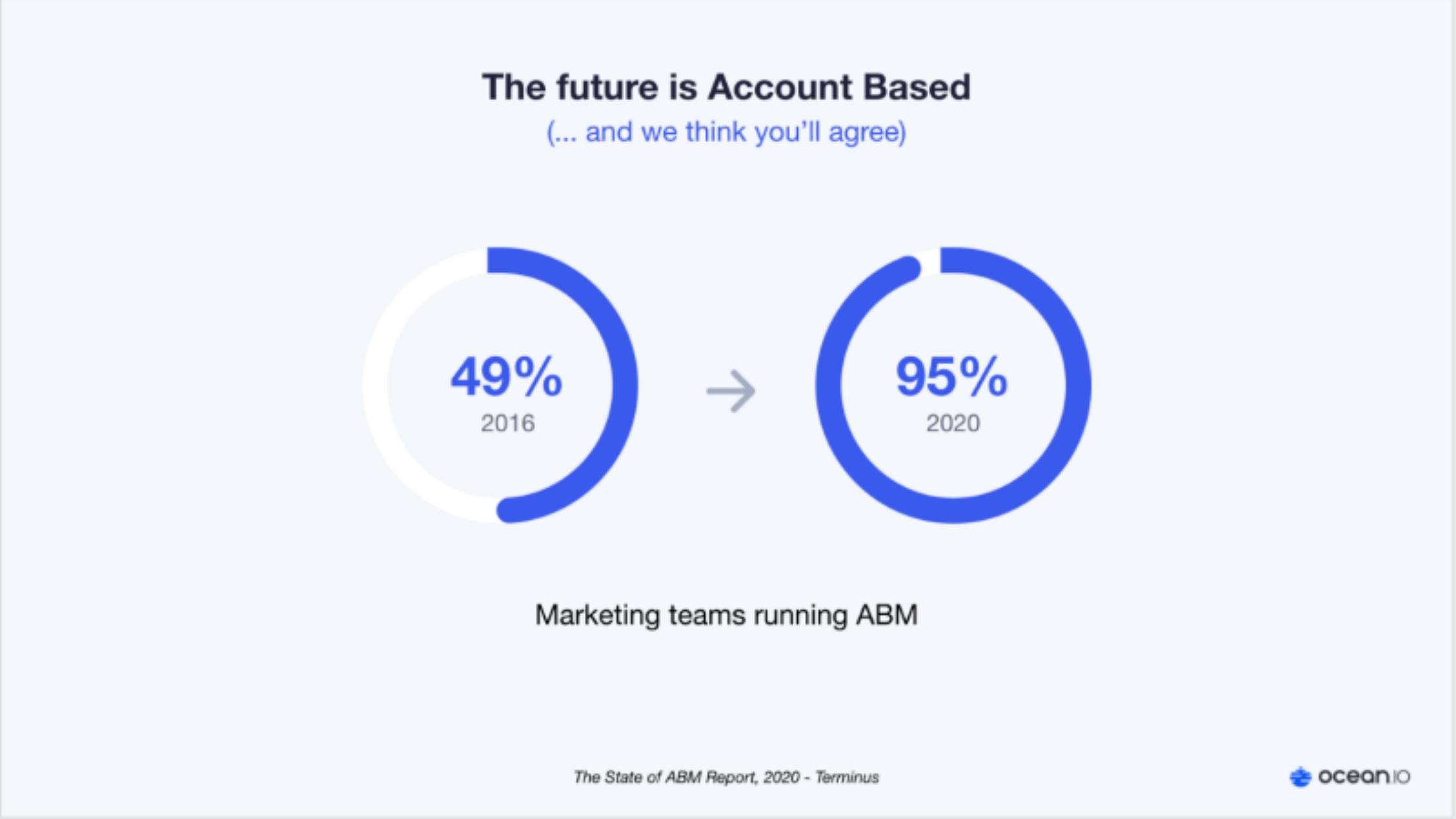
How to build a detailed financial model for Ocean.io
A complete walkthrough of the business, drivers, and assumptions behind the downloadable Ocean.io model - distilled from its pitch deck and publicly available information.
Product & value proposition
Ocean.io is a B2B data and ABM platform built around proprietary NLP-based company categorisation ("Context Vectors") that replaces legacy SIC/NAICS industry codes. Core modules:
- Targeting - AI lookalike search, 48 filters, zero-duplicate account lists, CRM-integrated search.
- Personas - contact search by job title/seniority/department; 43M+ contacts; validated email addresses.
- Intelligence - TAM calculator, market analysis, revenue projections, per-rep performance, customer firmographics dashboard.
- Integrations - bidirectional CRM sync with Salesforce, HubSpot, Pipedrive; LinkedIn export; Zapier.
Key differentiator vs. Cognism / ZoomInfo / Vainu / LinkedIn: company-first (not lead-first), two-way CRM integration, context-vector categorisation, and mid-range pricing with broader European coverage.
Data sourced from 300M+ web pages, company registries, and public databases; 9 languages.
Market
- TAM: "Multi-billion B2B CRM market, growing 10% YoY". No specific $ figure given.
- Target ICP (2021 Q3 onward): B2B companies with 10+ people in sales/marketing, initially enterprise in Western Europe with HubSpot or Salesforce CRM.
- ABM adoption tailwind: 49% of marketing teams ran ABM in 2016 → 95% in 2020, per Terminus State of ABM Report 2020.
- No SAM/SOM breakout in deck.
Revenue model
- Subscription SaaS - platform access sold to B2B companies. Pricing described as "mid-range" vs. competitors.
- Pricing tiers/seats not disclosed in deck.
- Product-led and sales-led motion implied by CRM-integrated workflow and enterprise focus.
- Average deal value observable in product UI screenshot: €12,625 (shown as a sample customer's avg. deal value in the Intelligence module - this is a customer's *own* sales data, not Ocean.io's ACV).
- Ocean.io's own contract value / ARPU not stated in deck.
Traction & metrics
All figures as of August 2021:
| Metric | Value | Source |
|---|---|---|
| MRR | $60K | Slide 15 |
| MRR growth | 3x in 2021 (YTD) | Slide 15 |
| ARR (implied) | ~$720K | Calculated from MRR |
| NRR | 100% | Slide 15 |
| Customers | 150 | Slide 15 |
| Headcount | 53 across 3 offices | Slide 15 |
| Prior investment | $6M (initial) | Slide 15 |
Notable customers (logo wall): SONY, Leadinfo, SCHOTT, Brandwatch, UserTesting, TELE2, Quanos, JLG.
Testimonials cite "doubled demo booking rate in first week" (Leadinfo), "new bandwidth in sales" (Brandbassador), "focuses spend on right companies" (ZenMedia).
Unit economics
- NRR: 100% - net flat (no stated expansion revenue above churn yet).
Competition / moat
Competitive matrix:
| Ocean.io | Cognism | Vainu | ZoomInfo | ||
|---|---|---|---|---|---|
| Pricing | Mid | High | Mid | High | Mid |
| Industry model | Context vector | Traditional | Traditional | Traditional | Traditional |
| Data focus | Companies | Leads | Companies | Leads | Leads |
| 2-way CRM sync | Yes | No | No | No | No |
| Coverage | Global | UK-centric | Nordic | US-centric | Global |
Moats claimed: proprietary NLP/context-vector categorisation (4 years of data science, $6M invested); 300M+ page data corpus; bidirectional CRM integration (unique among peers shown).
Team & funding ask / use of funds
- Team: 53 people, 3 offices (Aug 2021). Named individuals not in deck.
- Prior capital: $6M initial investment.
Recommended financial model
Archetype: SaaS ARR model with cohort-based NRR expansion layer.
Rationale: Ocean.io is a subscription B2B SaaS with 150 customers and $60K MRR at early-growth stage. The key revenue drivers are new customer adds and ARPU expansion. NRR is currently 100% (no net expansion yet) but the product has upsell potential (seats, modules, contact add-ons). A standard SaaS ARR waterfall is the right frame.
Forecast horizon & granularity:
- Monthly for Year 1–2 (operational granularity, cash management).
- Quarterly/annual for Years 3–5 (strategic).
- Base case: 5-year horizon.
Key drivers & assumptions:
| Driver | Seed value |
|---|---|
| Starting MRR | $60,000 |
| Starting customers | 150 |
| Starting ARPU/month | ~$400 |
| New customer adds/month (base) | ~15–25/mo |
| MRR growth trajectory | 3x in 2021 implies ~10–12% MoM through H1 2021 |
| Gross churn rate | 1–2%/mo |
| NRR | 100% base; 105–115% bull |
| ARPU expansion | Flat in base; +5–10%/yr in bull |
| Gross margin | 75% |
| Headcount | 53 at Aug '21 |
| Avg. fully-loaded cost/employee | ~€65–80K/yr |
| Sales & Marketing % of revenue | 40–50% in early growth, declining to 25–30% at scale |
| R&D % of revenue | 20–25% |
| G&A % of revenue | 10–15% |
Scenarios (which variables flex):
| Bear | Base | Bull | |
|---|---|---|---|
| New cust adds/mo | 8 | 18 | 30 |
| NRR | 95% | 100% | 115% |
| ARPU growth (YoY) | 0% | 3% | 10% |
| Gross margin | 70% | 75% | 80% |
Required sheets / outputs:
- Assumptions - all drivers in one tab, colour-coded inputs.
- MRR Bridge - monthly: starting ARR → new ARR → expansion → churn → ending ARR.
- P&L (Income Statement) - Revenue, COGS, Gross Profit, S&M, R&D, G&A, EBITDA, Net Income.
- Headcount Plan - by function (Engineering, Sales, CS, G&A); salary + benefits.
- Cash Flow - operating CF, funding runway; key: when does the company run out of cash at current burn?
- Unit Economics - LTV, CAC, LTV/CAC, payback period (populate once CAC data available).
- Cohort Analysis - monthly cohorts; NRR waterfall by cohort vintage.
- Dashboard / Summary - KPI cards: ARR, MRR growth, customers, NRR, burn, runway.
Frequently asked
Is the Ocean.io financial model free?+
Yes. The Ocean.io model is a free Excel (.xlsx) download with live formulas. Sign up with your email and the workbook is yours to keep, review, and edit.
What's included in the model?+
A 5-year monthly forecast with P&L, cash flow and runway, valuation (exit multiple plus a DCF cross-check), MOIC/IRR returns, and unit economics, with live formulas throughout.
How was this model built?+
It was built from Ocean.io's pitch deck and publicly available information, then structured to investment-banking standards as a fully editable Excel model.
Can I change the assumptions?+
Yes. You can change assumptions and the live formulas will recalculate in the downloadable Excel model.
Have more financial modelling questions? Contact us

Created by ex-finance professionals
Hey, I’m Alex and I created Finamodel.
Over my years in the finance industry I kept building the same models over and over again. Same structure, same assumptions, different logo. So I started building frameworks to turn them into clean, reusable templates.
Every model here is one I’d actually use for a client, and I personally vet each one before it goes up.
I’m not an expert in every industry, but I’ve built enough models to know what belongs in one. And when something is completely foreign to me, I reach out to my network for experts to work on our models with us.
Having a template library on hand cuts a first build from hours to minutes.
Need help finding your model? You’ll find me in the Finamodel app!
Other Dev Tools Startup Financial Models
Browse another startup in the same category.

8base
Low-code/no-code platform providing backend and frontend development tools for building digital products, internal apps, and SaaS.
Ably
Enterprise realtime messaging infrastructure (pub/sub) delivered as a cloud-native platform, enabling developers to build scalable live experiences without managing complex realtime infrastructure.

Amplitude
Mobile analytics SaaS platform giving app developers real-time behavioral analytics, funnel/retention analysis, and raw data warehouse access at scale.
Anima
Automated design-to-code platform - designers export production-ready code from their design tools with one click.

Apollo
Apollo builds and sells an enterprise "data graph" platform (powered by GraphQL) that sits as a unified API layer between frontend apps and backend microservices.
BrowserStack
Cloud-based cross-browser and mobile app testing platform used by 50,000+ customers across 135 countries.
CodeSandbox
Cloud-native collaborative web IDE that lets entire product teams (not just developers) code, review, and iterate together in the browser.
CommandBar
SaaS SDK that embeds a search-based command bar into web apps, improving UX, onboarding, and retention for B2B software companies.


