OROrbit Financial Model
Dev Tools Startup Financials (Free Excel Download)
Community analytics and engagement platform built on the "Orbit Model" - helping developer-facing companies understand, engage, and grow their communities.



professionals from Deloitte
Used by professionals from






About this model
Orbit is a community platform for developer-facing companies that ingests GitHub, Slack, Twitter, Discourse, and other signals. Its open-source Orbit Model classifies members by Love, measuring activity, and Reach, measuring influence, then groups them from highly engaged Ambassadors to passive Observers and suggests engagement actions.
The open model drives bottom-up awareness, while the commercial platform adds analytics, reporting, and action execution. The research does not disclose pricing, ARR, paid workspaces, or customer count, but a workspace or team SaaS model is consistent with its DevRel and community-team target users.
The Orbit Model had 180 GitHub stars and 13 contributors. Orbit’s own dashboard tracked 821 members, with weekly activity rising from roughly 5–10 to more than 80 by August 2020. The model should forecast community signups, activated workspaces, paid conversion, seats, integrations, expansion, churn, and data cost.
A turnkey financial model
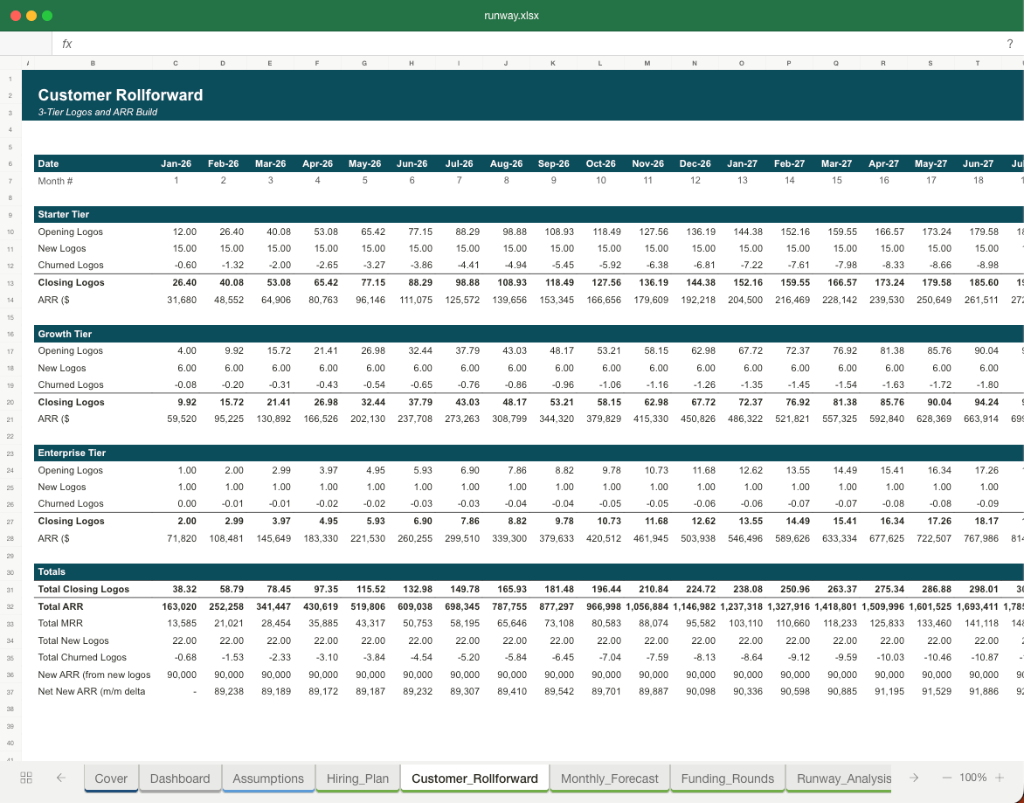
Live formulas, no hardcoded values
Outputs are driven by live formulas, so the workbook updates from its assumptions instead of relying on hardcoded results.
All assumptions in one tab
Inputs are clearly marked in the Assumptions tab and separated from calculations, making it clear what to change and what to leave intact.
Statements always balancing
For integrated-statement models, the balance sheet, cash flow, and supporting schedules tie through properly.
Distinct schedules for clarity
Debt, working capital, taxes, and cash flow can get messy quickly. We group calculations in clear schedules, not across disconnected tabs.
No hidden macros or external links
There are no unexplained external workbook links or macros to undermine auditability or portability.
Changes flow through the model
Update a key driver and see the impact carry through the forecast, financing, and return outputs. We never use hardcoded numbers in formulas.
About Orbit
orbit.love
How to build a detailed financial model for Orbit
A complete walkthrough of the business, drivers, and assumptions behind the downloadable Orbit model - distilled from its pitch deck and publicly available information.
Product & value proposition
Orbit is a SaaS platform that ingests signals from developer communities (GitHub, Slack, Twitter, Discourse, etc.) and structures them using the proprietary "Orbit Model." The model classifies community members by two axes:
- Love: measure of a member's activity level in the community
- Reach: measure of a member's sphere of influence
Members are segmented into four orbit levels (1 = most engaged Ambassadors → 4 = passive Observers). The platform then surfaces recommended actions (reply on GitHub, tweet shoutout, send personal email) directly inside the product, automating community engagement workflows.
Key differentiator: the Orbit Model is open source (github.com/orbit-love/orbit-model, 180 stars, 13 contributors as of deck date) which drives bottom-up awareness and product-led adoption. The commercial platform adds analytics, reporting, and action execution on top of the free model.
Traction & metrics
All traction shown is for the Orbit Model open source project and Orbit's own community (their dog-fooding instance), not for paying customers:
- Orbit Model GitHub repo: 180 stars, 22 watchers, 13 contributors
- One customer community (API Evangelist's dashboard, Aug 2019 – Aug 2020):
- Total members: 644
- Orbit 1 (Ambassadors): 24; Orbit 2: 72; Orbit 3: 110; Orbit 4 (Observers): 328
- Orbit's own community dashboard (Feb 1 – Aug 31, 2020):
- Total members: 821
- Orbit 1: 63; Orbit 2: 75; Orbit 3: 393; Orbit 4: 267
- Activities tracked by type: GitHub (issues, PRs), Twitter mentions, Slack, events, signups - weekly activity volume rising from ~5–10/week in Feb 2020 to ~80+/week by Aug 2020
- No ARR, MRR, paying customer count, or revenue figures in deck.
Competition / moat
- Deck positions existing CRMs as the incumbent workaround - citing a16z's Martin Casado tweet calling CRMs "an ill fit" for community-led growth
- Cultural problem framed: enterprise sales teams doing outbound (LinkedIn spam) on developer communities is actively counterproductive
- Moat claimed: open-source Orbit Model drives bottom-up adoption and word-of-mouth; brand equity with DevRel community
- No named direct competitors listed.
Team & funding ask / use of funds
Team:
- Patrick Woods, CEO - Director of Customer Success at FigureEight & Keen IO; Partner at DeveloperMode
- Josh Dzielak, CTO - DevRel Lead at Algolia; VP Engineering at Keen IO; Partner at DeveloperMode
- Backed by Heavybit Industries and Harrison Metal (accelerator/early-stage investors implied)
Advisors:
- James Tamplin (CEO & Founder, Firebase)
- Sam Ramji (CSO, DataStax; former Head of DevRel, Google)
- Aghi Marietti (CEO & Founder, Kong)
- Andrew Miklas (CTO & Founder, PagerDuty)
- Kyle Wild (CEO & Founder, Keen IO)
- James Governor (Co-founder, RedMonk)
Ask:
- "Thoughtful partners" - no dollar amount specified
- Use of funds: scale product & engineering; onboard new customers; category evangelism; refine pricing and packaging
Recommended financial model
- Archetype + why: SaaS ARR model (bottom-up PLG motion). Revenue is subscription-based SaaS targeting DevRel/community teams. Growth is product-led (open-source model → platform trial → paid conversion), making a seats/workspaces ARR model most appropriate. No marketplace or transactional layer evident.
- Forecast horizon & granularity: 3 years monthly (Month 1–36), then annual summary. Early stage with no revenue yet means Year 1 is largely pre-revenue / early customer ramp; monthly granularity matters for cash runway and hiring pacing.
- Key drivers & assumptions:
- New logos per month (customer count ramp): starts at 2–5/month in Month 1, scaling to 20–30/month by Month 24 as PLG flywheel builds; rationale: pre-revenue stage, small team
- Average ACV: $6,000–$18,000/year (community tools typically $500–$1,500/month for SMB DevRel teams); no pricing in deck
- Seats or workspaces per customer: 1–3 seats per DevRel/community team; rationale: small buyer persona
- Free-to-paid conversion rate: 3–8%; rationale: PLG open-source → paid, typical for developer tools
- Monthly churn: 1.5–2.5%; rationale: DevRel budget is discretionary and smaller companies may churn
- Gross margin: 70–80%; rationale: pure SaaS, likely AWS-hosted, minimal COGS
- Headcount plan: 8–12 FTEs post-raise (engineering-heavy, 1–2 AEs, 1 DevRel); salaries drive OpEx
- CAC: $2,000–$5,000 (PLG-assisted, low-touch sales); no data in deck
- LTV: derived from ACV / churn; at 2% monthly churn, avg customer life ~50 months → LTV/CAC likely 8–15x at scale
- S&M as % revenue: 40–60% in early years, declining as PLG matures
- R&D as % revenue: 35–50% in early years (engineering-first company)
- G&A: 15–25% in early years
- Scenarios (Base / Bull / Bear - which variables flex):
- Base: 3–5 new logos/month at launch, 5% free-to-paid conversion, $10k ACV, 2% monthly churn
- Bull: Orbit Model open-source virality accelerates; 10–15 logos/month by Month 12, ACV lifts to $15k as enterprise buyers enter, churn drops to 1%
- Bear: Pricing/packaging takes longer to finalize (deck acknowledges this); slow logo growth (1–2/month), ACV $6k, churn 3%
- Required sheets / outputs:
- Assumptions dashboard (all drivers in one place)
- Customer cohort model (monthly new logos, cumulative ARR by cohort, churn waterfall)
- P&L (Revenue, COGS, Gross Profit, S&M, R&D, G&A, EBITDA)
- Headcount plan (by function, fully-loaded cost)
- Cash flow & runway (monthly burn, cash balance, months of runway)
- ARR bridge (new ARR, expansion, churn, net new ARR)
- Unit economics summary (CAC, LTV, LTV/CAC, payback period)
- Scenario toggle (Base / Bull / Bear)
Frequently asked
Is the Orbit financial model free?+
Yes. The Orbit model is a free Excel (.xlsx) download with live formulas. Sign up with your email and the workbook is yours to keep, review, and edit.
What's included in the model?+
A 5-year monthly forecast with P&L, cash flow and runway, valuation (exit multiple plus a DCF cross-check), MOIC/IRR returns, and unit economics, with live formulas throughout.
How was this model built?+
It was built from Orbit's pitch deck and publicly available information, then structured to investment-banking standards as a fully editable Excel model.
Can I change the assumptions?+
Yes. You can change assumptions and the live formulas will recalculate in the downloadable Excel model.
Have more financial modelling questions? Contact us

Created by ex-finance professionals
Hey, I’m Alex and I created Finamodel.
Over my years in the finance industry I kept building the same models over and over again. Same structure, same assumptions, different logo. So I started building frameworks to turn them into clean, reusable templates.
Every model here is one I’d actually use for a client, and I personally vet each one before it goes up.
I’m not an expert in every industry, but I’ve built enough models to know what belongs in one. And when something is completely foreign to me, I reach out to my network for experts to work on our models with us.
Having a template library on hand cuts a first build from hours to minutes.
Need help finding your model? You’ll find me in the Finamodel app!
Other Dev Tools Startup Financial Models
Browse another startup in the same category.

8base
Low-code/no-code platform providing backend and frontend development tools for building digital products, internal apps, and SaaS.
Ably
Enterprise realtime messaging infrastructure (pub/sub) delivered as a cloud-native platform, enabling developers to build scalable live experiences without managing complex realtime infrastructure.

Amplitude
Mobile analytics SaaS platform giving app developers real-time behavioral analytics, funnel/retention analysis, and raw data warehouse access at scale.
Anima
Automated design-to-code platform - designers export production-ready code from their design tools with one click.

Apollo
Apollo builds and sells an enterprise "data graph" platform (powered by GraphQL) that sits as a unified API layer between frontend apps and backend microservices.
BrowserStack
Cloud-based cross-browser and mobile app testing platform used by 50,000+ customers across 135 countries.
CodeSandbox
Cloud-native collaborative web IDE that lets entire product teams (not just developers) code, review, and iterate together in the browser.
CommandBar
SaaS SDK that embeds a search-based command bar into web apps, improving UX, onboarding, and retention for B2B software companies.