OROrganise Financial Model
Enterprise/Security Startup Financials (Free Excel Download)
Workplace advocacy platform giving UK workers tools to campaign for better pay, rights, and conditions



professionals from Deloitte
Used by professionals from






About this model
Organise is a UK workplace-advocacy platform that gives workers tools to campaign for better pay, rights, and conditions. It is a civic and worker-tech product focused on collective participation rather than a conventional enterprise software buyer.
The platform targets individual workers through a membership model, so growth depends on member acquisition, engagement, and willingness to support the service financially. Campaign participation and community trust are therefore as important as standard SaaS sales metrics.
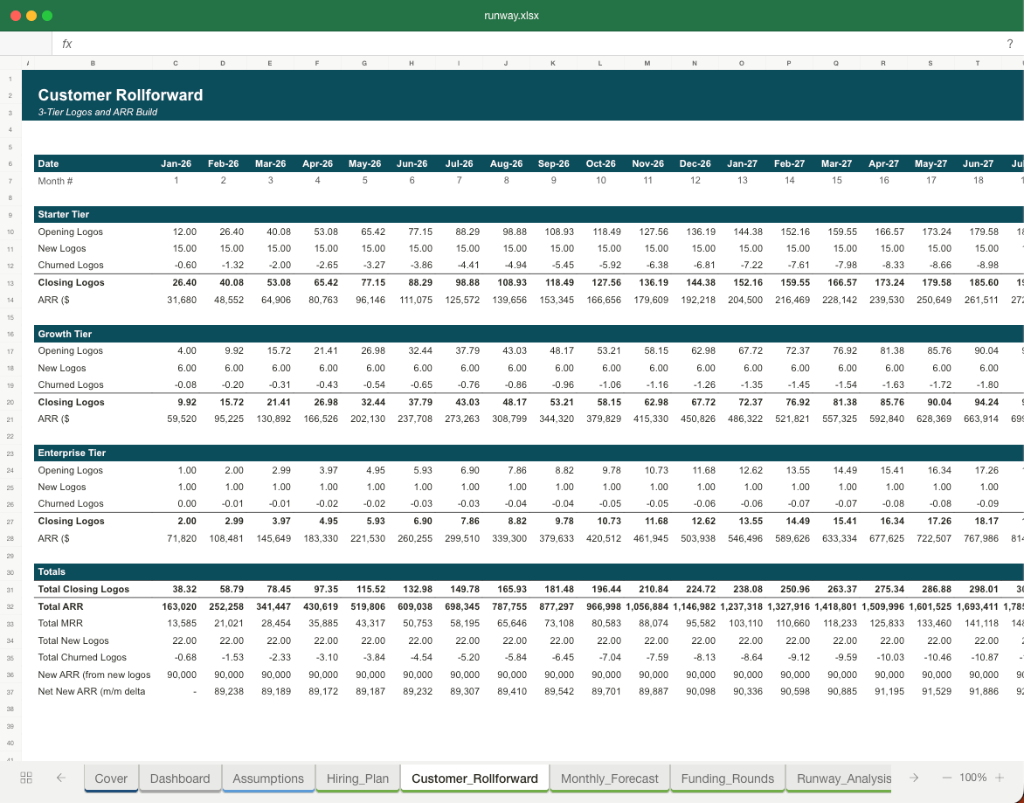
The model uses member cohorts, tracking signups, active members, paid conversion, recurring membership revenue, churn, and referral-led growth. It connects campaign and community costs, payment processing, product development, marketing, headcount, and cash runway to the operating plan.
A turnkey financial model
Live formulas, no hardcoded values
Outputs are driven by live formulas, so the workbook updates from its assumptions instead of relying on hardcoded results.
All assumptions in one tab
Inputs are clearly marked in the Assumptions tab and separated from calculations, making it clear what to change and what to leave intact.
Statements always balancing
For integrated-statement models, the balance sheet, cash flow, and supporting schedules tie through properly.
Distinct schedules for clarity
Debt, working capital, taxes, and cash flow can get messy quickly. We group calculations in clear schedules, not across disconnected tabs.
No hidden macros or external links
There are no unexplained external workbook links or macros to undermine auditability or portability.
Changes flow through the model
Update a key driver and see the impact carry through the forecast, financing, and return outputs. We never use hardcoded numbers in formulas.
About Organise
organise.us
How to build a detailed financial model for Organise
A complete walkthrough of the business, drivers, and assumptions behind the downloadable Organise model - distilled from its pitch deck and publicly available information.
Product & value proposition
- Distributed campaign / petition platform enabling workers to organise workplace-level campaigns
- TakeNote mobile app (anti-harassment logging)
- Community Contact Centre - legal and campaign support chat with hybrid AI
- AI Machine + Deep Learning backend; RedShift data warehouse
- Value prop: self-serve tooling for the 77% of UK workers outside trade unions who have no existing collective voice
- Viral growth loop: petitions spread through workplace WhatsApp/Facebook groups
Market
- UK employed workforce: 32 million
- Unionised share: 23% (~7.4m workers); non-unionised: 77% (~24.6m workers)
- UK Trade Union membership fee pool: £1.42bn/year (excluding additional services) - used as TAM proxy
- US expansion target cited as 150 million working people
- No SAM/SOM breakdown or market-growth CAGR shown in deck
Revenue model
- Membership / subscription model implied: CEO background at 38 Degrees explicitly described as "revenue of £5 million a year - built through user subscriptions"
- No membership price point, tiers, or revenue figures disclosed in the deck
- Comparable benchmark framing: UK trade union fees (£1.42bn pool) suggests the addressable monetisation is a membership fee per worker per year
- Potential ancillary: legal support services (mentioned as a product feature)
Traction & metrics
- Total users: >80,000 as of deck date (~early 2020)
- Growth: organic, viral; bar chart shows approximate quarterly cadence from ~2,000 users in early 2017 to ~80,000 in late 2019
- Major campaign wins cited at ITV, Tesco, McDonald's, Ted Baker, Boots
- Tesco campaign: 5,000+ staff on Boots petition
- Ted Baker campaign: knocked ~£150m off share price; CEO resigned
- ITV: 18 weeks full maternity pay won within 6 weeks of campaign launch
Competition / moat
- Trade unions (23% share) explicitly called out as the incumbent - Organise positions itself as serving the unionised AND non-unionised
- No direct competitor named
- Moat claims: viral / network effects from petition spread; proprietary AI/ML backend; data warehouse on worker patterns; award-winning platform (FT/Google Top 100 Digital Champion 2018; MIT Inclusive Innovation Challenge 2019)
- High-profile campaign wins create brand credibility and flywheel user acquisition
Team & funding ask / use of funds
- Nat Whalley, CEO & co-founder: previously led fundraising at 38 Degrees (scaled to £5m/yr user subscriptions); 2nd UK staffer at Avaaz, built 3m UK list
- Bex Hay, CTO & co-founder: CTO at 38 Degrees (2m regular users, 10m globally); co-founded Amazon Anonymous (200k boycott movement); TechWomen100 2020 winner
- Company bootstrapped to date; transitioning to full-time from 2020
- Target of 1 million UK users by end of 2020 stated
Recommended financial model
Archetype + why: Consumer subscription / membership model (akin to a SaaS ARR model but B2C, per-member fee). Revenue = Members × ARPU. Growth is user-count-driven with a viral/organic acquisition loop, not sales-led. Closest archetype: B2C subscription with viral growth (user-count × ARPU). A simple 3-statement is premature given pre-revenue stage; a driver-based operating model (members → revenue → cost build-up) is the right deliverable.
Forecast horizon & granularity:
- Monthly for Year 1 (2020), quarterly for Years 2–3 (2021–2022); 3 years total
- Consistent with seed-stage fundraise and "1 million users by end of 2020" milestone claim
Key drivers & assumptions:
| Driver | Value / Source |
|---|---|
| Starting registered users (Jan 2020) | ~80,000 |
| Monthly user growth rate - Base | ~8–10% MoM in 2020; tapering to ~3% by 2022 (viral platform, high early momentum, decelerates post-mass-market penetration) |
| 1M UK user target (end 2020) | implies ~12.5× growth from 80k in ~12 months; used as Base scenario upper bound |
| UK addressable workers | 32 million |
| Conversion rate: registered → paying member | 5–10% in Year 1, rising to 15% by Year 3 (freemium-to-paid conversion; no data in deck) |
| Monthly membership fee (ARPU) | £3–5/month (consistent with UK civic-tech norms; 38 Degrees comparable; no price in deck) |
| Churn rate (monthly) | 2–3% (consumer subscription benchmark; campaign-win events may spike re-engagement) |
| Gross margin | ~70–75% (software platform; primary costs are support staff, legal chat, hosting) |
| Staff headcount (2020 full-time launch) | 5–10 FTE growing to 20 by 2022 (bootstrapped → funded; no headcount data in deck) |
| CAC | £0–2 (near-zero organic/viral; minimal paid marketing assumed for Base) |
| US expansion | modelled as upside / Bull scenario only, not in Base (no timeline given) |
Scenarios (Base / Bull / Bear - which variables flex):
- Base: 1M users by end of 2020; 5% paid conversion; £3/month ARPU; 2.5% monthly churn
- Bull: 1M users mid-2020 (faster viral); 10% paid conversion; £5/month ARPU; 1.5% churn; US expansion in Year 3
- Bear: User growth plateaus at 300–400k (virality slows post-initial wins); 3% paid conversion; £2/month ARPU; 4% churn
Required sheets / outputs:
- Assumptions - all drivers in one auditable panel
- User model - registered users, paying members, churn waterfall (monthly)
- Revenue build - ARPU × paying members → MRR / ARR
- P&L - Revenue, gross profit, OpEx (headcount, platform, marketing, legal), EBITDA
- Cash / runway - cash burn vs. funding raise (essential for seed pitch context)
- Scenarios - toggle Base / Bull / Bear via assumption panel
Frequently asked
Is the Organise financial model free?+
Yes. The Organise model is a free Excel (.xlsx) download with live formulas. Sign up with your email and the workbook is yours to keep, review, and edit.
What's included in the model?+
A 5-year monthly forecast with P&L, cash flow and runway, valuation (exit multiple plus a DCF cross-check), MOIC/IRR returns, and unit economics, with live formulas throughout.
How was this model built?+
It was built from Organise's pitch deck and publicly available information, then structured to investment-banking standards as a fully editable Excel model.
Can I change the assumptions?+
Yes. You can change assumptions and the live formulas will recalculate in the downloadable Excel model.
Have more financial modelling questions? Contact us

Created by ex-finance professionals
Hey, I’m Alex and I created Finamodel.
Over my years in the finance industry I kept building the same models over and over again. Same structure, same assumptions, different logo. So I started building frameworks to turn them into clean, reusable templates.
Every model here is one I’d actually use for a client, and I personally vet each one before it goes up.
I’m not an expert in every industry, but I’ve built enough models to know what belongs in one. And when something is completely foreign to me, I reach out to my network for experts to work on our models with us.
Having a template library on hand cuts a first build from hours to minutes.
Need help finding your model? You’ll find me in the Finamodel app!
Other Enterprise/Security Startup Financial Models
Browse another startup in the same category.
AgBiome
AgBiome is a microbial-platform agtech company that discovers, develops, and commercialises biological crop protection products (and licences the platform across adjacent markets).

Alation
Enterprise data intelligence platform - data catalog, governance, and metadata management for large organisations.

Archer SPAC
Archera
Cloud resource automation platform that continuously optimizes AWS commitment purchases, de-risks overcommitment, and automates FinOps workflows.

Ardoq
Cloud-native Enterprise Architecture (EA) SaaS platform that helps large enterprises navigate digital transformation through automated data collection, graph-based architecture modelling, and change impact analysis.

Ascend
Ascend.io is an enterprise big data automation platform ("Enterprise Intelligence Platform") that abstracts away the complexity of big data engineering so non-experts can build and run data pipelines.

Athennian
Cloud-based legal entity management system (EMS) uniting entity data with workflow and document automation.

Auditboard
Cloud-based integrated risk management platform connecting audit, risk, compliance, and ESG teams across the enterprise.