 Pento Financial Model
Enterprise/Security Startup Financials (Free Excel Download)
Cloud-native payroll automation platform replacing outsourced/spreadsheet-driven payroll for businesses [DECK]



professionals from Deloitte
Used by professionals from






About this model
Pento is a cloud-native payroll automation platform intended to replace outsourced and spreadsheet-driven payroll processes. It gives businesses a software-led way to run an important recurring finance and people operation.
The company sells B2B payroll subscriptions, with employees processed on the platform providing the natural unit of scale. More headcount and additional customers increase recurring value without turning the business into a transaction-only processor.
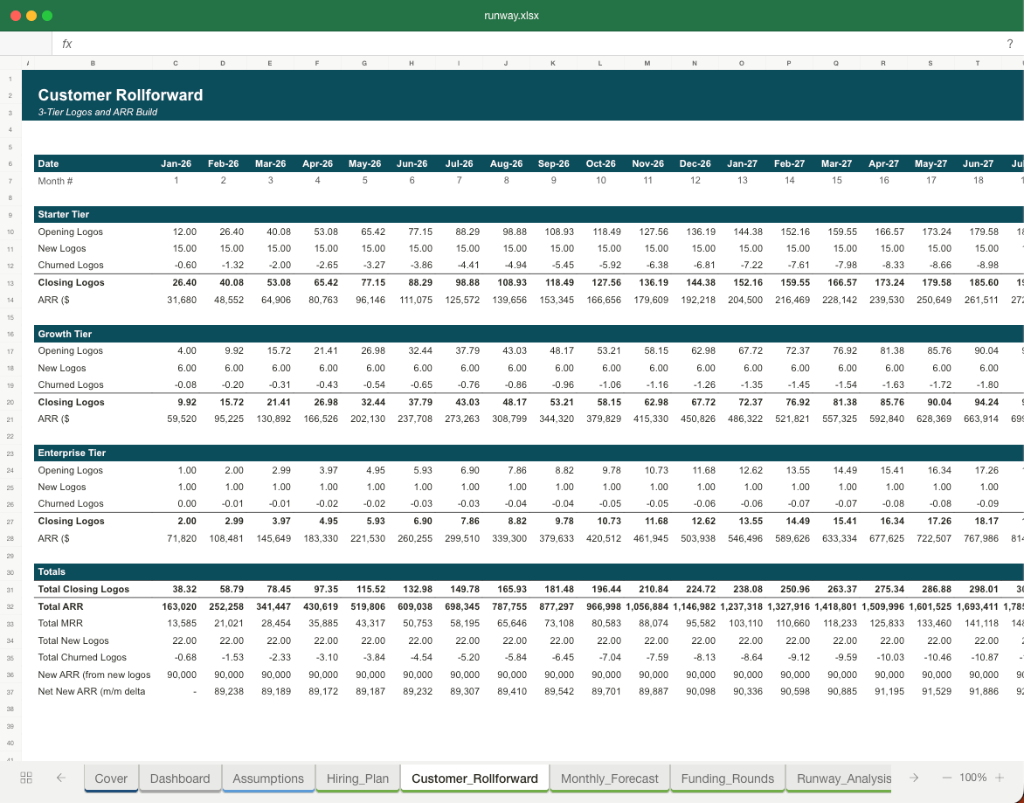
The model uses employees on platform times a per-employee-per-month fee, alongside new logos, expansion, and churn. It links payroll delivery, onboarding, support, gross margin, sales efficiency, product investment, and headcount to ARR and cash flow.
A turnkey financial model
Live formulas, no hardcoded values
Outputs are driven by live formulas, so the workbook updates from its assumptions instead of relying on hardcoded results.
All assumptions in one tab
Inputs are clearly marked in the Assumptions tab and separated from calculations, making it clear what to change and what to leave intact.
Statements always balancing
For integrated-statement models, the balance sheet, cash flow, and supporting schedules tie through properly.
Distinct schedules for clarity
Debt, working capital, taxes, and cash flow can get messy quickly. We group calculations in clear schedules, not across disconnected tabs.
No hidden macros or external links
There are no unexplained external workbook links or macros to undermine auditability or portability.
Changes flow through the model
Update a key driver and see the impact carry through the forecast, financing, and return outputs. We never use hardcoded numbers in formulas.
About Pento
pento.io
How to build a detailed financial model for Pento
A complete walkthrough of the business, drivers, and assumptions behind the downloadable Pento model - distilled from its pitch deck and publicly available information.
Product & value proposition
Pento is a real-time payroll platform that replaces the legacy outsourcing model (spreadsheets → PDF reports → email amendments → bank upload) with an integrated, cloud-based workflow. Core capabilities shown in product UI:
- Real-time gross/net pay calculations
- Built-in approval flows (Reject / Approve / Review payroll)
- Employee-level payslip detail with pay items, NICs, PAYE, pension
- Employer contributions tracking (Employer NIC, Employer pension)
Solution features:
- Full integration to HMRC and pension providers; automatic regulatory updates
- Statutory report generation
- HR, accounting, and scheduling integrations
- Open API (stated as "coming soon")
Vision: Three-layer architecture - payroll infrastructure (country-specific calculation engine), SaaS platform, and an applications/API layer enabling third-party and customer-built products (HR integrations, employee financial products).
Revenue model
Not explicitly stated in deck. Inferred from product and SaaS framing:
- Per-employee-per-month (PEPM) subscription - standard payroll SaaS pricing model; consistent with B2B platform positioning
- Possible API/usage-based tier for third-party integrators and global payroll providers (slide 6 describes these as distinct customer segments)
- Currency: GBP (UK-primary)
Competition / moat
Not explicitly shown. Implied competitive framing:
- Displaces legacy outsourced payroll providers (slow, error-prone, rigid)
- Moat signals: country-specific payroll calculation infrastructure (complex regulatory compliance); open API ecosystem play; multi-country expansion roadmap (UK, Spain, France)
- API strategy aims to make Pento the infrastructure layer for global payroll providers and employment platforms
Recommended financial model
- Archetype + why: B2B SaaS - PEPM (per-employee-per-month) ARR model. Pento sells to businesses who pay based on headcount processed; the natural unit is employees-on-platform × monthly fee. Standard SaaS ARR build is appropriate.
- Forecast horizon & granularity: 3 years monthly (Year 1–2 monthly detail, Year 3 quarterly roll-up). Series A stage warrants monthly granularity for the first 12–24 months to show cash burn and runway.
- Key drivers & assumptions:
| Driver | Value |
|---|---|
| PEPM pricing (GBP) | £5–£10 per employee/month |
| Average employees per customer (SMB) | 50–200 |
| New customers added per month (Yr 1) | To be confirmed |
| Monthly churn rate | 1.0–1.5% |
| Gross margin | 65–75% |
| S&M as % of revenue | 30–40% |
| R&D as % of revenue | 20–30% |
| G&A as % of revenue | 10–15% |
| Geographic expansion lag (Spain, France) | Month 18–24 |
| API / partner revenue contribution | 0% Yr 1, 5–10% Yr 3 |
- Scenarios (Base / Bull / Bear - which variables flex):
- Base: Mid-range PEPM, steady new logo acquisition, 1.0% monthly churn, UK-only Yr 1–2, Spain/France light in Yr 3
- Bull: Higher PEPM (enterprise deals), lower churn (0.5%), faster international ramp, API revenue materialises in Yr 2
- Bear: Slower sales cycles, higher churn (2%), delayed international, margin compression from compliance ops
- Required sheets / outputs:
- Assumptions - all PEPM, cohort, and cost inputs
- ARR Build - new MRR, expansion, churn, net new ARR waterfall by month
- Cohort Table - employee count per cohort × PEPM × retention curve
- P&L - Revenue, COGS (infrastructure, compliance), Gross Profit, S&M, R&D, G&A, EBITDA
- Headcount - sales, engineering, ops ramp
- Cash Flow & Runway - monthly burn, ending cash, months of runway
- KPI Summary - ARR, MRR, customers, employees-on-platform, LTV/CAC (when data available)
Frequently asked
Is the Pento financial model free?+
Yes. The Pento model is a free Excel (.xlsx) download with live formulas. Sign up with your email and the workbook is yours to keep, review, and edit.
What's included in the model?+
A 5-year monthly forecast with P&L, cash flow and runway, valuation (exit multiple plus a DCF cross-check), MOIC/IRR returns, and unit economics, with live formulas throughout.
How was this model built?+
It was built from Pento's pitch deck and publicly available information, then structured to investment-banking standards as a fully editable Excel model.
Can I change the assumptions?+
Yes. You can change assumptions and the live formulas will recalculate in the downloadable Excel model.
Have more financial modelling questions? Contact us

Created by ex-finance professionals
Hey, I’m Alex and I created Finamodel.
Over my years in the finance industry I kept building the same models over and over again. Same structure, same assumptions, different logo. So I started building frameworks to turn them into clean, reusable templates.
Every model here is one I’d actually use for a client, and I personally vet each one before it goes up.
I’m not an expert in every industry, but I’ve built enough models to know what belongs in one. And when something is completely foreign to me, I reach out to my network for experts to work on our models with us.
Having a template library on hand cuts a first build from hours to minutes.
Need help finding your model? You’ll find me in the Finamodel app!
Other Enterprise/Security Startup Financial Models
Browse another startup in the same category.
AgBiome
AgBiome is a microbial-platform agtech company that discovers, develops, and commercialises biological crop protection products (and licences the platform across adjacent markets).

Alation
Enterprise data intelligence platform - data catalog, governance, and metadata management for large organisations.

Archer SPAC
Archera
Cloud resource automation platform that continuously optimizes AWS commitment purchases, de-risks overcommitment, and automates FinOps workflows.

Ardoq
Cloud-native Enterprise Architecture (EA) SaaS platform that helps large enterprises navigate digital transformation through automated data collection, graph-based architecture modelling, and change impact analysis.

Ascend
Ascend.io is an enterprise big data automation platform ("Enterprise Intelligence Platform") that abstracts away the complexity of big data engineering so non-experts can build and run data pipelines.

Athennian
Cloud-based legal entity management system (EMS) uniting entity data with workflow and document automation.

Auditboard
Cloud-based integrated risk management platform connecting audit, risk, compliance, and ESG teams across the enterprise.