 Precursor Fund III Financial Model
Enterprise/Security Startup Financials (Free Excel Download)



professionals from Deloitte
Used by professionals from






About this model
Precursor Fund III is a venture fund rather than an operating business. The relevant question for LPs is how capital will be deployed and returned through a portfolio, not the gross margin or working capital of a product company.
Fund economics are shaped by commitments, investment pacing, portfolio construction, reserves, management fees, and carried interest. The J-curve reflects capital being called and invested well before distributions from successful exits arrive.
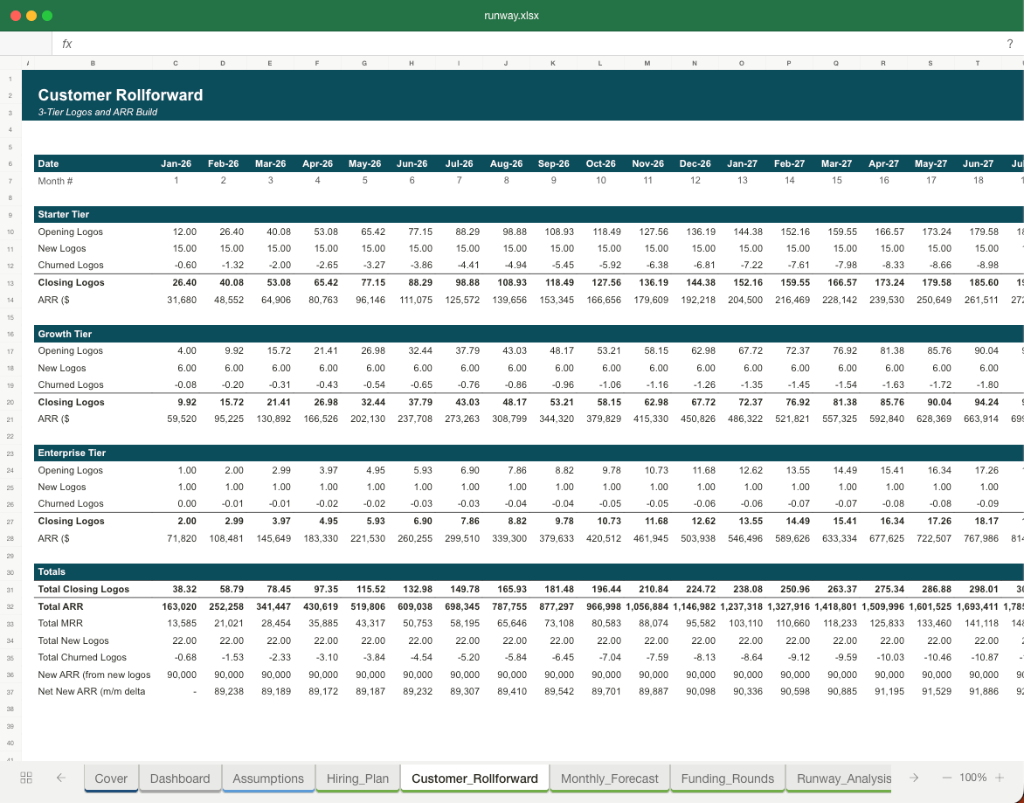
The model schedules capital calls, investments, follow-ons, fees, exits, and carry. It calculates MOIC, DPI, TVPI, RVPI, and gross and net IRR, with sensitivity cases for ownership, dilution, loss rates, exit values, and timing.
A turnkey financial model
Live formulas, no hardcoded values
Outputs are driven by live formulas, so the workbook updates from its assumptions instead of relying on hardcoded results.
All assumptions in one tab
Inputs are clearly marked in the Assumptions tab and separated from calculations, making it clear what to change and what to leave intact.
Statements always balancing
For integrated-statement models, the balance sheet, cash flow, and supporting schedules tie through properly.
Distinct schedules for clarity
Debt, working capital, taxes, and cash flow can get messy quickly. We group calculations in clear schedules, not across disconnected tabs.
No hidden macros or external links
There are no unexplained external workbook links or macros to undermine auditability or portability.
Changes flow through the model
Update a key driver and see the impact carry through the forecast, financing, and return outputs. We never use hardcoded numbers in formulas.
About Precursor Fund III
precursorvc.com
How to build a detailed financial model for Precursor Fund III
A complete walkthrough of the business, drivers, and assumptions behind the downloadable Precursor Fund III model - distilled from its pitch deck and publicly available information.
Product & value proposition
- Precursor leads pre-seed rounds of $1M or less - one of the few institutional firms willing to lead and set terms at this stage.
- Investment thesis: bet on founders before there is product-market-fit data; occupies the "low data on business, low familiarity with founders" quadrant that other firms avoid.
- Value-add beyond capital: help founders syndicate rounds, coach on fundraising, on-demand operational support (hiring, co-founder conflict, strategy).
- Community of 300+ founders across portfolio.
- Deep relationships with top seed and Series A firms to facilitate follow-on financing.
Market
Revenue model
Venture fund economics - standard LP/GP structure:
- Fund size: $40,000,000 (Fund III).
- Fund I: $15,300,000. Fund II: $31,300,000.
- Reserves/follow-on: Fund III uses a "Reserves Fund only" structure (replaces SPVs used in Funds I & II) to follow on in winners.
- SPV income (Funds I & II): used SPVs to syndicate follow-ons; Fund III eliminates SPVs in favor of an integrated reserves fund.
Traction & metrics
All numeric KPI values on the Fund I and Fund II summary dashboards (slides 11, 18) and the portfolio snapshot tables (slides 13, 20, 22, 23) are redacted (blacked out in source images). The following numbers ARE visible in the deck text:
Fund I:
- Fund size: $15,300,000; closed 2016
- Portfolio size: 83 companies
- Initial check: $150,000
- Target ownership: 1–3%
- Strategy: 20–25 companies/year; pre-seed ~65%, seed ~35%
Fund II:
- Fund size: $31,300,000
- Portfolio size: 95 companies
- Initial check: $250,000
- Target ownership: 4–6%
- Follow-on: $250K second investment proactively offered between initial check and next round
- Strategy: pre-seed ~60%, seed ~40%
Fund III:
- Fund size: $40,000,000
- Portfolio size target: 75 companies
- Initial check (pre-seed): $250,000; initial check (seed): $400,000
- Target ownership: 4–6%
- Target total invested per company pre-Series A: $500K–$750K
- Portfolio composition: pre-seed 75%, institutional seed 25%
- Pacing: 20–25 companies/year
- Follow-on: proactive capital outside of round; Reserves Fund (not SPVs)
Sector distribution (combined Funds I & II):
- Fund I: B2B Software 30%, Consumer 23%, Marketplaces 15%, Digital Health 10%, Hardware 8%, Fintech 7%, Media 7%
- Fund II: Consumer 34%, B2B Software 31%, Digital Health 10%, Marketplaces 8%, Fintech 6%, Hardware 4%, Media 4%, EdTech 2%, Consumer SaaS 1%
Co-investor network:
- YC is the most frequent seed co-investor (13 companies); Bloomberg Beta (9); Homebrew, Founders Fund, First Round (5 each)
- Series A–C: YC (9 companies), a16z (4), Founders Fund (3)
Founder demographics:
- Female founders: Fund I 25%, Fund II 45%
- Ethnicity: Fund I White 61%, Asian 19%, Black/AA 15%, LatinX 5%; Fund II White 55%, Asian 27%, Black/AA 12%, LatinX 3%
Deal sourcing (Funds I & II combined):
- Other VCs 43%, Portfolio Founders 17%, Friends 15%, LPs 13%, Accelerators 3%, Non-Portfolio Founders 3%, Other 3%, Precursor Employee 3%
Standout Fund I portfolio companies: The Athletic (Series D), Clearbanc (Series B), Incredible Health (Series A), Carrot (Series B), Juniper Square (Series C), Finix (Series B), Superhuman (Series B), AnyRoad (Series A)
Standout Fund II portfolio companies: Runa (Series A), Modern Health (Series B), Noyo (Series A), Passport (Series A), DriveTime (Series A)
Unit economics
All per-investment numeric data (MOIC, DPI, TVPI, loss rates, markup multiples by stage) are redacted in the dashboard and table slides. Structural parameters visible:
- Initial check size (Fund III): $250K pre-seed / $400K seed
- Target total exposure per company (Fund III): $500K–$750K
- Target ownership at entry (Fund III): 4–6%
- Implied avg. entry valuation at ownership target:
- Fund I / Fund II MOIC: redacted in images
Competition / moat
- Positions against top seed funds that have grown to $100M+ (Felicis, Forerunner, Lerer Hippeau, Floodgate, Uncork, Crosscut, Eniac, Freestyle) - argues those funds have migrated up-stage, creating a pre-seed vacuum.
- Differentiation: willingness to lead and set terms (not just participate) at pre-seed; community of 300+ founders for support; no requirement for business metrics at entry.
- Moat: co-investor network (YC, a16z, Founders Fund, First Round) validates deal quality; deal sourcing via other VCs (43%) and portfolio founders (17%) creates compounding referral flywheel.
- No direct competitor named - competition framed structurally (angel / friends-and-family below, seed funds above).
Team & funding ask / use of funds
Team:
- Charles Hudson (GP): Stanford BA Economics, Stanford MBA. Founded two companies. Prior: Google, IronPort, Gaia, Serious Business. Investor at Uncork Capital (SoftTech VC), Active Angel, In-Q Tel.
- Sydney Thomas (Partner): Duke BA Public Policy, Berkeley-Haas MBA. Operator at Naya Health, Kimberly Clark, Soma Water.
- Ayanna Kerrison (Partner): Baruch College BA Finance. Prior: Credit Suisse, Bank of Montreal, Merrill Lynch.
- Portfolio team grid shown on slide 2 (individual names not OCR'd).
Funding ask:
- Raising $40,000,000 for Fund III from LPs.
- No stated LP minimum, close date, or current close amount shown.
Use of funds (implied from strategy):
- 75 companies × ~$250K–$400K initial check = ~$19M–$30M in initial investments
- Remaining ~$10M–$21M allocated to follow-on reserves fund for pro-rata / opportunistic follow-ons in winners
- Management fees drawn from committed capital
Recommended financial model
This is a VC fund LP pitch, not an operating startup. The correct model is a VC fund economics / waterfall / cash-flow model - not a 3-statement operating model.
- Archetype + why: VC Fund Economics model (J-curve cash flow + waterfall). Models capital deployment, portfolio construction, MOIC/DPI/TVPI over fund life, management fees, carried interest splits, and LP return distributions. Appropriate because: (a) the entity IS the fund; (b) the LP audience needs to evaluate net returns, not operating P&L.
- Forecast horizon & granularity:
- 10-year fund life (standard VC), with optional 2-year extensions
- Annual granularity for deployment and portfolio markups; quarterly for cash flows
- Investment period: years 1–4; harvesting period: years 5–10
- Key drivers & assumptions:
| Driver | Value | Source |
|---|---|---|
| Fund size | $40,000,000 | - |
| Portfolio size | 75 companies | - |
| Pre-seed / seed split | 75% / 25% | - |
| Initial check - pre-seed | $250,000 | - |
| Initial check - seed | $400,000 | - |
| Target total per company pre-Series A | $500K–$750K | - |
| Target entry ownership | 4–6% | - |
| Pacing (companies/year) | 20–25 | - |
| Management fee rate | 2% p.a. of committed capital | - |
| Management fee period | 4 years (investment period) then declining | - |
| Carried interest | 20% | - |
| Preferred return (hurdle) | 8% | - |
| Gross MOIC - winners | 20–50x | - |
| Gross MOIC - portfolio avg. | 3–5x gross | - |
| Write-off rate | 40–50% of portfolio by count | - |
| Series A graduation rate | ~35–45% | - |
| Recycling | Partial - via reserves fund | - |
| Fund life | 10 years + optional 2-year extension | - |
- Scenarios (Base / Bull / Bear - which variables flex):
- Base: 3.5x gross MOIC, 45% write-off rate, 35% Series A graduation, 2.5x DPI
- Bull: 5x gross MOIC (one or two breakout portfolio companies, e.g., Superhuman / Carrot-scale exits), 30% write-off rate, 2x net MOIC to LPs
- Bear: 2x gross MOIC, 55% write-off rate, no carry generated, management fees only return
- Key flex variables: gross MOIC on top 10% of portfolio, write-off rate, time-to-exit/hold period, Series A graduation rate
- Required sheets / outputs:
- Inputs & Assumptions - fund params, fee structure, deployment schedule, MOIC assumptions by cohort
- Deployment Schedule - annual investments by stage (pre-seed vs. seed), check sizes, cumulative capital deployed vs. reserves
- Portfolio Construction - 75-company model with stage progression (pre-seed → seed → Series A → B → exit), loss/write-off buckets
- Management Fee Schedule - fee income to GP over fund life
- J-Curve Cash Flows - LP contributions (calls) and distributions (dividends) by year
- MOIC / IRR / DPI / TVPI - gross and net, by scenario
- Waterfall - return of capital → preferred return → catch-up → carry split (LP vs. GP)
- Sensitivity table - net IRR / net MOIC vs. (gross MOIC of top decile) × (write-off rate)
- Benchmark Comparison - optional: compare modeled returns to Cambridge Associates pre-seed index
Frequently asked
Is the Precursor Fund III financial model free?+
Yes. The Precursor Fund III model is a free Excel (.xlsx) download with live formulas. Sign up with your email and the workbook is yours to keep, review, and edit.
What's included in the model?+
A 5-year monthly forecast with P&L, cash flow and runway, valuation (exit multiple plus a DCF cross-check), MOIC/IRR returns, and unit economics, with live formulas throughout.
How was this model built?+
It was built from Precursor Fund III's pitch deck and publicly available information, then structured to investment-banking standards as a fully editable Excel model.
Can I change the assumptions?+
Yes. You can change assumptions and the live formulas will recalculate in the downloadable Excel model.
Have more financial modelling questions? Contact us

Created by ex-finance professionals
Hey, I’m Alex and I created Finamodel.
Over my years in the finance industry I kept building the same models over and over again. Same structure, same assumptions, different logo. So I started building frameworks to turn them into clean, reusable templates.
Every model here is one I’d actually use for a client, and I personally vet each one before it goes up.
I’m not an expert in every industry, but I’ve built enough models to know what belongs in one. And when something is completely foreign to me, I reach out to my network for experts to work on our models with us.
Having a template library on hand cuts a first build from hours to minutes.
Need help finding your model? You’ll find me in the Finamodel app!
Other Enterprise/Security Startup Financial Models
Browse another startup in the same category.
AgBiome
AgBiome is a microbial-platform agtech company that discovers, develops, and commercialises biological crop protection products (and licences the platform across adjacent markets).

Alation
Enterprise data intelligence platform - data catalog, governance, and metadata management for large organisations.

Archer SPAC
Archera
Cloud resource automation platform that continuously optimizes AWS commitment purchases, de-risks overcommitment, and automates FinOps workflows.

Ardoq
Cloud-native Enterprise Architecture (EA) SaaS platform that helps large enterprises navigate digital transformation through automated data collection, graph-based architecture modelling, and change impact analysis.

Ascend
Ascend.io is an enterprise big data automation platform ("Enterprise Intelligence Platform") that abstracts away the complexity of big data engineering so non-experts can build and run data pipelines.

Athennian
Cloud-based legal entity management system (EMS) uniting entity data with workflow and document automation.

Auditboard
Cloud-based integrated risk management platform connecting audit, risk, compliance, and ESG teams across the enterprise.