 Qover Financial Model
InsurTech Startup Financials (Free Excel Download)
API-first embedded insurance infrastructure that lets digital businesses distribute insurance products without a balance sheet.



professionals from Deloitte
Used by professionals from






About this model
Qover is API-first embedded insurance infrastructure that lets digital partners distribute insurance without holding a balance sheet. It connects insurers, products, pricing, servicing, claims, compliance, and white-label customer journeys through modular technology.
The platform had handled 800,000 insured customers in more than 32 countries and holds delegated authority from 12 insurers. Its MGA-style model earns commission on GWP from partners including Revolut, Wolt, Deliveroo, and Decathlon.
The model is embedded-insurance commission revenue. Partners, customer transactions, attachment, average premium, take rate, claims servicing cost, and retention determine revenue. Carrier capacity, integration speed, and partner growth drive the forecast.
A turnkey financial model
Live formulas, no hardcoded values
Outputs are driven by live formulas, so the workbook updates from its assumptions instead of relying on hardcoded results.
All assumptions in one tab
Inputs are clearly marked in the Assumptions tab and separated from calculations, making it clear what to change and what to leave intact.
Statements always balancing
For integrated-statement models, the balance sheet, cash flow, and supporting schedules tie through properly.
Distinct schedules for clarity
Debt, working capital, taxes, and cash flow can get messy quickly. We group calculations in clear schedules, not across disconnected tabs.
No hidden macros or external links
There are no unexplained external workbook links or macros to undermine auditability or portability.
Changes flow through the model
Update a key driver and see the impact carry through the forecast, financing, and return outputs. We never use hardcoded numbers in formulas.
About Qover
qover.com
How to build a detailed financial model for Qover
A complete walkthrough of the business, drivers, and assumptions behind the downloadable Qover model - distilled from its pitch deck and publicly available information.
Product & value proposition
- Full-stack embedded insurance platform: Qover sits between insurers (risk carriers) and digital partners (distributors), handling products, pricing, customer servicing, claims (TPA), tech integration, and compliance.
- Open API + white-label front-end; modular micro-architecture; can launch new insurance products in days/weeks.
- Partners integrate via API and can embed or cross-sell insurance in their own customer journey (e.g. Revolut's paid plans, Deliveroo/Wolt gig-worker coverage, Cowboy/Angell bike purchase flow, Immoweb renters insurance).
- Qover does NOT carry risk on its own balance sheet - risk is underwritten by capacity partners (Wakam, Lloyd's, NN, Baloise, Chubb, AXA, AIG, and others).
- Claim management (TPA) centrally operated from Brussels.
Market
- Embedded insurance TAM cited as "700B+ Opportunity" (P&C only); source attributed to Simon Torrance 2020.
- Positioned as the last unaddressed B2B FinTech vertical alongside Payments-as-a-Service (Stripe/Adyen), Banking-as-a-Service, Lending-as-a-Service, etc..
- No SAM, SOM, or growth-rate figures provided in the deck.
Revenue model
- Revenue mechanism not explicitly stated in the deck; standard IaaS / MGA model implies:
- Qover earns a commission/fee on Gross Written Premium (GWP) generated through partner channels - typical range 10–25% of GWP for MGA-style platforms. Rationale: they hold delegation of authority from 12 insurers and manage the full value chain but disclaim balance-sheet risk; net revenue = GWP × commission rate minus claims TPA costs.
- Consumer-facing pricing example visible: Angell Bike insurance at €9.90/month.
- Revolut integration: insurance bundled in paid plans across 33 countries.
- Distribution model: B2B2C - partners (Revolut, Deliveroo, Wolt, Cowboy, Decathlon, Immoweb, Poppy, Angell, Axel Springer/KKR, + others) drive end-consumer volume; Qover never sells direct to consumer.
- Two integration modes: Open API (real-time data exchange) and White-label front-end.
Traction & metrics
- 800k insured handled from Brussels - cumulative policyholders processed.
- >95% Customer Satisfaction.
- Active in 32+ countries.
- Delegation of authority from 12 insurers.
- Named partners (slide 7): Revolut, Wolt, Deliveroo, Cowboy, Decathlon, Immoweb, Axel Springer KKR, + many more.
- No revenue figures, GWP, growth rates, or ARR disclosed in the deck.
Competition / moat
- Claims to be "the only true digital insurance infrastructure play".
- Moat framed across five pillars:
- Tech: 100% proprietary, open API, white-label, modular micro-architecture.
- Data: centralised data warehouse; e-commerce conversion optimisation.
- Insurance: pan-European licences; delegation of authority from 12 insurers.
- Operations: centralised Brussels ops; >95% CSAT; 800k insured.
- Pan-European: active in 32+ countries; unique ability to launch and manage pan-European programs.
- Competitive set implicitly includes legacy insurers and broker aggregators; no direct InsurTech competitors named.
Team & funding ask / use of funds
- Founders: Quentin Colmant (CEO & Co-Founder) and Jean-Charles Velge (Co-Founder).
- No team bios, headcount, prior experience, or funding history disclosed in this deck.
- No funding ask amount, valuation, or use-of-funds slide present.
Recommended financial model
- Archetype + why: Insurance MGA / platform GWP model with commission P&L. Qover is a capital-light MGA (Managing General Agent) that generates revenue as a percentage of GWP flowing through its platform. The correct model archetype is a GWP-driven commission revenue model - analogous to a B2B marketplace GMV model but with insurance-specific KPIs (GWP, loss ratio, combined ratio, take rate). NOT a 3-statement model with underwriting reserves (no balance-sheet risk). Closest comparables: Cover Genius, Trov, Openly.
- Forecast horizon & granularity: 5-year annual model (2021–2025), with monthly granularity for Year 1 (2021). Monthly needed to track new partner onboarding cadence and ramp curves.
- Key drivers & assumptions (tag or):
- Number of active distribution partners (signed): 7 named + "many more"; assume ~10–15 at close - no exact number disclosed.
- GWP per partner per year: varies widely by partner type; Revolut (pan-European, 33 countries) likely >> Cowboy (niche bike). Model should segment by partner tier (large/mid/small) with separate GWP assumptions.
- Partner ramp curve: new partner reaches full run-rate GWP in 6–12 months post-go-live. Rationale: API integration + product launch takes days/weeks per deck; ramp driven by partner's user adoption, not Qover's.
- New partners added per year: 5–15/year in Base. Rationale: 7 named at Series B stage after ~3 years; growth funding should accelerate.
- Qover net take rate on GWP: 15–20% gross commission, net of reinsurer/capacity fees; ~10–15% net revenue margin on GWP. Rationale: MGA market norms; no deck data.
- Loss ratio / claims cost (TPA): 55–65% of net premium (i.e. the risk is borne by capacity partners, but TPA handling cost is Qover's OpEx). Model as a cost line, not a combined ratio.
- Consumer pricing example: €9.90/month for bike insurance - use as sanity check on per-policy GWP for product-level builds.
- Headcount growth: Brussels-centric ops team; scale with insured volume. Model 3 cost centres: tech/product, insurance/compliance, ops/CS.
- Countries active: 32+; geographic expansion not modelled separately unless country-level revenue data provided.
- Scenarios (Base / Bull / Bear - which variables flex):
- Base: moderate new partner adds (~8/year), mid-range take rate (15%), GWP/partner growing in line with partner user base.
- Bull: acceleration in partner signing (15+/year), large-partner wins (Revolut-scale), take rate holds at 18%, loss experience favourable.
- Bear: slow new partner pipeline (3–4/year), existing partner GWP growth disappoints, take rate pressure from insurers, regulatory friction in new markets.
- Primary flex variables: partner adds per year, GWP per partner, net take rate.
- Required sheets / outputs:
- Assumptions - all drivers tagged and clearly separated.
- Partner model - cohort table: partners by year of signing, GWP ramp, annual GWP per partner, total platform GWP.
- Revenue bridge - GWP → gross commission → net revenue (after capacity partner fees).
- P&L - net revenue, TPA/claims handling costs, tech/product opex, insurance/compliance opex, ops/CS opex, G&A, EBITDA.
- Headcount plan - by function, tied to operational scale.
- Cash flow / runway - Series B proceeds vs. burn to breakeven.
- KPI dashboard - GWP (total + by partner), policies in force, take rate, revenue per partner, cost per insured.
Frequently asked
Is the Qover financial model free?+
Yes. The Qover model is a free Excel (.xlsx) download with live formulas. Sign up with your email and the workbook is yours to keep, review, and edit.
What's included in the model?+
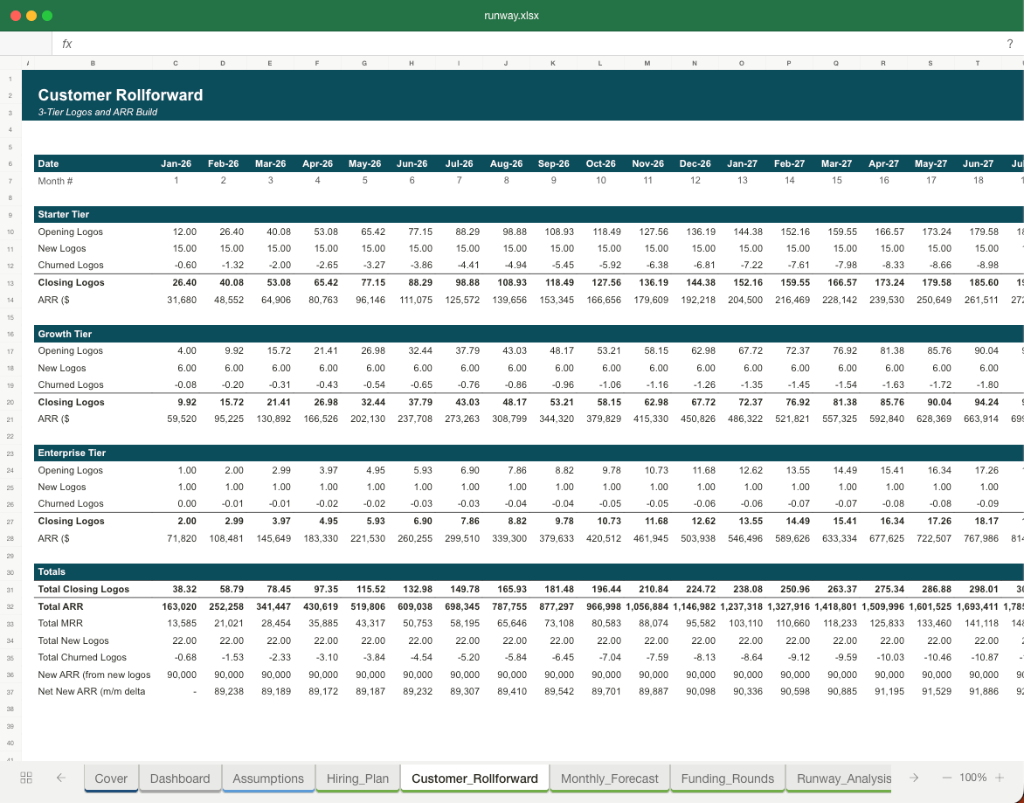
A 5-year monthly forecast with P&L, cash flow and runway, valuation (exit multiple plus a DCF cross-check), MOIC/IRR returns, and unit economics, with live formulas throughout.
How was this model built?+
It was built from Qover's pitch deck and publicly available information, then structured to investment-banking standards as a fully editable Excel model.
Can I change the assumptions?+
Yes. You can change assumptions and the live formulas will recalculate in the downloadable Excel model.
Have more financial modelling questions? Contact us

Created by ex-finance professionals
Hey, I’m Alex and I created Finamodel.
Over my years in the finance industry I kept building the same models over and over again. Same structure, same assumptions, different logo. So I started building frameworks to turn them into clean, reusable templates.
Every model here is one I’d actually use for a client, and I personally vet each one before it goes up.
I’m not an expert in every industry, but I’ve built enough models to know what belongs in one. And when something is completely foreign to me, I reach out to my network for experts to work on our models with us.
Having a template library on hand cuts a first build from hours to minutes.
Need help finding your model? You’ll find me in the Finamodel app!
Other InsurTech Startup Financial Models
Browse another startup in the same category.
Ark Kapital
AI-powered precision lending platform for European tech startups, providing non-dilutive growth loans using real-time raw data analytics.

Battleface
Tech-enabled travel insurance platform covering high-risk and non-standard destinations globally, sold direct and via B2B2C partners.
Beam
Digital-first dental insurance company selling group dental (and ancillary) benefits to employers via brokers

Branch
Tech-enabled home & auto insurance company operating as a reciprocal exchange, selling bundled policies via embedded, direct, and agency channels.
Cachet
B2B2C insurtech marketplace offering flexible, usage-based insurance products to gig/platform economy workers via partnerships with ride-hailing, delivery, and gig platforms.

Caura
Mobile app that aggregates all car-related payments (parking, congestion/ULEZ, tolls, tax, insurance) into a single platform, with insurance comparison as a key monetisation layer.

Clark
Digital insurance broker (Makler) providing a robo-advisor + human expert hybrid platform to manage and purchase all insurance lines via mobile app

Counterpart
Digital MGA (managing general agent) selling D&O and management liability insurance to US SMEs via a tech-enabled underwriting platform.