RORoadrunner Financial Model
Enterprise/Security Startup Financials (Free Excel Download)
Tech-enabled sustainable waste management and recycling company that replaces legacy haulers for commercial customers.



professionals from Deloitte
Used by professionals from






About this model
Roadrunner is a tech-enabled commercial waste-management and recycling company. It replaces legacy hauling with an asset-light operating model using smaller vehicles, pre-sorted waste streams, and direct routing to recycling centres.
Revenue comes from service contracts with customer locations, with additional upside from recycled-material commodity prices. Unlike a pure SaaS business, route density, fleet capacity, working capital, and vehicle investment are central to the operating economics.
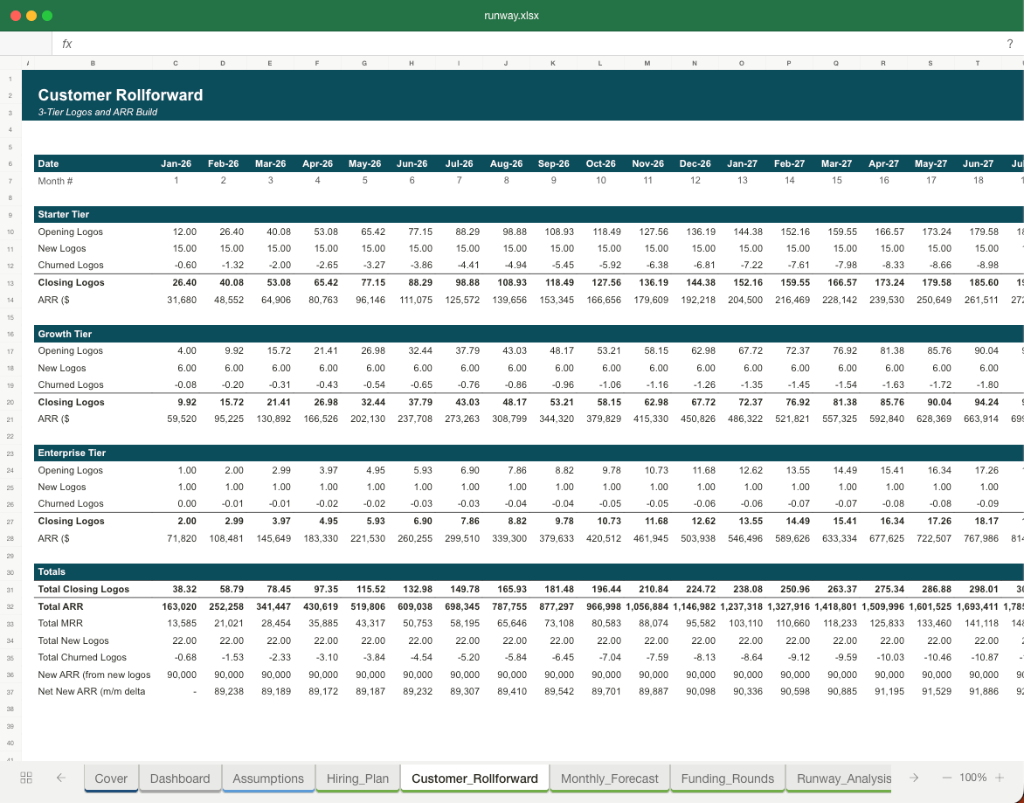
The model builds monthly contract revenue by locations and route density, then adds recycling commodity revenue. It tracks vehicles, labour, fuel, disposal and recycling costs, capex, working capital, debt financing, EBITDA, and cash flow across pricing and volume scenarios.
A turnkey financial model
Live formulas, no hardcoded values
Outputs are driven by live formulas, so the workbook updates from its assumptions instead of relying on hardcoded results.
All assumptions in one tab
Inputs are clearly marked in the Assumptions tab and separated from calculations, making it clear what to change and what to leave intact.
Statements always balancing
For integrated-statement models, the balance sheet, cash flow, and supporting schedules tie through properly.
Distinct schedules for clarity
Debt, working capital, taxes, and cash flow can get messy quickly. We group calculations in clear schedules, not across disconnected tabs.
No hidden macros or external links
There are no unexplained external workbook links or macros to undermine auditability or portability.
Changes flow through the model
Update a key driver and see the impact carry through the forecast, financing, and return outputs. We never use hardcoded numbers in formulas.
About Roadrunner
roadrunner.page
How to build a detailed financial model for Roadrunner
A complete walkthrough of the business, drivers, and assumptions behind the downloadable Roadrunner model - distilled from its pitch deck and publicly available information.
Product & value proposition
- Sustainable material management: pre-sorted curbside collection routed directly to recycling centers, bypassing MRF sorting facilities.
- 17 recycling streams handled ("fleethauled").
- Customer benefits: 15% average cost savings vs. incumbent; 10x recycling rate vs. solid waste company; improved service quality.
- Traditional approach cost benchmark: ~$90/ton in direct MRF sorting costs, plus transport, with only ~20% of original volume actually recycled.
- RoadRunner claims 99% of original volume recycled via direct routing.
Market
- Industry size: "$80B industry" cited as the total U.S. waste/recycling market.
- Market structure: 5 companies control 65% of market, all dependent on landfill for profit.
- Macro tailwind: $35+ trillion global sustainable investment; Fortune 500 companies with carbon goals grew ~6x from 2016–2020, reaching ~30% of Fortune Global 500; U.S. sustainable investing AUM grew from ~$8,000B (2016) to ~$17,000B (2020).
Revenue model
- Not explicitly detailed in deck. Based on operating model described:
- B2B service contracts with commercial customers for waste collection and recycling.
- Revenue likely per-pickup, per-ton, or monthly subscription per location.
- Secondary revenue stream: sale of sorted recyclable materials to recycling facilities at spot market rate.
- Channels: Direct sales to commercial customers; partner channel implied by "Partner Support Reference" label on cover.
Traction & metrics
- 350 employees
- 17 markets + expansion
- 17 recycling streams fleethauled
- $40M+ saved for businesses (cumulative)
- 160K+ tons recycled (cumulative)
- 40% effective recycling rate (RoadRunner average vs. 4% national average)
- No revenue, ARR, customer count, or growth rate figures disclosed.
Unit economics
- Cost benchmark: Traditional MRF sorting costs ~$90/ton.
- RoadRunner avoids MRF step via pre-sorting + direct routing → lower per-ton cost.
- Vehicles: Smaller, more fuel-efficient than compaction trucks (compaction trucks <3 mpg).
- Customer savings: 15% average vs. incumbent - implies pricing headroom is modest.
Competition / moat
- Top 5 incumbents control 65% of market (Waste Management, Republic Services, etc. implied).
- Incumbents: capital-intensive, landfill-dependent, lack innovation, poor CX.
- RoadRunner moat: technology stack (routing/logistics optimization implied by "world-class technology" claim), pre-sort methodology, sustainability credentials for ESG-driven enterprise buyers.
- No patents, proprietary data assets, or switching cost mechanics described.
Team & funding ask / use of funds
Recommended financial model
- Archetype + why: B2B service-contract revenue model with a recycled-materials commodity revenue layer. Best modelled as a route-economics / waste-hauler P&L - similar to a field-services or logistics operator: contract revenue per customer location per month, layered with commodity (recyclables spot price) upside. A 3-statement model is appropriate given capex (fleet), working capital, and potential debt financing for vehicle purchases.
- Forecast horizon & granularity: 5-year annual with monthly detail for Year 1. Market expansion (# markets) and customer ramp are the key pacing variables.
- Key drivers & assumptions:
| Driver | Value |
|---|---|
| Total addressable market (U.S. commercial waste) | $80B |
| Markets live at model start | 17 |
| New markets per year | 3–5 |
| Cost savings delivered to customers | 15% avg vs. incumbent |
| Headcount | 350 employees |
| Recycling rate (operational KPI) | 40% effective |
| Tons recycled (cumulative) | 160K+ |
- Scenarios (Base / Bull / Bear - which variables flex):
- Base: 3–4 new markets/year, steady customer ramp, stable recyclables pricing.
- Bull: 5+ new markets/year, enterprise channel accelerates (Fortune 500 ESG mandates), recyclables spot prices rise.
- Bear: Market expansion slows to 1–2/year, commodity prices fall, incumbent price response compresses margins.
- Required sheets / outputs:
- Assumptions - all drivers above, centralized.
- Market & Customer Build - markets live × customers/market × monthly ramp.
- Revenue - service contract revenue + commodity/recyclables revenue by market.
- P&L (Income Statement) - revenue, COGS (driver labor, fuel, vehicle depreciation), gross profit, SG&A, EBITDA.
- Fleet Capex Schedule - vehicles per market, useful life, depreciation.
- Balance Sheet & Cash Flow Statement - capex, working capital, debt service if fleet financed.
- KPI Dashboard - tons recycled, recycling rate, customers, markets, revenue/customer, EBITDA/ton.
- Scenarios toggle (Base / Bull / Bear).
Frequently asked
Is the Roadrunner financial model free?+
Yes. The Roadrunner model is a free Excel (.xlsx) download with live formulas. Sign up with your email and the workbook is yours to keep, review, and edit.
What's included in the model?+
A 5-year monthly forecast with P&L, cash flow and runway, valuation (exit multiple plus a DCF cross-check), MOIC/IRR returns, and unit economics, with live formulas throughout.
How was this model built?+
It was built from Roadrunner's pitch deck and publicly available information, then structured to investment-banking standards as a fully editable Excel model.
Can I change the assumptions?+
Yes. You can change assumptions and the live formulas will recalculate in the downloadable Excel model.
Have more financial modelling questions? Contact us

Created by ex-finance professionals
Hey, I’m Alex and I created Finamodel.
Over my years in the finance industry I kept building the same models over and over again. Same structure, same assumptions, different logo. So I started building frameworks to turn them into clean, reusable templates.
Every model here is one I’d actually use for a client, and I personally vet each one before it goes up.
I’m not an expert in every industry, but I’ve built enough models to know what belongs in one. And when something is completely foreign to me, I reach out to my network for experts to work on our models with us.
Having a template library on hand cuts a first build from hours to minutes.
Need help finding your model? You’ll find me in the Finamodel app!
Other Enterprise/Security Startup Financial Models
Browse another startup in the same category.
AgBiome
AgBiome is a microbial-platform agtech company that discovers, develops, and commercialises biological crop protection products (and licences the platform across adjacent markets).

Alation
Enterprise data intelligence platform - data catalog, governance, and metadata management for large organisations.

Archer SPAC
Archera
Cloud resource automation platform that continuously optimizes AWS commitment purchases, de-risks overcommitment, and automates FinOps workflows.

Ardoq
Cloud-native Enterprise Architecture (EA) SaaS platform that helps large enterprises navigate digital transformation through automated data collection, graph-based architecture modelling, and change impact analysis.

Ascend
Ascend.io is an enterprise big data automation platform ("Enterprise Intelligence Platform") that abstracts away the complexity of big data engineering so non-experts can build and run data pipelines.

Athennian
Cloud-based legal entity management system (EMS) uniting entity data with workflow and document automation.

Auditboard
Cloud-based integrated risk management platform connecting audit, risk, compliance, and ESG teams across the enterprise.