 Sharpist Financial Model
Enterprise/Security Startup Financials (Free Excel Download)
B2B SaaS platform delivering one-on-one digital coaching and learning to enterprise employees



professionals from Deloitte
Used by professionals from






About this model
Sharpist provides one-on-one digital coaching and learning for enterprise employees. Its platform is licensed to HR buyers, while a network of coaches supplies the human service that makes development programmes more personalised.
The company sells annual recurring contracts priced around seats or coaching credits. An emerging group-coaching offering adds a second delivery and margin profile, while account growth can come from adding employees, coaching credits, and programmes.
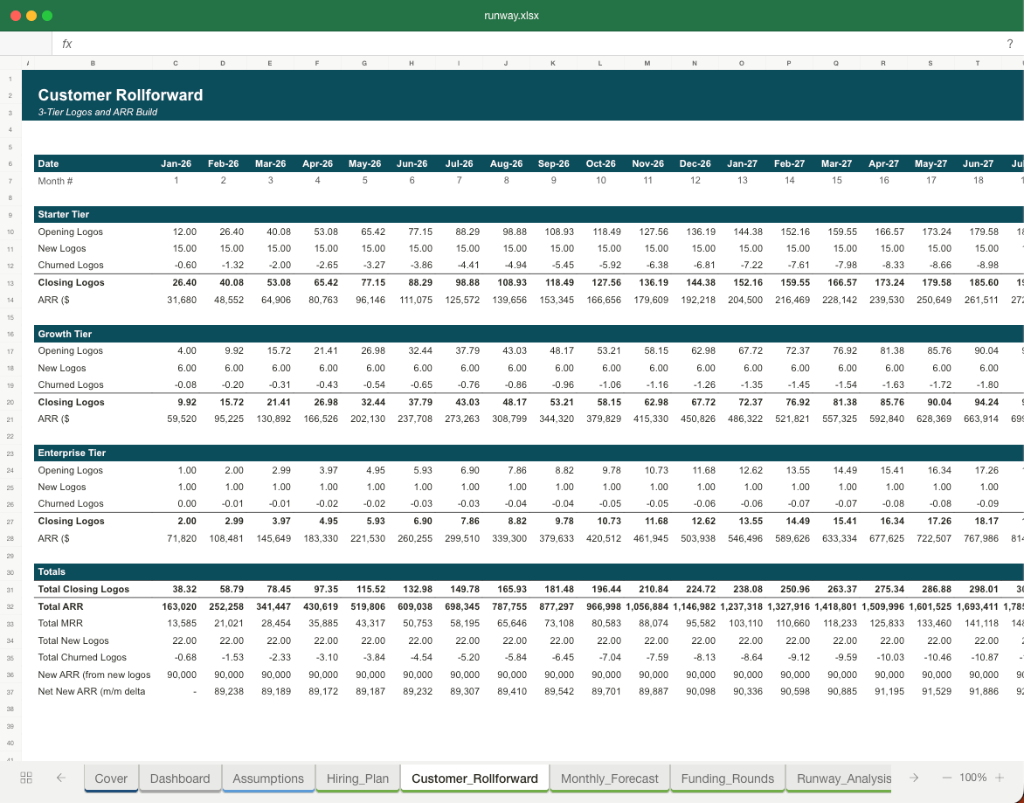
The model builds ARR from enterprise customers, employees covered, credits, expansion, and renewals. It separately forecasts coach supply and delivery costs, group-coaching revenue, gross margin, sales capacity, customer success, product investment, and cash runway.
A turnkey financial model
Live formulas, no hardcoded values
Outputs are driven by live formulas, so the workbook updates from its assumptions instead of relying on hardcoded results.
All assumptions in one tab
Inputs are clearly marked in the Assumptions tab and separated from calculations, making it clear what to change and what to leave intact.
Statements always balancing
For integrated-statement models, the balance sheet, cash flow, and supporting schedules tie through properly.
Distinct schedules for clarity
Debt, working capital, taxes, and cash flow can get messy quickly. We group calculations in clear schedules, not across disconnected tabs.
No hidden macros or external links
There are no unexplained external workbook links or macros to undermine auditability or portability.
Changes flow through the model
Update a key driver and see the impact carry through the forecast, financing, and return outputs. We never use hardcoded numbers in formulas.
About Sharpist
sharpist.com
How to build a detailed financial model for Sharpist
A complete walkthrough of the business, drivers, and assumptions behind the downloadable Sharpist model - distilled from its pitch deck and publicly available information.
Product & value proposition
- Holistic digital coaching platform: goal assessment → algorithmic coach matching → video 1:1 coaching sessions → micro-tasks → progress tracking
- Three stakeholder layers: Learner (mobile/web app), HR Customer (people analytics dashboard, cohort onboarding), Coach (session management)
- Key product metrics (platform engagement): 98% license activation rate, 92% first coach-match accuracy, 92% coaching session utilization, 95% micro-task upvotes, 5x mobile interactions vs. baseline
- Roadmap items in deck: "Coaching credits" (flexible session allocation, launched May 2021), "Group coaching" (June 2021 - cited as improving gross margin), Premium content, Cohort analytics
Market
- Total addressable market: $300B+ corporate learning market, with $150B rapidly shifting from offline to digital
- Segment breakdown (from timeline chart, slide 7):
- One-on-one digital coaching: $1.8B, CAGR 73%
- Learning experience systems: $0.6B, CAGR 25%
- People analytics: $2.2B, CAGR 14%
- Cohort/social/group learning: part of the $150B offline-to-digital shift
- Sources cited: ICF, Grand View, MarketWatch, Statista, Wonder
Revenue model
- Enterprise SaaS license: companies purchase coaching licences for employees (seat-based or credit-based)
- Session-credit model: employees receive a coaching plan (e.g. "30 min every 14 days") with a set number of sessions/minutes that expire on a fixed date
- "Top-up" mechanism implies add-on purchase beyond base licence
- Group coaching introduced June 2021 - cited as improving gross margin vs. 1:1 coaching; suggests blended delivery model
- Coaches are paid per session (supply-side cost); platform takes a margin
- Sales channel: direct enterprise sales (VP Sales + Regional VP roles on team slide)
- No per-user pricing tiers, upsell tiers, or ACV/ARR per customer figures disclosed in deck
Traction & metrics
- Market position: "Market-leader in DACH"
- ARR growth (y-o-y): redacted
- TCV bookings growth (q-o-q): redacted
- Projected ARR FY 2021: redacted
- Gross margin: redacted
- ARR trajectory chart (slide 9): monthly bars from Jan 2021 to Dec 2023; shows steep upward curve; all Y-axis values redacted
- Enterprise client count / client names: redacted (stacked client-logo chart shows clear upward growth in client count, 2020→2021)
- Platform engagement KPIs (confirmed as non-redacted):
- 98% license activation
- 92% first match accuracy
- 92% session utilization
- 95% micro-task upvote rate
- 200% increase in micro-task completion rate
- 100% of HR customers tracked progress on 32 focus areas monthly
- 80% of coaching sessions had coach-assigned micro tasks
Unit economics
- Gross margin: figure redacted
- Group coaching cited as improving gross margin vs. 1:1 (directional signal only)
Competition / moat
- Competitive framing: positions against offline coaching and legacy LMS / e-learning platforms
- Slide 6 title: "The #1 interface for people development of the future. The winning learning experience of today." - brand claim, no explicit comp table in deck
- Moat signals: algorithmic coach matching (92% first-match accuracy), proprietary engagement loop (goals → coaching → micro-tasks → analytics), people analytics dashboard for HR buyers
- No explicit competitor comparison matrix in deck
Team & funding ask / use of funds
- CEO / Co-Founder: Hendrik Schriefer - "Business Punk Top 10 thinker in HR for 2021"; background: Rocket
- COO / Co-Founder: Fabian Niedballa - background: GetYourGuide
- CPO / Co-Founder: Khurram Masood - Forbes Contributor; background: ALU, McKinsey
- VP Sales: Tine Schlaak - McKinsey & Company, Udacity
- Regional VP Sales: Dr. Jonas Vrany - Google, LinkedIn
- VP Customer Success: Karla Calinawan - Everpi
- VP Engineering: Joshua Hoffman - "Inventor of Prometheus", SoundCloud
- Head of Network Ops: Luigi D'Angelo - GetYourGuide, Booking.com
- Head of People: Samir Keck - Flixbus, Zalando
- Contact: hendrik.schriefer@sharpist.com
- Funding ask: redacted
Recommended financial model
- Archetype + why: Enterprise SaaS ARR model. Revenue is seat/credit-based licences sold to corporate HR buyers on annual contracts; the business tracks ARR, TCV bookings, and gross margin - all standard SaaS KPIs explicitly referenced in the deck. The emerging group-coaching line introduces a blended-margin layer worth modelling separately.
- Forecast horizon & granularity: Monthly for Year 1 (Jan–Dec 2021 actuals/forecast already in deck); quarterly for Years 2–3 (2022–2023 per the ARR chart). 3-year model total.
- Key drivers & assumptions:
| Driver | Value / Rationale |
|---|---|
| Starting ARR (Jan 2021) | Unknown - ARR chart redacted; placeholder €X to be filled from data room |
| YoY ARR growth rate | Metric exists but redacted; 100–150% for 2021 based on "market-leader" positioning and steep chart curve |
| New enterprise logos added per quarter | Directional: client chart shows rapid logo accumulation 2020→2021; assume ~5–10 new logos/quarter in 2021 |
| Gross margin - 1:1 coaching | Redacted; ~50–60% (marketplace coaching platforms typically 40–65%; group coaching improves this) |
| Gross margin - group coaching | Directionally higher than 1:1 per slide 6; 65–75% |
| Revenue mix shift to group coaching | 0% in 2021 (launched June 2021), growing to ~20% of sessions by 2023 |
| Churn / NRR | No churn data in deck; assume 90–95% gross retention (enterprise HR-tech benchmark); NRR >100% via seat expansion |
| Headcount / OpEx | 9 named senior hires visible; team size not given; assume 30–60 FTE scaling to 100+ by 2023 |
| Coach network cost | Largest COGS driver; assume coach paid 40–50% of session revenue; group coaching dilutes this |
- Scenarios (Base / Bull / Bear - which variables flex):
- Base: ARR growth 100% YoY (2021→2022), 80% (2022→2023); gross margin stable at ~55%; churn 7%
- Bull: ARR growth 150%/120%; faster mix shift to group coaching lifts margin to 65%+; NRR 110% from seat expansion
- Bear: Growth decelerates to 60%/50%; churn 12% (enterprise budget cuts); gross margin pressured by coach cost inflation
- Required sheets / outputs:
- Assumptions - all drivers in one place with scenario toggle (Base/Bull/Bear)
- ARR Bridge - new ARR, expansion ARR, churned ARR, ending ARR; monthly granularity
- Revenue - 1:1 coaching vs. group coaching split; total MRR → ARR
- P&L (Income Statement) - Revenue, COGS (coach payments, platform costs), Gross Profit, S&M, R&D, G&A, EBITDA
- Headcount plan - by function (Sales, CS, Eng, G&A)
- Cash & Runway - operating burn, cash-out date, funding need
- KPI Dashboard - ARR, MRR growth, gross margin %, NRR, logo count, CAC payback
Frequently asked
Is the Sharpist financial model free?+
Yes. The Sharpist model is a free Excel (.xlsx) download with live formulas. Sign up with your email and the workbook is yours to keep, review, and edit.
What's included in the model?+
A 5-year monthly forecast with P&L, cash flow and runway, valuation (exit multiple plus a DCF cross-check), MOIC/IRR returns, and unit economics, with live formulas throughout.
How was this model built?+
It was built from Sharpist's pitch deck and publicly available information, then structured to investment-banking standards as a fully editable Excel model.
Can I change the assumptions?+
Yes. You can change assumptions and the live formulas will recalculate in the downloadable Excel model.
Have more financial modelling questions? Contact us

Created by ex-finance professionals
Hey, I’m Alex and I created Finamodel.
Over my years in the finance industry I kept building the same models over and over again. Same structure, same assumptions, different logo. So I started building frameworks to turn them into clean, reusable templates.
Every model here is one I’d actually use for a client, and I personally vet each one before it goes up.
I’m not an expert in every industry, but I’ve built enough models to know what belongs in one. And when something is completely foreign to me, I reach out to my network for experts to work on our models with us.
Having a template library on hand cuts a first build from hours to minutes.
Need help finding your model? You’ll find me in the Finamodel app!
Other Enterprise/Security Startup Financial Models
Browse another startup in the same category.
AgBiome
AgBiome is a microbial-platform agtech company that discovers, develops, and commercialises biological crop protection products (and licences the platform across adjacent markets).

Alation
Enterprise data intelligence platform - data catalog, governance, and metadata management for large organisations.

Archer SPAC
Archera
Cloud resource automation platform that continuously optimizes AWS commitment purchases, de-risks overcommitment, and automates FinOps workflows.

Ardoq
Cloud-native Enterprise Architecture (EA) SaaS platform that helps large enterprises navigate digital transformation through automated data collection, graph-based architecture modelling, and change impact analysis.

Ascend
Ascend.io is an enterprise big data automation platform ("Enterprise Intelligence Platform") that abstracts away the complexity of big data engineering so non-experts can build and run data pipelines.

Athennian
Cloud-based legal entity management system (EMS) uniting entity data with workflow and document automation.

Auditboard
Cloud-based integrated risk management platform connecting audit, risk, compliance, and ESG teams across the enterprise.