 Spinach Financial Model
Enterprise/Security Startup Financials (Free Excel Download)
AI-powered standup meeting tool that helps remote product teams run faster, more structured daily standups



professionals from Deloitte
Used by professionals from






About this model
Spinach is an AI-powered standup tool for remote product teams. It helps teams run faster, structured daily updates, replacing the coordination burden of gathering status information across people, projects, and time zones.
The company has a product-led, seat- or team-based subscription motion and stated a $1 million ARR ambition. Its early-stage, YC-backed positioning makes team adoption and conversion more informative drivers than a conventional top-down enterprise-sales forecast.
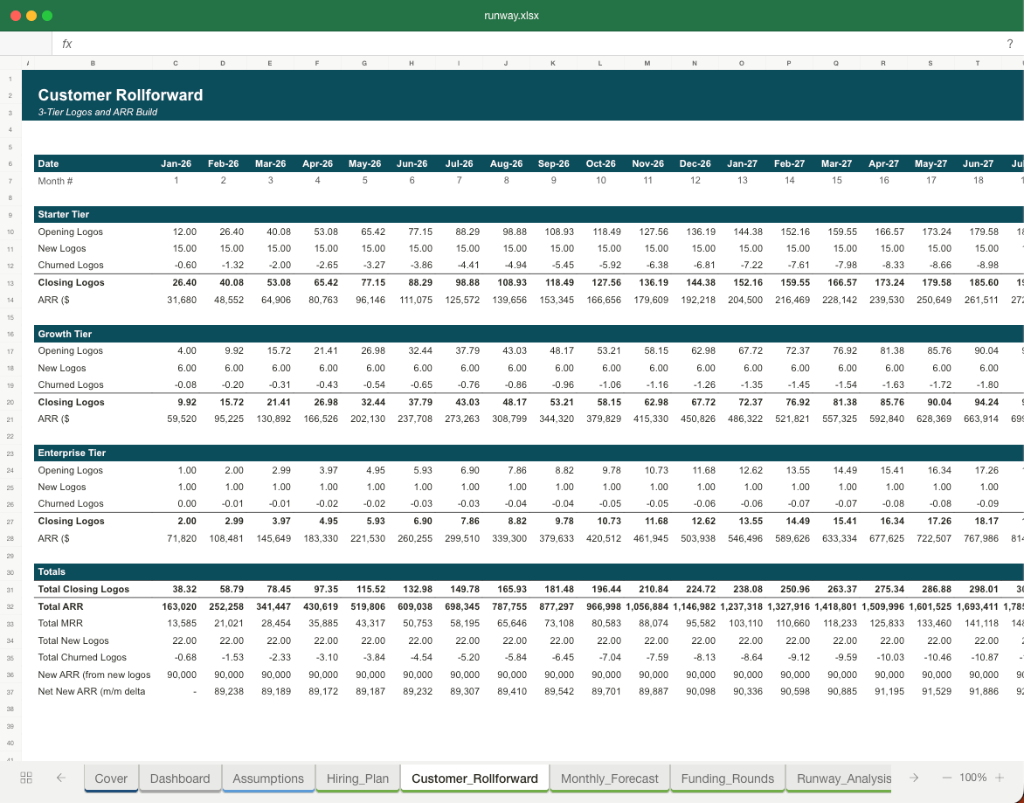
The model starts with new teams, average seats, and ARPU, then tracks activation, conversion, expansion, and churn. AI delivery costs sit below revenue, while product-led acquisition, customer support, gross margin, hiring, and operating spend determine cash requirements.
A turnkey financial model
Live formulas, no hardcoded values
Outputs are driven by live formulas, so the workbook updates from its assumptions instead of relying on hardcoded results.
All assumptions in one tab
Inputs are clearly marked in the Assumptions tab and separated from calculations, making it clear what to change and what to leave intact.
Statements always balancing
For integrated-statement models, the balance sheet, cash flow, and supporting schedules tie through properly.
Distinct schedules for clarity
Debt, working capital, taxes, and cash flow can get messy quickly. We group calculations in clear schedules, not across disconnected tabs.
No hidden macros or external links
There are no unexplained external workbook links or macros to undermine auditability or portability.
Changes flow through the model
Update a key driver and see the impact carry through the forecast, financing, and return outputs. We never use hardcoded numbers in formulas.
About Spinach
Spinach.io
How to build a detailed financial model for Spinach
A complete walkthrough of the business, drivers, and assumptions behind the downloadable Spinach model - distilled from its pitch deck and publicly available information.
Product & value proposition
- Spinach.io is a standup facilitator that integrates with existing workflows (Zoom, other video tools)
- Value prop: cuts standup time by 50%; surfaces updates per person in a structured format
- Product UI shows per-person update cards with task summaries and timestamps
- Targets product development teams ("Product – increase engagement 10x" roadmap language)
- Additional meeting types planned (beyond daily standup)
- Integration roadmap: more integrations + deepening existing ones
Market
Context: addressable market is remote/hybrid product & engineering teams globally - a large and growing segment post-COVID, but no figures are cited.
Revenue model
Not explicitly in deck. Inferred from roadmap language:
- Seat-based SaaS - goal stated as "200 paid accounts, 10K seats and $1M in ARR", confirming per-seat or per-team subscription model
- Unit = "seat" or "account/team"
- Channels: PLG (product-led growth) implied by team-level adoption across 90 companies; enterprise expansion to named logos (Wix, Fiverr, Snyk, Rappi, ZoomInfo, Asurion, Blend, Impact, eToro)
Traction & metrics
- 5x growth in 4 months
- 150 active teams from 90 companies
- DAU/WAU = 66%
- Cuts standup time by 50%
- Weekly Active Users chart:
- Sep 2021: ~0–50 WAU
- Oct–Nov 2021: ~100–150 WAU (flat plateau)
- Jan 2022: brief dip to ~50–75 WAU
- Mar 2022: ~500 WAU
- May 2022: ~850–900 WAU
- Named customers include: Wix, Fiverr, Snyk, Rappi, ZoomInfo, Asurion, Blend, Impact, eToro
Competition / moat
- Strong DAU/WAU ratio (66%) suggests habitual daily use - high stickiness
- Integration depth with Zoom and other tools creates switching cost
- YC network + Zoom as investor provides distribution credibility
Team & funding ask / use of funds
Team:
- Matan Talmi - Co-founder & CEO; previously co-founder & CEO of Drippler (acquired by Asurion); led Asurion smart home product growth from launch to $M
- Josh Willis - Co-founder; led design groups at Asurion, AT&T, and NYSE; facilitated hundreds of workshops and design sprints
- Yoav Grossman - Co-founder; early Uber PM, Walmart Ecommerce, EY Consulting; built & led support platform servingM customers at Asurion
Investors: Y Combinator, Cardumen Capital, Maven Ventures, Zoom, Tuesday (fund)
18-month goals (proxy for use of funds):
- Product: increase engagement 10x; launch more integrations; launch additional meeting types
- Growth: reach 200 paid accounts, 10K seats, $1M ARR
Recommended financial model
- Archetype + why: SaaS ARR model - seat/account-based subscription with PLG motion. Revenue target is stated in ARR terms ($1M); traction is measured in teams and seats. Classic bottom-up SaaS build: new logos × avg team size × ARPU.
- Forecast horizon & granularity: 3 years monthly (18-month plan aligns with deck; extend to 36 months for investor view). Monthly granularity to capture PLG ramp and seasonal cohort effects.
- Key drivers & assumptions:
| Driver | Value | Source |
|---|---|---|
| Active teams at deck date | 150 | - |
| Companies at deck date | 90 | - |
| Avg teams per company | 1.67 | calc |
| WAU at May 2022 | ~875 | - |
| DAU/WAU ratio | 66% | - |
| WAU growth (Sep 2021 → May 2022) | ~5x in 4 months (Jan–May 2022) | - |
| 18-month ARR target | $1,000,000 | - |
| 18-month paid accounts target | 200 | - |
| 18-month seats target | 10,000 | - |
| Implied avg seats per account | 50 | calc (10K / 200) |
| Implied ARPU per seat / year | ~$100 | $1M ARR ÷ 10K seats; reasonable for SMB productivity SaaS |
| Implied ARPU per account / year | ~$5,000 | $1M ÷ 200 accounts |
| Free-to-paid conversion rate | 15% | typical PLG B2B; freemium to paid conversion for team tools |
| Monthly logo churn | 1.5% | early-stage SaaS; high engagement (66% DAU/WAU) suggests low churn |
| Gross margin | 75% | SaaS at this scale; predominantly infra + light support costs |
| S&M as % of revenue | 40% | PLG-heavy motion reduces paid CAC; still meaningful at growth stage |
| R&D as % of revenue | 35% | three-person technical founding team; heavy product investment phase |
| G&A as % of revenue | 15% | lean ops at seed stage |
- Scenarios (Base / Bull / Bear - which variables flex):
- Base: Linear ramp to 200 paid accounts by month 18; WAU growth decelerates to 2x/6 months post-Jan 2022 spike
- Bull: Viral expansion via enterprise logos (Wix, Fiverr, etc.) drives avg team size to 75 seats; churn at 0.8%/month; $1.5M ARR by month 18
- Bear: Conversion rate falls to 8%; avg account ARR $3,000; $600K ARR by month 18; cash runway risk
- Required sheets / outputs:
- Assumptions - all drivers centralized
- WAU / DAU cohort build - monthly new team adds, active teams, WAU/DAU
- Revenue - free teams, paid conversion, seats × ARPU, MRR/ARR waterfall
- P&L - gross profit, EBITDA, burn
- Headcount - hiring plan by function (the primary cost driver)
- Cash & runway - months of runway given raise
- KPI dashboard - WAU, paid accounts, seats, MRR, NRR, DAU/WAU ratio
Frequently asked
Is the Spinach financial model free?+
Yes. The Spinach model is a free Excel (.xlsx) download with live formulas. Sign up with your email and the workbook is yours to keep, review, and edit.
What's included in the model?+
A 5-year monthly forecast with P&L, cash flow and runway, valuation (exit multiple plus a DCF cross-check), MOIC/IRR returns, and unit economics, with live formulas throughout.
How was this model built?+
It was built from Spinach's pitch deck and publicly available information, then structured to investment-banking standards as a fully editable Excel model.
Can I change the assumptions?+
Yes. You can change assumptions and the live formulas will recalculate in the downloadable Excel model.
Have more financial modelling questions? Contact us

Created by ex-finance professionals
Hey, I’m Alex and I created Finamodel.
Over my years in the finance industry I kept building the same models over and over again. Same structure, same assumptions, different logo. So I started building frameworks to turn them into clean, reusable templates.
Every model here is one I’d actually use for a client, and I personally vet each one before it goes up.
I’m not an expert in every industry, but I’ve built enough models to know what belongs in one. And when something is completely foreign to me, I reach out to my network for experts to work on our models with us.
Having a template library on hand cuts a first build from hours to minutes.
Need help finding your model? You’ll find me in the Finamodel app!
Other Enterprise/Security Startup Financial Models
Browse another startup in the same category.
AgBiome
AgBiome is a microbial-platform agtech company that discovers, develops, and commercialises biological crop protection products (and licences the platform across adjacent markets).

Alation
Enterprise data intelligence platform - data catalog, governance, and metadata management for large organisations.

Archer SPAC
Archera
Cloud resource automation platform that continuously optimizes AWS commitment purchases, de-risks overcommitment, and automates FinOps workflows.

Ardoq
Cloud-native Enterprise Architecture (EA) SaaS platform that helps large enterprises navigate digital transformation through automated data collection, graph-based architecture modelling, and change impact analysis.

Ascend
Ascend.io is an enterprise big data automation platform ("Enterprise Intelligence Platform") that abstracts away the complexity of big data engineering so non-experts can build and run data pipelines.

Athennian
Cloud-based legal entity management system (EMS) uniting entity data with workflow and document automation.

Auditboard
Cloud-based integrated risk management platform connecting audit, risk, compliance, and ESG teams across the enterprise.