 Supernormal Financial Model
Enterprise/Security Startup Financials (Free Excel Download)
AI-powered automatic meeting notes for Google Meet (expanding to Zoom and Teams), delivered via Chrome extension with no user input required.



professionals from Deloitte
Used by professionals from






About this model
Supernormal creates AI-generated meeting notes through a low-friction Chrome-extension workflow for Google Meet, with Zoom and Teams expansion planned. The product requires no active note taking, turning recorded meetings into a shareable artifact for the wider organisation.
The business uses a product-led, seat-based motion. Shared notes can bring new users into a workspace, while paid seats and team plans monetise broader adoption; the deck identifies AI inference cost per recorded hour as a key operating driver.
The model tracks activation, shared-note sign-ups, paid conversion, seats, expansion, and churn. Recorded hours and inference cost build delivery COGS, while product-led acquisition, sales assistance, gross margin, headcount, and operating expenses determine cash runway.
A turnkey financial model
Live formulas, no hardcoded values
Outputs are driven by live formulas, so the workbook updates from its assumptions instead of relying on hardcoded results.
All assumptions in one tab
Inputs are clearly marked in the Assumptions tab and separated from calculations, making it clear what to change and what to leave intact.
Statements always balancing
For integrated-statement models, the balance sheet, cash flow, and supporting schedules tie through properly.
Distinct schedules for clarity
Debt, working capital, taxes, and cash flow can get messy quickly. We group calculations in clear schedules, not across disconnected tabs.
No hidden macros or external links
There are no unexplained external workbook links or macros to undermine auditability or portability.
Changes flow through the model
Update a key driver and see the impact carry through the forecast, financing, and return outputs. We never use hardcoded numbers in formulas.
About Supernormal
supernormal.com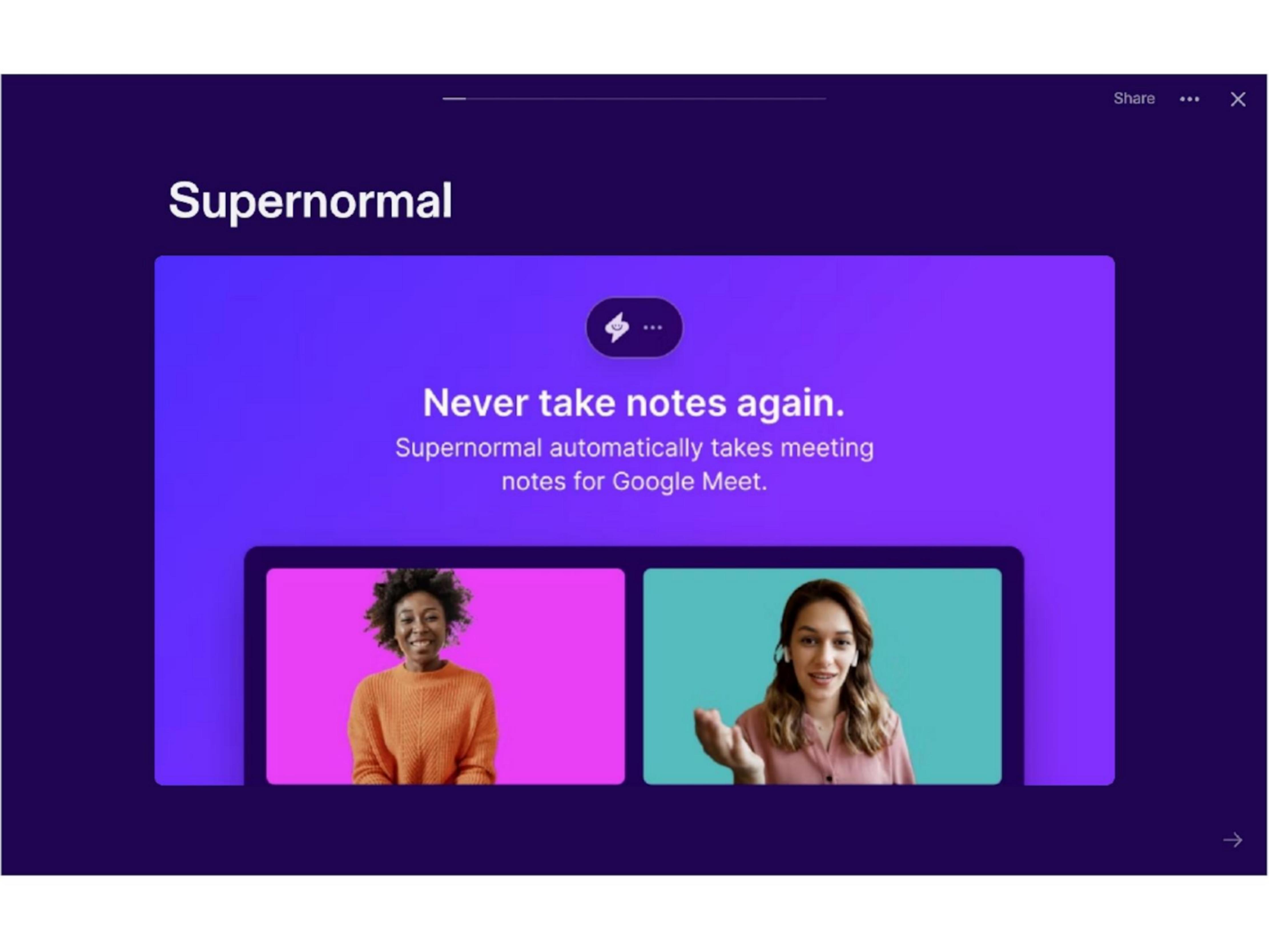
How to build a detailed financial model for Supernormal
A complete walkthrough of the business, drivers, and assumptions behind the downloadable Supernormal model - distilled from its pitch deck and publicly available information.
Product & value proposition
- Chrome extension that auto-captures Google Meet audio, produces a full recording, transcript, and AI-crafted structured notes (Summary, Decisions, Action Items, Blockers) in <2 seconds after meeting ends.
- Notes are organized into extensible "Sections" - each section is a prompt run through a fine-tuned base model.
- Action-item auto-routing: detected action items can trigger automated follow-up emails / task assignments.
- Team/org layer: personal recordings → shared team spaces → org-wide repository (searchable recordings + transcripts).
- Quality benchmark: 8.2/10 notes rated indistinguishable from human-written.
- 60,000 hours of annotated meetings used to build proprietary training data (bootstrapped).
- Expanding to Zoom and Teams (beta).
Market
- TAM: $22B
- SAM: $12B
- Early Target Market (Google Meet users): $250M
- Problem quantification: Lack of meeting notes costs businesses $10,000 per employee annually; duplicate meetings up 25% without notes; avg person could skip >20% of meetings with an alternative way to stay informed.
Revenue model
- Seat-based SaaS subscription.
- Bottom-up / PLG motion: individual adoption within org → team expansion → org-wide deal.
- Channels: Chrome Web Store (Google Meet integration), performance marketing, vertical-by-vertical GTM (Sales+CS, Design, Ops, HR, Finance).
- K-factor virality: AI meeting notes are shared by default, creating inherent viral loop.
Traction & metrics
- $600K in productivity gains delivered over last 3 months; implied value-based metric, not revenue.
- 125 paying teams in a month
- Avg paying organization starts with 5 seats in first week, doubling every 10 days
- 48% sign-up to aha-moment conversion
- 72% DAU/MAU
- 3.8 avg recordings per user per day
- Hours saved chart (slide 10 image): exponential growth from ~Feb 2022 to Oct 2022; y-axis peaks at ~16,000 hours/month by October 2022.
- Fundraising target: $4M ARR with 200K+ DAU
- Notable customers: Netflix, Wayfair, Salesforce, Clover, TNW, Pillar, Exness, Veolia Water, Headset.
Unit economics
- Cost per recorded hour (AI inference):
- GPT-3 Da Vinci 2: ~$8.50 at Q1, declining to ~$4.80 by Q4 (year 2)
- GPT-4: ~$11.00 at Q2, declining to ~$6.80 by Q4 (year 2)
- Supernormal V1: ~$4.20 at Q1, declining to ~$2.90 by Q3
- Supernormal V2: ~$1.70 at Q3, stabilizing ~$1.30 by Q1 (year 2)
- Supernormal V3: ~$0.90 at Q1 (year 2), stable ~$0.80 by Q4
- On Device: approaching ~$0.20 by Q2+ (year 2)
- Seat expansion: 5 seats → doubling every 10 days implies ~40 seats within a month per org.
Competition / moat
- No explicit competitor slide. "Why Now" cites: "No one on the market has a completely automatic solution."
- Moats: 60K hours proprietary training data; custom real-time processing protocol (<2 sec latency); fine-tuned models (V1/V2/V3) with dramatically lower inference cost than GPT-3/GPT-4; on-device roadmap for near-zero cost.
- Named tech benchmarks: GPT-3 Da Vinci 2, GPT-4 used as cost-per-hour comparators.
Team & funding ask / use of funds
- Colin Treseler, Co-founder: ran ML teams at Facebook/Instagram, Klarna.
- Fabian Perez, Co-founder: Director of Design & Engineering at GitHub, Splice.
- Jim Kleban, Head of ML (ML PhD): ML at Stripe, Facebook, Microsoft.
- Julio Ody, Full Stack Engineer: open-source author/contributor 10+ years.
- Committed in round: EQT Ventures (pre-seed) @ $1M+; Angels @ $200K (Jehad Affoneh / Toast CDO, Nir Eyal / Hooked author, Mick Johnson / FB News Feed, Alex Schleifer / fmr CDO Airbnb, Josh Brewer / fmr Principal Designer Twitter, David Helgason / Unity founder, et al.).
- Round target size: Not explicitly stated.
- Fundraising target milestone: $4M ARR, 200K+ DAU.
Recommended financial model
- Archetype + why: Bottom-up SaaS ARR model with PLG seat-expansion mechanics. The revenue engine is seat-based subscriptions sold via viral individual adoption expanding to teams and orgs. The dominant growth driver is the K-factor (shared notes → new sign-ups → paying teams), and the key cost driver is AI inference cost per recorded hour (declining rapidly). A standard SaaS ARR waterfall (new ARR, expansion ARR, churn ARR, net revenue retention) fits perfectly.
- Forecast horizon & granularity: Monthly for Year 1–2 (aligns with seed-stage operational cadence); quarterly for Years 3–5. 3-year base case minimum; 5-year if valuation is needed.
- Key drivers & assumptions:
| Driver | Value |
|---|---|
| Starting paying teams | 125 |
| Avg seats per new org (week 1) | 5 |
| Seat doubling period (within org) | 10 days → ~3x per month |
| Max seats per org (ceiling) | 50 |
| Monthly new org additions | Extrapolated from hours-saved curve growth rate |
| Seat price (monthly) | $15–$25 / seat / month |
| Sign-up → paying conversion | 48% sign-up to aha moment; paying conversion rate unknown |
| DAU/MAU | 72% |
| Avg recordings per user per day | 3.8 |
| Avg meeting duration (hours) | 0.75 hrs |
| AI cost per recorded hour (current) | ~$0.80–$0.90 (V3) trending to ~$0.20 (on-device) |
| Gross margin | 60–70% |
| Monthly churn (team-level) | 2–4% |
| Net Revenue Retention | 120–140% |
| Headcount additions (Y1) | ~8–12 FTEs |
| S&M spend | 20–30% of revenue |
- Scenarios (Base / Bull / Bear - which variables flex):
- Bull: Seat doubling holds at 10-day pace, higher org ceiling (100 seats), price at $25/seat, on-device cost realized by Q3 Year 2.
- Base: Seat expansion slows post-month-1 (doubling at 20 days), org ceiling 50 seats, $18/seat, V3 cost stays at ~$0.85/hr.
- Bear: High churn (5%), low conversion, expansion plateaus at 10 seats/org, price pressure to $12/seat.
- Required sheets / outputs:
- Assumptions - all drivers listed above with toggle for Base/Bull/Bear
- User & Seat Model - new sign-ups → paying orgs → seat expansion → total paying seats (monthly)
- Revenue - MRR/ARR waterfall (new, expansion, churn, net), broken out by tier if pricing tiers are added
- COGS & Gross Margin - AI inference cost per recorded hour × total hours; infrastructure/hosting
- OpEx - headcount (R&D, S&M, G&A), other opex
- P&L - monthly income statement through EBITDA
- Cash & Runway - cash from raise, burn rate, months of runway
- KPI Dashboard - DAU, MAU, DAU/MAU, recordings/user/day, paying teams, NRR, CAC payback (once data available)
Frequently asked
Is the Supernormal financial model free?+
Yes. The Supernormal model is a free Excel (.xlsx) download with live formulas. Sign up with your email and the workbook is yours to keep, review, and edit.
What's included in the model?+
A 5-year monthly forecast with P&L, cash flow and runway, valuation (exit multiple plus a DCF cross-check), MOIC/IRR returns, and unit economics, with live formulas throughout.
How was this model built?+
It was built from Supernormal's pitch deck and publicly available information, then structured to investment-banking standards as a fully editable Excel model.
Can I change the assumptions?+
Yes. You can change assumptions and the live formulas will recalculate in the downloadable Excel model.
Have more financial modelling questions? Contact us

Created by ex-finance professionals
Hey, I’m Alex and I created Finamodel.
Over my years in the finance industry I kept building the same models over and over again. Same structure, same assumptions, different logo. So I started building frameworks to turn them into clean, reusable templates.
Every model here is one I’d actually use for a client, and I personally vet each one before it goes up.
I’m not an expert in every industry, but I’ve built enough models to know what belongs in one. And when something is completely foreign to me, I reach out to my network for experts to work on our models with us.
Having a template library on hand cuts a first build from hours to minutes.
Need help finding your model? You’ll find me in the Finamodel app!
Other Enterprise/Security Startup Financial Models
Browse another startup in the same category.
AgBiome
AgBiome is a microbial-platform agtech company that discovers, develops, and commercialises biological crop protection products (and licences the platform across adjacent markets).

Alation
Enterprise data intelligence platform - data catalog, governance, and metadata management for large organisations.

Archer SPAC
Archera
Cloud resource automation platform that continuously optimizes AWS commitment purchases, de-risks overcommitment, and automates FinOps workflows.

Ardoq
Cloud-native Enterprise Architecture (EA) SaaS platform that helps large enterprises navigate digital transformation through automated data collection, graph-based architecture modelling, and change impact analysis.

Ascend
Ascend.io is an enterprise big data automation platform ("Enterprise Intelligence Platform") that abstracts away the complexity of big data engineering so non-experts can build and run data pipelines.

Athennian
Cloud-based legal entity management system (EMS) uniting entity data with workflow and document automation.

Auditboard
Cloud-based integrated risk management platform connecting audit, risk, compliance, and ESG teams across the enterprise.


