SWSwit Financial Model
Enterprise/Security Startup Financials (Free Excel Download)
All-in-one team collaboration suite combining chat, task management, and project tools to replace the multi-app stack (Slack + Trello/Asana).



professionals from Deloitte
Used by professionals from






About this model
Swit combines chat, task management, and project tools in one team-collaboration product. It is positioned as a replacement for the multi-application stack, bringing functions associated with Slack, Trello, and Asana into a shared workplace.
The company has a freemium, per-user subscription model with annual paid tiers. Initial team adoption can progress to Standard, Premium, and Enterprise plans, while its beta-stage context means free-to-paid conversion and tier mix should remain explicit rather than assumed.
The model follows sign-ups, activation, paid conversion, seats, tier mix, expansion, and churn. Product-led acquisition, delivery and support costs, gross margin, hiring, and operating expenses show the cash required to scale the collaboration platform.
A turnkey financial model
Live formulas, no hardcoded values
Outputs are driven by live formulas, so the workbook updates from its assumptions instead of relying on hardcoded results.
All assumptions in one tab
Inputs are clearly marked in the Assumptions tab and separated from calculations, making it clear what to change and what to leave intact.
Statements always balancing
For integrated-statement models, the balance sheet, cash flow, and supporting schedules tie through properly.
Distinct schedules for clarity
Debt, working capital, taxes, and cash flow can get messy quickly. We group calculations in clear schedules, not across disconnected tabs.
No hidden macros or external links
There are no unexplained external workbook links or macros to undermine auditability or portability.
Changes flow through the model
Update a key driver and see the impact carry through the forecast, financing, and return outputs. We never use hardcoded numbers in formulas.
About Swit
swit.ioenhomepage.html
How to build a detailed financial model for Swit
A complete walkthrough of the business, drivers, and assumptions behind the downloadable Swit model - distilled from its pitch deck and publicly available information.
Product & value proposition
- Integrated "Command Center" combining: instant chat (channels, DMs), kanban/task management, timeline (Gantt), calendar, file sharing, and ideas/posts - competing with the combined Slack + Trello/Asana stack.
- Key claim: replaces ~$36.66/user/month of stacked apps with $9.99/user/month at Standard tier.
- Cross-workspace features (search, calendar, activity log) at Premium tier - differentiation vs. Slack and Asana which were designed for single-team use.
- SaaS + Hybrid deployment options for enterprise.
- Target persona: business teams of all sizes; specific push toward larger enterprises via Super Admin Management and cross-workspace capabilities.
Market
- Enterprise IT & SW accounted for 72% of venture revenue in 2017.
- Enterprise IT market: $2T growing to $4T by 2022.
- 10 of 15 most-funded US startups in 2017–2018 were Enterprise IT & SW.
- Over 50% of VCs invested in B2B startups; $13B invested in 2017 in the US.
- Collaboration is the fastest-growing Enterprise SaaS segment (~40% YoY revenue growth per Synergy Research Group Q2 2017).
- Business software IPOs outperforming consumer tech IPOs by ~200% median share price change from 2016–2019.
- 61% of enterprises have digital workplace plans (doing today or evaluating or planning for 2018–2019).
- Digital workplace drivers: increased functionality 31.7%, cost savings 31.1%.
- 92% of teams use multiple apps.
- 90% of enterprises use Office 365; 8.5% use G Suite - Swit targets integration layer on top of these.
- SAM/SOM not explicitly stated.
Revenue model
- Freemium SaaS, per-user/month, billed annually (monthly billing available at premium).
- Tiers:
- Free: $0 - up to 5 projects, 300 tasks, 10K searchable messages, 5GB/WS storage.
- Standard: $9.99/user/month annual ($12 monthly) - unlimited projects/tasks/messages, calendar, timeline, corporate exports.
- Premium: $19.99/user/month annual ($24 monthly) - cross-workspace features, G Suite/Office 365 integration, My Tasks.
- Premium Plus: $29.99/user/month annual - 1TB/user storage.
- Enterprise: contact pricing - phone support, SAML SSO, Active Directory sync, user provisioning.
- Business model section label: "SaaS - Credit Card & Invoice, License".
- Channel: self-serve (credit card) + enterprise invoicing/licensing.
Traction & metrics
- Beta recently released at time of deck; early users offered "special membership benefits for the first 6 months".
- No ARR, MRR, customer count, or growth rate figures disclosed for Swit itself.
- Competitor benchmark cited for context: Salesforce - 15,000 clients, ~3.75M estimated users, 2018 revenue $10.48B, market cap $123.91B (used as aspiration/comparator, not Swit's own metrics).
- Productivity stats cited as market pain: 40% decreased productivity from app switching, 23 min to re-focus after interruption, 373 window changes/day.
Unit economics
- Pricing comparison claim: Swit at $9.99/user/month vs. competing multi-app stack at $36.66/user/month - implied 73% cost saving for customers, not Swit's own economics.
- No CAC, LTV, gross margin, or payback period data disclosed.
Competition / moat
- Direct competitors named: Slack, Microsoft Teams, Asana, Trello, Notion, Monday.com, Basecamp, Jira.
- Adjacent/integrated tools: Dropbox, Yammer, Workplace (Facebook), Zoom, Google Drive/Docs, Box.
- Swit's stated moat:
- Usability (multi-function UX + data binding).
- Performance (high-end tech stack).
- Customization (MSA, component-configurator).
- Cross-workspace features unavailable in competitors.
- IP: 19 patents, 6 program copyrights, 28 trademarks across 9 countries.
- Positioning: "Swit covers Red [chat+tasks], will integrate Blue [docs/files/video]".
Team & funding ask / use of funds
- Team: Korean-founded; office culture shown (slides 14–16); content/marketing team names visible in product UI screenshots (internal use of Swit).
- No named founders/executives shown with bios.
Recommended financial model
- Archetype + why: SaaS ARR / bottoms-up seat model. Revenue is per-user/month across freemium tiers; the model should track free-to-paid conversion, expansion across tiers (Standard → Premium → Enterprise), and churn. Classic PLG (product-led growth) SaaS motion.
- Forecast horizon & granularity: 3 years monthly (Year 1–2) + annual (Year 3). Monthly granularity needed to model cohort conversion from free beta users.
- Key drivers & assumptions:
- Free users acquired (monthly new signups) - no baseline in deck; start at ~500/month ramp given early beta
- Free-to-paid conversion rate ~5–8% at 3–6 months post-signup (PLG SaaS benchmark)
- Tier mix: Standard 65% / Premium 25% / Premium Plus 5% / Enterprise 5% - based on pricing ladder; Enterprise skewed low given early stage
- ARPU by tier: Standard $9.99, Premium $19.99, Premium Plus $29.99, Enterprise ~$40/user (conservative)
- Blended ARPU ~$12–14/user/month at mix above
- Monthly churn ~2.0% (SaaS B2B benchmark; no deck data)
- Seats per paying customer ~15 (SMB-weighted; enterprise accounts larger)
- Annual billing discount: ~17% off monthly (e.g., Standard $9.99 vs $12 monthly)
- Gross margin ~75–80% (typical B2B SaaS infrastructure + hosting)
- S&M % of revenue ~40% Year 1, declining to 30% Year 3
- R&D % of revenue ~25% (heavy tech investment implied by IP count)
- G&A % of revenue ~15%
- Scenarios (Base / Bull / Bear - which variables flex):
- Bear: free user growth slower, conversion 3%, churn 3%, Enterprise revenue minimal
- Base: conversion 5–6%, churn 2%, Standard-heavy mix
- Bull: viral PLG kicks in, conversion 8–10%, faster Enterprise penetration, lower churn 1.2%
- Required sheets / outputs:
- Assumptions - all drivers, tier pricing, conversion/churn inputs
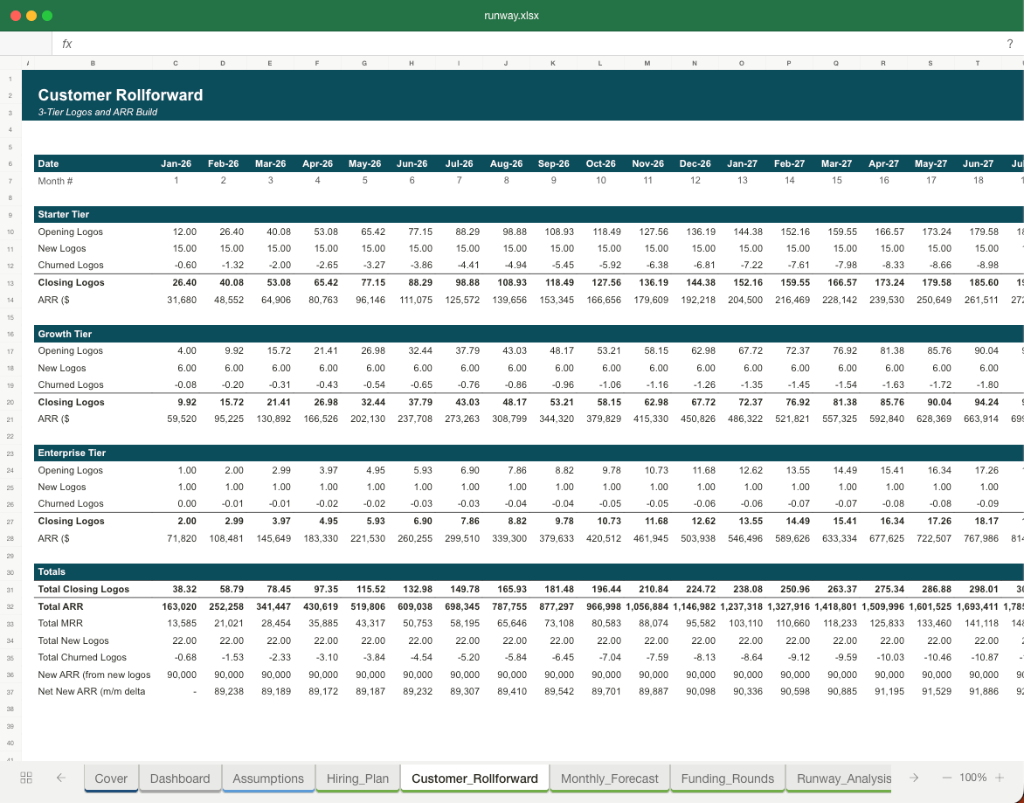
- User Funnel - free signups → paid conversions by tier, monthly cohort waterfall
- ARR Build - new ARR, expansion ARR, churned ARR, net new ARR, ending ARR
- Revenue - MRR/ARR by tier, blended ARPU
- P&L - revenue, gross profit, S&M, R&D, G&A, EBITDA, net income
- Headcount - by function (engineering, sales, CS, G&A)
- Cash Flow & Runway - burn rate, cash ending balance
- Dashboard - ARR, MRR, paying users, ARPU, burn, runway KPIs
Frequently asked
Is the Swit financial model free?+
Yes. The Swit model is a free Excel (.xlsx) download with live formulas. Sign up with your email and the workbook is yours to keep, review, and edit.
What's included in the model?+
A 5-year monthly forecast with P&L, cash flow and runway, valuation (exit multiple plus a DCF cross-check), MOIC/IRR returns, and unit economics, with live formulas throughout.
How was this model built?+
It was built from Swit's pitch deck and publicly available information, then structured to investment-banking standards as a fully editable Excel model.
Can I change the assumptions?+
Yes. You can change assumptions and the live formulas will recalculate in the downloadable Excel model.
Have more financial modelling questions? Contact us

Created by ex-finance professionals
Hey, I’m Alex and I created Finamodel.
Over my years in the finance industry I kept building the same models over and over again. Same structure, same assumptions, different logo. So I started building frameworks to turn them into clean, reusable templates.
Every model here is one I’d actually use for a client, and I personally vet each one before it goes up.
I’m not an expert in every industry, but I’ve built enough models to know what belongs in one. And when something is completely foreign to me, I reach out to my network for experts to work on our models with us.
Having a template library on hand cuts a first build from hours to minutes.
Need help finding your model? You’ll find me in the Finamodel app!
Other Enterprise/Security Startup Financial Models
Browse another startup in the same category.
AgBiome
AgBiome is a microbial-platform agtech company that discovers, develops, and commercialises biological crop protection products (and licences the platform across adjacent markets).

Alation
Enterprise data intelligence platform - data catalog, governance, and metadata management for large organisations.

Archer SPAC
Archera
Cloud resource automation platform that continuously optimizes AWS commitment purchases, de-risks overcommitment, and automates FinOps workflows.

Ardoq
Cloud-native Enterprise Architecture (EA) SaaS platform that helps large enterprises navigate digital transformation through automated data collection, graph-based architecture modelling, and change impact analysis.

Ascend
Ascend.io is an enterprise big data automation platform ("Enterprise Intelligence Platform") that abstracts away the complexity of big data engineering so non-experts can build and run data pipelines.

Athennian
Cloud-based legal entity management system (EMS) uniting entity data with workflow and document automation.

Auditboard
Cloud-based integrated risk management platform connecting audit, risk, compliance, and ESG teams across the enterprise.