TBTime by Ping Financial Model
Enterprise/Security Startup Financials (Free Excel Download)
AI-powered time automation software that automatically captures, contextualises, and releases billable time entries for legal timekeepers.



professionals from Deloitte
Used by professionals from






About this model
Time by Ping uses AI to automatically capture, contextualise, and release billable time entries for legal timekeepers. It addresses lost billable time by fitting time capture into lawyers' existing work rather than requiring delayed manual entry.
The company sells seat-based subscriptions to law firms and was raising a Series B in 2021. Legal is the initial vertical, with a planned expansion into accounting and consulting, so timekeepers and firm-level adoption are the practical revenue units.
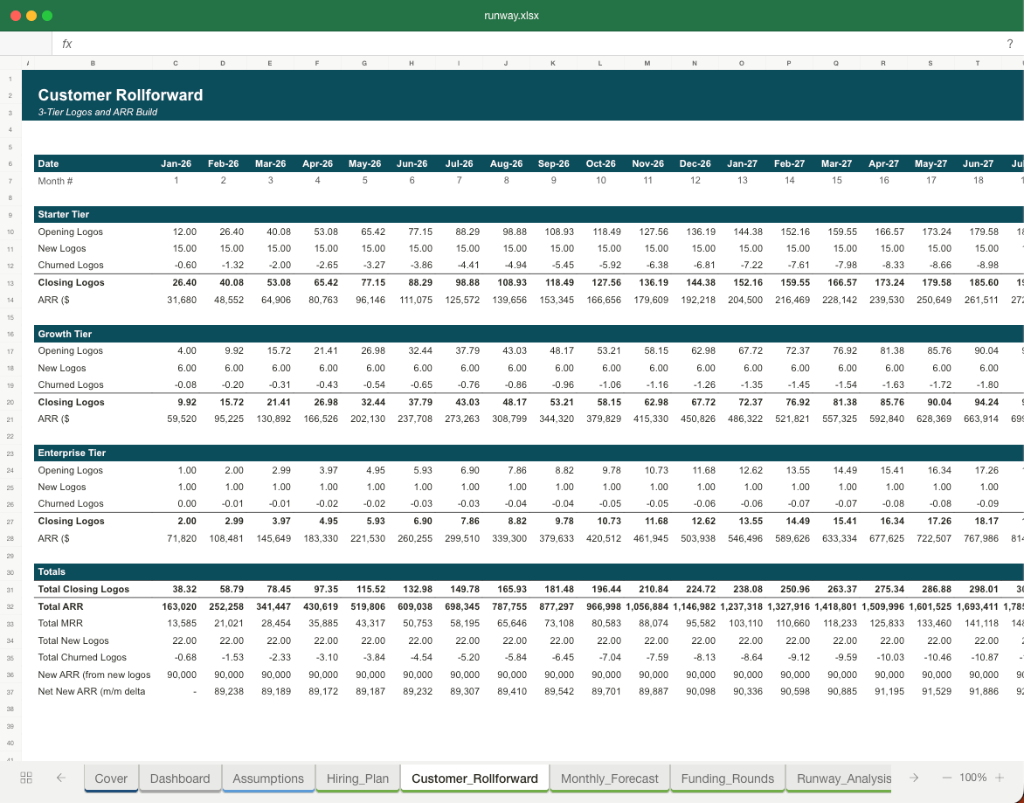
The model tracks firms, new timekeepers, pricing, expansion, and churn by vertical. AI processing, integrations, and support form delivery costs, while sales capacity, gross margin, product investment, hiring, and operating expenses determine ARR growth and runway.
A turnkey financial model
Live formulas, no hardcoded values
Outputs are driven by live formulas, so the workbook updates from its assumptions instead of relying on hardcoded results.
All assumptions in one tab
Inputs are clearly marked in the Assumptions tab and separated from calculations, making it clear what to change and what to leave intact.
Statements always balancing
For integrated-statement models, the balance sheet, cash flow, and supporting schedules tie through properly.
Distinct schedules for clarity
Debt, working capital, taxes, and cash flow can get messy quickly. We group calculations in clear schedules, not across disconnected tabs.
No hidden macros or external links
There are no unexplained external workbook links or macros to undermine auditability or portability.
Changes flow through the model
Update a key driver and see the impact carry through the forecast, financing, and return outputs. We never use hardcoded numbers in formulas.
About Time by Ping
timebyping.com
How to build a detailed financial model for Time by Ping
A complete walkthrough of the business, drivers, and assumptions behind the downloadable Time by Ping model - distilled from its pitch deck and publicly available information.
Product & value proposition
- Core product: "Time Automation™" - desktop/browser software that passively captures all digital activity (emails, documents, meetings, phone calls, browser research) across Outlook/Exchange, Microsoft Suite, Adobe/KOFAX PDF, Cisco/Jabber/Zoom/Teams, IE/Edge/Chrome.
- ML pipeline: Named Entity Recognition + NLP + Machine Learning converts raw activity into structured time entries with Client/Matter, Narrative, and Billing Codes auto-populated.
- UX: Timeline and Timesheet views; time entries released daily by timekeepers, not reconstructed at month-end.
- Three-phase vision: Phase 1 = Time Automation (current); Phase 2 = Time → Outcomes (pricing analytics using aggregated time data); Phase 3 = Outcomes → Time (extend to all digital workers).
Market
- Industry problem: Professional services industry loses 2,000 years of time / $7.4B in productivity daily from manual time tracking.
- Legal industry specifically leaves $140B on the table annually due to manual timekeeping.
- 20% of total work time is never billed
- 18% of total work time is client-rejected
- 5% of total work time is spent manually tracking
- Addressable ARR market (legal, by segment):
- Enterprise Legal: $1B ARR
- Corporate Legal: $0.5B ARR
- SMB Legal: $2B ARR
- Total Legal ARR Opportunity: $3.5B
- Expansion ARR market (legal + adjacent):
- Accounting: $2.5B ARR
- Legal: $3.5B ARR
- Consulting: $4B ARR
- Total ARR Opportunity: $10B
- Workforce sizing for Phase 3 expansion:
- Law: 1.1M workers
- Accounting: 1M workers
- Consulting: 1.6M workers
- Tech: 6M workers
- 1099s: 16M workers
- Government: 20M workers
- Digital Workers worldwide: 1B
Revenue model
- Model type: SaaS subscription, billed per timekeeper (seat-based) - implied by the $90K profit-per-timekeeper ROI framing and "ARR" language used throughout.
- Channels: Enterprise top-down (current flagship); Series B use of proceeds includes adding bottoms-up / product-led growth distribution.
- Verticals: Legal (current); Accounting and Consulting (expansion).
- Lighthouse reference customers: unnamed "premier law firm" (slide 11) and unnamed "major accounting firm" (slide 16).
Traction & metrics
- ROI case study - premier law firm:
- $90K direct bottom-line profit per Timekeeper
- Only 2 timekeepers using TBP needed to recoup the firm's cost
- 1 dedicated resource hired by firm to maximize value
- Product outcomes:
- 1–2 hours saved per timekeeper per week
- 7.5% more billable credit on average per timekeeper
- 7.5% more revenue on average for firms
- 70% of users release time daily (engagement metric)
- 35% more time entries per user
Unit economics
- LTV proxy: $90K bottom-line profit per seat per year for the customer (implies strong willingness to pay and high retention).
Competition / moat
- Incumbent: Manual timekeeping (status quo). No direct named competitors in the deck.
- Moat claims:
- Proprietary ML trained on legal billing data (NER, NLP, billing codes).
- Network/data flywheel: aggregated time data across industry creates a pricing analytics layer competitors cannot replicate (Time Data Feedback Loop).
- "New market category" positioning - Time Automation™.
- Deep integrations: Outlook/Exchange, MS Suite, Adobe/KOFAX, Cisco/Jabber/Zoom/Teams, major browsers.
Team & funding ask / use of funds
- Raise: $30M Series B.
- Use of funds:
- Grow ARR in Enterprise and SMB Legal in 2022.
- Expand Time Automation into Enterprise Accounting and Consulting.
- Team (13 named):
- Ryan, CEO - Lawyer @ Manatt
- Patrick, CTO - SVP @ Symantec
- Alison, CS - Senior CS Mgr @ Scoop
- Tara, Sales - VP @ Afinety
- Kourosh, COO - Founder @ YPOSF; VP @ Bailard
- Niket, Product - Founder @ Punchd (acq. Google); CoS @ Flipkart
- Jon, Strategy - First GTM @ Everlaw
- Mallory, Ops - Founder @ Verto
- Michael, Design - First Designer @ Nest
- Sarah, Eng - Engineering Manager @ Xero
- Chris, Legal - Lawyer @ Paul Hastings
- Sydney, Marketing - First Marketer @ Proscia
- Ravi, Engineering - Engineering Leader @ Point Card
- Investor type sought: Mission-oriented, vision-aligned, PLG experience, cross-vertical experience, generational company builders.
Recommended financial model
- Archetype + why: SaaS ARR model (seat/timekeeper-based). Revenue is explicitly framed as ARR, growth is seat-driven, and the company segments market opportunity by ARR vertical. A 3-statement wrapper is secondary but useful for burn/runway given the $30M raise context.
- Forecast horizon & granularity: 5 years (2022–2026); monthly for Year 1–2 (to show PLG ramp and burn), annual thereafter.
- Key drivers & assumptions:
| Driver | Value |
|---|---|
| Starting ARR (end of 2021) | Unknown - use placeholder $Xm |
| Enterprise Legal seats (Y1 target) | Model-driven from legal firm count |
| Average Contract Value (ACV) per seat | $X,000/yr (placeholder) |
| Net Revenue Retention (NRR) | 110–120% |
| Gross margin | 75–80% |
| Logo churn | 5–10% annually |
| New logo adds per quarter (Enterprise Legal) | ramp from existing base |
| PLG seat adds (SMB Legal, Y2+) | bottoms-up motion starts post-Series B |
| New vertical entry (Accounting) | Year 2 |
| New vertical entry (Consulting) | Year 3 based on roadmap sequencing |
| Legal TAM (ARR) | $3.5B |
| Total 3-vertical TAM (ARR) | $10B |
| Headcount growth (S&M, R&D, G&A) | sized to $30M raise and 5-year plan |
| Burn / runway | from headcount + infra opex vs. ARR |
- Scenarios (Base / Bull / Bear - which variables flex):
- Bear: slower Enterprise Legal seat growth, no SMB PLG take-off, Accounting entry delayed to Y3; NRR 105%.
- Base: Enterprise Legal ramp per stated plan, SMB PLG begins Y2, Accounting Y2, Consulting Y3; NRR 115%.
- Bull: faster PLG adoption, Accounting lighthouse converts to enterprise rollout early, NRR 125%+, expansion into Tech workers begins.
- Required sheets / outputs:
- Assumptions - all drivers, scenario toggles (Base/Bull/Bear via CHOOSE).
- ARR Bridge - starting ARR, new logo ARR, expansion ARR, churn ARR, ending ARR; monthly Y1–2, annual Y3–5.
- Seat / Customer Count - by vertical (Enterprise Legal, SMB Legal, Corporate Legal, Accounting, Consulting).
- Revenue & Gross Profit - ARR, recognised revenue, COGS, gross margin %.
- Opex - S&M (incl. PLG CAC), R&D, G&A; headcount by function.
- P&L - EBITDA / operating loss, path to profitability.
- Cash & Runway - burn rate, months of runway from $30M raise.
- Unit Economics - ACV, CAC (blended enterprise + PLG), LTV, LTV/CAC, payback period.
- Market Penetration - ARR as % of $3.5B legal TAM and $10B total TAM.
- Dashboard - KPI cards: ARR, seats, NRR, gross margin, burn, runway.
Frequently asked
Is the Time by Ping financial model free?+
Yes. The Time by Ping model is a free Excel (.xlsx) download with live formulas. Sign up with your email and the workbook is yours to keep, review, and edit.
What's included in the model?+
A 5-year monthly forecast with P&L, cash flow and runway, valuation (exit multiple plus a DCF cross-check), MOIC/IRR returns, and unit economics, with live formulas throughout.
How was this model built?+
It was built from Time by Ping's pitch deck and publicly available information, then structured to investment-banking standards as a fully editable Excel model.
Can I change the assumptions?+
Yes. You can change assumptions and the live formulas will recalculate in the downloadable Excel model.
Have more financial modelling questions? Contact us

Created by ex-finance professionals
Hey, I’m Alex and I created Finamodel.
Over my years in the finance industry I kept building the same models over and over again. Same structure, same assumptions, different logo. So I started building frameworks to turn them into clean, reusable templates.
Every model here is one I’d actually use for a client, and I personally vet each one before it goes up.
I’m not an expert in every industry, but I’ve built enough models to know what belongs in one. And when something is completely foreign to me, I reach out to my network for experts to work on our models with us.
Having a template library on hand cuts a first build from hours to minutes.
Need help finding your model? You’ll find me in the Finamodel app!
Other Enterprise/Security Startup Financial Models
Browse another startup in the same category.
AgBiome
AgBiome is a microbial-platform agtech company that discovers, develops, and commercialises biological crop protection products (and licences the platform across adjacent markets).

Alation
Enterprise data intelligence platform - data catalog, governance, and metadata management for large organisations.

Archer SPAC
Archera
Cloud resource automation platform that continuously optimizes AWS commitment purchases, de-risks overcommitment, and automates FinOps workflows.

Ardoq
Cloud-native Enterprise Architecture (EA) SaaS platform that helps large enterprises navigate digital transformation through automated data collection, graph-based architecture modelling, and change impact analysis.

Ascend
Ascend.io is an enterprise big data automation platform ("Enterprise Intelligence Platform") that abstracts away the complexity of big data engineering so non-experts can build and run data pipelines.

Athennian
Cloud-based legal entity management system (EMS) uniting entity data with workflow and document automation.

Auditboard
Cloud-based integrated risk management platform connecting audit, risk, compliance, and ESG teams across the enterprise.