 Todd and Rahul's Angel Fund Financial Model
Enterprise/Security Startup Financials (Free Excel Download)
Todd Goldberg and Rahul Vohra (both YC alums and serial founders) raising Fund II, an early-stage angel fund focused on pre-seed through Series A, with opportunistic follow-on capacity.

professionals from Deloitte
Used by professionals from






About this model
Todd and Rahul's Angel Fund is a closed-end investment vehicle for pre-seed through Series A companies. Led by YC alumni and serial founders Todd Goldberg and Rahul Vohra, Fund II also retains capacity for selective follow-on investments.
This is an LP fundraise, not an operating company. Fund I was $7.3 million, while the available research does not state Fund II's total size; economics come from management fees and carried interest, with returns driven by ownership, reserves, and exits.
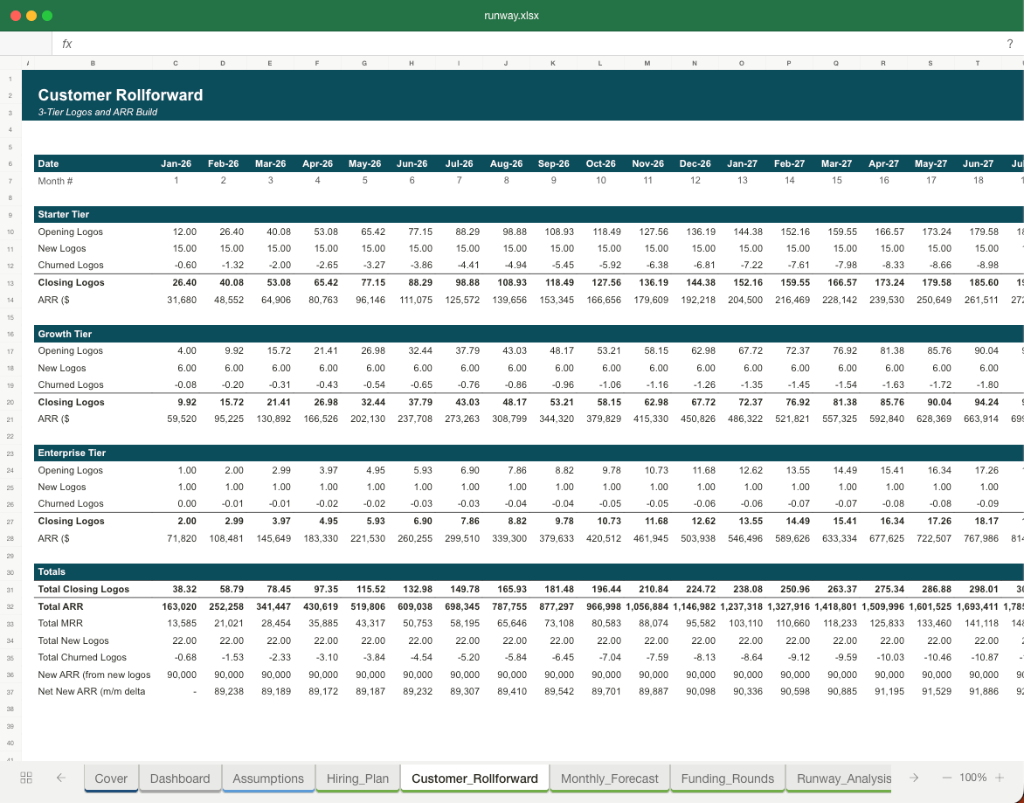
The model schedules commitments, capital calls, initial investments, follow-ons, fees, portfolio marks, exits, and carry. It produces a fund J-curve and LP-return outputs including DPI, TVPI, RVPI, and net IRR under portfolio and timing scenarios.
A turnkey financial model
Live formulas, no hardcoded values
Outputs are driven by live formulas, so the workbook updates from its assumptions instead of relying on hardcoded results.
All assumptions in one tab
Inputs are clearly marked in the Assumptions tab and separated from calculations, making it clear what to change and what to leave intact.
Statements always balancing
For integrated-statement models, the balance sheet, cash flow, and supporting schedules tie through properly.
Distinct schedules for clarity
Debt, working capital, taxes, and cash flow can get messy quickly. We group calculations in clear schedules, not across disconnected tabs.
No hidden macros or external links
There are no unexplained external workbook links or macros to undermine auditability or portability.
Changes flow through the model
Update a key driver and see the impact carry through the forecast, financing, and return outputs. We never use hardcoded numbers in formulas.
About Todd and Rahul's Angel Fund
toddandrahulangelfund.com
How to build a detailed financial model for Todd and Rahul's Angel Fund
A complete walkthrough of the business, drivers, and assumptions behind the downloadable Todd and Rahul's Angel Fund model - distilled from its pitch deck and publicly available information.
Product & value proposition
- Two-GP angel fund: Todd Goldberg (founded Eventjoy/acq. Ticketmaster, Mailjoy) and Rahul Vohra (founded Superhuman, Rapportive/acq. LinkedIn)
- Value to LPs: access to competitive early-stage deals via founder brand, YC network, co-investment with top-tier firms (a16z, Sequoia, First Round, etc.)
- Value to portfolio companies: hands-on help with product, onboarding, virality, go-to-market, waitlist management, and fundraising
- Distribution engine: 100+ portfolio founder community + LP base of world-class founders and operators as co-investment/deal-flow flywheel
- Structure: AngelList backoffice; deploying mid-Q2 2021; LPs get 1-2 updates/quarter + early product access + co-invest rights
Revenue model
Fund economics (standard VC structure; specifics not stated in deck):
Traction & metrics
- Fund I size: $7.3M
- Fund I investments: 42 companies to date
- Fund I markups: 9 markups
- Fund I deployment: 70% deployed at time of deck
- Specific markup multiples cited (appendix spotlights):
- /daily (Developer API): 4.29x markup; Series A preempted by Lachy Groom
- Clubhouse (Consumer Social): 9x markup; Series A preempted by a16z
- NexHealth (Healthcare/B2B SaaS): 2.85x markup; Series A preempted by Josh Buckley
- Levels (Consumer Health): 3.13x markup; seed led by a16z
- NexHealth ARR: "7 digit ARR"
- Levels waitlist: "exceeds 8k people" at time of deck
- Markup table (slide 04) and Fund I Snapshot tables (slides 12–13): fully redacted in this version of the deck
Unit economics
- Implied at portfolio level: fund targets 100x on core positions, >10x on opportunistic
- Average check sizes by tranche:
- Core: $200k–$300k, 30–40 companies, 60% of capital
- Opportunistic: $500k–$750k, 4–8 companies, 25% of capital
- Exploratory: $50k–$100k, 15–20 companies, 15% of capital
Competition / moat
- Differentiation vs. other angels/micro-VCs: founder brand (Superhuman, Eventjoy), product expertise (onboarding/virality/PMF), network density (a16z, Sequoia, First Round, Box Group relationships)
- Named solo capitalists they work closely with: Josh Buckley, Harry Stebbings, Jeff Morris Jr.
- LP base itself is a competitive moat: dozens of top operators and founders who generate and validate deal flow
- No direct competitor analysis shown
Team & funding ask / use of funds
- GPs: Todd Goldberg and Rahul Vohra
- Fund II ask: size not stated; deploying mid-Q2 2021
- Use of funds: 60% core early-stage ($200k–$300k), 25% opportunistic breakout ($500k–$750k), 15% exploratory ($50k–$100k)
- Key LPs (Fund I): Jack Altman (Lattice), Harry Stebbings (20MinVC), Shahed Khan (Loom), Balaji Srinivasan, Des Traynor (Intercom), Shishir Mehrotra (Coda), Christian Reber (Pitch), Scott Belsky (Behance), Caterina Fake (Flickr), and others
Recommended financial model
- Archetype + why: Venture fund economics model (LP returns / fund waterfall). This is NOT an operating company - it is a closed-end fund raising LP capital. The correct model is a fund-level J-curve + DPI/TVPI/RVPI model with management fee and carried interest waterfall. An operating forecast is not appropriate.
- Forecast horizon & granularity: 10-year fund life (standard for early-stage); annual granularity for LP reporting; quarterly for deployment tracking.
- Key drivers & assumptions:
- Fund II size:
- Management fee: 2% p.a. on committed capital
- Carry: 20%
- Preferred return / hurdle: 8%
- Deployment period: 3 years
- Portfolio construction - Core (60%): 30–40 companies, $200k–$300k checks
- Portfolio construction - Opportunistic (25%): 4–8 companies, $500k–$750k checks
- Portfolio construction - Exploratory (15%): 15–20 companies, $50k–$100k checks
- Return targets: Core 100x, Opportunistic >10x; Exploratory not stated
- Loss ratio (Core):
- Loss ratio (Opportunistic):
- Loss ratio (Exploratory):
- Fund I TVPI proxy from spotlights: four highlighted deals at 2.85x–9x; 9 markups out of 42 companies; overall TVPI not disclosed
- Follow-on reserves: implied via SPVs and opportunity fund in Fund I; Fund II bakes follow-on into Opportunistic tranche
- Scenarios (Base / Bull / Bear - which variables flex):
- Base: standard power-law distribution; 1–2 breakout companies at 20x–50x, ~10 markups at 2–5x, balance at <1x
- Bull: 1 Clubhouse-like outcome (9x+) in Core + 1 Opportunistic position compounds to >20x; overall fund TVPI ~3–4x net
- Bear: no breakout, markups cluster at 2–3x; management fee drag dominates; net TVPI ~1.2–1.5x
- Required sheets / outputs:
- Assumptions - fund size, fee structure, carry, portfolio construction, return assumptions by tranche
- Deployment Schedule - capital called by year, by tranche
- Portfolio Returns - company-level (anonymized rows), entry check, markup multiple, realized/unrealized proceeds by year
- Fund P&L - management fees in, expenses, gross proceeds, carry calculation, net LP distributions
- J-Curve - cumulative LP cash flows (called capital vs. distributions) by year
- LP Returns Summary - DPI, RVPI, TVPI, net IRR by scenario
- Waterfall - GP carry calculation (preferred return hurdle, catch-up, split)
Frequently asked
Is the Todd and Rahul's Angel Fund financial model free?+
Yes. The Todd and Rahul's Angel Fund model is a free Excel (.xlsx) download with live formulas. Sign up with your email and the workbook is yours to keep, review, and edit.
What's included in the model?+
A 5-year monthly forecast with P&L, cash flow and runway, valuation (exit multiple plus a DCF cross-check), MOIC/IRR returns, and unit economics, with live formulas throughout.
How was this model built?+
It was built from Todd and Rahul's Angel Fund's pitch deck and publicly available information, then structured to investment-banking standards as a fully editable Excel model.
Can I change the assumptions?+
Yes. You can change assumptions and the live formulas will recalculate in the downloadable Excel model.
Have more financial modelling questions? Contact us

Created by ex-finance professionals
Hey, I’m Alex and I created Finamodel.
Over my years in the finance industry I kept building the same models over and over again. Same structure, same assumptions, different logo. So I started building frameworks to turn them into clean, reusable templates.
Every model here is one I’d actually use for a client, and I personally vet each one before it goes up.
I’m not an expert in every industry, but I’ve built enough models to know what belongs in one. And when something is completely foreign to me, I reach out to my network for experts to work on our models with us.
Having a template library on hand cuts a first build from hours to minutes.
Need help finding your model? You’ll find me in the Finamodel app!
Other Enterprise/Security Startup Financial Models
Browse another startup in the same category.
AgBiome
AgBiome is a microbial-platform agtech company that discovers, develops, and commercialises biological crop protection products (and licences the platform across adjacent markets).

Alation
Enterprise data intelligence platform - data catalog, governance, and metadata management for large organisations.

Archer SPAC
Archera
Cloud resource automation platform that continuously optimizes AWS commitment purchases, de-risks overcommitment, and automates FinOps workflows.

Ardoq
Cloud-native Enterprise Architecture (EA) SaaS platform that helps large enterprises navigate digital transformation through automated data collection, graph-based architecture modelling, and change impact analysis.

Ascend
Ascend.io is an enterprise big data automation platform ("Enterprise Intelligence Platform") that abstracts away the complexity of big data engineering so non-experts can build and run data pipelines.

Athennian
Cloud-based legal entity management system (EMS) uniting entity data with workflow and document automation.

Auditboard
Cloud-based integrated risk management platform connecting audit, risk, compliance, and ESG teams across the enterprise.