TOTomoCredit Financial Model
InsurTech Startup Financials (Free Excel Download)
No-credit-check Mastercard credit card targeting "hidden prime" consumers - immigrants, international students, and first-time cardholders - using alternative underwriting and interchange revenue.



professionals from Deloitte
Used by professionals from






About this model
TomoCredit is a no-credit-check Mastercard for consumers who may be creditworthy but lack a traditional credit profile. It uses alternative underwriting and offers no APR or annual fee, aiming to help immigrants, students, and first-time cardholders build credit.
Revenue comes from merchant-paid interchange rather than cardholder interest or fees. Monthly spend per active user was about $1,000, implying that active card usage and interchange yield are the core commercial drivers.
The model is card-interchange economics. Accounts, activation, spend per active user, interchange rate, cashback, fraud, credit losses, and servicing cost determine profitability. Funding, underwriting, cardholder retention, and spend growth are key variables.
A turnkey financial model
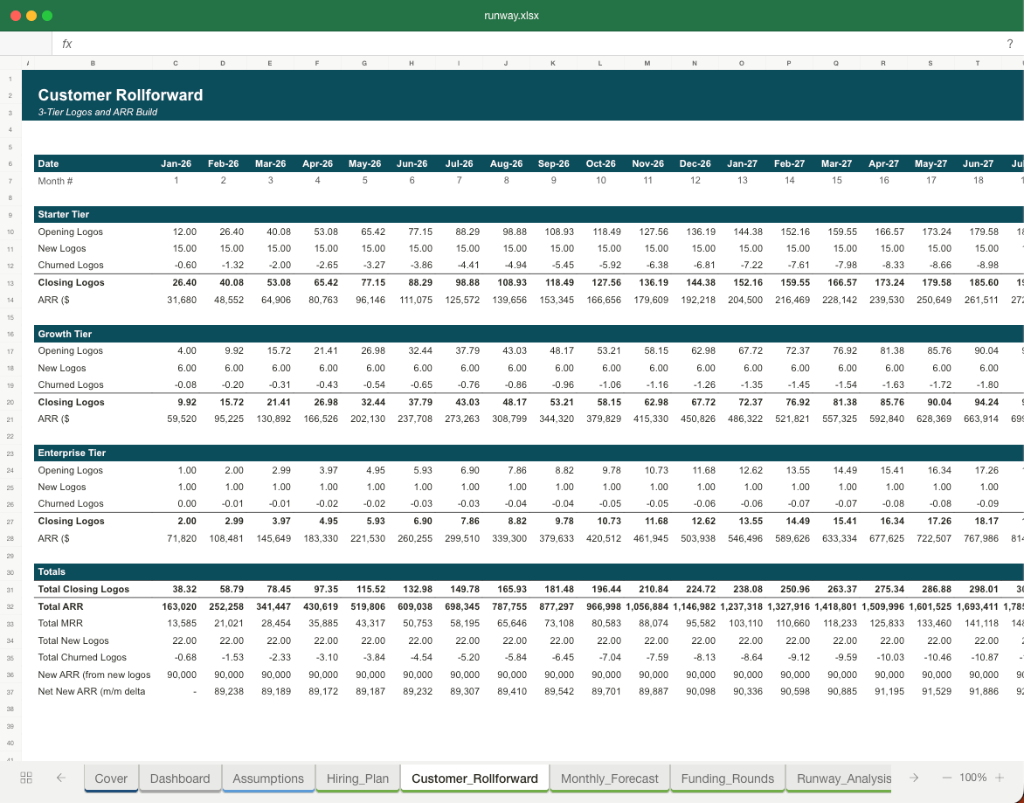
Live formulas, no hardcoded values
Outputs are driven by live formulas, so the workbook updates from its assumptions instead of relying on hardcoded results.
All assumptions in one tab
Inputs are clearly marked in the Assumptions tab and separated from calculations, making it clear what to change and what to leave intact.
Statements always balancing
For integrated-statement models, the balance sheet, cash flow, and supporting schedules tie through properly.
Distinct schedules for clarity
Debt, working capital, taxes, and cash flow can get messy quickly. We group calculations in clear schedules, not across disconnected tabs.
No hidden macros or external links
There are no unexplained external workbook links or macros to undermine auditability or portability.
Changes flow through the model
Update a key driver and see the impact carry through the forecast, financing, and return outputs. We never use hardcoded numbers in formulas.
About TomoCredit
How to build a detailed financial model for TomoCredit
A complete walkthrough of the business, drivers, and assumptions behind the downloadable TomoCredit model - distilled from its pitch deck and publicly available information.
Product & value proposition
- Credit card issued on Mastercard network, no credit score check required.
- 0% APR, no hidden fees.
- Helps users build a credit score, enabling downstream access to mortgages and car loans.
- Revenue model is merchant-paid interchange; cardholders pay nothing.
- Referral program with 1% active cashback incentive.
Market
Credit-score pyramid (Source: CFPB):
- High credit score (800+): 50M people
- Mid credit score (650–800): 80M people
- Low credit score (0–650): 120M people
- No credit score: 30M people - labeled "Hidden Prime"; target segment
Market segmentation:
- Students (international & domestic): 20M
- Immigrant workers (proven financial responsibility): 27M
- First-time cardholders: 170M
Gen Z awareness gap: 76% of college students do not know their credit score.
No explicit TAM/SAM/SOM dollar figures in deck.
Revenue model
- Interchange revenue: paid by merchants on every transaction; not charged to cardholders.
- Typical Mastercard credit interchange: ~1.5–2.0% of transaction value.
- No annual fee, no APR charges (0% APR product).
- Cashback referral at 1% - this is a cost item (funded from interchange spread).
- Monthly spend per active user: $1,000.
- Implied monthly interchange per active user at 1.5%: ~$15.
Traction & metrics
- Transaction volume and active spenders grew 15x in the 6 months from Aug 2020 to Jan 2021.
- Chart shows near-zero activity Aug–Sep 2020, inflection at Oct 2020, steep growth through Jan 2021.
- Monthly spend per user: $1,000.
Unit economics
- CAC: $2.
- LTV: described as "High LTV users" - no dollar figure given.
- Monthly spend per active user: $1,000.
- Implied monthly interchange revenue per user: ~$15 at 1.5%.
- Implied CAC payback: ~0.1 months at $2 CAC / $15 monthly revenue per user.
- No churn rate, no LTV figure, no credit loss / default rate disclosed.
Competition / moat
Competitive positioning: scatter plot on axes of Income (Low→High) vs. Credit Requirement (None→Required):
- Tomo: high-income / no credit requirement quadrant - unique position.
- Chime: low-income / no credit requirement.
- Discover, Capital One: mid-income / credit required.
- Amex, Chase: high-income / credit required.
Moat claims:
- Alternative underwriting (no credit score check) - specific methodology not disclosed.
- Brand / community ("tomorangers") and referral flywheel.
- First-mover in high-income, no-credit-check card segment per their own positioning.
Team & funding ask / use of funds
- Founder is a former international student at UC Berkeley; contact: kristy@tomocredit.com.
- Headcount projections (from projections table): 10 (2020) → 50 (2021) → 500 (2022).
Recommended financial model
- Archetype + why: Consumer fintech credit card - interchange-revenue P&L model. Revenue is purely GMV × interchange rate; no loan book, no interest income (0% APR). Closest archetype is a DTC/fintech card model: cardholders × monthly spend × net interchange rate = revenue. A full 3-statement is appropriate to size headcount cost ramp and burn.
- Forecast horizon & granularity: Monthly for Years 1–2 (2021–2022), quarterly for Year 3 (2023). Deck projections cover 2020–2022 - extend to 2023 for a 3-year forward view.
- Key drivers & assumptions:
- Active cardholders (start of period) -
- Monthly new cardholder adds -
- Cardholder churn rate (monthly) -
- Monthly spend per active cardholder: $1,000
- Gross interchange rate:
- Network / processing cost rate:
- Cashback / referral cost rate: 1% on referred users;
- Net interchange margin:
- CAC: $2
- Headcount: 10 / 50 / 500 for 2020 / 2021 / 2022
- Average fully-loaded salary per head:
- Credit loss / charge-off rate:
- Marketing spend (non-referral):
- Scenarios (Base / Bull / Bear - which variables flex):
- Base: Monthly adds grow linearly per GTM plan; $1,000/user spend holds; net interchange ~0.9%.
- Bull: Viral referral loop accelerates adds 2×; spend per user lifts to $1,500 as user quality improves; faster path to profitability.
- Bear: CAC creep (TikTok / paid channels scale poorly), churn 5%+, spend per user drops to $700 as lower-income cohorts enter; net interchange compressed by cashback.
- Required sheets / outputs:
- Assumptions - all drivers above with scenario toggle (Base / Bull / Bear)
- Cardholder Cohort Model - monthly new adds, churn, active card count by cohort
- GMV & Revenue - active cards × spend × net interchange rate
- P&L - Revenue, processing costs, cashback, gross profit, opex (headcount, marketing, tech), EBITDA
- Headcount Plan - departmental build matching deck ramp (10→50→500)
- Cash & Runway - burn rate, cash balance, months of runway (requires funding amount as input)
- Dashboard - KPI summary: active cards, GMV, revenue, CAC, net margin, runway
Frequently asked
Is the TomoCredit financial model free?+
Yes. The TomoCredit model is a free Excel (.xlsx) download with live formulas. Sign up with your email and the workbook is yours to keep, review, and edit.
What's included in the model?+
A 5-year monthly forecast with P&L, cash flow and runway, valuation (exit multiple plus a DCF cross-check), MOIC/IRR returns, and unit economics, with live formulas throughout.
How was this model built?+
It was built from TomoCredit's pitch deck and publicly available information, then structured to investment-banking standards as a fully editable Excel model.
Can I change the assumptions?+
Yes. You can change assumptions and the live formulas will recalculate in the downloadable Excel model.
Have more financial modelling questions? Contact us

Created by ex-finance professionals
Hey, I’m Alex and I created Finamodel.
Over my years in the finance industry I kept building the same models over and over again. Same structure, same assumptions, different logo. So I started building frameworks to turn them into clean, reusable templates.
Every model here is one I’d actually use for a client, and I personally vet each one before it goes up.
I’m not an expert in every industry, but I’ve built enough models to know what belongs in one. And when something is completely foreign to me, I reach out to my network for experts to work on our models with us.
Having a template library on hand cuts a first build from hours to minutes.
Need help finding your model? You’ll find me in the Finamodel app!
Other InsurTech Startup Financial Models
Browse another startup in the same category.
Ark Kapital
AI-powered precision lending platform for European tech startups, providing non-dilutive growth loans using real-time raw data analytics.

Battleface
Tech-enabled travel insurance platform covering high-risk and non-standard destinations globally, sold direct and via B2B2C partners.
Beam
Digital-first dental insurance company selling group dental (and ancillary) benefits to employers via brokers

Branch
Tech-enabled home & auto insurance company operating as a reciprocal exchange, selling bundled policies via embedded, direct, and agency channels.
Cachet
B2B2C insurtech marketplace offering flexible, usage-based insurance products to gig/platform economy workers via partnerships with ride-hailing, delivery, and gig platforms.

Caura
Mobile app that aggregates all car-related payments (parking, congestion/ULEZ, tolls, tax, insurance) into a single platform, with insurance comparison as a key monetisation layer.

Clark
Digital insurance broker (Makler) providing a robo-advisor + human expert hybrid platform to manage and purchase all insurance lines via mobile app

Counterpart
Digital MGA (managing general agent) selling D&O and management liability insurance to US SMEs via a tech-enabled underwriting platform.