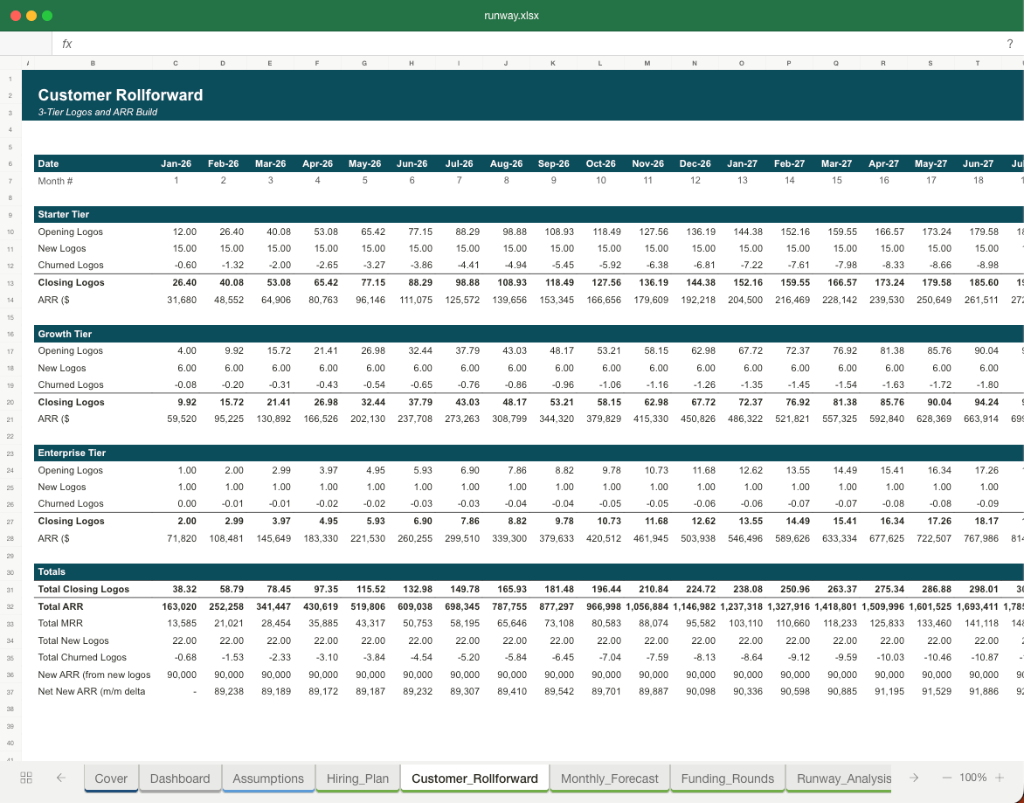
TWTwilio Financial Model
Dev Tools Startup Financials (Free Excel Download)
Cloud API platform that lets developers embed voice and SMS into applications via a simple REST API and pay-per-use billing.



professionals from Deloitte
Used by professionals from






About this model
Twilio is a cloud API platform that lets developers embed voice, SMS, and phone-number capabilities into applications. Its free developer entry point and simple REST API made telecom infrastructure accessible as software.
Customers pay per call, SMS, and phone number, moving from free registration to paid usage. The early deck showed monthly revenue rising from under $2,000 to more than $38,000 over its first year of reported growth.
The model is developer-funnel consumption SaaS. Registrations, paid conversion, calls, messages, numbers, unit pricing, expansion, and churn determine revenue. Carrier cost, reliability investment, and cohort retention drive gross margin.
A turnkey financial model
Live formulas, no hardcoded values
Outputs are driven by live formulas, so the workbook updates from its assumptions instead of relying on hardcoded results.
All assumptions in one tab
Inputs are clearly marked in the Assumptions tab and separated from calculations, making it clear what to change and what to leave intact.
Statements always balancing
For integrated-statement models, the balance sheet, cash flow, and supporting schedules tie through properly.
Distinct schedules for clarity
Debt, working capital, taxes, and cash flow can get messy quickly. We group calculations in clear schedules, not across disconnected tabs.
No hidden macros or external links
There are no unexplained external workbook links or macros to undermine auditability or portability.
Changes flow through the model
Update a key driver and see the impact carry through the forecast, financing, and return outputs. We never use hardcoded numbers in formulas.
About Twilio
How to build a detailed financial model for Twilio
A complete walkthrough of the business, drivers, and assumptions behind the downloadable Twilio model - distilled from its pitch deck and publicly available information.
Product & value proposition
- Twilio exposes telecom primitives (voice calls, SMS, phone number provisioning) as a web API
- Developers sign up for free (free tier), build apps using the API, then upgrade to paid accounts
- Key products referenced: core voice/SMS API; OpenVBX (open-source virtual business phone app built on Twilio)
- "Discover" apps & developers directory under development - marketplace to surface Twilio-powered apps
- Scalability tested to 5,000 simultaneous calls; reliability tracked by customer-facing failure rate (end-to-end loopback tests)
- Infrastructure on AWS EC2; risks include single availability zone dependency and carrier inbound limits
Revenue model
- Usage-based: developers pay per call, per SMS, per phone number provisioned
- Free-to-paid funnel: free developer registration → upgrade to paid account
- No explicit per-unit pricing shown in deck
- Revenue is monthly recurring + variable usage; accounts can churn or expand based on API usage
Traction & metrics
Sales (monthly revenue): | Month | Revenue | | ------ | -------- | | 2009-01 | $1,789 | | 2009-02 | $4,591 | | 2009-03 | $4,869 | | 2009-04 | $10,219 | | 2009-05 | $7,676 | | 2009-06 | $17,288 | | 2009-07 | $12,799 | | 2009-08 | $16,725 | | 2009-09 | $24,186 | | 2009-10 | $34,321 | | 2009-11 | $33,328 | | 2009-12 | $33,166 | | 2010-01 | $38,056 | | 2010-02 | $68,302 | | 2010-03 | $48,703 (pace as of March 22nd) |
New Website Visitors (monthly):
- Peaked at 26,220 in 2010-02; 2010-03 pace 12,593
Developer Registrations (monthly):
- 5.8% conversion (visitors → registrations)
- Peaked at 1,005 in 2010-02; 2010-03 pace 735
- Total developer accounts as of March 22, 2010: 7,841
- Adding >1,000 new developer accounts per month
Upgraded (paid) accounts (monthly):
- 24.2% conversion (registrations → upgrades)
- 240 upgrades in 2010-02; 2010-03 pace 178
- Total upgraded accounts as of March 22, 2010: 1,316
- Adding >250 upgrades per month
Customer service SLA: Response under 12 hours
Marketing funnel stages tracked: New Website Visitors → Signups → Upgrades
Unit economics
- Visitor-to-registration conversion: 5.8%
- Registration-to-upgrade conversion: 24.2%
- Implied end-to-end conversion (visitor → paid): ~1.4% [calculated from deck figures]
- No CAC, LTV, ARPU, gross margin, or payback data shown
- Revenue per upgraded account (implied): ~$68,302 / 1,316 accounts ≈ $52/mo ARPU
Competition / moat
- Developer testimonials (Twitter quotes) emphasise ease of integration and speed (15 minutes to hook SMS into a Ruby app)
- Moat implied: API simplicity, developer community/ecosystem, OpenVBX open-source app directory
- No competitive landscape slide shown
Team & funding ask / use of funds
Leadership visible from org chart:
- Jeff Lawson - CEO
- Evan (CTO)
- Tom (CFO, via Ravix Group)
- John Sheehan - Evangelist
- Danielle - Marketing
G&A: Ravix Group (outsourced CFO), Krohn & Godby (accountant), Gunderson (lawyers), Dan Arkind & Joanna Samuels (recruiting)
Open headcount (March 2010):
- 2 Web Engineers, 1 Senior Web Engineer, 1 Core Engineer, 1 Ops Engineer, 1 Sales Evangelist (TBD), 1 Developer Evangelist, 1 Apps Product Manager, 1 Telecom BD
- Big hire: 1 VP Business Development
Recommended financial model
- Archetype + why: Usage-based SaaS / API revenue model with developer funnel. Twilio's economics are driven by a free-to-paid funnel (visitors → registrations → upgrades) and then variable usage (calls, SMS, phone numbers) per paid account. The right model is a two-layer structure: (1) cohort-based account acquisition model for the funnel, and (2) usage expansion / ARPU model for revenue per account. This is closest to a usage-based / bottoms-up SaaS model.
- Forecast horizon & granularity: 3-year monthly model (2010–2012); monthly for Year 1, quarterly summary for Years 2–3. The business is growing fast enough that monthly granularity is essential to capture seasonality and funnel dynamics.
- Key drivers & assumptions:
- New website visitors / month: 26,220 in Feb-2010; grow at 10% MoM declining to 5% MoM by end of Year 1 - early-stage dev tool with organic word-of-mouth + hackathon events
- Visitor → registration conversion: 5.8%
- Registration → upgrade (paid) conversion: 24.2%
- Total developer accounts: 7,841 as of March 22, 2010
- Total upgraded accounts: 1,316 as of March 22, 2010
- Monthly new developer accounts: >1,000/mo
- Monthly new upgraded accounts: >250/mo
- Monthly revenue: $68,302 in Feb-2010; $48,703 pace in Mar-2010
- ARPU (revenue per upgraded account / month): ~$50–55/mo derived from deck numbers; no explicit pricing shown
- Monthly revenue churn on upgraded accounts: 2–3%/mo - typical for early usage-based dev tools; not in deck
- Gross margin: 55–65% - telecom API businesses carry carrier termination costs; not stated in deck
- Headcount additions: ~10 hires planned in near term; ~$120k–150k fully loaded cost per technical hire
- OpenVBX launch target: week of April 26, 2010 - model as a potential step-change in new signups post-launch
- Scenarios (Base / Bull / Bear - which variables flex):
- Base: visitor growth 8% MoM declining; conversion rates held flat at deck levels; ARPU flat
- Bull: visitor growth 15% MoM sustained; upgrade conversion improves to 30%; OpenVBX launch drives 2x signup spike
- Bear: visitor growth stalls at 3% MoM; churn rises to 5%/mo on upgraded accounts; ARPU compresses 10%
- Required sheets / outputs:
- Assumptions - all driver inputs, scenario toggle (Base/Bull/Bear)
- Funnel - monthly: visitors → signups → upgrades → active paying accounts
- Revenue - monthly: upgraded accounts × ARPU + breakdown by product (voice, SMS, DIDs) if data becomes available
- P&L - revenue, gross profit (after carrier COGS), opex (headcount, G&A, marketing), EBITDA
- Headcount - planned hires by role, fully-loaded cost build
- Cash & Runway - cash balance, burn, months of runway
- Dashboard - KPI summary: MRR, accounts, conversion rates, ARPU, gross margin %
Frequently asked
Is the Twilio financial model free?+
Yes. The Twilio model is a free Excel (.xlsx) download with live formulas. Sign up with your email and the workbook is yours to keep, review, and edit.
What's included in the model?+
A 5-year monthly forecast with P&L, cash flow and runway, valuation (exit multiple plus a DCF cross-check), MOIC/IRR returns, and unit economics, with live formulas throughout.
How was this model built?+
It was built from Twilio's pitch deck and publicly available information, then structured to investment-banking standards as a fully editable Excel model.
Can I change the assumptions?+
Yes. You can change assumptions and the live formulas will recalculate in the downloadable Excel model.
Have more financial modelling questions? Contact us

Created by ex-finance professionals
Hey, I’m Alex and I created Finamodel.
Over my years in the finance industry I kept building the same models over and over again. Same structure, same assumptions, different logo. So I started building frameworks to turn them into clean, reusable templates.
Every model here is one I’d actually use for a client, and I personally vet each one before it goes up.
I’m not an expert in every industry, but I’ve built enough models to know what belongs in one. And when something is completely foreign to me, I reach out to my network for experts to work on our models with us.
Having a template library on hand cuts a first build from hours to minutes.
Need help finding your model? You’ll find me in the Finamodel app!
Other Dev Tools Startup Financial Models
Browse another startup in the same category.

8base
Low-code/no-code platform providing backend and frontend development tools for building digital products, internal apps, and SaaS.
Ably
Enterprise realtime messaging infrastructure (pub/sub) delivered as a cloud-native platform, enabling developers to build scalable live experiences without managing complex realtime infrastructure.

Amplitude
Mobile analytics SaaS platform giving app developers real-time behavioral analytics, funnel/retention analysis, and raw data warehouse access at scale.
Anima
Automated design-to-code platform - designers export production-ready code from their design tools with one click.

Apollo
Apollo builds and sells an enterprise "data graph" platform (powered by GraphQL) that sits as a unified API layer between frontend apps and backend microservices.
BrowserStack
Cloud-based cross-browser and mobile app testing platform used by 50,000+ customers across 135 countries.
CodeSandbox
Cloud-native collaborative web IDE that lets entire product teams (not just developers) code, review, and iterate together in the browser.
CommandBar
SaaS SDK that embeds a search-based command bar into web apps, improving UX, onboarding, and retention for B2B software companies.