 Upstream Financial Model
Enterprise/Security Startup Financials (Free Excel Download)
Mobile app for professional networking via communities, events, and peer Q&A



professionals from Deloitte
Used by professionals from






About this model
Upstream is a professional-networking app built around communities, events, and peer questions and answers. It aims to create useful professional interaction through membership and participation, with an early product context focused on building a network before fully shipping monetisation.
The company combines consumer community growth with an emerging B2B corporate-community channel. This makes it a hybrid model: member acquisition and engagement create network value, while corporate contracts offer the clearer near-term route to monetisable revenue.
The model separates members, engagement, and consumer paid conversion from corporate contracts and subscription value. Marketing, product, community operations, retention, and cash costs are forecast independently so the model can test whether B2B revenue supports continued consumer-network investment.
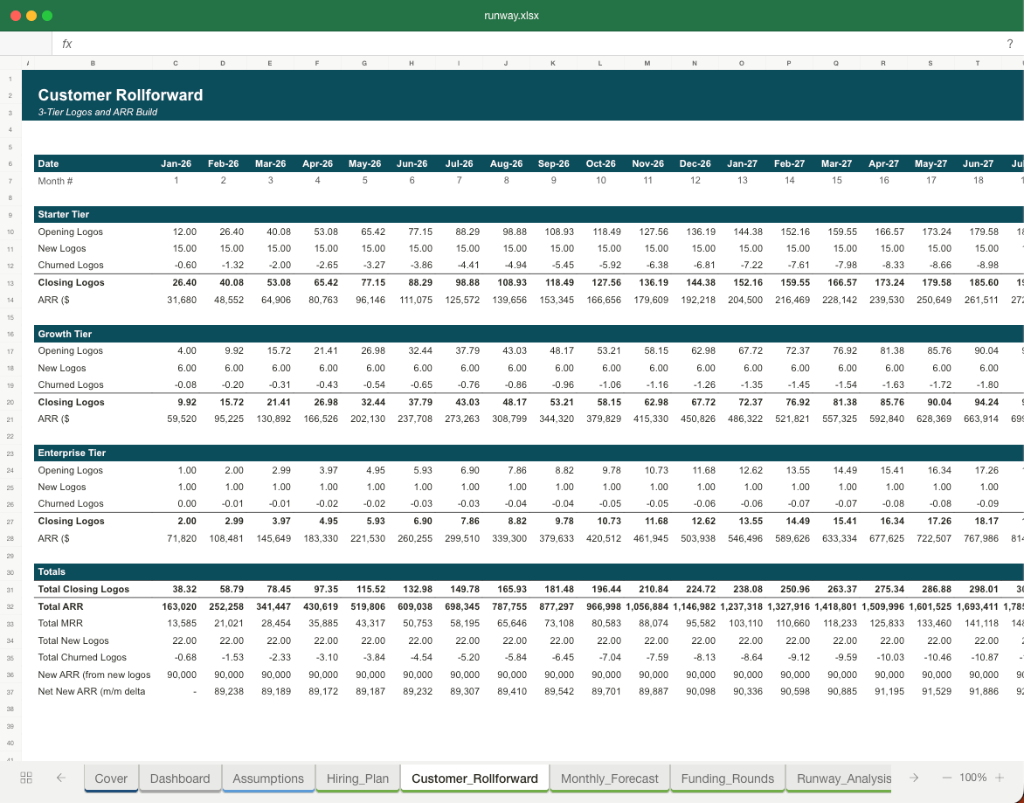
A turnkey financial model
Live formulas, no hardcoded values
Outputs are driven by live formulas, so the workbook updates from its assumptions instead of relying on hardcoded results.
All assumptions in one tab
Inputs are clearly marked in the Assumptions tab and separated from calculations, making it clear what to change and what to leave intact.
Statements always balancing
For integrated-statement models, the balance sheet, cash flow, and supporting schedules tie through properly.
Distinct schedules for clarity
Debt, working capital, taxes, and cash flow can get messy quickly. We group calculations in clear schedules, not across disconnected tabs.
No hidden macros or external links
There are no unexplained external workbook links or macros to undermine auditability or portability.
Changes flow through the model
Update a key driver and see the impact carry through the forecast, financing, and return outputs. We never use hardcoded numbers in formulas.
About Upstream
upstreamapp.com
How to build a detailed financial model for Upstream
A complete walkthrough of the business, drivers, and assumptions behind the downloadable Upstream model - distilled from its pitch deck and publicly available information.
Product & value proposition
- Professional networking via interest-based communities (e.g. "Jews in Tech," "Orchestrated Gatherings")
- Three core features: Communities, Upstream Asks (peer Q&A / help requests), Upstream Events (structured video networking with 1:1 video breakout matching)
- Positioned as "LinkedIn Groups if it were started today"
- Events run as matchmaking sessions: host intro, then timed 1:1 video chats with other attendees
- Post-event contact exchange (encrypted, opt-in)
- Corporate/B2B channel: companies and organizations using Upstream for internal networking, alumni events
Market
- 640 million business professionals in the world
- 2 billion+ active users monthly in group products (addressable engagement pool)
- $52.7 billion market size of social networking measured by revenue
- $26.2 billion LinkedIn acquisition price paid by Microsoft (comparable exit anchor)
- Macro tailwind: Zoom daily meeting participants went from ~10MM (Jan 2019) to 200MM (Mar 2020) - 20x in months, cited as "5 years of acceleration in 5 months"
- No SAM/SOM breakdown presented
Revenue model
- No live monetization shown in deck
- Roadmap explicitly includes "Ship monetization products for community organizers"
- Implied future monetization vectors:
- B2B / corporate community product (companies pay to host communities)
- Platform API (Upstream Platform API on roadmap)
- Potential event ticketing or premium community fees (inferred from organizer monetization language)
- No pricing, ARPU, or take-rate figures in deck
Traction & metrics
- Over 100,000 members across 100+ communities on waiting list to join
- 72% of members who attend one event, attend a second one (event retention rate)
- Average user attends an event per week
- One bullet on slide 7 is redacted (blacked out) - unknown metric
- Shipped: iOS app, Android app, Upstream Asks, Upstream Events
- No revenue figures disclosed
Competition / moat
- Two competitive buckets identified:
- Group products: LinkedIn Groups, Facebook Groups, Telegram, WhatsApp, Yahoo Groups, Google Groups, Slack
- Professional + Event products: Icebreaker, Mighty Networks, Lunchclub, Hopin, Fishbowl, Glimpse, Run The World, Meetup, Zoom
- Moat claims: structured matchmaking format for events; community + Q&A + events bundled in one product; "meaningful long-term relationships" vs. passive connection graphs
- No proprietary data / network effects claim stated explicitly
Team & funding ask / use of funds
- Alex Taub - CEO/Co-founder; prior: Co-founder SocialRank, Head of BD at Dwolla, Lead BD at Aviary
- Michael Schonfeld - CTO/Co-founder; prior: Co-founder SocialRank, Developer Evangelist at Dwolla, Full Stack Engineer at Nerve
- Zhanna Schonfeld - Product Design; prior: SocialRank, DigitalOcean, Quirky
- Kazi Islam - Product; prior: Director of Sales SocialRank, AE at Apploi, Paycom
- Use of funds: hire 6 people (engineer / community heavy), ship Web version, new community tabs, monetization products, Platform API, expand corporate product
Recommended financial model
- Archetype + why: Consumer social / community platform with a dual-revenue model - B2C freemium (organizer monetization, potential premium tiers) + B2B corporate community SaaS. Closest archetype is a marketplace / community SaaS hybrid: B2C member growth drives community value; B2B corporate deals drive near-term monetizable revenue. A 3-statement operating model with a separate B2C/B2B revenue build is the right structure given early stage and no live revenue.
- Forecast horizon & granularity: 3 years monthly (Years 1–2 monthly detail, Year 3 quarterly roll-up). Pre-revenue today, so Year 1 is a cash-burn / hiring model; revenue starts in Year 2 once monetization ships.
- Key drivers & assumptions:
- Total registered members: 100,000+ on waitlist at model start; assume 50% conversion to active
- Active member growth rate:
- Event attendance rate: 1 event/user/week
- Event retention (D2 event): 72%
- B2C monetization ARPU:
- B2C monetization attach rate:
- B2B corporate communities - number of corporate clients:
- B2B ACV:
- Headcount: 4 current + 6 hires = 10;
- Gross margin:
- CAC:
- Churn (B2B):
- Scenarios (Base / Bull / Bear - which variables flex):
- Bear: waitlist conversion 30%, B2B ramp slow (5 clients by end Year 2), monetization delayed to Year 3
- Base: waitlist conversion 50%, B2B 15 clients by end Year 2, monetization live mid-Year 2
- Bull: viral event-driven growth (20% MoM), B2B 30+ clients, premium B2C tier scales
- Required sheets / outputs:
- Assumptions - all drivers with scenario toggle
- Member growth - registered, active, organizers; cohort event attendance
- B2C revenue - organizer premium subscriptions, optional event ticketing
- B2B revenue - corporate community clients, ACV, renewal
- P&L - revenue, COGS, gross profit, opex (headcount, marketing, infra), EBITDA
- Headcount plan - current 4 + 6 planned hires, timing, role, fully loaded cost
- Cash flow & runway - burn rate, funding need, months of runway
- Dashboard - KPI summary (members, events, B2B clients, ARR, runway)
Frequently asked
Is the Upstream financial model free?+
Yes. The Upstream model is a free Excel (.xlsx) download with live formulas. Sign up with your email and the workbook is yours to keep, review, and edit.
What's included in the model?+
A 5-year monthly forecast with P&L, cash flow and runway, valuation (exit multiple plus a DCF cross-check), MOIC/IRR returns, and unit economics, with live formulas throughout.
How was this model built?+
It was built from Upstream's pitch deck and publicly available information, then structured to investment-banking standards as a fully editable Excel model.
Can I change the assumptions?+
Yes. You can change assumptions and the live formulas will recalculate in the downloadable Excel model.
Have more financial modelling questions? Contact us

Created by ex-finance professionals
Hey, I’m Alex and I created Finamodel.
Over my years in the finance industry I kept building the same models over and over again. Same structure, same assumptions, different logo. So I started building frameworks to turn them into clean, reusable templates.
Every model here is one I’d actually use for a client, and I personally vet each one before it goes up.
I’m not an expert in every industry, but I’ve built enough models to know what belongs in one. And when something is completely foreign to me, I reach out to my network for experts to work on our models with us.
Having a template library on hand cuts a first build from hours to minutes.
Need help finding your model? You’ll find me in the Finamodel app!
Other Enterprise/Security Startup Financial Models
Browse another startup in the same category.
AgBiome
AgBiome is a microbial-platform agtech company that discovers, develops, and commercialises biological crop protection products (and licences the platform across adjacent markets).

Alation
Enterprise data intelligence platform - data catalog, governance, and metadata management for large organisations.

Archer SPAC
Archera
Cloud resource automation platform that continuously optimizes AWS commitment purchases, de-risks overcommitment, and automates FinOps workflows.

Ardoq
Cloud-native Enterprise Architecture (EA) SaaS platform that helps large enterprises navigate digital transformation through automated data collection, graph-based architecture modelling, and change impact analysis.

Ascend
Ascend.io is an enterprise big data automation platform ("Enterprise Intelligence Platform") that abstracts away the complexity of big data engineering so non-experts can build and run data pipelines.

Athennian
Cloud-based legal entity management system (EMS) uniting entity data with workflow and document automation.

Auditboard
Cloud-based integrated risk management platform connecting audit, risk, compliance, and ESG teams across the enterprise.