VOVoro Financial Model
InsurTech Startup Financials (Free Excel Download)
Healthcare social network where people share trusted doctor reviews and health advice using real names.



professionals from Deloitte
Used by professionals from






About this model
Voro is a real-identity healthcare social network where users share doctor reviews, health advice, and local recommendations. It combines community discovery with appointment-booking and a future steerage product for directing patients to appropriate care.
The public beta had more than 50,000 users and doctor reviews, growing more than 30% month over month without paid acquisition. Revenue is planned through per-referral transaction fees and PMPM contracts with insurers, providers, or self-insured employers.
The model combines referral volume and recurring healthcare contracts. Users, reviews, booking conversion, steerage events, referral price, PMPM members, and retention determine revenue. Network growth, provider supply, healthcare partners, and trust drive margin.
A turnkey financial model
Live formulas, no hardcoded values
Outputs are driven by live formulas, so the workbook updates from its assumptions instead of relying on hardcoded results.
All assumptions in one tab
Inputs are clearly marked in the Assumptions tab and separated from calculations, making it clear what to change and what to leave intact.
Statements always balancing
For integrated-statement models, the balance sheet, cash flow, and supporting schedules tie through properly.
Distinct schedules for clarity
Debt, working capital, taxes, and cash flow can get messy quickly. We group calculations in clear schedules, not across disconnected tabs.
No hidden macros or external links
There are no unexplained external workbook links or macros to undermine auditability or portability.
Changes flow through the model
Update a key driver and see the impact carry through the forecast, financing, and return outputs. We never use hardcoded numbers in formulas.
About Voro
voro.com
How to build a detailed financial model for Voro
A complete walkthrough of the business, drivers, and assumptions behind the downloadable Voro model - distilled from its pitch deck and publicly available information.
Product & value proposition
Real-identity healthcare social network. Users connect with friends and local communities to share health advice and doctor reviews. Key differentiator: real names (vs. anonymous review sites like Yelp/Healthgrades). Community groups organised by geography (neighbourhood, county) and by condition (e.g., Lyme Disease group). Appointment booking feature also present (implied by repeat-booking metric). Longer-term monetisation pivot: "Steerage" - routing patients to high-value care to improve outcomes and reduce costs, billed to payors/providers/employers.
Market
- TAM: $300 billion - defined as total US healthcare spending on low-value or unnecessary medical care
- Note: The $300B TAM is framed around the Steerage monetisation thesis, not the consumer social network itself. The two are at different stages of development.
Revenue model
Two stated revenue models:
- Transaction fee - per patient steerage/referral event (implied per-appointment or per-referral)
- PMPM (per member per month) - recurring fee billed to insurance companies, healthcare providers, and self-insured employers
No pricing/rate card shown. No current revenue disclosed. Consumer product appears free at time of deck (no paid acquisition, no monetisation slide for the social layer).
Traction & metrics
All figures from public beta phase:
- 50k+ doctor reviews
- 50k+ users
- 30%+ MoM user growth
- No paid acquisition
- MAU chart shows consistent upward trend with acceleration in recent months; axis values unlabelled - no absolute MAU figures readable
- 50% of users have written a doctor review - very high content-creation rate
- 45% of appointment bookers return and book again - repeat booking retention
- User base: 90% women, median age 39
Unit economics
- CAC: Effectively $0 (no paid acquisition stated); organic/viral growth through community networks
- Note: Unit economics are pre-revenue; only engagement proxies available
Competition / moat
- Positioning: Only healthcare social network using real identity
- Competitive axes: Real identity vs. anonymous; healthcare-specific vs. general (non-healthcare networks)
- Named competitors implied (not listed): anonymous forums/message boards, Yelp/Healthgrades (anonymous healthcare reviews), general social networks (Facebook groups)
- Moat: Network effects within trusted communities; real-name social graph creates switching cost; UGC doctor review corpus (50k+ reviews)
Team & funding ask / use of funds
- Tomas Hoyos - Co-Founder / CEO; Private Equity investor at American Securities, healthcare focus; Harvard
- Drew Tunney - Co-Founder / CTO; Tech team lead at Sighten (solar marketplace), grew team 5→25; Dartmouth
Recommended financial model
- Archetype + why: Two-phase model required.
- Phase 1 (0–18 months): Consumer social / marketplace growth model - MAU/DAU funnel, organic growth rate, community/group expansion, appointment booking volume. No revenue yet; cost model only (team, infra, marketing).
- Phase 2 (18m+): B2B SaaS/PMPM + transaction revenue model - members enrolled in steerage program, PMPM rate × enrolled members + transaction fees per referral. This is the monetisation thesis and should be the primary valuation driver. Analogous to a health plan navigation / benefits-tech SaaS (e.g., Accolade, Transcarent).
- Combined: 3-statement model with a consumer funnel feeding B2B steerage pipeline.
- Forecast horizon & granularity: Monthly for Years 1–2; quarterly for Years 3–5. 5-year total horizon to show path to B2B scale.
- Key drivers & assumptions:
- Starting MAU: ~50k; defined as registered users at beta launch
- MoM user growth rate: 30% - clearly not sustainable at scale; model decay curve to ~8% MoM by month 18 and ~3% MoM by Year 3 (typical social network S-curve)
- Review-writing rate: 50% of users
- Repeat appointment booking rate: 45% of bookers
- Appointment booking penetration (% of MAU who book): 10–15%; rationale: appointment booking is an advanced action; most users are browsers/reviewers
- Geographic expansion pace: 2–3 new metro areas per quarter starting Y2; NYC metro is current base
- B2B revenue launch: Month 18–24; requires pilot contracts with 1–2 insurers or self-insured employers
- PMPM rate: $2–$5 PMPM; rationale: health navigation / steerage tools (e.g., Accolade) price in this range; no deck data
- Transaction fee per steerage event: $25–$75 per referral; rationale: comparable to care navigation referral fees; no deck data
- Enrolled members (B2B): starts at 5k–10k in first contract, scales with employer/insurer partnerships
- Headcount: small team (~5–10) at beta; model 20–30 by end Y2 as B2B sales motion builds
- Gross margin (B2B SaaS): 70–80%; rationale: software-delivered steerage, low marginal cost per member
- Gross margin (transaction): 60–70%; some fulfilment / care coordination cost
- Scenarios (Base / Bull / Bear - which variables flex):
- Bear: MoM growth decays faster (to 5% by month 12); B2B launch delayed to Month 30; PMPM at low end ($2); low employer adoption
- Base: 30% MoM decaying to 8% by M18; B2B launch M20; PMPM $3.50; 2–3 employer contracts by end Y3
- Bull: Growth sustains at 20%+ through M12 (viral word-of-mouth in new metros); B2B launch M15; PMPM $5; insurance company pilot in Y2
- Required sheets / outputs:
- Assumptions - all drivers, toggled by scenario
- Consumer Funnel - registered users, MAU, review volume, appointment bookings by month
- B2B Revenue - enrolled members × PMPM + transaction volume × fee; by quarter
- P&L (Income Statement) - revenue, COGS, gross profit, OpEx (S&M, R&D, G&A), EBITDA
- Headcount Plan - by function, tied to OpEx
- Cash Flow & Runway - monthly burn, cash balance, months of runway
- Balance Sheet - simplified
- Valuation - EV/Revenue and EV/MAU comps at exit; DCF optional given pre-revenue stage
- Dashboard - KPI summary (MAU growth, review count, PMPM enrolled, ARR, runway)
Frequently asked
Is the Voro financial model free?+
Yes. The Voro model is a free Excel (.xlsx) download with live formulas. Sign up with your email and the workbook is yours to keep, review, and edit.
What's included in the model?+
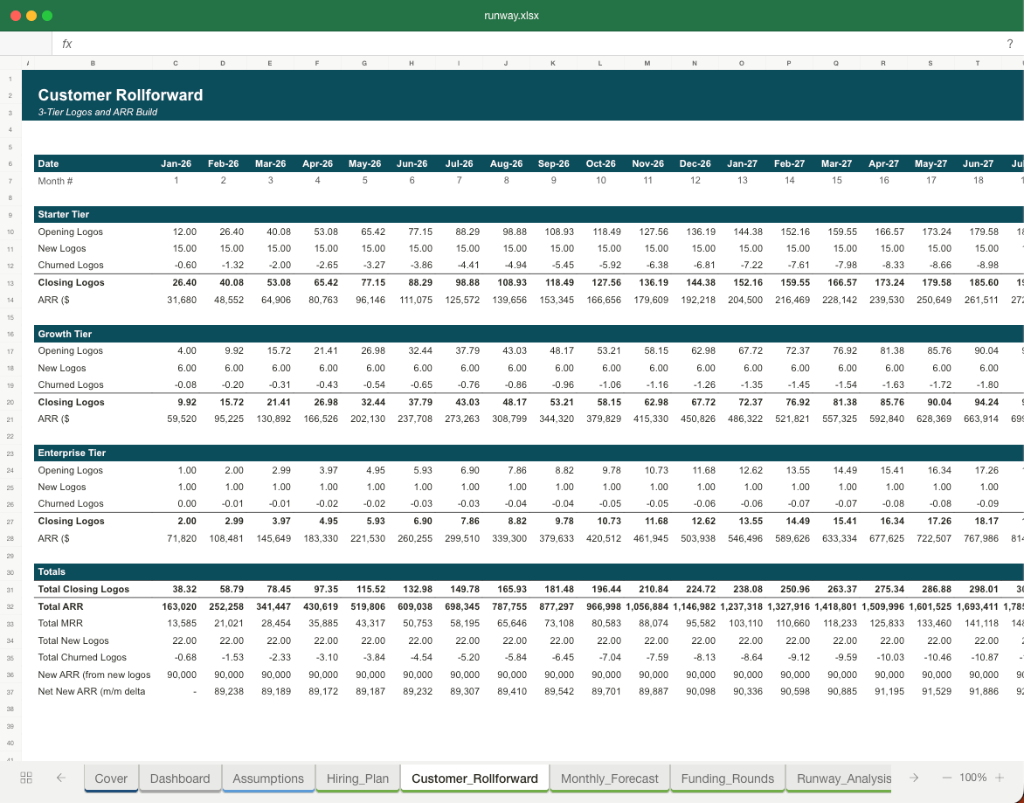
A 5-year monthly forecast with P&L, cash flow and runway, valuation (exit multiple plus a DCF cross-check), MOIC/IRR returns, and unit economics, with live formulas throughout.
How was this model built?+
It was built from Voro's pitch deck and publicly available information, then structured to investment-banking standards as a fully editable Excel model.
Can I change the assumptions?+
Yes. You can change assumptions and the live formulas will recalculate in the downloadable Excel model.
Have more financial modelling questions? Contact us

Created by ex-finance professionals
Hey, I’m Alex and I created Finamodel.
Over my years in the finance industry I kept building the same models over and over again. Same structure, same assumptions, different logo. So I started building frameworks to turn them into clean, reusable templates.
Every model here is one I’d actually use for a client, and I personally vet each one before it goes up.
I’m not an expert in every industry, but I’ve built enough models to know what belongs in one. And when something is completely foreign to me, I reach out to my network for experts to work on our models with us.
Having a template library on hand cuts a first build from hours to minutes.
Need help finding your model? You’ll find me in the Finamodel app!
Other InsurTech Startup Financial Models
Browse another startup in the same category.
Ark Kapital
AI-powered precision lending platform for European tech startups, providing non-dilutive growth loans using real-time raw data analytics.

Battleface
Tech-enabled travel insurance platform covering high-risk and non-standard destinations globally, sold direct and via B2B2C partners.
Beam
Digital-first dental insurance company selling group dental (and ancillary) benefits to employers via brokers

Branch
Tech-enabled home & auto insurance company operating as a reciprocal exchange, selling bundled policies via embedded, direct, and agency channels.
Cachet
B2B2C insurtech marketplace offering flexible, usage-based insurance products to gig/platform economy workers via partnerships with ride-hailing, delivery, and gig platforms.

Caura
Mobile app that aggregates all car-related payments (parking, congestion/ULEZ, tolls, tax, insurance) into a single platform, with insurance comparison as a key monetisation layer.

Clark
Digital insurance broker (Makler) providing a robo-advisor + human expert hybrid platform to manage and purchase all insurance lines via mobile app

Counterpart
Digital MGA (managing general agent) selling D&O and management liability insurance to US SMEs via a tech-enabled underwriting platform.