 Weekend Fund 3.0 Financial Model
Enterprise/Security Startup Financials (Free Excel Download)
Weekend Fund is a pre-seed/seed stage venture fund raising Fund 3.0, led by Ryan Hoover (founder of Product Hunt).



professionals from Deloitte
Used by professionals from






About this model
Weekend Fund 3.0 is a pre-seed and seed venture fund led by Product Hunt founder Ryan Hoover. Its LP proposition is access to early deal flow, brand-led sourcing, and portfolio support, rather than revenue from an operating company.
The fund targeted $18 million, following a $3 million Fund 1 in 2017 and a $10 million Fund 2 in 2019. Management fees and carried interest are its economics, while LP outcomes depend on deployment, ownership, reserves, portfolio value, and exit timing.
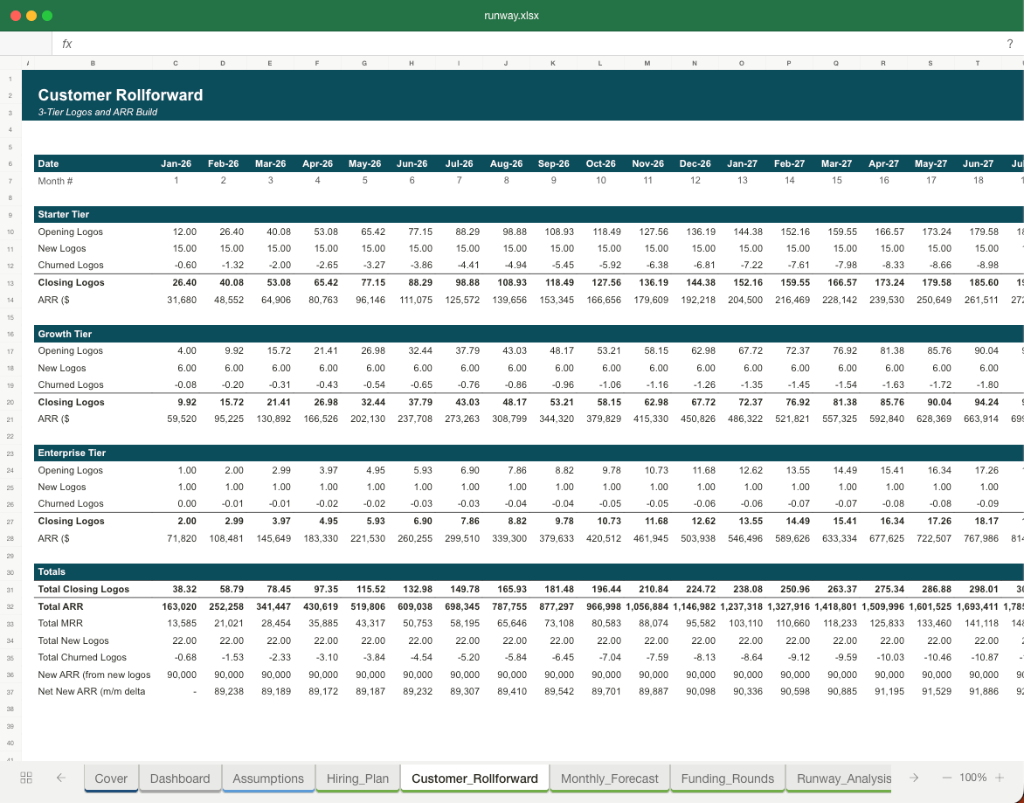
The model schedules commitments, capital calls, investments, follow-ons, fees, valuations, exits, carry, and distributions. It produces a J-curve with DPI, TVPI, RVPI, and net IRR, allowing return scenarios for dilution, exit multiples, and holding periods.
A turnkey financial model
Live formulas, no hardcoded values
Outputs are driven by live formulas, so the workbook updates from its assumptions instead of relying on hardcoded results.
All assumptions in one tab
Inputs are clearly marked in the Assumptions tab and separated from calculations, making it clear what to change and what to leave intact.
Statements always balancing
For integrated-statement models, the balance sheet, cash flow, and supporting schedules tie through properly.
Distinct schedules for clarity
Debt, working capital, taxes, and cash flow can get messy quickly. We group calculations in clear schedules, not across disconnected tabs.
No hidden macros or external links
There are no unexplained external workbook links or macros to undermine auditability or portability.
Changes flow through the model
Update a key driver and see the impact carry through the forecast, financing, and return outputs. We never use hardcoded numbers in formulas.
About Weekend Fund 3.0
weekend.fund
How to build a detailed financial model for Weekend Fund 3.0
A complete walkthrough of the business, drivers, and assumptions behind the downloadable Weekend Fund 3.0 model - distilled from its pitch deck and publicly available information.
Product & value proposition
- Weekend Fund invests in pre-seed/seed technology startups capitalizing on early consumer behavior or technology shifts.
- Key differentiation: Ryan Hoover's brand and network via Product Hunt (375K LinkedIn, 165K Twitter, 180K Clubhouse followers) drives inbound deal flow and helps portfolio companies with PR, fundraising introductions, and hiring.
- Intentionally small fund size to remain competitive in early-stage deals and write meaningful checks ($150K–$250K).
- Value-add to founders: intros to co-investors and lead investors for next rounds; PR and go-to-market support; NPS of 86 from portfolio founders.
- AngelList back-office platform handles fund administration.
Revenue model
This is a fund, not a product company. Economics are standard VC fund terms:
- Management fee: 2% average annual (front-loaded) on $18M fund size = ~$360K/yr average gross; front-loading means higher fees in early years.
- Carry: 20% carried interest on profits above hurdle.
- Back-office cost: $25K/yr fee to AngelList.
- Follow-on reserves: 30% of fund (~$5.4M) reserved for follow-on investments.
- Early-stage deployment: 70% of fund (~$12.6M) into ~45 companies at $150K–$250K per check. Implied average check: ~$280K (12.6M / 45).
Traction & metrics
- Fund 1 (Apr 2017–Jun 2019): 3.26x TVPI, 36.5% IRR
- Fund 2 (Jun 2019–Present): 2.73x TVPI, 117.6% IRR
- Combined Fund 1+2: 84 portfolio companies
- Performance as of April 2021; returns partially unrealized
- AngelList data (Jan 2021, n=107 funds, min 10 investments): Weekend Fund placed in the "Good" quadrant - top-right on both FundPerfCalc Percentile (~80th percentile) and Markups over Baseline Score (~1.3–1.5)
- Portfolio NPS from founders: 86 (surveyed annually 2018–2021)
- Founder helpfulness survey: 57% "one of the most helpful investors," 29% "more helpful than average," 14% "as helpful as average," 0% below average
- Select portfolio markups cited: Deel ~10.1x (WF1 seed → Series B); InVideo 3.3x in 3 months (WF2 → Sequoia India Series A); one redacted co 7x valuation since initial meeting
- MainStreet: $14M ARR in under 10 months; raised $60M Series A (SignalFire)
Unit economics
Not applicable as an operating business. Fund-level unit economics:
- Average check size: $150K–$250K
- Target companies per fund: ~45 early-stage
- Follow-on reserve ratio: 30%
- Management fee as % of AUM: ~2%/yr
- Carry rate: 20%
Competition / moat
- Not framed as competitive analysis vs. other VC funds explicitly.
- Moat articulated as: brand/audience (Product Hunt community; Ryan's social following); proprietary deal flow from founders seeking WF before raising; ability to "sneak into" competitive rounds at a discount due to small check size; network of co-investors (a16z, Sequoia, Craft, Coatue, etc.).
- AngelList data cited as third-party validation of performance vs. 107 peer funds.
Team & funding ask / use of funds
- Ryan Hoover - General Partner. Founder of Product Hunt (backed by a16z + YC, acquired by AngelList). Co-author of *Hooked*. Stepped down as Product Hunt CEO Oct 2020 to focus full-time on Weekend Fund.
- Vedika Jain - Chief of Staff. Former Stripe Analyst, first PM at TrueLayer (6→80 headcount). Prior VC at Mithril Capital, Kalaari Capital, Kairos Society. London-based.
- Fund ask: $18M target fund size (may fluctuate slightly based on demand).
- Use of funds:
- ~$12.6M (70%) → ~45 early-stage investments at $150K–$250K
- ~$5.4M (30%) → follow-on reserves (pro-rata in later rounds; SPVs for large follow-ons)
- Management fee: ~2%/yr average on $18M (front-loaded)
- $25K/yr → AngelList back-office
- Investment period: 24 months.
- LP communication: bi-monthly updates.
Recommended financial model
- Archetype + why: VC Fund Economics / LP Waterfall model. This is a fund raise, not an operating company. The right model is a fund-level cash flow and return waterfall - deploying capital, earning management fees, marking up/down a portfolio, then distributing proceeds via a carried-interest waterfall to GP and LPs.
- Forecast horizon & granularity:
- Investment period: Years 1–2 (24-month deployment)
- Hold period: Years 3–10 (typical pre-seed fund life ~10 years)
- Annual granularity for J-curve and cash flows; quarterly optional for deployment schedule
- Key drivers & assumptions:
- Fund size: $18M
- Early-stage allocation: 70% ($12.6M)
- Follow-on reserve: 30% ($5.4M)
- Number of portfolio companies: ~45
- Average initial check: $150K–$250K; model midpoint $200K; implied ~45 companies
- Management fee: 2% average annual, front-loaded; model as 2.5% yr1–2, 1.5% yr3–5, 1% yr6–10 to approximate "front-loaded"
- Carry: 20%
- Back-office fee: $25K/yr to AngelList
- Deployment pace: 24 months; ~22–23 investments/yr split evenly
- Follow-on deployment timing: years 3–6 as portfolio companies raise Series A/B
- Loss ratio: 40% of companies return <1x (standard pre-seed); 40% return 1x–5x; 20% are outliers (>5x) - informed by prior fund TVPI of 3.26x and 2.73x
- Target fund TVPI: 3.0x–3.5x based on Fund 1+2 track record
- Exit timeline: avg 5–7 years to liquidity event (M&A or IPO)
- Recycling: not mentioned no recycling modeled unless FAQ clarifies
- Scenarios (Base / Bull / Bear - which variables flex):
- Bear: Loss ratio 55%; outlier rate 10%; TVPI ~1.8x
- Base: Loss ratio 40%; outlier rate 20%; TVPI ~3.0x
- Bull: Loss ratio 30%; outlier rate 30%; TVPI ~4.5x
- Primary flex variables: loss ratio, outlier MOIC (e.g. 10x vs 20x), exit timing
- Required sheets / outputs:
- Assumptions - fund terms, deployment schedule, fee schedule, loss/return distribution inputs
- Deployment Schedule - capital called by year, check sizes, company count
- Portfolio Returns - per-tranche MOIC distribution (loss / 1x–5x / outlier buckets), gross proceeds by year
- Management Fee & Expenses - fee income to GP, AngelList fee, net fund expenses
- J-Curve / Cash Flow - net cash flows to LPs (contributions + distributions) by year
- Waterfall - LP preferred return, GP catch-up, carried interest split (20/80)
- LP Summary - TVPI, DPI, RVPI, IRR by scenario
- GP Economics - total management fees + carry by scenario
- Dashboard - key outputs: fund TVPI, IRR, DPI, GP carry, LP net IRR vs gross IRR
Frequently asked
Is the Weekend Fund 3.0 financial model free?+
Yes. The Weekend Fund 3.0 model is a free Excel (.xlsx) download with live formulas. Sign up with your email and the workbook is yours to keep, review, and edit.
What's included in the model?+
A 5-year monthly forecast with P&L, cash flow and runway, valuation (exit multiple plus a DCF cross-check), MOIC/IRR returns, and unit economics, with live formulas throughout.
How was this model built?+
It was built from Weekend Fund 3.0's pitch deck and publicly available information, then structured to investment-banking standards as a fully editable Excel model.
Can I change the assumptions?+
Yes. You can change assumptions and the live formulas will recalculate in the downloadable Excel model.
Have more financial modelling questions? Contact us

Created by ex-finance professionals
Hey, I’m Alex and I created Finamodel.
Over my years in the finance industry I kept building the same models over and over again. Same structure, same assumptions, different logo. So I started building frameworks to turn them into clean, reusable templates.
Every model here is one I’d actually use for a client, and I personally vet each one before it goes up.
I’m not an expert in every industry, but I’ve built enough models to know what belongs in one. And when something is completely foreign to me, I reach out to my network for experts to work on our models with us.
Having a template library on hand cuts a first build from hours to minutes.
Need help finding your model? You’ll find me in the Finamodel app!
Other Enterprise/Security Startup Financial Models
Browse another startup in the same category.
AgBiome
AgBiome is a microbial-platform agtech company that discovers, develops, and commercialises biological crop protection products (and licences the platform across adjacent markets).

Alation
Enterprise data intelligence platform - data catalog, governance, and metadata management for large organisations.

Archer SPAC
Archera
Cloud resource automation platform that continuously optimizes AWS commitment purchases, de-risks overcommitment, and automates FinOps workflows.

Ardoq
Cloud-native Enterprise Architecture (EA) SaaS platform that helps large enterprises navigate digital transformation through automated data collection, graph-based architecture modelling, and change impact analysis.

Ascend
Ascend.io is an enterprise big data automation platform ("Enterprise Intelligence Platform") that abstracts away the complexity of big data engineering so non-experts can build and run data pipelines.

Athennian
Cloud-based legal entity management system (EMS) uniting entity data with workflow and document automation.

Auditboard
Cloud-based integrated risk management platform connecting audit, risk, compliance, and ESG teams across the enterprise.