 Woven Financial Model
Enterprise/Security Startup Financials (Free Excel Download)
Intelligent calendar platform that unifies fragmented time data, applies ML/NLP to surface context, and enables rich scheduling collaboration for executives and their admins.



professionals from Deloitte
Used by professionals from






About this model
Woven is an intelligent calendar platform that unifies fragmented time data and applies ML and NLP to surface context and improve scheduling collaboration. It is designed for executives and their administrative partners.
The company is a recurring enterprise productivity SaaS business, with a two-persona opportunity across executive and admin seats. A freemium executive tier and paid administrative or company deployment are plausible routes, although pricing was not disclosed.
The model uses seats and companies as ARR drivers, tracking trials, paid conversion, executive-admin adoption, expansion, and churn. Product delivery, integrations, gross margin, sales assistance, customer support, and cash runway complete the plan.
A turnkey financial model
Live formulas, no hardcoded values
Outputs are driven by live formulas, so the workbook updates from its assumptions instead of relying on hardcoded results.
All assumptions in one tab
Inputs are clearly marked in the Assumptions tab and separated from calculations, making it clear what to change and what to leave intact.
Statements always balancing
For integrated-statement models, the balance sheet, cash flow, and supporting schedules tie through properly.
Distinct schedules for clarity
Debt, working capital, taxes, and cash flow can get messy quickly. We group calculations in clear schedules, not across disconnected tabs.
No hidden macros or external links
There are no unexplained external workbook links or macros to undermine auditability or portability.
Changes flow through the model
Update a key driver and see the impact carry through the forecast, financing, and return outputs. We never use hardcoded numbers in formulas.
About Woven
woven.com
How to build a detailed financial model for Woven
A complete walkthrough of the business, drivers, and assumptions behind the downloadable Woven model - distilled from its pitch deck and publicly available information.
Product & value proposition
Three-layer value prop:
- Fragmentation fix - "One Meeting" representation that brokers interactions across Exchange, Office 365, Google, CalDAV, TeamSnap, FB Events, Evite, etc. so the same meeting is never duplicated.
- Intelligence - ML/NLP engine auto-detects meeting type and tags, enriched data-driven actions/triggers, assisted scheduling, analytics & portfolio analysis.
- Rich permissions & collaboration - granular transient sharing beyond "all / free-busy / nothing"; enables admin delegation, third-party integrations (HR, recruiting, CRM, customer service).
Product surfaces: mobile (iOS, Android), web. Two key UX modes: Executive View and Admin View (separate personas with differentiated workflows).
Competition / moat
Competitors segmented into four buckets:
- Office Suites w/ Calendar (Strong Competition): Microsoft, Google, + others.
- Calendar Apps (Weak Competition): Fantastical, Calendars 5, aCalendar+, + 100s more.
- Bots & Smart Assistants (Weak Competition): WizCal, Clara Labs, x.ai, + 10s more.
- Optimizers & Analytics (Weak Competition): BogushTech, Esper, Priority Matrix, + 10s more.
Moat framing: deep ML/NLP calendar intelligence, "One Meeting" canonical representation, and rich two-sided admin/exec collaboration layer - areas where Microsoft and Google do not compete on intelligence or admin-delegation depth.
Team & funding ask / use of funds
Team:
- Tim Campos - Co-founder & CEO. Former Facebook CIO (6+ yrs, scaled 1,400 → ~12,000 employees). Prior CIO at KLA-Tencor; engineering roles at Sybase, Silicon Graphics. BS/MS EE+CS + MBA, UC Berkeley.
- Burc Arpat - Co-founder & CTO. Sr. Engineering Manager at Facebook (4 yrs, sales/marketing/ads products). Staff Engineer at Google Search Infrastructure (3 yrs). PhD Stanford (spatial statistics/ML/NLP). MBA UC Berkeley. Several ML/NLP/analytics patents.
Recommended financial model
- Archetype + why: B2B SaaS ARR model. The product is clearly a recurring-subscription enterprise software play (per-seat or per-company licensing is the natural fit). Two-persona selling (exec + admin seat) suggests a team/company seat model, potentially with a freemium exec tier and paid admin tier, but no pricing is confirmed.
- Forecast horizon & granularity: 5 years (Year 1–5), monthly granularity for Years 1–2, annual for Years 3–5. Seed-stage company needs cash runway detail.
- Key drivers & assumptions:
- Starting headcount (sales, eng, G&A)
- ACV (annual contract value) per customer
- New logo wins per month
- Gross retention / logo churn rate
- Net revenue retention
- Gross margin
- CAC (blended sales + marketing spend / new logos)
- Sales cycle length
- Seed raise amount and burn rate
- Runway to Series A
- Scenarios (Base / Bull / Bear - which variables flex):
- Base: 2 new logos/month Year 1, $20k ACV, 85% retention, 24-month runway.
- Bull: 4 new logos/month, $30k ACV, 90% retention, faster enterprise adoption driven by ex-Facebook network.
- Bear: 1 new logo/month, $15k ACV, 80% retention, longer sales cycles pushing revenue growth out 6–12 months.
- Required sheets / outputs:
- Assumptions (all drivers, toggle scenarios)
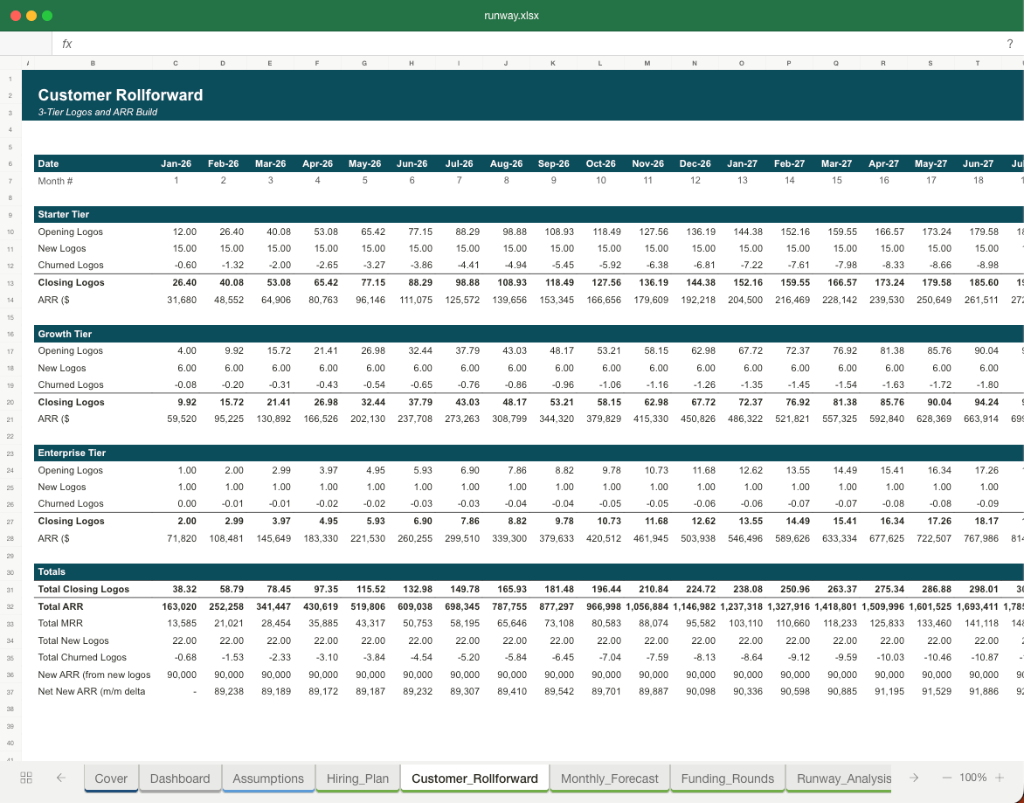
- Revenue build (new logos × ACV, churn waterfall, expansion, ARR bridge)
- P&L (revenue, COGS, gross profit, OpEx by department, EBITDA)
- Headcount plan (by role/department, linked to OpEx)
- Cash flow & runway (burn rate, funding tranches, months to zero)
- SaaS metrics summary (ARR, MRR, ACV, CAC, LTV, LTV:CAC, payback period, NRR, gross retention)
- Dashboard / KPI summary
Frequently asked
Is the Woven financial model free?+
Yes. The Woven model is a free Excel (.xlsx) download with live formulas. Sign up with your email and the workbook is yours to keep, review, and edit.
What's included in the model?+
A 5-year monthly forecast with P&L, cash flow and runway, valuation (exit multiple plus a DCF cross-check), MOIC/IRR returns, and unit economics, with live formulas throughout.
How was this model built?+
It was built from Woven's pitch deck and publicly available information, then structured to investment-banking standards as a fully editable Excel model.
Can I change the assumptions?+
Yes. You can change assumptions and the live formulas will recalculate in the downloadable Excel model.
Have more financial modelling questions? Contact us

Created by ex-finance professionals
Hey, I’m Alex and I created Finamodel.
Over my years in the finance industry I kept building the same models over and over again. Same structure, same assumptions, different logo. So I started building frameworks to turn them into clean, reusable templates.
Every model here is one I’d actually use for a client, and I personally vet each one before it goes up.
I’m not an expert in every industry, but I’ve built enough models to know what belongs in one. And when something is completely foreign to me, I reach out to my network for experts to work on our models with us.
Having a template library on hand cuts a first build from hours to minutes.
Need help finding your model? You’ll find me in the Finamodel app!
Other Enterprise/Security Startup Financial Models
Browse another startup in the same category.
AgBiome
AgBiome is a microbial-platform agtech company that discovers, develops, and commercialises biological crop protection products (and licences the platform across adjacent markets).

Alation
Enterprise data intelligence platform - data catalog, governance, and metadata management for large organisations.

Archer SPAC
Archera
Cloud resource automation platform that continuously optimizes AWS commitment purchases, de-risks overcommitment, and automates FinOps workflows.

Ardoq
Cloud-native Enterprise Architecture (EA) SaaS platform that helps large enterprises navigate digital transformation through automated data collection, graph-based architecture modelling, and change impact analysis.

Ascend
Ascend.io is an enterprise big data automation platform ("Enterprise Intelligence Platform") that abstracts away the complexity of big data engineering so non-experts can build and run data pipelines.

Athennian
Cloud-based legal entity management system (EMS) uniting entity data with workflow and document automation.

Auditboard
Cloud-based integrated risk management platform connecting audit, risk, compliance, and ESG teams across the enterprise.