 YuLife Financial Model
InsurTech Startup Financials (Free Excel Download)
Gamified group life insurance and employee wellbeing platform sold B2B to employers in the UK.



professionals from Deloitte
Used by professionals from






About this model
YuLife is a gamified group life-insurance and employee-wellbeing platform sold to UK employers. Its app uses activity, mindfulness, rewards, coaching, and benefits to engage members while providing life and related insurance cover.
Employers pay group insurance premiums, with YuLife acting as an MGA or distributor alongside an implied platform fee. The app had 62% download, 56% monthly active, and 36% daily active rates among covered employees, supporting a differentiated engagement proposition.
The model combines insurance commission with employer SaaS revenue. Employer groups, covered employees, premium, commission, platform fee, engagement, retention, and rewards cost determine revenue. Broker channels, cross-sell, and insurer economics drive margin.
A turnkey financial model
Live formulas, no hardcoded values
Outputs are driven by live formulas, so the workbook updates from its assumptions instead of relying on hardcoded results.
All assumptions in one tab
Inputs are clearly marked in the Assumptions tab and separated from calculations, making it clear what to change and what to leave intact.
Statements always balancing
For integrated-statement models, the balance sheet, cash flow, and supporting schedules tie through properly.
Distinct schedules for clarity
Debt, working capital, taxes, and cash flow can get messy quickly. We group calculations in clear schedules, not across disconnected tabs.
No hidden macros or external links
There are no unexplained external workbook links or macros to undermine auditability or portability.
Changes flow through the model
Update a key driver and see the impact carry through the forecast, financing, and return outputs. We never use hardcoded numbers in formulas.
About YuLife
yulife.com
How to build a detailed financial model for YuLife
A complete walkthrough of the business, drivers, and assumptions behind the downloadable YuLife model - distilled from its pitch deck and publicly available information.
Product & value proposition
Three-pillar model branded ENGAGE / PREVENT / PROTECT:
- ENGAGE - YuLife app: step tracking, mindfulness, gamification (200+ levels, quests, streaks, leaderboards). Members earn YuCoin for daily healthy activity, redeemable for vouchers at Amazon, Nike, ASOS, Avios, Tesco, John Lewis, Decathlon, Calm, Fitbit, Garmin, etc..
- PREVENT - YuMatter EAP (mental health counselling, virtual GP, financial support, career coaching, will-writing, second medical opinion via Best Doctors, nutrition plans).
- PROTECT - Group Life Insurance (Death in Service), Group Income Protection, Group Critical Illness; underwritten via AIG and RGA, backed by Bupa.
B2B distribution: employer buys a group policy; employees download the app and receive insurance + wellbeing benefits. HR gets analytics dashboard with anonymised wellbeing, engagement, and billing data.
Market
- £3 trillion global life protection gap.
- UK life insurance industry: >£100bn market, 200-year-old incumbents.
- 66% of UK professionals are uninsured.
- 60% of UK women with a dependent child have no life cover.
- UK has the third-highest life insurance gap in Europe.
- 80% of chronic disease could be eliminated by lifestyle choices.
- Covid-19 tailwind: 56% of adults report wellbeing impact; 38% high anxiety; 55% decline in financial wellbeing.
No SAM/SOM figures stated in deck. No explicit market-size numbers for the employee benefits / EAP sub-market.
Revenue model
Two interlinked revenue streams (not broken out numerically in deck):
- Insurance premium - Employer pays group insurance premiums. YuLife acts as an MGA / distributor; risk is underwritten by AIG/RGA. Revenue is likely a commission or net premium retained margin.
- Platform / SaaS fee - Implied by the HR dashboard, account management, and billing described as a separate employer-facing tool. No explicit SaaS fee disclosed.
Reward currency (YuCoin) is funded by employer budgets or brand partnerships (Amazon, Nike, ASOS, Avios, etc.) - cost item for YuLife or passed through to partners.
Pricing model: per-employee-per-month embedded in group insurance quote. No per-seat price or ARPU stated in deck.
Traction & metrics
All figures from slide 19 unless noted:
| Metric | Value |
|---|---|
| App download rate | 62% of covered employees |
| Avg Monthly Active Users | 56% of covered employees |
| Avg Daily Active Users | 36% of covered employees |
| 18-month retention | 47% |
| Avg daily steps (YuLifers) | 6,134 (vs. UK avg 3,100) |
| Meditation per week (avg) | 84 min |
| Wellbeing survey: "live healthier" | 67% |
| Wellbeing survey: "feel happier" | 87% |
| Wellbeing survey: "feel more energised" | 87% |
| Wellbeing survey: "feel more positive at work" | 85% |
| Survey sample | 305 members |
Clients visible on slide 24: Mintel, Vodafone, Havas, What3Words, Landbay, Signal, Fladgate, SSAFA, and ~10 others. Total customer count not stated.
Trustpilot score: 4.8 (vs. Perkbox 4.4, LifeWorks 2.9, Canada Life UK 2.5, Unum UK 3.6, Zurich 3.1, Aviva UK 1.6).
No revenue, ARR, GWP, or employee headcount disclosed in deck.
Competition / moat
Direct competitive comparison on Trustpilot only. Competitors implied: Perkbox (rewards/perks), LifeWorks (EAP), Canada Life, Unum, Aviva, Zurich (traditional life/group insurers).
Moat claims:
- Behavioural-science-driven engagement loop (YuCoin reward currency locks in daily app habit).
- Dynamic underwriting: healthy behaviours feed back into risk pricing.
- High Trustpilot score relative to incumbents.
- Insurance-backed by established carriers (AIG, RGA, Bupa) - regulatory and balance-sheet credibility.
- Partnerships with Fitbit, Garmin, Calm, Teladoc, Workplace Options, FIIT.
Team & funding ask / use of funds
Founders:
- Sammy Rubin - CEO; ex-VitalityLife
- Sam Fromson - COO; ex-Orbis
- Josh Hart - CT&PO; ex-Chelsea Apps Factory
- Jonathan Roomer - Head of CS; ex-KPMG
- Jaco Oosthuizen - Chief Insurance Officer; ex-Multiply
- Dr. Rangan Chatterjee - Chief Wellbeing Officer
Advisors: Herschel Mayers (ex-CEO Discovery Life), Ricard Verdin (ex-MD RGAx, ex-CEO Aviva Life).
Funding: £13m across Seed and Series A. Investors: Creandum, Notion, Anthemis, MMC, LocalGlobe.
Series A hires: Lauren Berkemeyer (VP Marketing, ex-WSJ/LifeWorks), Keith Bale (Head of Sales, ex-Unum), Steve Harry (CFO, ex-Aviva/Unum).
Recommended financial model
Archetype + why: Insurance GWP / loss-ratio model combined with B2B SaaS ARR - because revenue has two components: (1) group insurance premium (GWP), from which YuLife earns a commission or MGA margin, and (2) an implied platform/account-management fee per employer. The engagement metrics (MAU, DAU, retention) directly drive underwriting risk reduction and renewal probability, so a combined model is needed.
Forecast horizon & granularity:
- 5-year annual model (Year 1–5), monthly detail for Year 1.
- Unit: employer clients × avg employees per client × GWP per employee.
Key drivers & assumptions:
| Driver | Seed / Source |
|---|---|
| New employer clients added per year | Start ~30 in Y1, grow 60–80% YoY; no headcount or sales pipeline disclosed |
| Avg employees per employer | ~150–300 (SME to mid-market mix based on client logos on slide 24) |
| Annual GWP per employee (group life) | ~£100–£200/yr (UK group life typical range) |
| YuLife commission / MGA margin on GWP | 15–25% (typical MGA range) |
| Platform fee per employer per month | £0 or bundled; unclear - flag as open question |
| App download rate (% of covered lives) | 62% |
| Monthly active user rate | 56% of covered lives |
| 18-month employer renewal rate | 80–90%; no churn data disclosed; proxy: 47% 18-month user retention |
| Loss ratio (claims / GWP) | ~20–35% for group life (young workforce, wellbeing-driven); wellness discount benefit to risk carrier assumed passed through to YuLife in pricing |
| Reward cost (YuCoin) per MAU per month | £2–£5; partially subsidised by brand partners |
| Headcount scaling | 10–20% of revenue; Series A team structure visible but no headcount count |
| CAC | £5k–£15k per employer (B2B broker/direct sales cycle); not in deck |
| Gross margin on insurance | 60–70% of commission revenue after reward costs |
Scenarios (Base / Bull / Bear - which variables flex):
- Base: 60% YoY client growth; avg 200 employees/client; 20% MGA margin; 85% renewal.
- Bull: 100% YoY client growth; 300 employees/client; 22% margin; 90% renewal; platform fee introduced in Y2.
- Bear: 30% YoY client growth; 150 employees/client; 15% margin; 75% renewal; higher reward costs.
Required sheets / outputs:
- Assumptions - all drivers above with toggle for Base/Bull/Bear
- Client Cohort Build - new clients per year × avg employees × GWP × commission
- Revenue Bridge - GWP, commission, platform fee (if any), reward costs → gross profit
- P&L (simplified) - gross profit, S&M, R&D, G&A, EBITDA
- Headcount plan
- Cash & Runway - tied to £13m raised; model burn to next round
- KPI Dashboard - clients, covered lives, MAU, DAU, GWP, commission, gross margin %
Frequently asked
Is the YuLife financial model free?+
Yes. The YuLife model is a free Excel (.xlsx) download with live formulas. Sign up with your email and the workbook is yours to keep, review, and edit.
What's included in the model?+
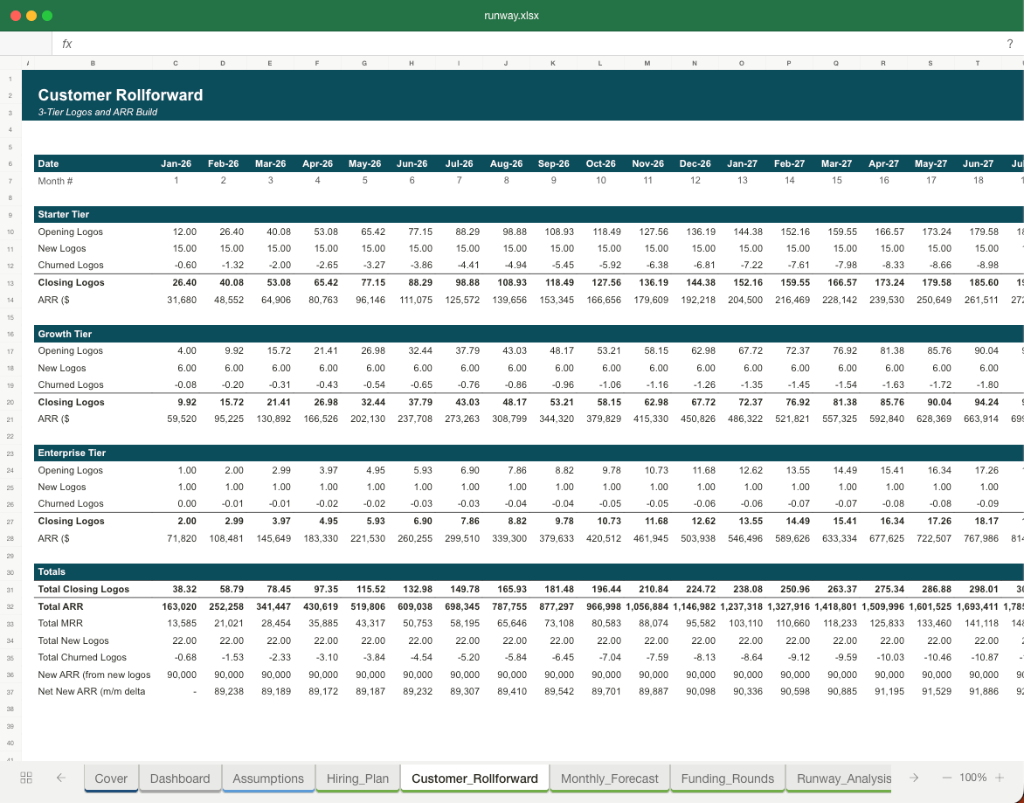
A 5-year monthly forecast with P&L, cash flow and runway, valuation (exit multiple plus a DCF cross-check), MOIC/IRR returns, and unit economics, with live formulas throughout.
How was this model built?+
It was built from YuLife's pitch deck and publicly available information, then structured to investment-banking standards as a fully editable Excel model.
Can I change the assumptions?+
Yes. You can change assumptions and the live formulas will recalculate in the downloadable Excel model.
Have more financial modelling questions? Contact us

Created by ex-finance professionals
Hey, I’m Alex and I created Finamodel.
Over my years in the finance industry I kept building the same models over and over again. Same structure, same assumptions, different logo. So I started building frameworks to turn them into clean, reusable templates.
Every model here is one I’d actually use for a client, and I personally vet each one before it goes up.
I’m not an expert in every industry, but I’ve built enough models to know what belongs in one. And when something is completely foreign to me, I reach out to my network for experts to work on our models with us.
Having a template library on hand cuts a first build from hours to minutes.
Need help finding your model? You’ll find me in the Finamodel app!
Other InsurTech Startup Financial Models
Browse another startup in the same category.
Ark Kapital
AI-powered precision lending platform for European tech startups, providing non-dilutive growth loans using real-time raw data analytics.

Battleface
Tech-enabled travel insurance platform covering high-risk and non-standard destinations globally, sold direct and via B2B2C partners.
Beam
Digital-first dental insurance company selling group dental (and ancillary) benefits to employers via brokers

Branch
Tech-enabled home & auto insurance company operating as a reciprocal exchange, selling bundled policies via embedded, direct, and agency channels.
Cachet
B2B2C insurtech marketplace offering flexible, usage-based insurance products to gig/platform economy workers via partnerships with ride-hailing, delivery, and gig platforms.

Caura
Mobile app that aggregates all car-related payments (parking, congestion/ULEZ, tolls, tax, insurance) into a single platform, with insurance comparison as a key monetisation layer.

Clark
Digital insurance broker (Makler) providing a robo-advisor + human expert hybrid platform to manage and purchase all insurance lines via mobile app

Counterpart
Digital MGA (managing general agent) selling D&O and management liability insurance to US SMEs via a tech-enabled underwriting platform.