Deposit Insurance Premium Assessment Tracker
Banking Financial Model (Excel Download)
Check your bank's deposit insurance premium before you book or pay it. The workpaper rebuilds the assessment base from daily data, reconciles deposit records and ties the invoice to each part.



professionals from Deloitte






About this model
A deposit protection premium workpaper for bank finance and treasury teams. It calculates the quarterly premium, reconciles the underlying records and checks the invoice. The shipped case is a fictional bank under an FDIC-style ordinary quarterly method, with 92 daily records and 75 account records.
The assessment base is daily average total assets less average tangible equity and approved deductions. The approved annual rate in basis points is applied for a quarter. Available credits and prior adjustments give the net invoice, which is compared with the booked provision. Monthly deposit records are reconciled to the daily extract and the general ledger.
On the shipped case the assessment base is $136.8m and the rate is 11bps, giving a gross premium of $37,610. After credits and adjustments the estimated net invoice is $34,610 against a $38,000 provision, a proposed release of $3,390. The received invoice is $290 above the model, beyond the $100 tolerance, so it is held for review.
What every model includes
Live formulas, no hardcoded values
Outputs are driven by live formulas, so the workbook updates from its assumptions instead of relying on hardcoded results.
All assumptions in one tab
Inputs are clearly marked in the Assumptions tab and separated from calculations, making it clear what to change and what to leave intact.
Statements always balancing
For integrated-statement models, the balance sheet, cash flow, and supporting schedules tie through properly.
Distinct schedules for clarity
Debt, working capital, taxes, and cash flow can get messy quickly. We group calculations in clear schedules, not across disconnected tabs.
No hidden macros or external links
There are no unexplained external workbook links or macros to undermine auditability or portability.
Changes flow through the model
Update a key driver and see the impact carry through the forecast, financing, and return outputs. We never use hardcoded numbers in formulas.
What's inside the Deposit Insurance Premium Assessment Tracker
- Daily averages of total assets, tangible equity and deposits
- Assessment base as average assets less tangible equity and deductions
- Approved annual rate applied for the quarter
- Credits used and signed prior adjustment
- Estimated net invoice against booked provision
- Proposed provision release or top-up
- Account-level deposit records with domestic and foreign split
- Monthly reconciliation of records, daily data and GL



Formatted to IB standards
Named theme colors repaint the whole workbook in one click, on top of an investment-banking structure with clear input, output, and cross-sheet reference styling - brand-ready, institutional-grade, and fully auditable.

Created by ex-finance professionals
Hey, I’m Alex and I created Finamodel.
Over my years in the finance industry I kept building the same models over and over again. Same structure, same assumptions, different logo. So I started building frameworks to turn them into clean, reusable templates.
Every model here is one I’d actually use for a client, and I personally vet each one before it goes up.
I’m not an expert in every industry, but I’ve built enough models to know what belongs in one. And when something is completely foreign to me, I reach out to my network for experts to work on our models with us.
Having a template library on hand cuts a first build from hours to minutes.
Frequently asked
What is a deposit protection premium?+
Banks pay a premium to the deposit protection fund that insures customer deposits. The premium is usually a rate applied to an assessment base for each period, less any credits and adjustments.
How is the assessment base calculated here?+
The workbook uses daily average consolidated total assets less average tangible equity and any approved deductions. It does not substitute insured deposits for this base.
What happens when the invoice differs from the model?+
Each invoice component is compared with the modeled amount. If any difference is above the tolerance, the invoice is held. Review the bridge before posting or paying.
What are the limits?+
The method and rate are illustrative and based on a fictional memo. Review records are user entries, not authenticated regulator data. A zero deposit balance alone does not mean a zero premium.
How do I use it for my bank?+
Load the quarter's daily extract and month-end account records, enter the approved rate, credits and provision, then record the received invoice components.
Have more financial modelling questions? Contact us
Related templates
Prudential Return Data Reconciliation and Sign-Off Pack
Reconcile regulatory return lines to the ledger, approved adjustments and filed amounts, and control the sign-off.
Accounting Estimates Register
List each accounting estimate with its method, range, owner and review date, and control adjustments before posting.
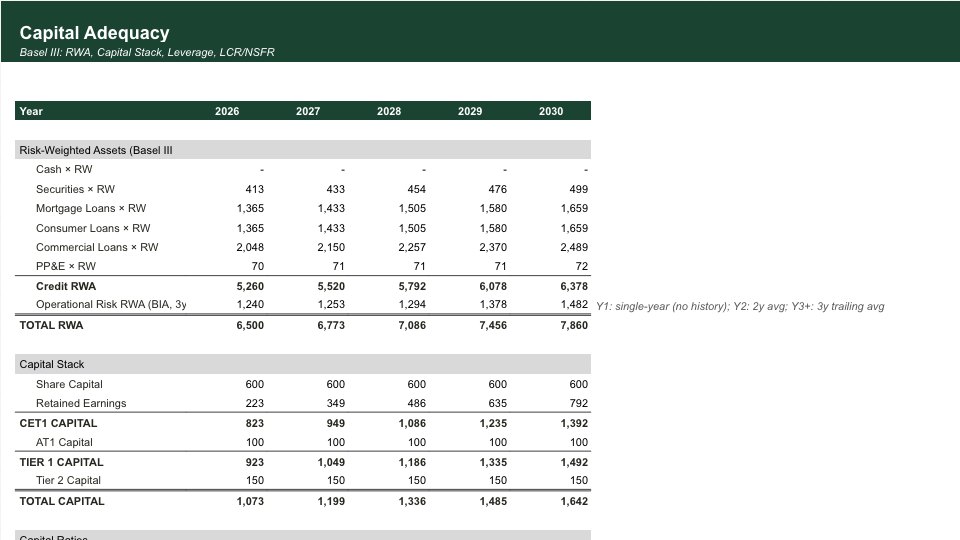
Bank Capital Adequacy Model
Regulatory capital calculations and stress testing for banks.
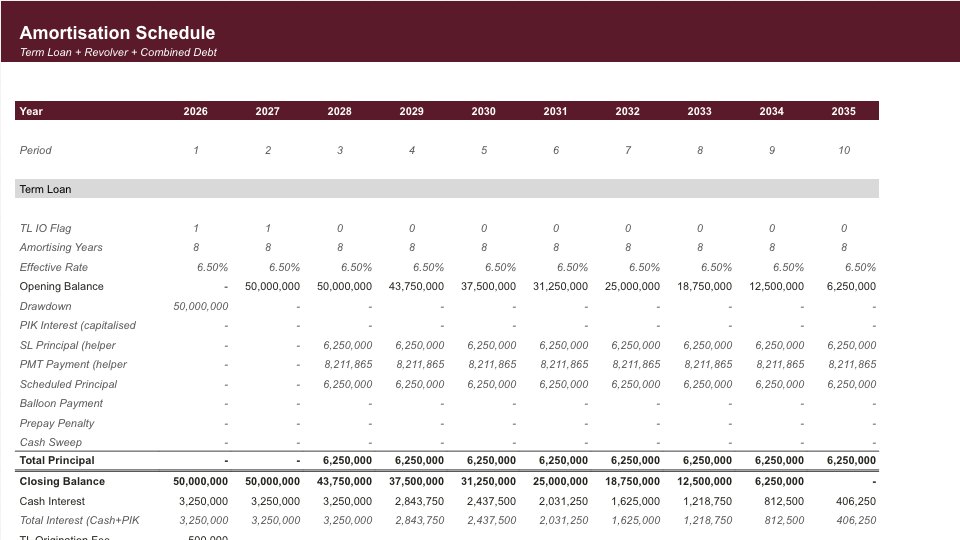
Bank Loan Analysis Model
Commercial bank loan origination and portfolio underwriting.







