


Maturing inventory value = closing barrels × barrel costDistillery Model
Consumer Financial Model (Free Excel Download)
Forecast distillery economics from production volume, aging inventory, wholesale and visitor sales, pricing, excise taxes, working capital, and equipment investment.
DownloadSign up to downloadFree, no credit card required
Edit in Excelprofessionals from Deloitte
Loading...
Used by professionals from






About this model
This model helps you assess a distillery producing and selling spirits through wholesale, direct-to-consumer, and visitor channels. It connects production plans and ageing inventory to pricing, distribution, tasting-room sales, and the costs of making and marketing the product.
Use it to evaluate a new distillery, production expansion, or brand growth plan. Test volume, product mix, release timing, and route to market to understand the cash requirements and returns.
What every model includes
Live formulas, no hardcoded values
Outputs are driven by live formulas, so the workbook updates from its assumptions instead of relying on hardcoded results.
All assumptions in one tab
Inputs are clearly marked in the Assumptions tab and separated from calculations, making it clear what to change and what to leave intact.
Statements always balancing
For integrated-statement models, the balance sheet, cash flow, and supporting schedules tie through properly.
Distinct schedules for clarity
Debt, working capital, taxes, and cash flow can get messy quickly. We group calculations in clear schedules, not across disconnected tabs.
No hidden macros or external links
There are no unexplained external workbook links or macros to undermine auditability or portability.
Changes flow through the model
Update a key driver and see the impact carry through the forecast, financing, and return outputs. We never use hardcoded numbers in formulas.
What's inside the Distillery Model
- Volume inputs: Year-1 wholesale, DTC, and export cases and growth, barrels filled and fill growth, cases per barrel, opening maturing stock
- Pricing: wholesale, DTC, and export price per case, price escalation, contract revenue and growth
- Cost structure: cost of goods, excise duty per case, labour, marketing and sales, and SG&A, barrel cost, depreciation, tax rate
- Capital and working capital: maintenance capex, growth capex, NWC change, base-year revenue
- Valuation: WACC, terminal growth, net debt, shares outstanding
- Production sheet: case volumes by channel and the barrel-maturation roll-forward
- Revenue sheet: wholesale, DTC, export, and contract and bulk revenue, total revenue
- P&L sheet: cost of goods, excise duty, labour, marketing, SG&A, EBITDA, depreciation, EBIT, tax, net income, identity check
Distillery Financial Model: How Barrel Maturation Drives Cash and Value
This distillery financial model captures the economics of a craft-spirits producer, where barrel maturation ties up cash for years before a bottle can be sold. It links production volumes and ageing inventory to channel pricing, excise duty, operating costs, and an unlevered DCF, showing how the maturing-stock build shapes free cash flow and enterprise value.
Operating Drivers: Demand, Pricing, and Channel Mix
The model runs on case volumes split across wholesale, tasting-room and direct-to-consumer, and export channels.
- Each channel grows from a Year-1 base at its own rate, with price per case escalating over time.
- A separate contract and bulk line sells barrels and new-make to other brands, providing early cash while the owned brand's stock ages.
- Because every channel carries its own volume and price assumptions, the model lets you test how changes in demand or mix ripple through revenue without hardcoding outcomes.
Barrel Maturation and the Maturing-Stock Roll-Forward
The distinguishing mechanic is barrel maturation. Barrels filled are set to run slightly ahead of barrels dumped, where dumping equals total cases divided by cases per barrel.
- Maturing stock rolls forward as opening barrels plus filled minus dumped, with opening Year 1 from an assumption and later years carrying prior close. Maturing inventory value equals closing barrels times barrel cost.
- Inventory cover, closing barrels divided by annual dumping, shows how many years of aged stock are on hand, a reserve metric that reveals whether future supply is likely to be adequate or thin.
From Revenue to Net Income and Free Cash Flow
Revenue minus cost of goods, excise duty per case removed from bond, labour, marketing and sales, and SG&A produces EBITDA.
- Depreciation and tax then lead to net income.
- Excise duty is a per-case charge on bottled volume, a feature that separates a spirits P&L from fast-turn beverage models.
- Unlevered free cash flow starts from NOPAT plus depreciation, subtracts maintenance and growth capital expenditure, then subtracts the maturing-stock build, calculated as barrels filled minus barrels dumped times barrel cost, plus changes in other working capital.
Outputs and Practical Use for Evaluation
The model produces a seven-year operating summary and a Dashboard with KPI cards, charts, and a Revenue-to-Net-Income bridge.
- A DCF discounts explicit unlevered free cash flow at WACC and adds a Gordon-growth terminal value to reach enterprise value, then subtracts net debt for equity value and value per share, with an implied EV/EBITDA cross-check.
- You can use it to explore a new distillery, production expansion, or brand growth by changing volume, product mix, release timing, and route to market to see the cash requirements and returns.
income_statement.xlsx
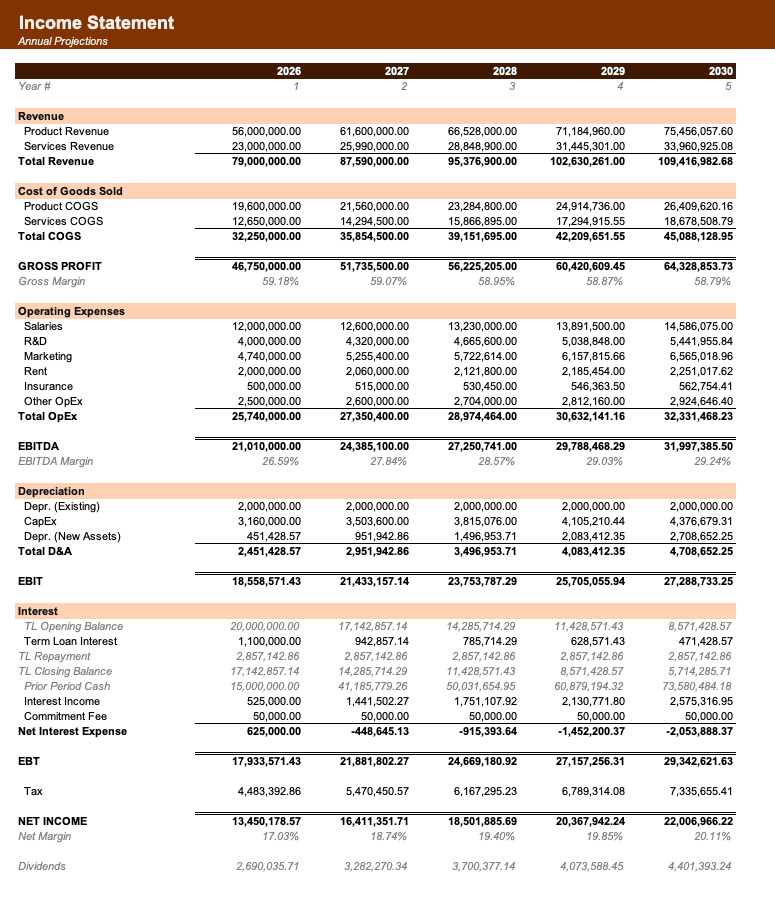
income_statement.xlsx
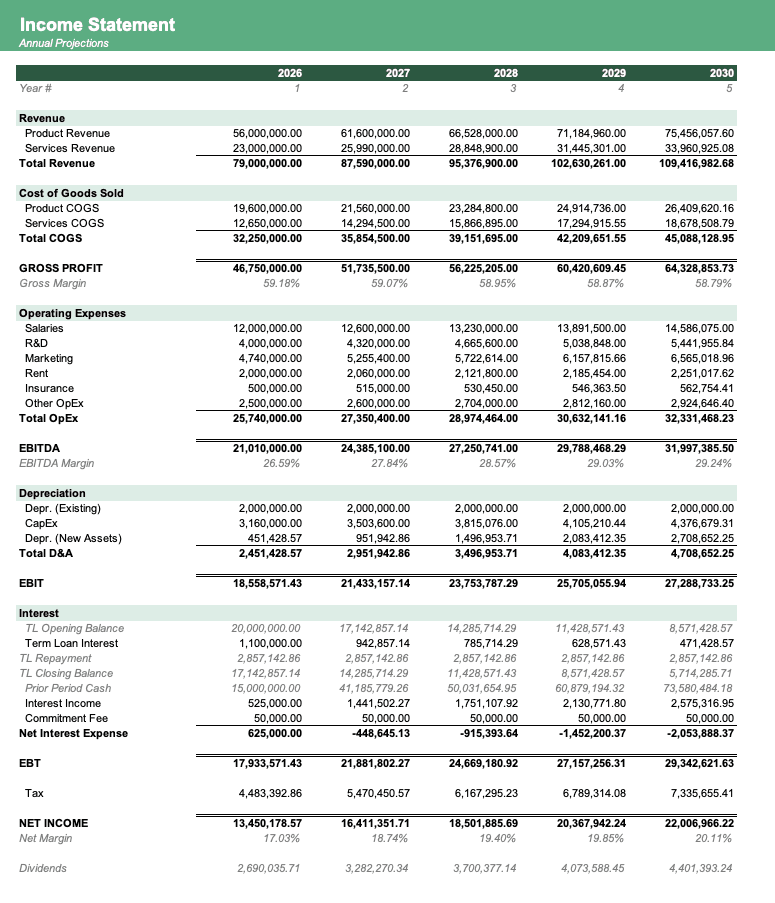
income_statement.xlsx
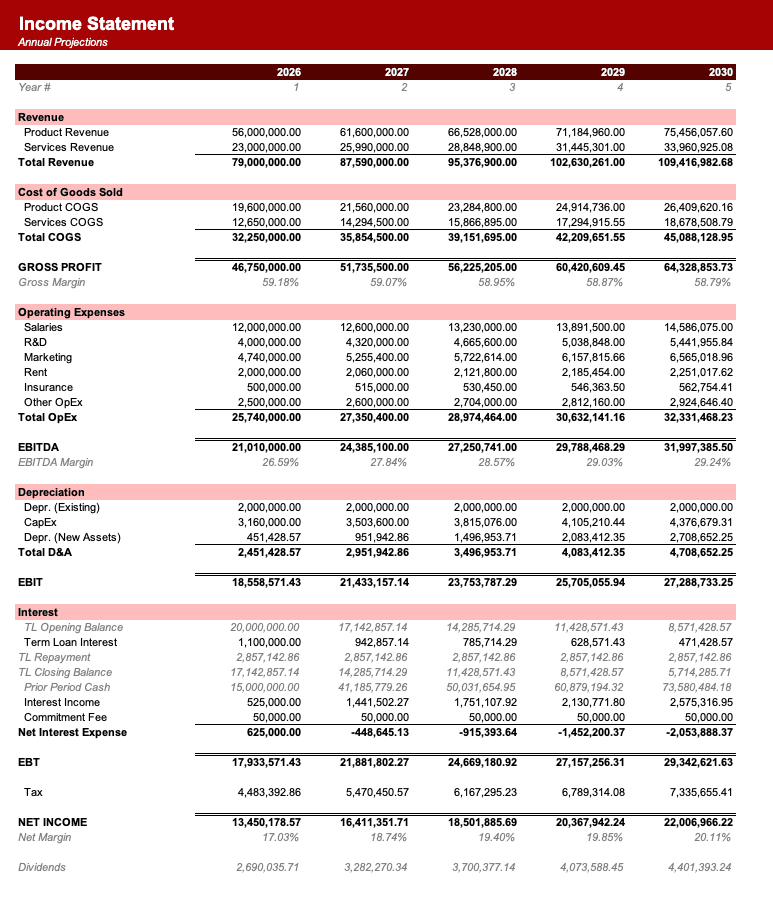
Formatted to IB standards
Named theme colors repaint the whole workbook in one click, on top of an investment-banking structure with clear input, output, and cross-sheet reference styling - brand-ready, institutional-grade, and fully auditable.

Created by ex-finance professionals
Hey, I’m Alex and I created Finamodel.
Over my years in the finance industry I kept building the same models over and over again. Same structure, same assumptions, different logo. So I started building frameworks to turn them into clean, reusable templates.
Every model here is one I’d actually use for a client, and I personally vet each one before it goes up.
I’m not an expert in every industry, but I’ve built enough models to know what belongs in one. And when something is completely foreign to me, I reach out to my network for experts to work on our models with us.
Having a template library on hand cuts a first build from hours to minutes.
Need help finding your model? You’ll find me in the Finamodel app!
Frequently asked
What is a distillery model?+
A distillery model captures the seven-year operating economics and intrinsic value of a craft-spirits producer. It rolls case volumes forward by channel, runs a barrel-maturation roll-forward, builds revenue across those channels plus a contract and bulk-distilling book, runs a margin-driven P&L with excise duty to net income, and discounts an unlevered free-cash-flow stream to enterprise value, equity value, and value per share. It is how a private-equity associate, founder, or lender values a distillery.
Why does barrel maturation matter so much?+
Whiskey and other aged spirits must mature in cask for years before they can be bottled and sold, so the business sinks cash into stock long before it earns revenue and permanently carries a large maturing-inventory balance. That ageing inventory is the single biggest working-capital drag on the model, which is why the roll-forward and the isolated maturing-stock build in the cash bridge are the whole point of modelling a distillery rather than a fast-turn beverage maker.
What is inventory cover and why watch it?+
Inventory cover is the closing maturing stock divided by annual dumping, the number of years of aged stock on hand at the current pull rate. Aged spirits need multi-year cover to keep bottling without running dry; thin cover signals a future supply gap, while very high cover ties up cash that could fund growth. The model reports it each year so the lay-down can be flexed against demand.
How is excise duty handled?+
Excise duty is charged per case removed from bond, on bottled volume rather than as a percentage of revenue, so it moves with cases sold and flexes independently of pricing. It sits as its own line in the P&L between cost of goods and the operating-cost stack, the way a spirits producer actually incurs the tax.
Can I make it a levered or single-still model?+
The template is a single-entity unlevered DCF. For an equity-IRR view, add a debt schedule and bridge to levered free cash flow; for a single still or single brand, set the channel volumes and the barrel fill rate to that operation. The net-debt line already bridges enterprise value to equity value, so a financing layer slots in cleanly.
Have more financial modelling questions? Contact us
Related templates
Brewery_Operations_Model.xlsx
Metric
2026
Revenue
--
EBITDA
--
Brewery Operations Model
Craft brewery financial projections with production and distribution.
Farm_Operations_Model.xlsx
Metric
2026
Revenue
--
EBITDA
--
Farm Operations Model
Agricultural business model with crop yields, commodity pricing, operating costs, and profitability.
Unit_Economics_Dashboard.xlsx
Metric
2026
Revenue
--
EBITDA
--
Unit Economics Dashboard
Track customer acquisition cost, lifetime value, payback period, and margins by customer segment.
Food_Manufacturing_Model.xlsx
Metric
2026
Revenue
--
EBITDA
--
Food Manufacturing Model
Operating model for food production and processing businesses with ingredient sourcing, production scheduling, and margin analysis.


