Brewery Model
Consumer Financial Model (Free Excel Download)
Plan brewery production and expansion using barrels sold, taproom and wholesale mix, pricing, gross margin, brewing capacity, equipment capex, and cash flow.



professionals from Deloitte
Used by professionals from






About this model
A craft brewery financial model projects revenue across wholesale (kegs and packaged), taproom (direct-to-consumer), and contract brewing channels, modelling production capacity constraints, channel-specific margins, and the profitability impact of shifting mix toward higher-margin taproom sales. The model answers what EBITDA margin is achievable given the brewhouse capacity ceiling, what working capital and debt the business can support, and when the brewery reaches free cash flow positive given capex requirements.
Revenue is driven by sellable barrel volumes (limited by brewhouse batch cycle, uptime, and shrinkage), channel mix (35% kegs, 40% packaged, 55% taproom in year 1, shifting over time), and price per barrel by channel ($175/BBL kegs, $155/BBL packaged, $350/BBL taproom equivalent). COGS includes raw materials ($35/BBL), packaging ($45/BBL for wholesale only), excise tax ($7/BBL federal rate), and direct labour (12% of COGS subtotal). Gross margin is 42–48% on wholesale and 78–83% on taproom, with blended margin improving from 62% to 65% as taproom mix grows. Operating expenses include rent, salaries, utilities, marketing (2.5% of revenue), insurance, maintenance (3% of PP&E), and G&A. The model tracks a 7-year straight-line principal amortisation on an equipment loan ($910K at 8.75%), and includes DSCR covenant monitoring (lender requirement 1.25x minimum). Working capital is positive given inventory build (45 DIO) and sales AR (25 DSO).
SBA lenders, craft breweries seeking to expand, strategic beverage companies, and hospitality PE sponsors use brewery models to size equipment loans, stress test revenue around beer price commodity volatility, and project when taproom customer loyalty can support store expansion.
What every model includes
Live formulas, no hardcoded values
Outputs are driven by live formulas, so the workbook updates from its assumptions instead of relying on hardcoded results.
All assumptions in one tab
Inputs are clearly marked in the Assumptions tab and separated from calculations, making it clear what to change and what to leave intact.
Statements always balancing
For integrated-statement models, the balance sheet, cash flow, and supporting schedules tie through properly.
Distinct schedules for clarity
Debt, working capital, taxes, and cash flow can get messy quickly. We group calculations in clear schedules, not across disconnected tabs.
No hidden macros or external links
There are no unexplained external workbook links or macros to undermine auditability or portability.
Changes flow through the model
Update a key driver and see the impact carry through the forecast, financing, and return outputs. We never use hardcoded numbers in formulas.
What's inside the Brewery Model
- Production capacity and utilisation forecast
- Taproom retail vs wholesale distribution revenue build
- Gross margin per barrel analysis by beer style
- Brewing equipment capex and depreciation schedules
- Excise tax, packaging, and spoilage mechanics
- Brewing capacity and utilization by production run
- Cost per barrel: raw materials, packaging, labor, and overhead allocation
- Product mix: house beers, limited releases, contract production
Inside the Brewery Model: Unit Economics, Cash Flow and Returns
This brewery model explains how a craft brewery's unit economics, taproom and wholesale channel mix, brewing equipment capital costs and per‑barrel margins are projected over a five‑year horizon. It shows the operating drivers, calculation flow and outputs of a full three‑statement build, so you can judge whether its structure fits your evaluation of an investment, loan or acquisition decision.
Rates and financial results described here reflect illustrative model settings, not industry benchmarks.
What the Brewery Model Projects
The model answers a specific investment question: should you invest in, lend to, or acquire a craft brewery, and what cash return does it produce over five years?
- It integrates four revenue streams—wholesale kegs, wholesale packaged cans, taproom direct sales and contract brewing—into a single three-statement structure with a debt schedule and a returns analysis.
- The brewery is treated as both a manufacturer and a hospitality operator, because its asset-heavy production economics and its near-100% margin taproom economics must be modelled separately and then summed at the revenue line.
Operating Drivers: Capacity and Channel Mix
Production volume defines the ceiling on revenue. A 15-barrel brewhouse on a 14-day batch cycle at 90% uptime gives roughly 4,745 barrels of maximum annual capacity.
- Actual production depends on a utilisation rate that rises from 40% to 80% across the projection, and sellable volume is reduced by shrinkage. Total capacity used includes contract brewing, so actual barrels plus contract barrels must stay within the cap.
- On the revenue side, channel mix is a primary margin lever: taproom sales command a higher price per barrel than wholesale, while the wholesale split between kegs and packaged cans reflects distribution development. Contract brewing uses surplus fermentation capacity at a low toll fee to absorb overhead.
Price escalation is applied annually, and mix shifts towards the highest-margin channel as the business scales.
Calculation Flow: COGS, Opex, Capex and Debt
Cost of goods sold is built per barrel. Raw materials, packaging and excise duty are applied to the appropriate volumes—packaging only to wholesale, excise to all sold volume—and direct production labour is grossed up as a percentage of those costs.
- Operating expenses are semi-fixed and escalated annually, with marketing tied to revenue and repairs tied to gross PP&E. Initial capital expenditure covers brewing equipment, taproom build-out, a canning line and other assets, depreciated straight-line.
- An equipment loan with an interest-only period and straight-line amortisation, plus a working-capital revolver, complete the funding side. Interest is calculated on opening balances, avoiding circularity.
Outputs, Checks and Practical Use
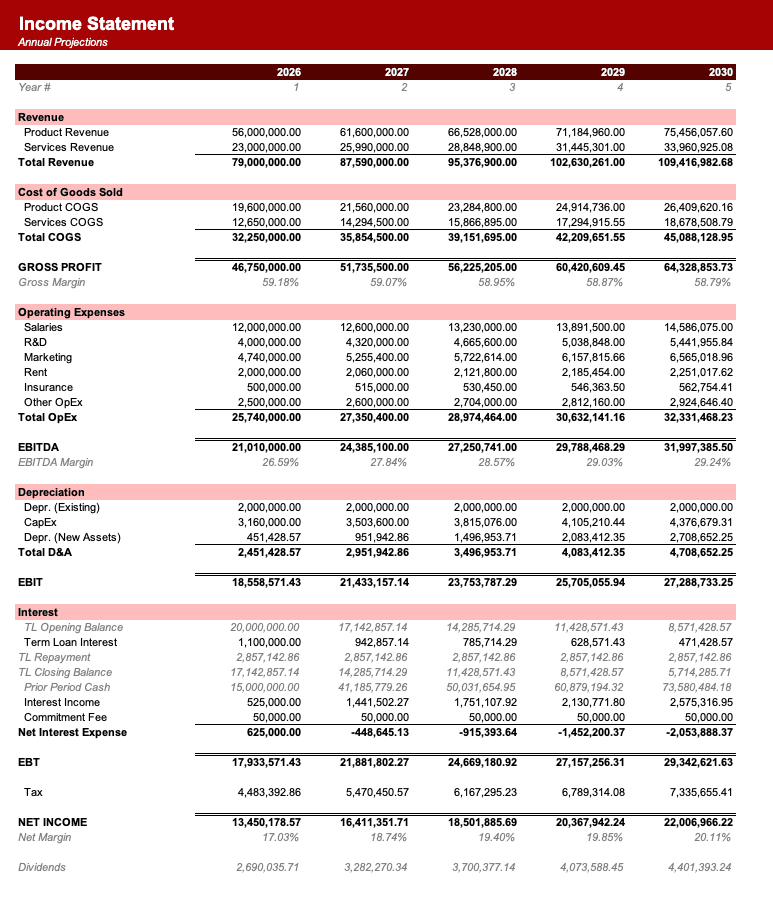
The model outputs a full income statement through to net income, with NOL carry-forward, a balance sheet, a cash flow statement and a debt schedule. It also produces returns metrics including IRR and MOIC under different utilisation and exit multiple scenarios.
- A checks sheet validates balance sheet integrity, capacity compliance, debt covenants and margin ranges. Because it tracks DSCR and peak cash trough, the model is practically useful for testing whether a brewery can service its debt while funding growth, and for comparing the cash impact of different channel mixes or capital structures.
- The downloadable public file is a values-only preview of the underlying template.
Formatted to IB standards
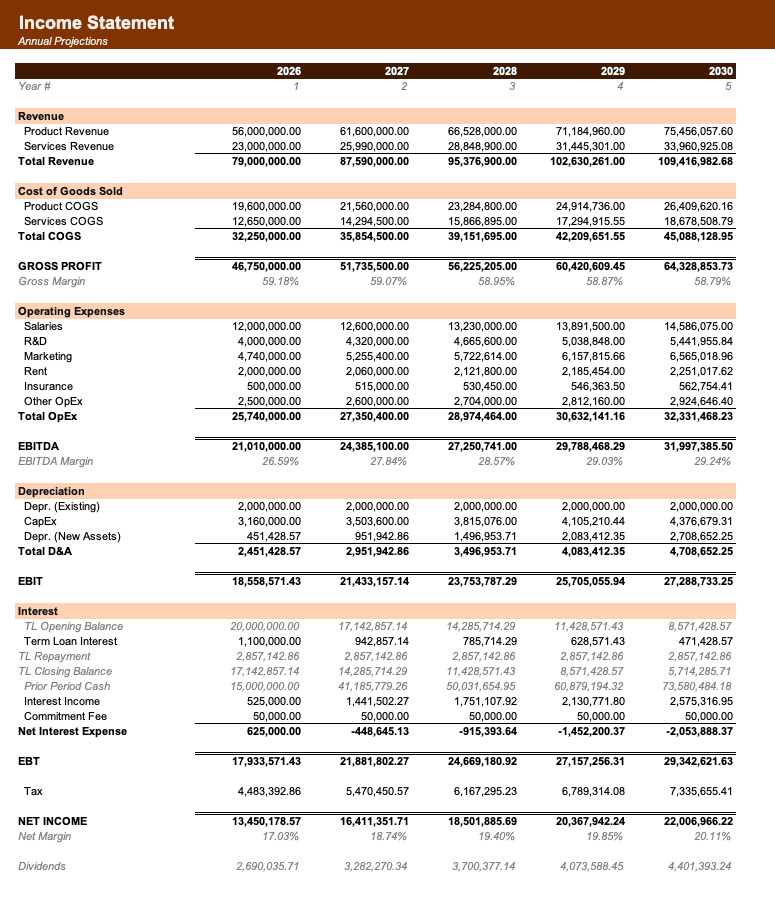
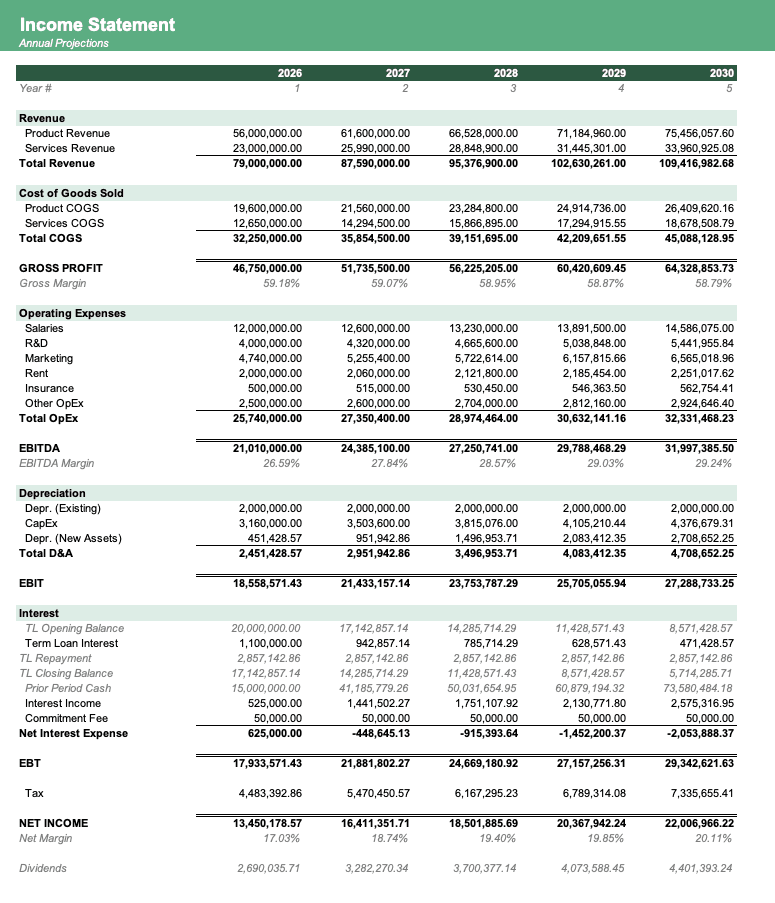
Named theme colors repaint the whole workbook in one click, on top of an investment-banking structure with clear input, output, and cross-sheet reference styling - brand-ready, institutional-grade, and fully auditable.

Created by ex-finance professionals
Hey, I’m Alex and I created Finamodel.
Over my years in the finance industry I kept building the same models over and over again. Same structure, same assumptions, different logo. So I started building frameworks to turn them into clean, reusable templates.
Every model here is one I’d actually use for a client, and I personally vet each one before it goes up.
I’m not an expert in every industry, but I’ve built enough models to know what belongs in one. And when something is completely foreign to me, I reach out to my network for experts to work on our models with us.
Having a template library on hand cuts a first build from hours to minutes.
Need help finding your model? You’ll find me in the Finamodel app!
Frequently asked
What is a brewery financial model?+
It is a model that forecasts production, revenue by channel, per-barrel margins, equipment capex, and operating profitability for a craft brewery.
Who uses brewery financial models?+
Brewery owners, F&B investors, commercial lenders, and hospitality consultants use them for planning, lending, and investment analysis.
What should a brewery model include?+
It should include production capacity, taproom and wholesale revenue, per-barrel COGS, equipment capex, excise tax, and break-even analysis.
Does it handle both taproom and distribution?+
Yes. The model separates revenue streams so you can see the distinct margins, costs, and operating expenses for each channel.
Can I plan brewing capacity expansion?+
Yes. The capex schedule supports fermenter additions and equipment upgrades, flowing into the balance sheet and depreciation schedules.
Have more financial modelling questions? Contact us
Related templates
Food Manufacturing Model
Operating model for food production and processing businesses with ingredient sourcing, production scheduling, and margin analysis.
Restaurant Unit Economics and Multi-Unit Model
Single-unit operating metrics, cost of goods sold, labor, rent, and multi-unit chain economics.
E-Commerce Unit Economics
P&L model for e-commerce business with CAC, LTV, gross margin, and unit economics.
Ecommerce Forecast
18-month ecommerce forecast: traffic, conversion, AOV, contribution margin.