Factoring Model
Credit Financial Model (Free Excel Download)
Evaluate receivables finance with advance rates, discount fees, reserves, debtor concentration, funding costs, and portfolio profitability across payment scenarios.



professionals from Deloitte
Used by professionals from






About this model
A factoring program model values the economics of an accounts receivable factoring business, where a factor (lender) advances cash against invoices that a client expects to collect. The factor advances 70–90% of invoice face value immediately, charges a discount fee (typically 1.5–3% of invoice face value for 30-day payment terms), and collects payment directly from the client's customers. The model tracks invoice pool composition, advance rates, customer concentration risk, and expected collection rates.
Revenue to the factor is the discount fee plus interest accrued on the advanced balance. Costs are credit losses (invoices that don't pay and are not recoverable) and funding costs (the cost of borrowing the cash to advance to clients). The model applies a recourse reserve to conservative advance rates: if the factor advances 80% and the invoice doesn't pay, the client is responsible for the shortfall. Working capital dynamics are favorable to the factor (cash outflow on advance, cash inflow on collection from customer, net zero if collections are reliable).
This template is suitable for lenders evaluating factoring programs, accounting firms structuring factoring facilities, and clients (SMEs) evaluating factoring as a working capital solution.
What every model includes
Live formulas, no hardcoded values
Outputs are driven by live formulas, so the workbook updates from its assumptions instead of relying on hardcoded results.
All assumptions in one tab
Inputs are clearly marked in the Assumptions tab and separated from calculations, making it clear what to change and what to leave intact.
Statements always balancing
For integrated-statement models, the balance sheet, cash flow, and supporting schedules tie through properly.
Distinct schedules for clarity
Debt, working capital, taxes, and cash flow can get messy quickly. We group calculations in clear schedules, not across disconnected tabs.
No hidden macros or external links
There are no unexplained external workbook links or macros to undermine auditability or portability.
Changes flow through the model
Update a key driver and see the impact carry through the forecast, financing, and return outputs. We never use hardcoded numbers in formulas.
What's inside the Factoring Model
- Dynamic advance rate and discount fee engine
- Reserve account and holdback reconciliation
- Debtor concentration and credit limit analysis
- Recourse vs non-recourse risk modelling
- Annualised cost and effective yield outputs
- Invoice pool volume and customer concentration
- Advance rates (typically 70–90% of invoice face value)
- Factoring fee (discount) and finance charge structure
Factoring Model: How the Template Works for Invoice Finance
This factoring model template is a 36-month business forecast for invoice factoring operations. It connects client growth, invoice ageing, fee structures and funding to produce integrated financial statements.
The design supports reviewing revenue yield, warehouse utilisation, equity needs and credit performance. The following sections explain the operating drivers, calculation logic, key outputs and practical use cases.
Documented Operating Drivers
The factoring model begins with client rollforward: opening clients plus new additions less monthly attrition. Monthly invoice volume is based on average opening and closing clients multiplied by volume per client, with an optional growth factor.
- Invoice cohorts then flow through four ageing buckets (0–30, 31–60, 61–90 and 90+ days), and closing receivables are the remaining balance from current and earlier cohorts. Expected write-offs are calculated from bucket exposures, assumed default probabilities and loss given default.
- Advance rates determine client reserves, which are the unadvanced invoice share released over time using collection patterns and a days-based lag.
Calculation Flow and Dependencies
Assumptions feed client volume and ageing, which in turn drive funding, revenue and reserve balances. Factoring fees are tiered and applied to portions of total monthly volume, with a minimum monthly fee.
- Discount income is calculated on average gross receivables using a base rate plus client margin, divided by 12. Non-recourse premium and insurance costs depend on non-recourse volume.
- Warehouse debt takes the lower of eligible receivables times lender advance or the facility cap. Equity top-ups after the first month cover the gap between target receivable-based equity and the prior period's book equity.
These funding costs then feed into net revenue and operating expenses.
Primary Outputs and Statements
The model produces a dashboard showing final-month receivables, advances, invoice volume, yield and margin trends. Revenue Build details progressive factoring fees, minimum-fee top-up, discount and ancillary fees, and direct costs.
- Funding provides eligible borrowing base, facility cap, equity top-ups and warehouse movements. Operating cost sheets, profit and loss, balance sheet and cash flow statements are linked to these drivers.
- Ratios and covenants calculate annualised performance measures, default and dilution ratios (using trailing 12 months) and final-period covenants. Checks test selected whole-horizon conditions and three final totals.
All financial statements are integrated, with costs, write-offs, dilution and repayments typically negative, while invoice volume, receivables and debt balances are positive.
Practical Use and Documented Boundaries
This template is designed for factoring companies and businesses using accounts receivable finance to review revenue yield, warehouse utilisation, equity requirements and credit performance over a 36-month horizon. It supports stress testing by editing individual assumptions, as there is no dedicated case selector.
- The model captures monthly dynamics of invoice factoring, from client onboarding to fee income and funding draws. Limitations include that discount income is charged on average gross receivables rather than advances, and that recourse/non-recourse mix affects premiums but does not separately eliminate credit losses or model recoveries.
- Equity top-ups follow a book-equity ratio and do not guarantee liquidity. Operating expenses based on percentages of net revenue can become positive credits if net revenue turns negative, so extreme scenarios need review.
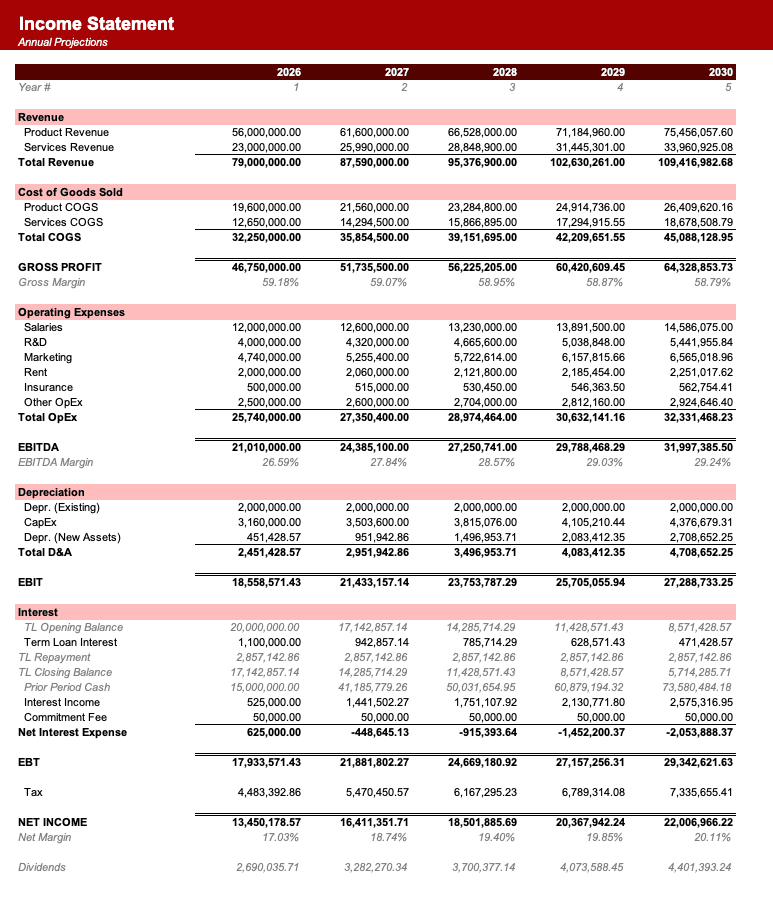
Formatted to IB standards
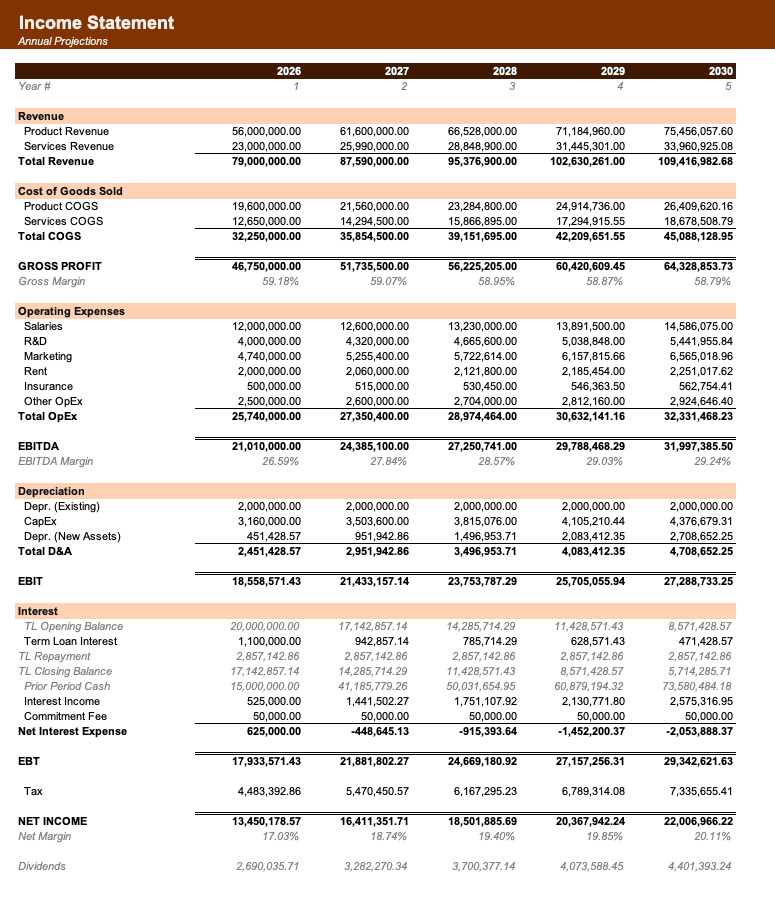
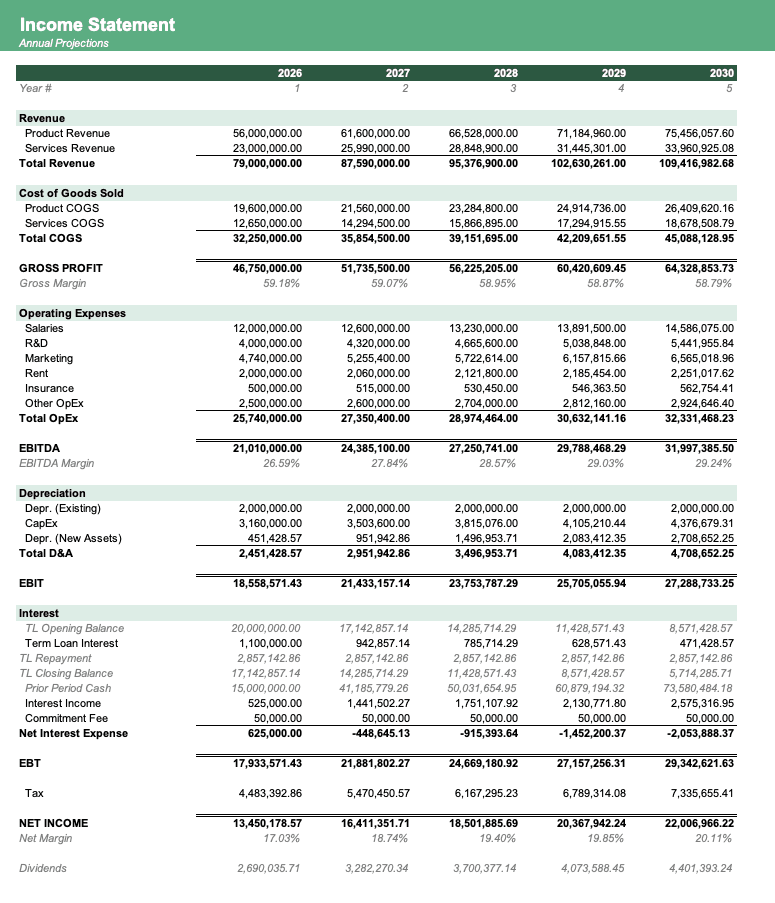
Named theme colors repaint the whole workbook in one click, on top of an investment-banking structure with clear input, output, and cross-sheet reference styling - brand-ready, institutional-grade, and fully auditable.

Created by ex-finance professionals
Hey, I’m Alex and I created Finamodel.
Over my years in the finance industry I kept building the same models over and over again. Same structure, same assumptions, different logo. So I started building frameworks to turn them into clean, reusable templates.
Every model here is one I’d actually use for a client, and I personally vet each one before it goes up.
I’m not an expert in every industry, but I’ve built enough models to know what belongs in one. And when something is completely foreign to me, I reach out to my network for experts to work on our models with us.
Having a template library on hand cuts a first build from hours to minutes.
Need help finding your model? You’ll find me in the Finamodel app!
Frequently asked
What is a factoring financial model?+
It is a model that tracks accounts receivable financing, including advance rates, discount fees, reserve mechanics, and portfolio yield for a factoring facility.
Who uses factoring models?+
Factoring companies, high-growth businesses with long-dated receivables, and lenders use them for operational planning and risk assessment.
What should a factoring model include?+
It should include advance rates, tiered fee structures, reserve accounts, debtor concentration limits, and annualised cost calculations.
Does it handle spot and whole ledger facilities?+
Yes. The model supports both selective spot factoring and whole ledger assignments with adjustable utilisation and eligibility criteria.
Can it calculate the true cost of factoring?+
Yes. The model annualises all costs including discount fees, service charges, and interest to provide a transparent effective yield and APR comparison.
Have more financial modelling questions? Contact us
Related templates
Trade Finance Underwriting
Model trade finance facilities with collateral coverage, payment terms, and default loss scenarios.
Working Capital Model
Model cash conversion cycle with DSO, DIO, and DPO to forecast working capital needs.
Direct Lending Fund Model
Financial model for direct lending fund with loan origination, yield, losses, and fund returns.
Auto Loan Portfolio Model
Automotive loan securitization and portfolio analysis.