Trade Finance Model
Capital Markets Financial Model (Free Excel Download)
Forecast trade-finance volumes, tenor, fees, funding costs, defaults, and working-capital cycles to evaluate transaction-level and portfolio profitability.



professionals from Deloitte
Used by professionals from






About this model
Model a trade finance credit facility with collateral coverage ratios, payment term mechanics, and default loss scenarios. The facility finances short-term trade transactions: importers obtain letters of credit (L/C) or supply-chain financing against invoices or inventory collateral. Each transaction is underwritten with a coverage ratio: advance amount divided by collateral value (invoices, inventory, receivables) determines margin over the advance.
The model tracks counterparty concentration, payment term risk (30–90 days typical), and loss scenarios under good/expected/stressed conditions. Collateral haircuts reflect receivable quality (80–95% of invoice face value, lower for buyer concentration risk), inventory haircuts (50–70% depending on product type), and duration risk (longer payment terms = higher risk). Expected loss is calculated as probability of default × loss severity; reserve requirements are modeled as a percentage of drawn balances.
Key metrics: utilization rate (% of facility drawn), concentration metrics (largest counterparty as % of portfolio), average tenor (weighted payment term), and reserve adequacy. Trade finance is a working-capital solution for high-volume, short-duration transactions; margins are tight (100–300 bps) but throughput is high. This model applies to banks, specialty finance firms, and supply-chain finance platforms.
What every model includes
Live formulas, no hardcoded values
Outputs are driven by live formulas, so the workbook updates from its assumptions instead of relying on hardcoded results.
All assumptions in one tab
Inputs are clearly marked in the Assumptions tab and separated from calculations, making it clear what to change and what to leave intact.
Statements always balancing
For integrated-statement models, the balance sheet, cash flow, and supporting schedules tie through properly.
Distinct schedules for clarity
Debt, working capital, taxes, and cash flow can get messy quickly. We group calculations in clear schedules, not across disconnected tabs.
No hidden macros or external links
There are no unexplained external workbook links or macros to undermine auditability or portability.
Changes flow through the model
Update a key driver and see the impact carry through the forecast, financing, and return outputs. We never use hardcoded numbers in formulas.
What's inside the Trade Finance Model
- Letter of credit issuance, amendment, and confirmation fee schedules
- Factoring and invoice discounting with advance rate and dilution reserve logic
- Supply chain finance and reverse factoring mechanics
- Risk-adjusted net interest margin and ROI reporting
- Transaction-level turnover, tenor, and volume forecasting
- Trade finance facility structure (L/C, supply chain, inventory financing)
- Transaction-level detail with invoice amount, payment terms, and due date
- Collateral values (invoices, inventory, receivables) and margin over advances
Trade Finance Model: How the Lending Book Projection Works
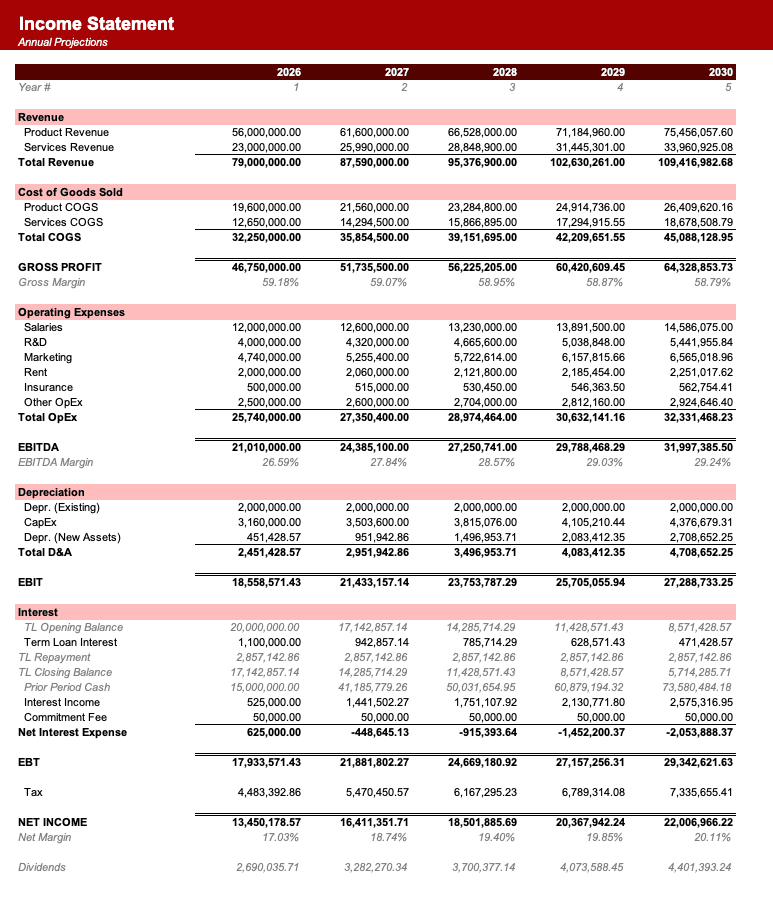
This trade finance model projects a receivables-finance lending book over five years, linking origination, discount yield, two-tier funding, and credit losses. It helps readers evaluate whether a lender generates positive net interest margin, reaches profitability, and stays within funding covenants.
The public download is a values-only preview; the underlying model captures the full calculation flow.
Operating drivers: origination, tenor, pricing, and funding mix
The model is driven by monthly origination that compounds at an annual growth rate, with Base, Good, and Stressed scenarios selecting different growth, probability of default, loss given default, and advance rate values. A 30/60/90-day tenor mix produces a weighted-average tenor that governs how quickly the book turns over.
- Pricing combines an effective discount APR on the funded balance with per-invoice transaction fees and an arrangement fee on the warehouse limit. Funding uses a senior warehouse facility sized to a borrowing base and a subordinated mezzanine facility covering the slice the warehouse does not reach, with margins over SOFR and a non-utilisation fee on undrawn capacity.
- Operating costs scale semi-variably with invoice throughput.
Calculation flow: roll-forward, funded-balance income, and credit losses
The receivables roll-forward sets closing book equal to opening plus originations minus repayments and defaults, where repayments reflect the share of the book maturing within the year based on tenor.
- Discount income is charged on the funded balance, defined as gross receivables times the advance rate, and the warehouse funding cost is scaled to the same base so net interest margin is consistent.
- Credit losses follow a PD times exposure times LGD relationship, with an allowance on the balance sheet that reconciles to the income statement provision and write-offs.
- The two-tier debt structure ensures total debt equals the closing book, so debt growth funds book growth.
Outputs: financial statements, portfolio metrics, and checks
The model produces an income statement, balance sheet, and indirect-method cash flow statement, along with a ratios sheet covering profitability, portfolio risk, and covenant metrics.
- These outputs show net interest margin, return on equity, collateral coverage, facility utilisation, and concentration measures.
- A checks sheet validates balance-sheet balancing, warehouse debt within the borrowing base and facility limit, debt-to-equity and NPL covenants, the minimum cash buffer, and the receivables roll-forward.
- Under the Stressed scenario, the model reports losses and a covenant breach while the balance sheet still balances, helping distinguish genuine economic stress from construction errors.
Practical use: evaluating the lending book under different scenarios
For a reader assessing whether a trade-finance lender can generate positive net interest margin and reach profitability, the model provides a structured view. The scenario toggle lets you compare Base, Good, and Stressed outcomes for origination growth, credit risk, and advance rates.
- The funding stack shows how the warehouse and mezzanine facilities interact with the borrowing base and limits. The covenant checks highlight when debt or credit conditions could breach agreed thresholds.
- The public download is a values-only preview of a debt-funded, five-year lending-book projection, useful for understanding the documented mechanics without live formulas.
Formatted to IB standards
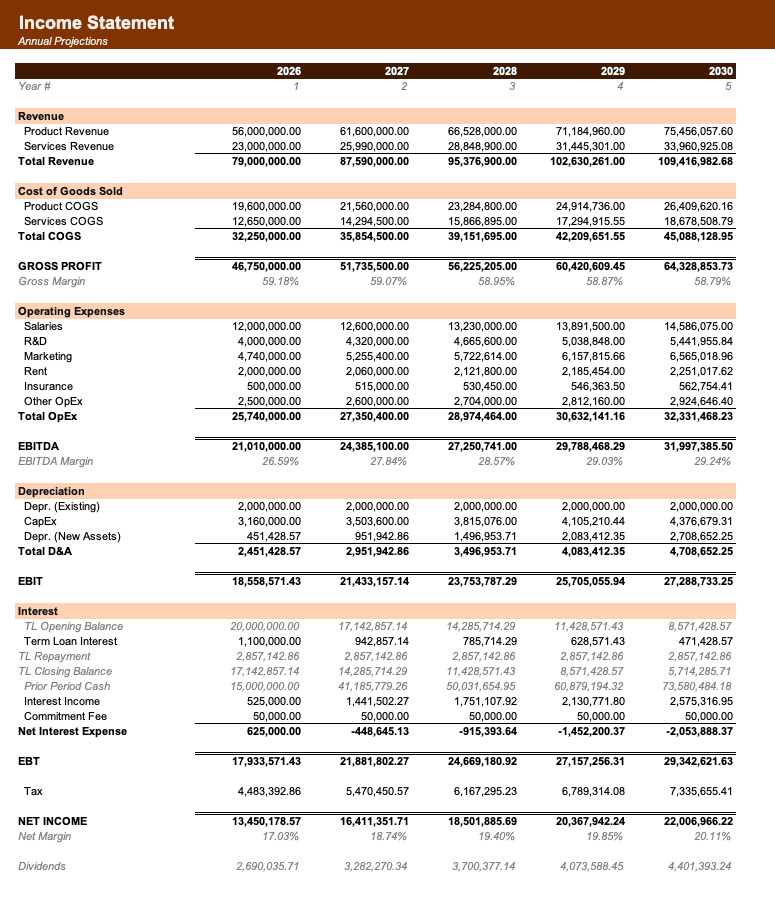
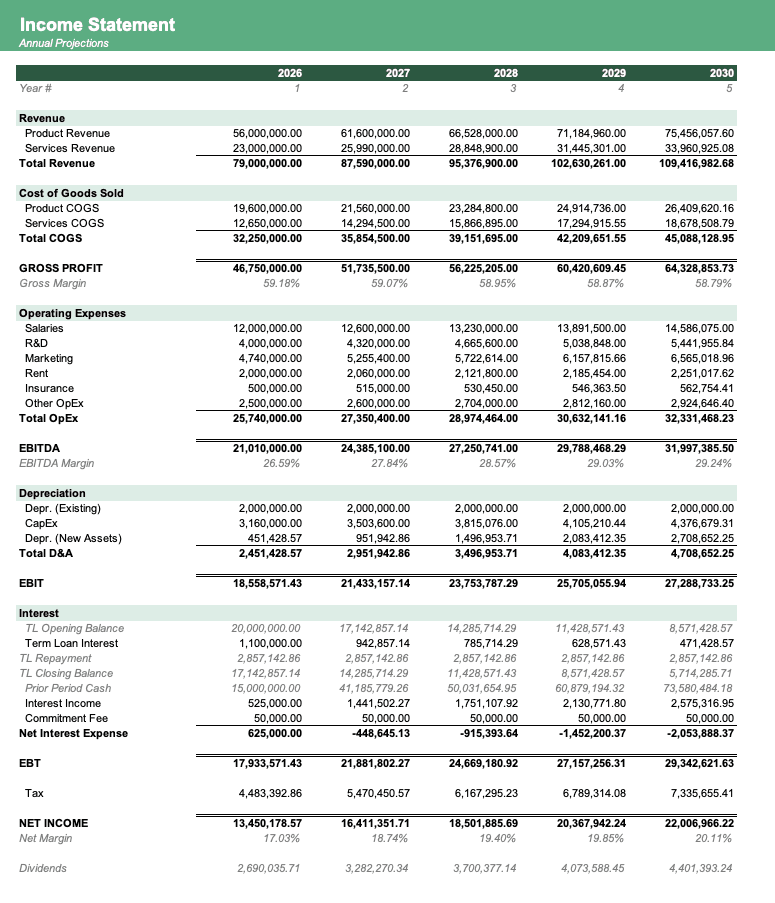
Named theme colors repaint the whole workbook in one click, on top of an investment-banking structure with clear input, output, and cross-sheet reference styling - brand-ready, institutional-grade, and fully auditable.

Created by ex-finance professionals
Hey, I’m Alex and I created Finamodel.
Over my years in the finance industry I kept building the same models over and over again. Same structure, same assumptions, different logo. So I started building frameworks to turn them into clean, reusable templates.
Every model here is one I’d actually use for a client, and I personally vet each one before it goes up.
I’m not an expert in every industry, but I’ve built enough models to know what belongs in one. And when something is completely foreign to me, I reach out to my network for experts to work on our models with us.
Having a template library on hand cuts a first build from hours to minutes.
Need help finding your model? You’ll find me in the Finamodel app!
Frequently asked
What is a trade finance financial model?+
It is a model that forecasts fee income, funding costs, and risk-adjusted returns for trade finance operations including letters of credit, factoring, and supply chain finance.
Who uses trade finance models?+
Trade finance banks, specialty factoring companies, commodity traders, and export-import managers use them for facility underwriting and portfolio management.
What should a trade finance model include?+
It should include LC fee schedules, factoring advance rates, cost of funds analysis, credit insurance, and net interest margin outputs.
Does it support different LC tenors?+
Yes. The model handles sight, usance, and deferred payment LCs with automatic fee and interest accrual calculations based on specific payment terms.
Can I model recourse and non-recourse factoring?+
Yes. The model includes toggles for different risk-sharing structures, incorporating credit insurance premiums and bad debt provisioning logic.
Have more financial modelling questions? Contact us
Related templates
Factoring Program Model
Financial model for accounts receivable factoring with advance rates, discount fees, and portfolio metrics.
Bank Loan Analysis Model
Commercial bank loan origination and portfolio underwriting.
Credit Portfolio CDO Model
Model credit default swap portfolio, tranching, and waterfall for CDO securitization.
DCF Model
Discounted cash flow valuation model with explicit forecast, terminal value, and WACC.