Invoice Price and Contract Compliance Tracker
Operating Businesses Financial Model (Excel Download)
Check that customers are billed at the signed contract price. The workbook finds each overbilled or underbilled line, explains the difference and tracks approval and issue of each correction.



professionals from Deloitte






About this model
A billing control that compares customer invoice lines with signed contract terms. The shipped case uses six fictional customer contracts and twelve monthly invoice lines across two months.
Each line is matched to its contract by key and billing month. The signed rate, discount and quantity basis give the allowed amount, using either a fixed monthly entitlement or an up-to cap. The difference is split into a quantity effect and a rate and discount effect. Missing rates or signed evidence hold the line until fixed.
On the shipped case customers were billed $22,660 against $21,852 allowed, so $888 of credits and $80 of debits are due. A correction queue ranks customers by gross exposure. Approvals and issued credit notes are recorded separately, so an approval is never treated as an issued credit, and a bridge check ties all drivers to zero.
What every model includes
Live formulas, no hardcoded values
Outputs are driven by live formulas, so the workbook updates from its assumptions instead of relying on hardcoded results.
All assumptions in one tab
Inputs are clearly marked in the Assumptions tab and separated from calculations, making it clear what to change and what to leave intact.
Statements always balancing
For integrated-statement models, the balance sheet, cash flow, and supporting schedules tie through properly.
Distinct schedules for clarity
Debt, working capital, taxes, and cash flow can get messy quickly. We group calculations in clear schedules, not across disconnected tabs.
No hidden macros or external links
There are no unexplained external workbook links or macros to undermine auditability or portability.
Changes flow through the model
Update a key driver and see the impact carry through the forecast, financing, and return outputs. We never use hardcoded numbers in formulas.
What's inside the Invoice Price and Contract Compliance Tracker
- Invoice line tests against signed contract rate, discount and quantity
- Contract register with customer, SKU, dates and signed terms
- Fixed monthly or up-to cap entitlement basis
- Correction bridge split into quantity and rate effects
- Holds for missing keys, months, rates or signed evidence
- Gross credits and debits shown without netting
- Controller approval with decision, approver and date
- Correction document log with signed amount and issue date



Formatted to IB standards
Named theme colors repaint the whole workbook in one click, on top of an investment-banking structure with clear input, output, and cross-sheet reference styling - brand-ready, institutional-grade, and fully auditable.

Created by ex-finance professionals
Hey, I’m Alex and I created Finamodel.
Over my years in the finance industry I kept building the same models over and over again. Same structure, same assumptions, different logo. So I started building frameworks to turn them into clean, reusable templates.
Every model here is one I’d actually use for a client, and I personally vet each one before it goes up.
I’m not an expert in every industry, but I’ve built enough models to know what belongs in one. And when something is completely foreign to me, I reach out to my network for experts to work on our models with us.
Having a template library on hand cuts a first build from hours to minutes.
Frequently asked
What is an invoice price compliance check?+
It compares what a customer was billed with what the signed contract allows. Lines billed above the contract need a credit note, and lines billed below need a debit. It protects both the customer relationship and revenue.
How is the allowed amount set?+
Each line uses the signed rate, discount and quantity for its contract and billing month. A fixed monthly basis bills the signed entitlement. An up-to cap bills the lower of billed units and the cap.
Why are credits and debits not netted?+
A credit owed to one customer and a debit due from another are separate actions. The workbook shows gross credits and gross debits, and approval applies to each line, so neither hides the other.
What happens if a correction changes after a credit was issued?+
The issued credit stays on record. If the proposal later grows, only the extra amount is open. The earlier credit note cannot close the updated proposal.
How do I adapt it to my contracts?+
Replace the contracts and invoice lines with your own in the blue cells, keeping stable line IDs and dates. For more rows, extend every range and formula together and rerun the checks.
Have more financial modelling questions? Contact us
Related templates
Sales Order and Invoice Completeness Reconciliation
Match sales orders to deliveries and invoices line by line to find unbilled deliveries, overbilling and invoice errors.
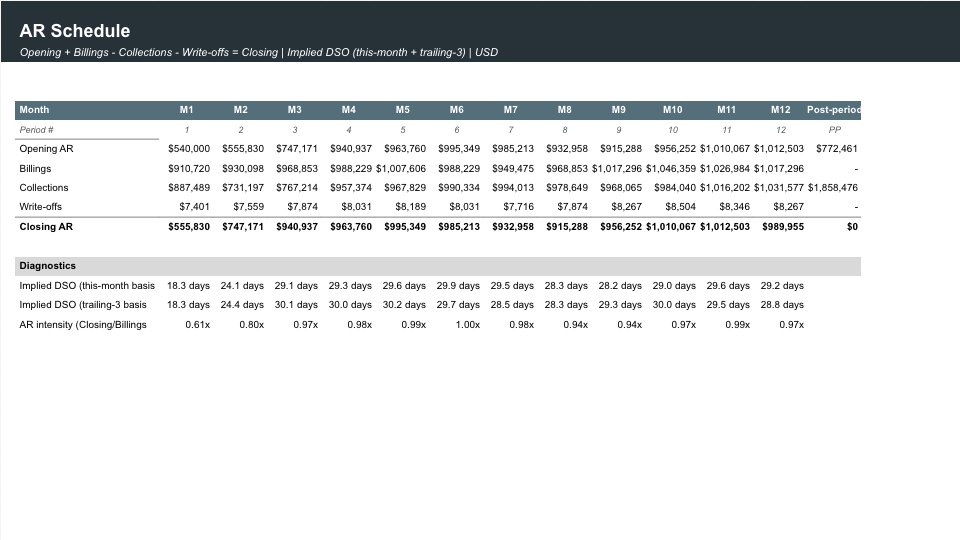
AR Forecast
12-month accounts-receivable timing forecast with customer terms and DSO.
Three-Way Invoice Matching Workpaper
Match supplier invoices to purchase orders and goods receipts, hold exceptions and control payment release.
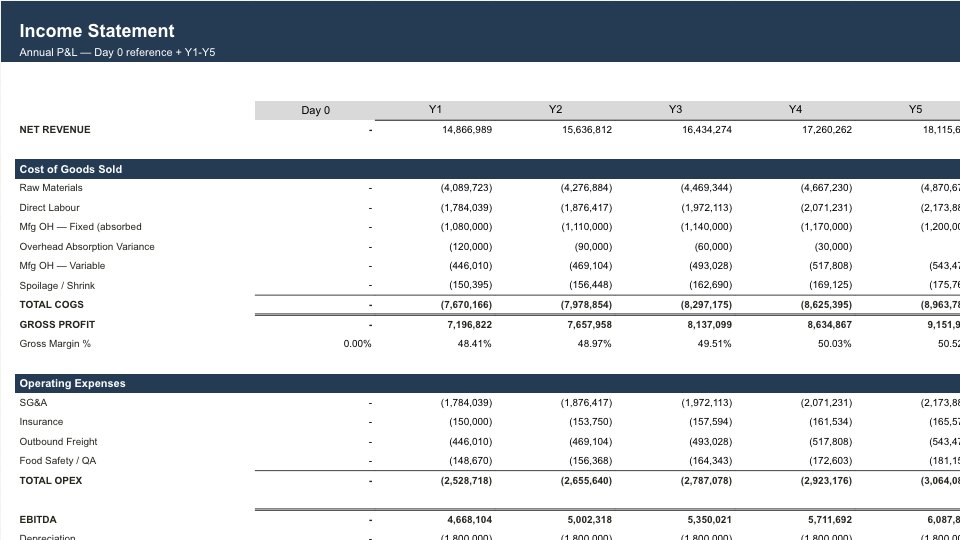
Food Manufacturing Model
Operating model for food production and processing businesses with ingredient sourcing, production scheduling, and margin analysis.







